
Reviewed by the clinical team at Aref Psychotherapy — a team of Registered Psychotherapists serving clients across Canada.
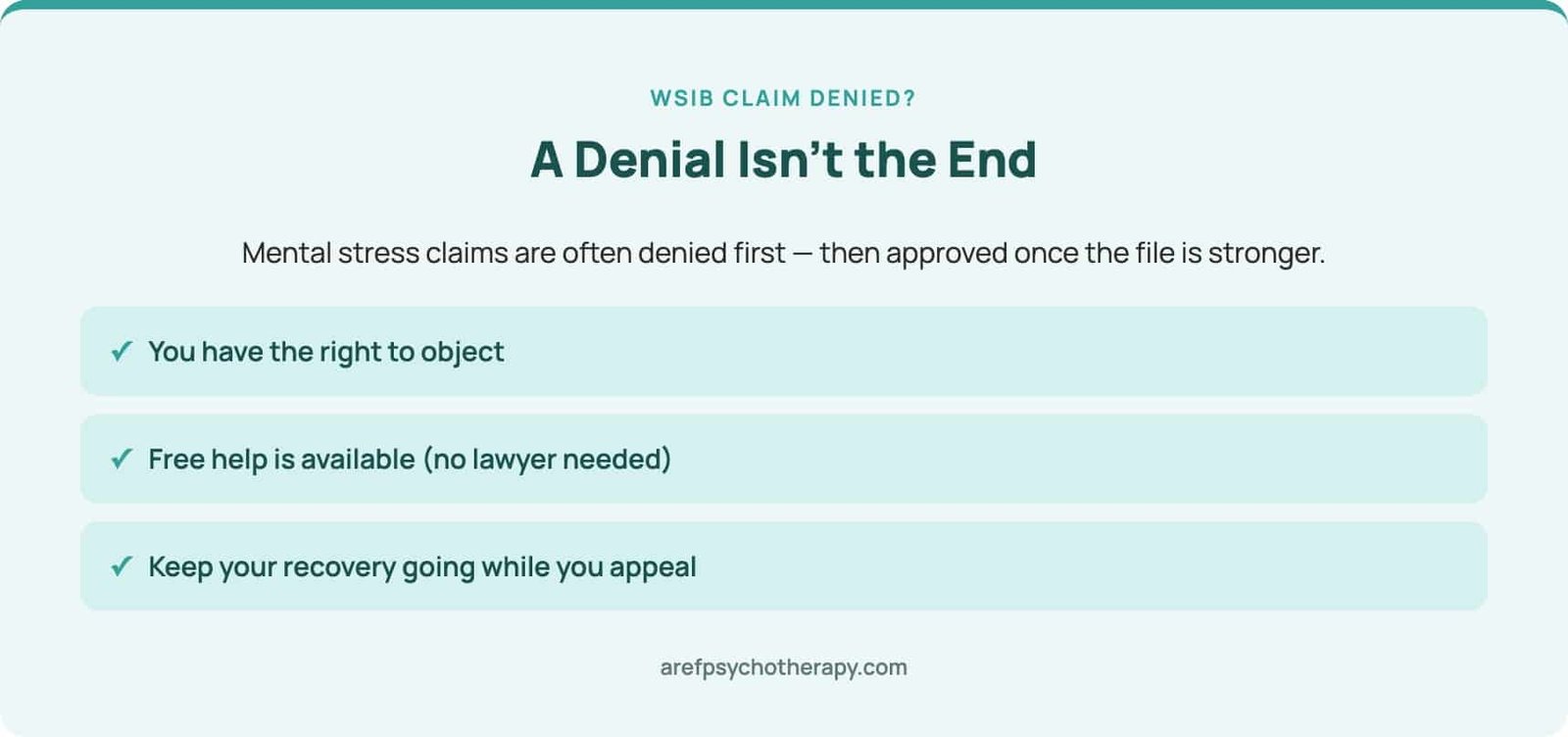
Getting a denial letter from WSIB when you’re already struggling can feel like a door slamming shut. It isn’t. A denied claim is the start of a process, not the end of it — and mental stress claims, in particular, are often turned down first and approved later once the file is stronger.
This guide explains, in plain language, why WSIB mental health claims get denied, exactly how to object, the deadlines you can’t miss, and where to get free expert help. If you’re navigating this, you don’t have to do it alone.
What Can I Do If My WSIB Mental Stress Claim Is Denied?
You can object — and you have a limited time to do it. File an Intent to Object form before the deadline in your decision letter: 30 days for return-to-work decisions, and six months for most other decisions (like whether your claim is allowed). Your objection goes first to WSIB’s own Appeals Services, and if that doesn’t resolve it, to the independent Workplace Safety and Insurance Appeals Tribunal (WSIAT). Free help is available. The most important thing is to act quickly and keep your documentation strong.
Why WSIB Mental Stress Claims Get Denied
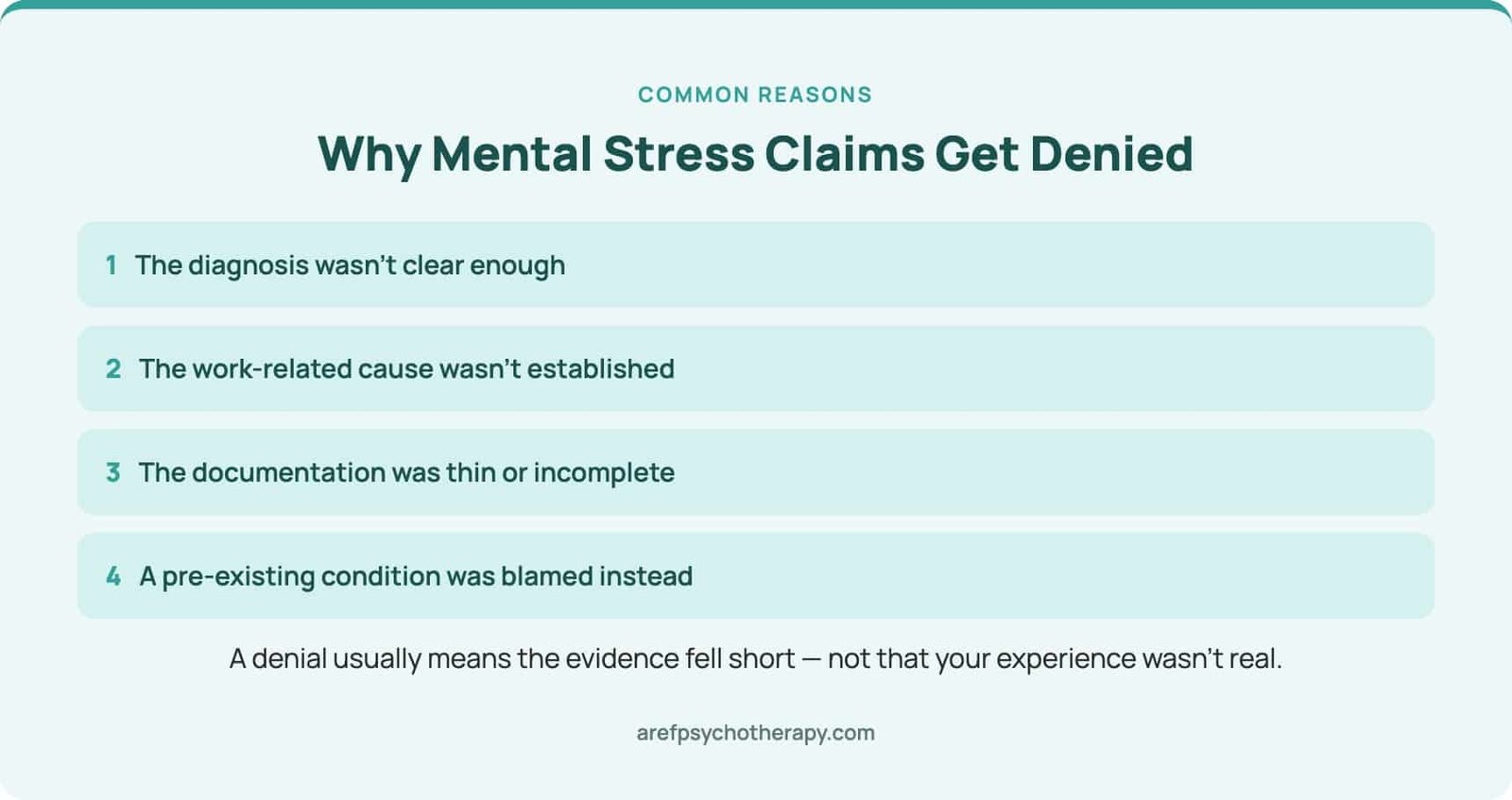
Mental stress claims are harder to approve than physical-injury claims because the injury is invisible and the cause has to be proven. Common reasons for a denial include:
- The diagnosis wasn’t clear enough — WSIB needs a DSM-5 diagnosis from a physician, nurse practitioner, psychologist, or psychiatrist (see WSIB’s rules for work-related mental stress).
- The work-related cause wasn’t established — WSIB has to see that a substantial work-related stressor or traumatic event was the primary cause.
- The documentation was thin — missing forms, vague medical notes, or gaps in the timeline.
- A pre-existing condition was treated as the “real” cause instead of the workplace.
A denial usually means the evidence fell short — not that your experience wasn’t real. That’s often fixable. (If you’re still building your claim, our guide on how to file a WSIB mental stress claim covers the foundations.)
You Can Object — Here’s How
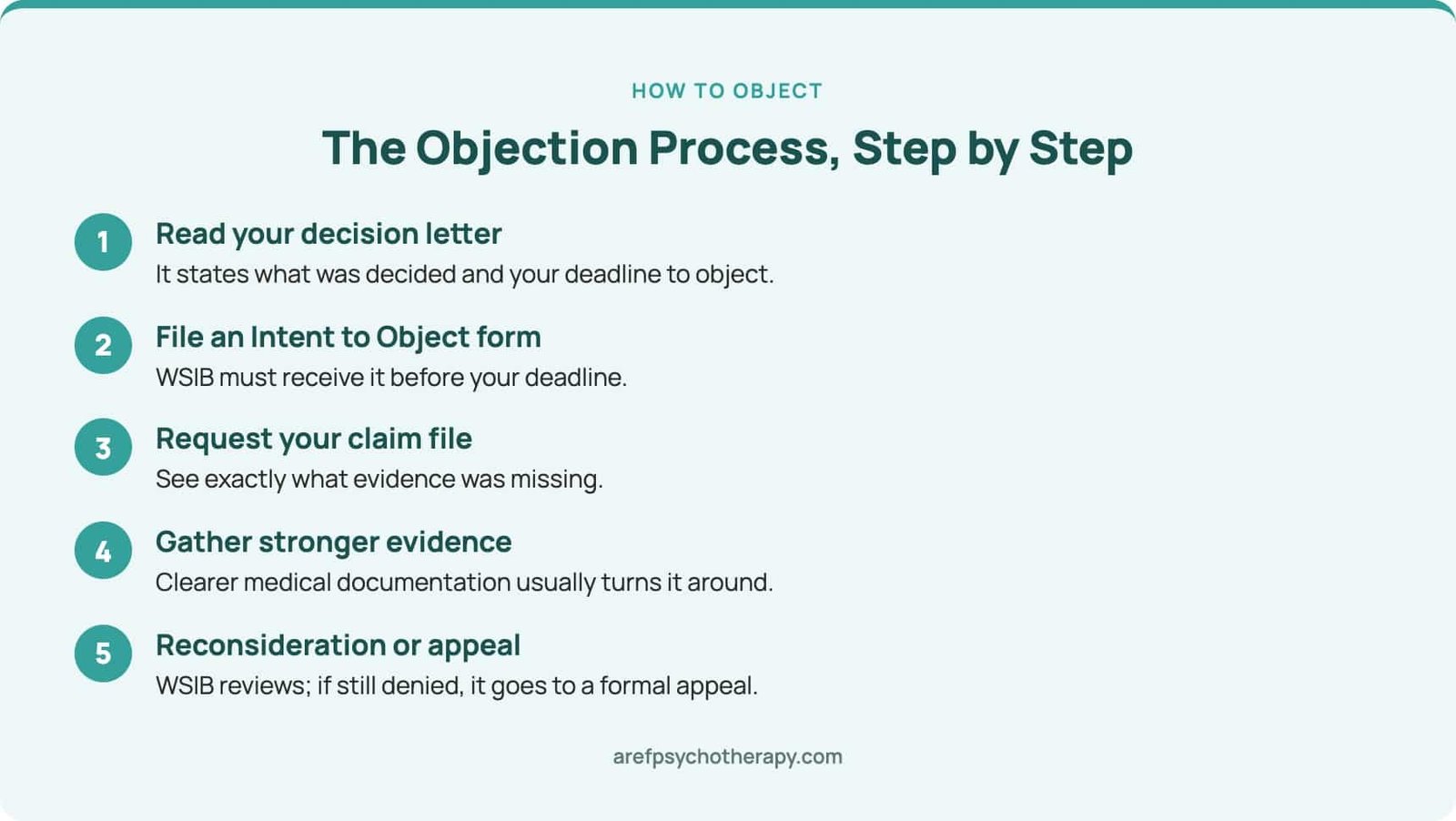
The objection process has a clear path:
- Read your decision letter carefully. It states what was decided and your deadline to object.
- File an Intent to Object form. Get it from WSIB’s website, by mail, or by phone, and make sure WSIB receives it before your deadline.
- Request your claim file. You’re entitled to everything WSIB used to make its decision — read it to see exactly what’s missing.
- Gather new evidence. Stronger medical documentation is usually what turns a denial around.
- Go to reconsideration or appeal. WSIB reviews the objection (reconsideration typically takes a few weeks); if it’s still denied, it moves to a formal appeal.
See WSIB’s appeals practices and procedures and its guide to disagreeing with a decision about a claim.
The Deadlines That Matter
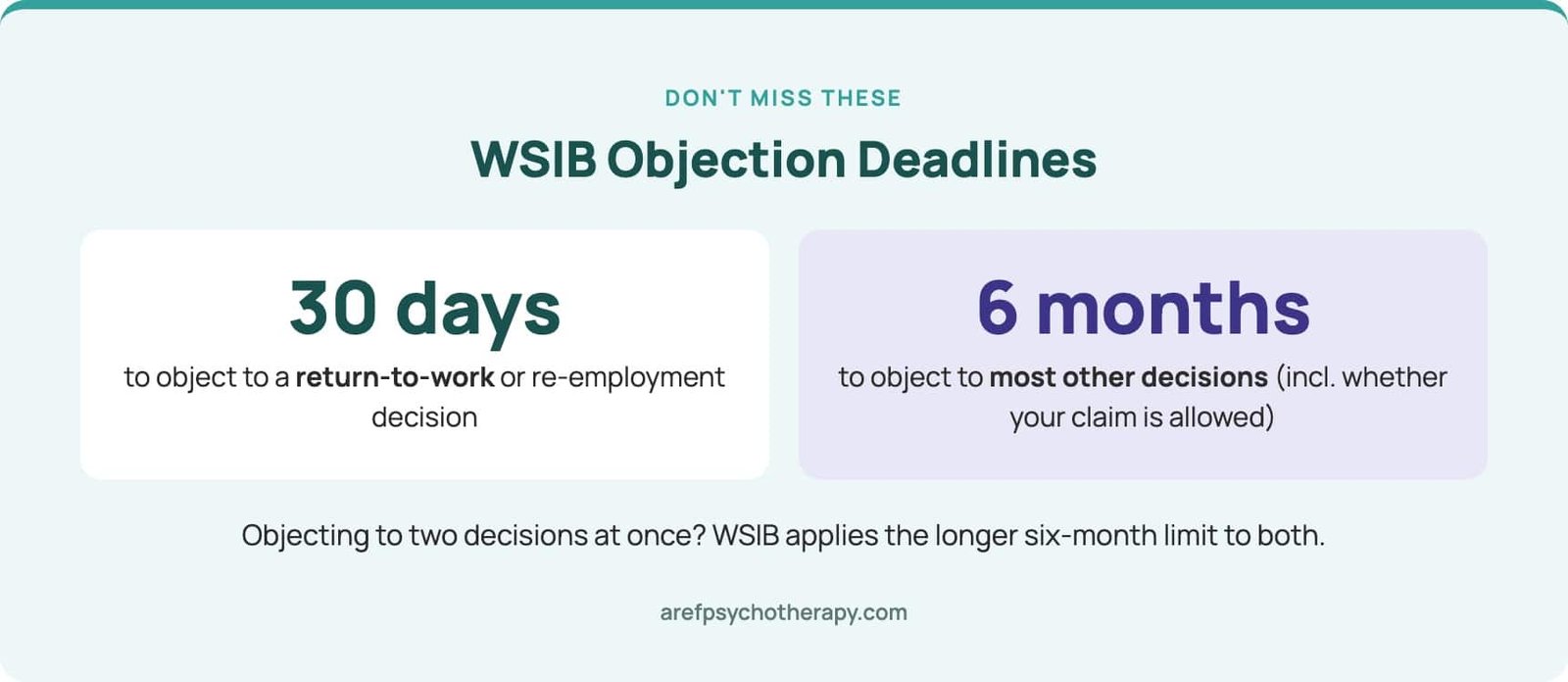
Missing a deadline is the single most common way people lose the right to object — so mark these down:
- 30 days — to object to a return-to-work (including re-employment) decision.
- Six months — to object to most other decisions, including whether your claim is allowed or your loss-of-earnings benefit.
- If you’re objecting to two decisions with different deadlines at once, WSIB applies the longer six-month limit to both.
- Missed the deadline? You can still ask — send a letter to the decision-maker requesting an extension and explaining why you missed it.
How to Strengthen Your Case
An objection succeeds on evidence. The things that most often turn a denial around:
- A clearer diagnostic report from a physician, nurse practitioner, psychologist, or psychiatrist, explicitly linking your condition to the workplace.
- Consistent treatment records — ongoing therapy notes show the injury is real and being treated. A Registered Psychotherapist (like our team) can provide those notes even though the formal diagnosis comes from one of the professionals above.
- A clear timeline connecting the work event(s) to when your symptoms started.
- Witness statements or workplace records (for harassment or a traumatic incident).
The Two Levels of Appeal
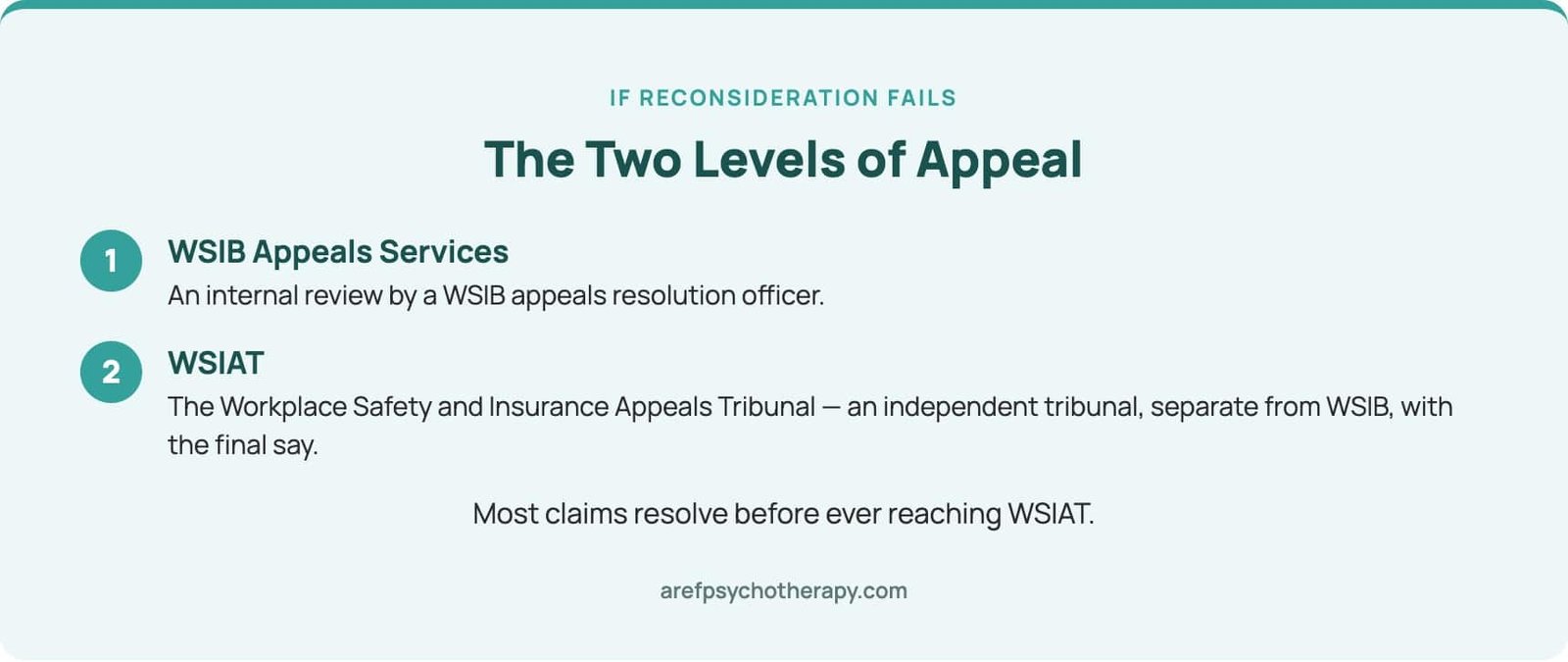
If reconsideration doesn’t resolve it, there are two levels:
- WSIB Appeals Services — an internal review by an appeals resolution officer at WSIB.
- WSIAT (Workplace Safety and Insurance Appeals Tribunal) — an independent tribunal, completely separate from WSIB, that has the final say. See WSIAT, the tribunal that reviews appeals after WSIB’s own process is exhausted.
Most claims are resolved before ever reaching WSIAT, but knowing the full path helps you stay the course.
Free Help: The Office of the Worker Adviser
You don’t have to pay a lawyer to appeal. The Office of the Worker Adviser (OWA) is a free, independent Ontario government agency that advises and represents non-unionized workers (and survivors) on WSIB claims and appeals. If you’re in a union, your union can represent you. See the OWA’s guide to appeals at the WSIB.
Don’t Stop Your Recovery While You Appeal
Appeals take time — but your mental health can’t wait for a decision. Continuing therapy while you appeal does two things: it supports your recovery, and it builds the consistent treatment record that strengthens your claim. Our team at Aref Psychotherapy offers virtual therapy across Canada for people dealing with workplace trauma and PTSD — learn about our WSIB therapy support and workplace PTSD care. (WSIB also funds specialized mental-health treatment through its network, including programs at hospitals such as CAMH.)
Ready to Take the Next Step?
Our team at Aref Psychotherapy offers virtual therapy across Canada. If a workplace injury is weighing on you while you appeal, book a free consultation and we’ll help you find the right therapist for you.
- Virtual sessions across every province
- Registered Psychotherapists experienced in workplace trauma
- Support in 14+ languages
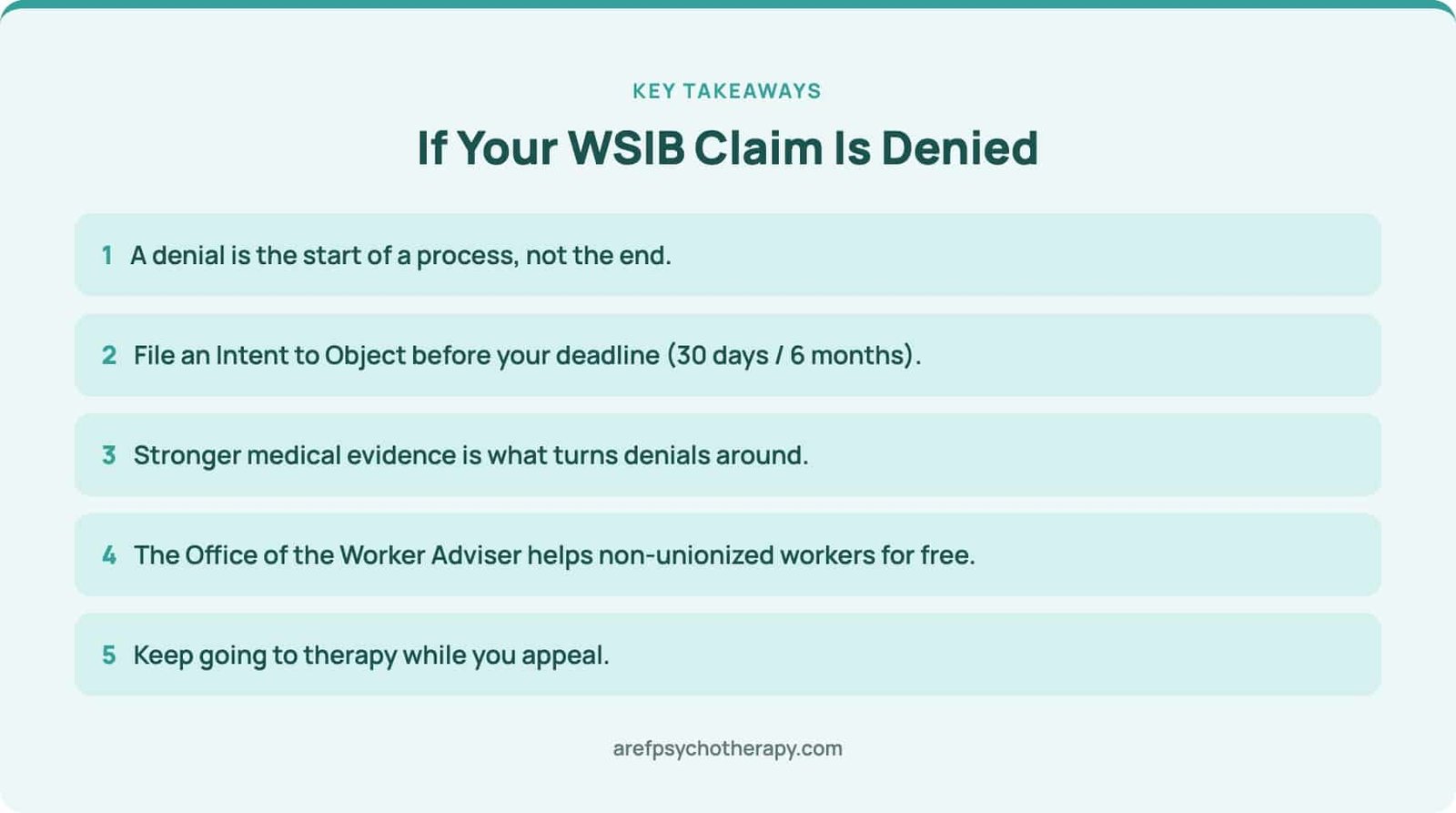
Key Takeaways
Frequently Asked Questions
What should I do first if my WSIB claim is denied?
Read your decision letter for the deadline, then file an Intent to Object form before that date — 30 days for return-to-work decisions, six months for most others. Request your claim file so you can see what evidence was missing, and start gathering stronger medical documentation. Acting quickly protects your right to object.
How long do I have to appeal a WSIB decision?
You have 30 days to object to a return-to-work or re-employment decision, and six months for most other decisions, including whether your claim is allowed. If you're objecting to two decisions with different deadlines, WSIB applies the six-month limit to both. Miss it and you can request an extension with a reason.
Why was my WSIB mental stress claim denied?
Usually because the evidence fell short — an unclear diagnosis, a work-related cause that wasn't established, thin documentation, or a pre-existing condition treated as the main cause. A denial reflects the file, not whether your experience was real, and stronger evidence often turns it around.
Can I get free help to appeal?
Yes. The Office of the Worker Adviser (OWA) is a free Ontario government agency that advises and represents non-unionized workers on WSIB appeals. If you belong to a union, your union can represent you instead. You do not need to hire a lawyer to object to a WSIB decision.
Should I keep going to therapy while I appeal?
Yes. Continuing therapy supports your recovery and creates a consistent treatment record that can strengthen your claim. Waiting for a decision before getting care usually makes symptoms harder to treat, and the ongoing notes may help your file.
Disclaimer
This article is for informational purposes only and does not replace professional mental health advice or legal advice about your claim. If you’re in crisis, please contact Canada’s 9-8-8 Suicide Crisis Helpline by calling or texting 9-8-8. For first responder peer support, Boots on the Ground is available 24/7 at 1-833-677-2668.
Reviewed by the clinical team at Aref Psychotherapy — a team of Registered Psychotherapists serving clients across Canada. Meet our team.