
Reviewed by the clinical team at Aref Psychotherapy — a team of Registered Psychotherapists serving clients across Canada.
If a workplace event left you struggling — flashbacks after something you witnessed on the job, or months of stress from harassment that finally caught up with you — you may be able to get help paid for through WSIB. Many people never file, because they assume WSIB only covers broken bones and physical injuries. That hasn’t been true for years — mental health is now a recognized part of workplace health and safety (see CAMH on mental health and the workplace).
Since January 1, 2018, Ontario’s Workplace Safety and Insurance Board (WSIB) covers work-related mental stress — including post-traumatic stress disorder (PTSD). That means treatment, income support while you can’t work, and help getting back on your feet.
This guide walks through what WSIB actually pays for, who qualifies, the forms involved, and what to do if you’re turned down — in plain language, from a clinical team that supports people through these claims every week.
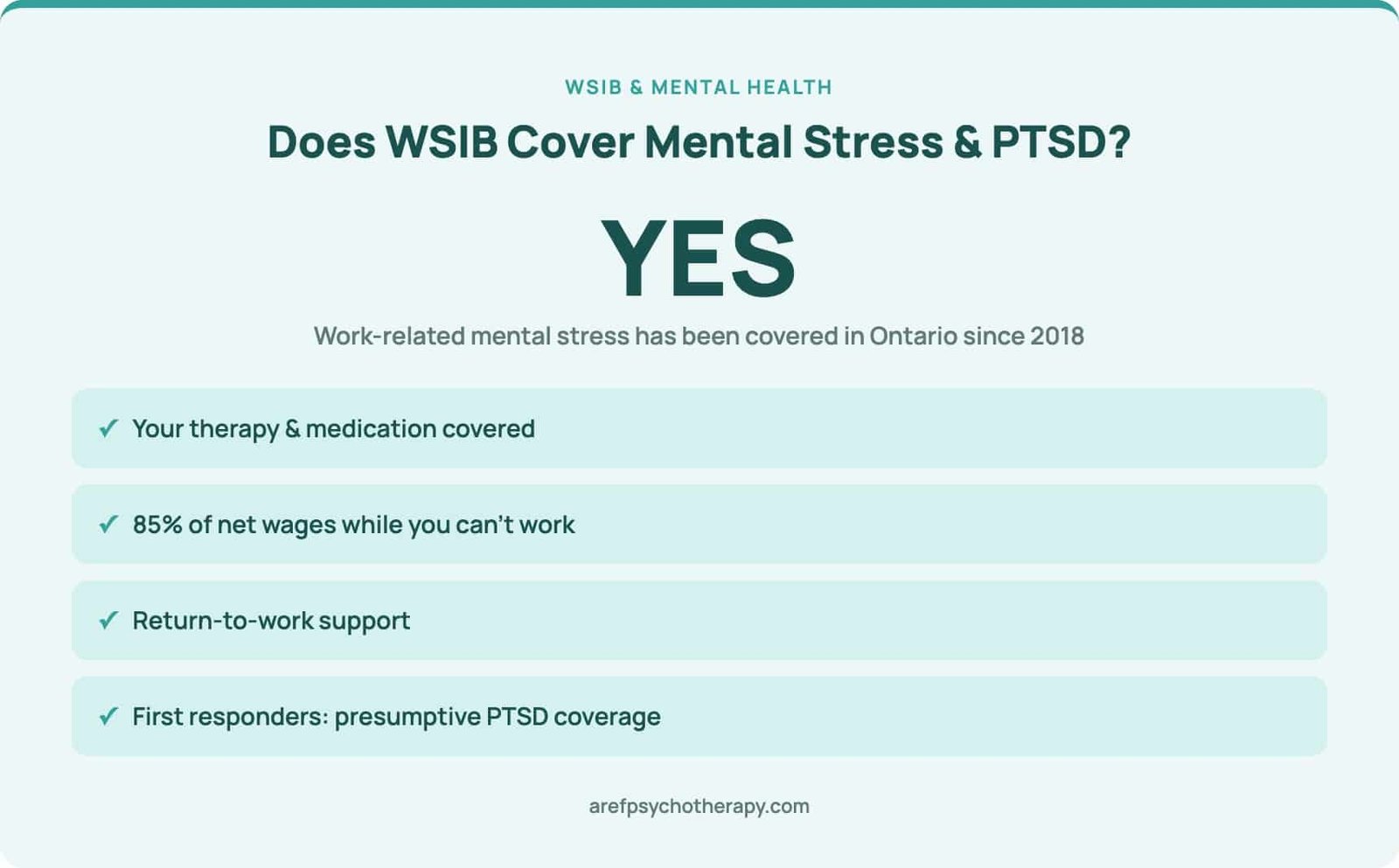
Does WSIB Cover PTSD and Mental Stress?
Yes. WSIB covers work-related mental stress in Ontario, including PTSD. There are two categories: traumatic mental stress (from a work-related traumatic event) and chronic mental stress (where a work-related stressor, like ongoing harassment, is the primary cause). If your claim is approved, WSIB can pay for your therapy, cover lost wages while you recover, and support your return to work. First responders get presumptive coverage for PTSD — see our guide to first responder PTSD coverage in Ontario — which makes their claims faster to approve.
Everything below explains how that works — and how to give your claim the best chance.
Chronic vs. Traumatic Mental Stress: Which One Is Your Claim?
WSIB sorts work-related mental stress into two types. Knowing which one fits your situation helps you and your health provider describe it correctly.
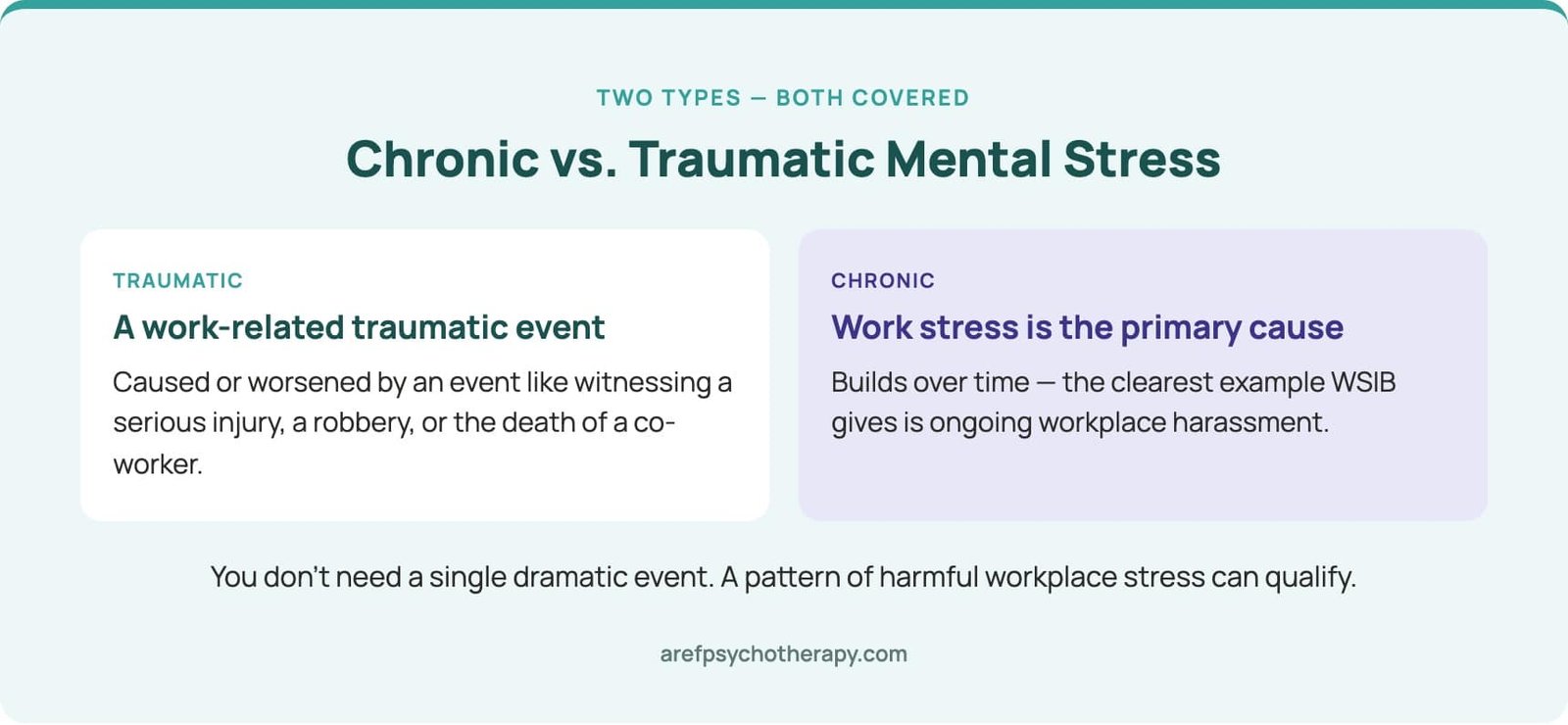
Traumatic mental stress is a diagnosed mental stress injury caused or significantly worsened by one or more work-related traumatic events — for example, witnessing a serious injury, an armed robbery, or the death of a co-worker. (See WSIB’s Traumatic Mental Stress policy.)
Chronic mental stress is a diagnosed mental stress injury where a work-related stressor is the primary (predominant) cause. The clearest example WSIB gives is workplace harassment that builds over time. (See WSIB’s Chronic Mental Stress policy.)
The important thing to understand: both are covered. You don’t need a single dramatic event. A pattern of harmful workplace stress can qualify.
Do You Qualify? The Three Things WSIB Looks For
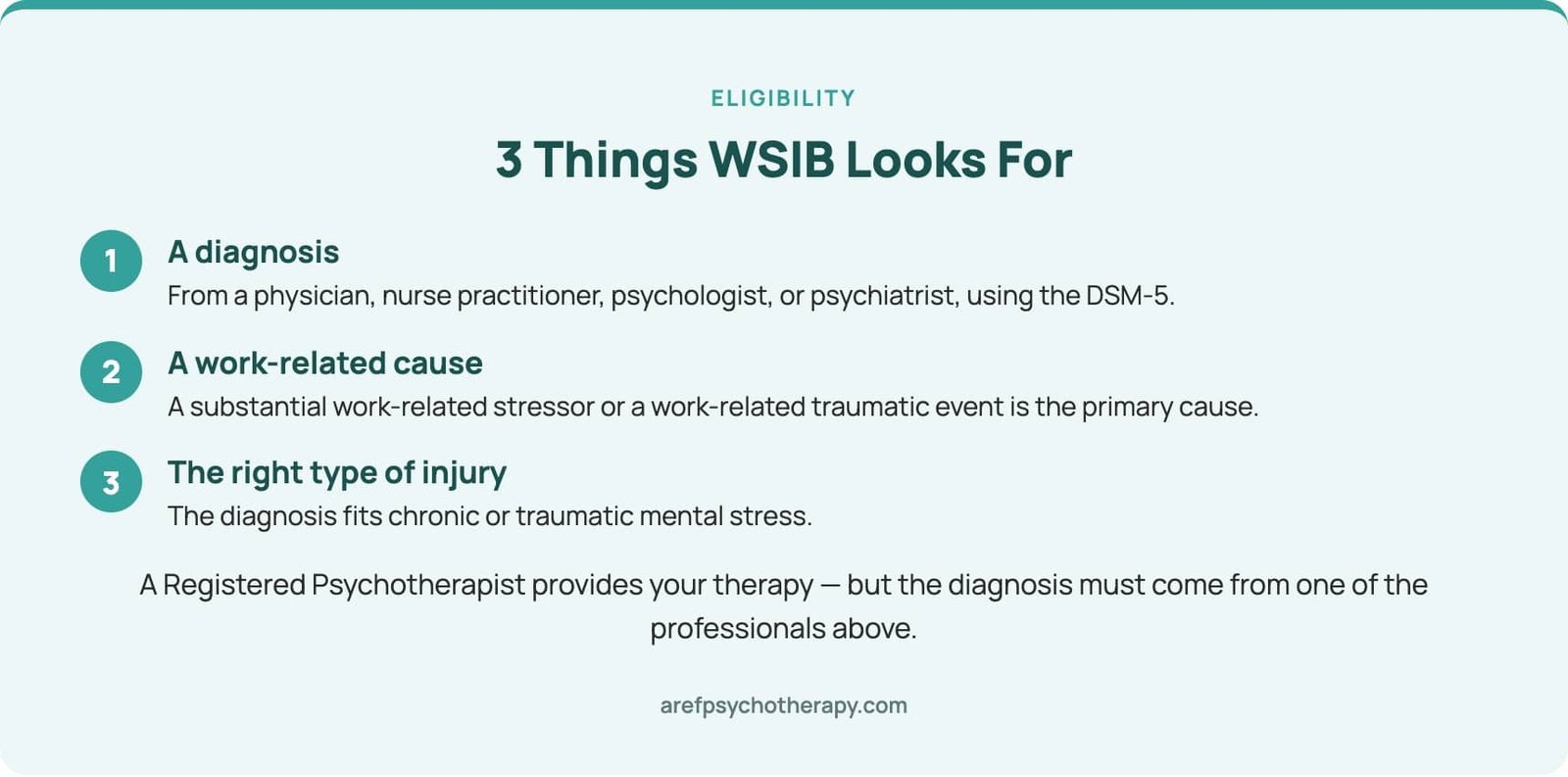
For a work-related mental stress claim to be approved, WSIB looks for three things together:
1. A diagnosis. A qualified professional — a physician, nurse practitioner, psychologist, or psychiatrist — must diagnose your condition using the DSM-5 (the standard manual mental health professionals use). 2. A work-related cause. The primary cause must be a substantial work-related stressor or a work-related traumatic event. 3. The right type of injury. The diagnosis has to fit chronic or traumatic mental stress.
One point that trips people up: the diagnosis has to come from a physician, nurse practitioner, psychologist, or psychiatrist. A Registered Psychotherapist (like our team) can provide your ongoing therapy, but is not the professional who signs the diagnostic report for the claim. If you don’t have a diagnosis yet, your first step is to see a provider who can assess you.
The Benefits You Can Receive
This is the part most people don’t realize. An approved WSIB mental stress claim can include several kinds of support:
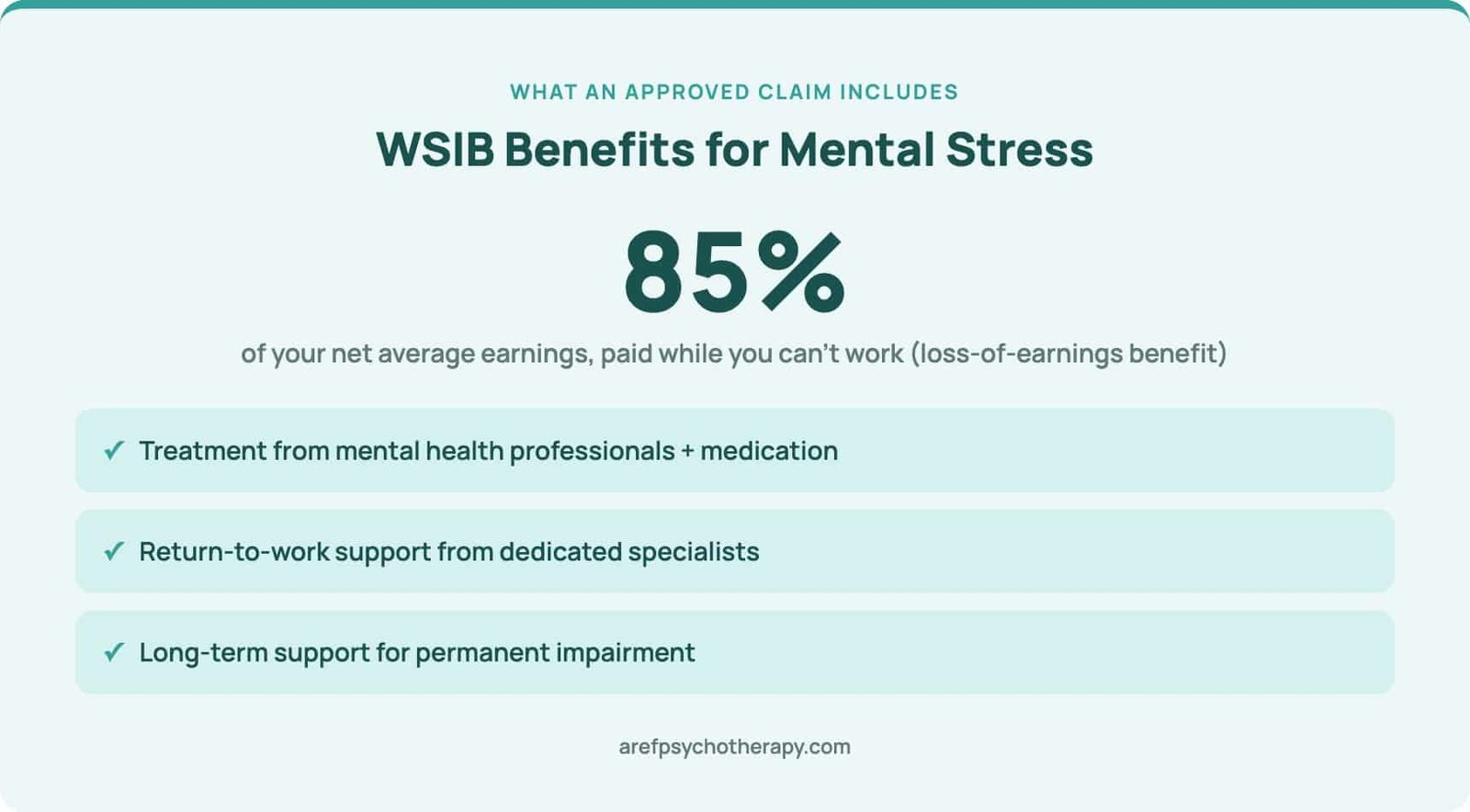
- Income support (loss-of-earnings benefits). If you lose time and wages because of the injury, WSIB pays loss-of-earnings (LOE) benefits at 85% of your net average earnings — your take-home pay after probable deductions like income tax, EI, and CPP. For the first 12 weeks it’s based on your short-term earnings, and after that WSIB may recalculate to better reflect your situation. (See WSIB’s Loss of Earnings benefit.)
- Health care coverage. WSIB pays for treatment from mental health professionals and for prescription medication related to your injury.
- Return-to-work support. You get access to specialists who help you return to work safely, at a pace that fits your recovery.
- Long-term support if the injury leads to a permanent impairment.
There’s no single “WSIB payout for PTSD” number — the amount depends on your earnings and how long you’re unable to work. But the combination of covered therapy plus wage replacement is often worth far more than people expect.
How WSIB Pays for Your Therapy: The Mental Health Program of Care
Once your claim is approved, WSIB doesn’t just hand you a list of therapists and wish you luck. Treatment is delivered through a structured program.
As of April 27, 2026, WSIB’s Mental Health Program of Care (which replaced the earlier Community Mental Health Program) provides psychological assessment and evidence-based, outcome-focused treatment. It’s organized into phases — intake, assessment, and treatment blocks — so your care is planned and reviewed as you go. (See WSIB’s Community Mental Health Program page.)
Alongside that program, many people also want flexible, ongoing therapy they can do from home. That’s where virtual psychotherapy fits in — you can keep working with a therapist between appointments, in your own language, without a commute. If you’re weighing your options, our team offers free consultations to help you figure out the right fit.
The Forms That Matter
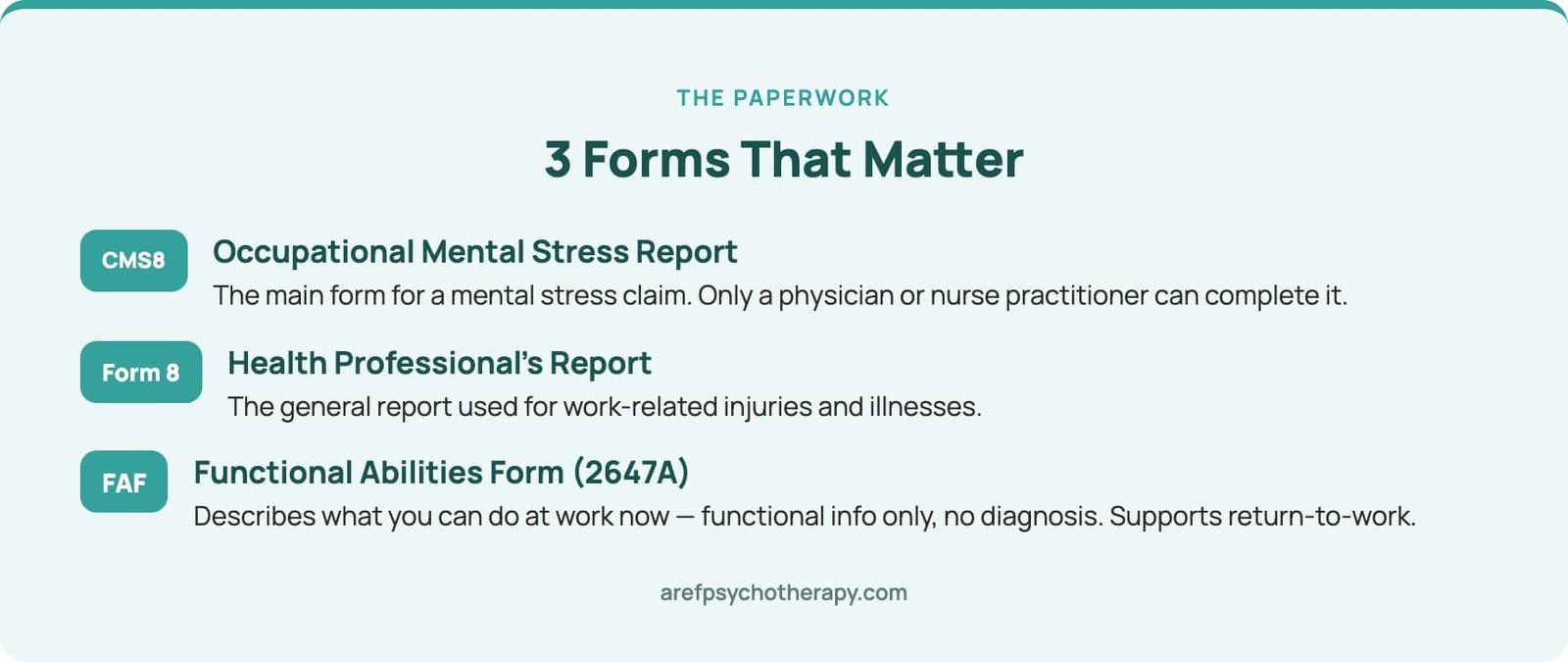
Paperwork is where mental stress claims often stall. Three forms come up most:
- Form CMS8 — Health Professional’s Report for Occupational Mental Stress. This is the form for a mental stress claim. Only a physician or nurse practitioner can complete it, and prompt completion is critical to WSIB processing your claim.
- Form 8 — Health Professional’s Report. The general report used for work-related injuries and illnesses.
- Functional Abilities Form (FAF, 2647A). Describes what you can and can’t do at work right now, to support return-to-work planning. It contains functional information only — not your diagnosis.
You start the claim by reporting your injury to WSIB (you can do this online), after which you’ll get a claim number and a case manager. Our step-by-step guide on how to file a WSIB mental stress claim covers the process in detail. (See WSIB’s work-related mental stress injuries page and its commonly used forms.)
Time Off Work and “Stress Leave”
There’s no WSIB program literally called “stress leave” — that’s the everyday phrase people use. What actually happens is this: if your mental stress claim is approved and you can’t work, the loss-of-earnings benefit replaces most of your income (85% of net average earnings) while you recover. So the “leave” is real, and so is the pay — it just runs through your WSIB claim rather than a separate program.
If you can do some work but not your full duties, WSIB and your employer may arrange modified duties, and your benefits can top up the difference.
What If Your Claim Is Denied?
Mental stress claims are turned down more often than physical-injury claims — usually because the diagnosis, the work-related cause, or the documentation wasn’t clear enough. A denial is not the end of the road.
You have the right to object to a WSIB decision, but there’s a time limit (WSIB states the deadline in your decision letter), so act quickly. If an objection doesn’t resolve it, you can appeal to the Workplace Safety and Insurance Appeals Tribunal (WSIAT) — an independent tribunal separate from WSIB. Strengthening the file usually means clearer medical documentation linking your condition to the workplace. Ongoing therapy notes from a Registered Psychotherapist can be part of that supporting picture, even though the formal diagnosis comes from a physician, NP, psychologist, or psychiatrist.
If you’ve been denied, don’t give up on care while you sort out the claim — waiting rarely makes symptoms easier to treat.
Where Therapy Fits In
Navigating WSIB is stressful on top of the injury itself. Our team at Aref Psychotherapy offers virtual therapy across Canada, in 14+ languages, for people dealing with workplace trauma, PTSD, and chronic work stress. We can’t file your claim for you, but we can support your recovery — and clear, consistent therapy is good for both your health and your file. Learn more about our WSIB therapy support and workplace PTSD care.
Ready to Take the Next Step?
Our team at Aref Psychotherapy offers virtual therapy across Canada. If you’re dealing with work-related stress or PTSD, book a free consultation and we’ll help you find the right therapist for you.
- Virtual sessions across every province
- Registered Psychotherapists experienced in workplace trauma
- Support in 14+ languages
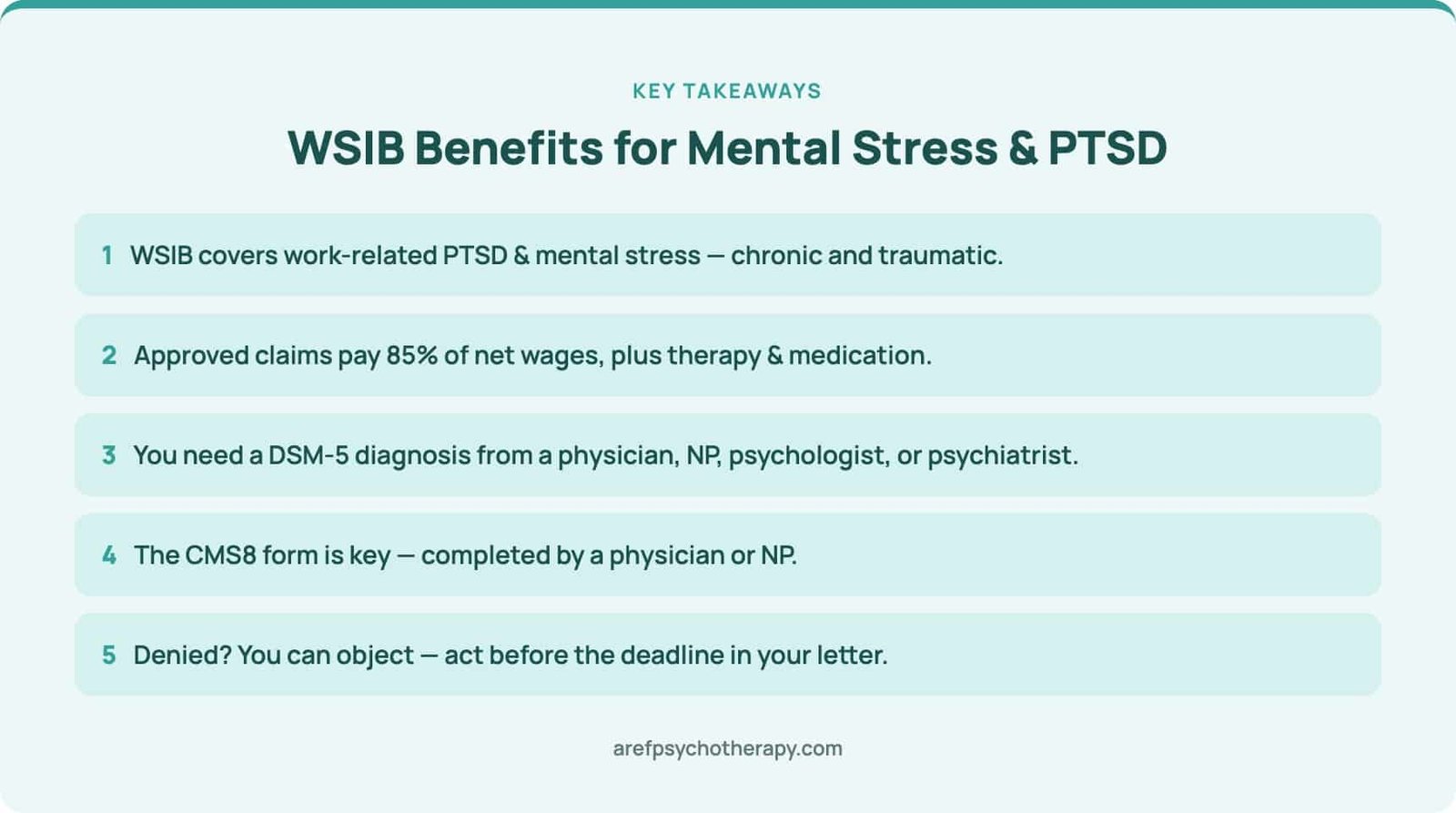
Key Takeaways
Frequently Asked Questions
Does WSIB cover PTSD?
Yes. WSIB covers work-related PTSD as a form of traumatic mental stress. If a work-related traumatic event caused or significantly contributed to a diagnosed condition, you may be eligible for covered treatment and income support. First responders receive presumptive PTSD coverage, which makes their claims faster to approve.
How much is a WSIB payout for PTSD?
There's no fixed amount. If you can't work because of the injury, WSIB pays loss-of-earnings benefits at 85% of your net average earnings, plus your treatment and medication. The total depends on your earnings and how long you're off, so two people with the same diagnosis can receive very different amounts.
What is Form CMS8?
Form CMS8 is the Health Professional's Report for Occupational Mental Stress — the main report used for a WSIB mental stress claim. Only a physician or nurse practitioner can complete it. Getting it filled out promptly is one of the most important things you can do to keep your claim moving.
Is WSIB "stress leave" a real thing?
Not by that name. "Stress leave" is the everyday term. What actually happens is that an approved mental stress claim pays loss-of-earnings benefits (85% of net average earnings) while you're unable to work, so the time off and the income support come through your WSIB claim.
Can a psychotherapist diagnose my condition for the claim?
No. The diagnosis for a WSIB claim must come from a physician, nurse practitioner, psychologist, or psychiatrist. A Registered Psychotherapist can provide your ongoing therapy and treatment notes, which can support your recovery and your file, but does not sign the diagnostic report.
Disclaimer
This article is for informational purposes only and does not replace professional mental health advice or legal advice about your claim. If you’re in crisis, please contact Canada’s 9-8-8 Suicide Crisis Helpline by calling or texting 9-8-8. For first responder peer support, Boots on the Ground is available 24/7 at 1-833-677-2668.
Reviewed by the clinical team at Aref Psychotherapy — a team of Registered Psychotherapists serving clients across Canada. Meet our team.