
Reviewed by the AREF Psychotherapy team
Grief does not keep to a schedule. It can hit you in the grocery store, on the drive to work, or halfway through a sentence. You may wonder if what you feel is normal, or if it is time to talk to someone. If you are looking for grief counselling in Toronto, this guide is for you.
Grief counselling is not only for people who feel broken. It is for anyone carrying a loss that feels heavy: a death, the end of a relationship, a lost job, or a hard diagnosis. Your grief is real, and it deserves care.
Below, you will find what grief is, when it may become prolonged grief disorder, what the research says, and what sessions look like. You will also find free and paid support in Toronto, and how to book a free consultation with our Registered Psychotherapists.
What grief is, and why it is more than sadness
Grief, also called bereavement, is the experience of loss. The Canadian Mental Health Association (CMHA) explains that people grieve after any important loss that affects their life, not only a death. That can be a job, a relationship, or your health after a diagnosis.
Grief also reaches past your mood. The Centre for Addiction and Mental Health (CAMH) says grief can affect your emotions, your thoughts, your behaviour and even how you feel in your body. CMHA adds that some people feel numb, and that at times many people even feel relief or peace after a loss.
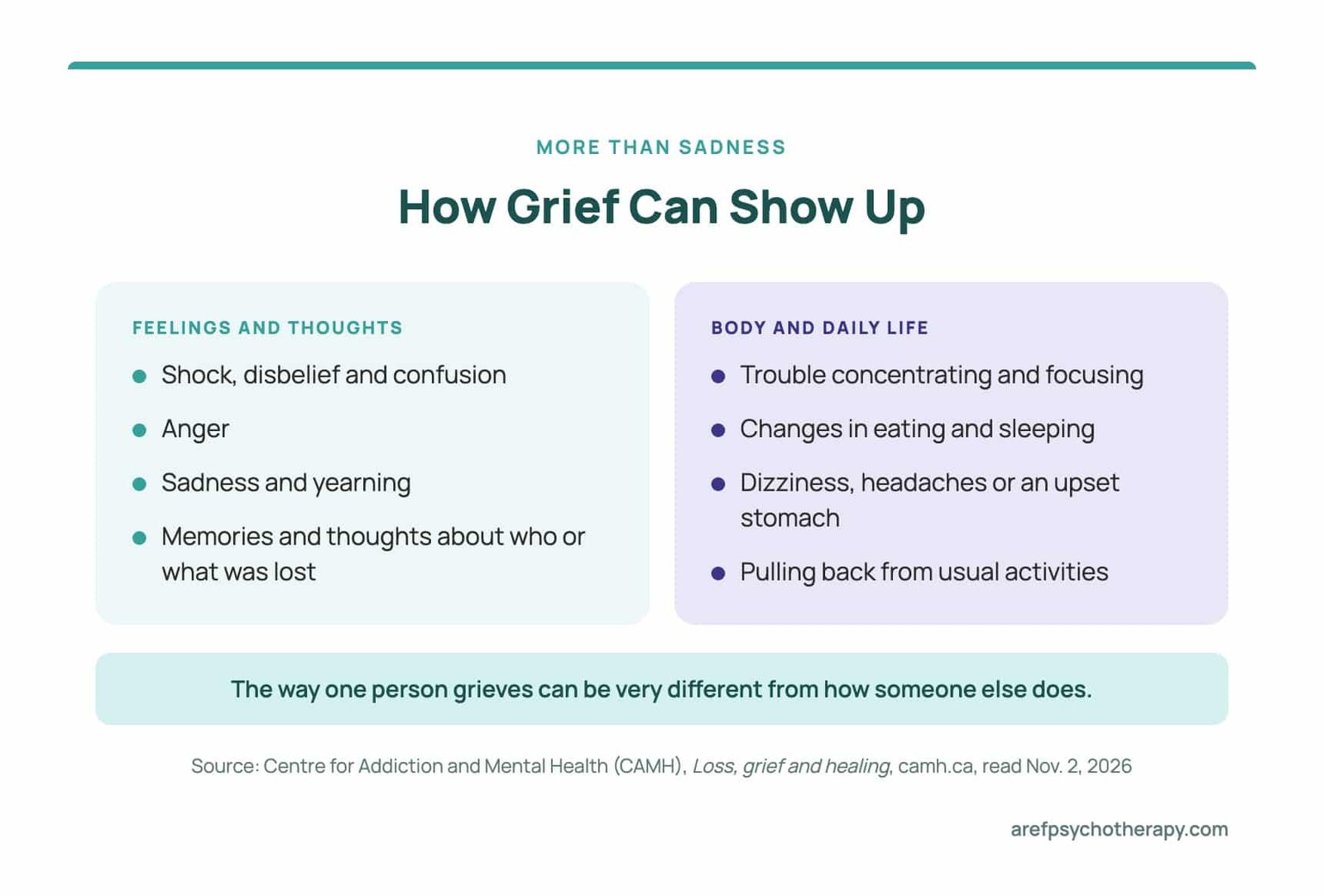
There is no single right way to grieve. CAMH notes that mourning can take many forms and can vary between cultures, from crying to art, writing, rituals and prayer. CMHA says there is no normal grieving period.
If grief is tangled up with anxiety, low mood or stress, our adult mental health therapy can look at all of it together. You do not have to sort it into separate boxes first.
Why grief does not follow a script
Many of us have heard of the five stages of grief: denial, anger, bargaining, depression and acceptance. It is easy to treat them as a map, and then worry that you are grieving the wrong way when your grief does not follow it.
Grief researchers have questioned that map. In a 2017 review in the journal Omega, Margaret Stroebe, Henk Schut and Kathrin Boerner pointed to the lack of sound evidence for stage theory. They also warned that expecting people to go through stages can harm those who do not.
A different model fits real grief better. In their Dual Process Model, first described in 1999, Stroebe and Schut describe two kinds of stress after a loss. One is the loss itself (loss-oriented). The other is the work of rebuilding daily life (restoration-oriented). People move back and forth between the two, sometimes facing the loss and sometimes setting it aside. The model treats this back-and-forth as part of healthy coping. It also says that taking breaks from grief is part of coping, not a failure.
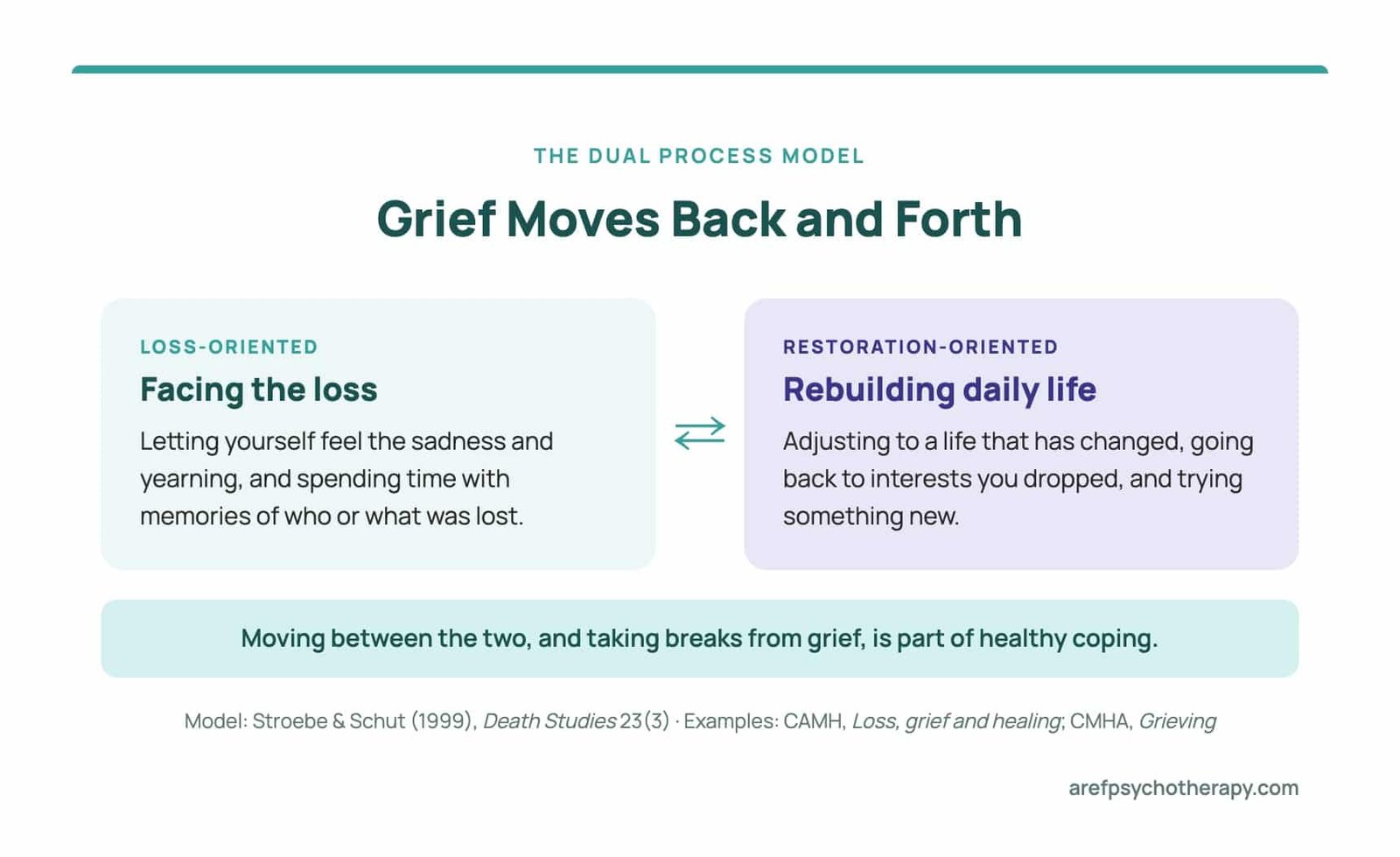
So if you have a good week and then a terrible day, you are not going backwards. CMHA notes that the strength of grief often changes a lot over time, and that holidays can bring up strong feelings. The goal of grief counselling is not to rush you. It is to help when grief feels stuck.
When grief becomes prolonged grief disorder
For most people, grief eases over time and does not need mental health treatment. That is the view of the American Psychiatric Association, which publishes the DSM, the manual clinicians use to name mental health conditions. For some people, though, grief stays intense and keeps getting in the way of daily life.
Prolonged grief disorder was added to the DSM-5-TR, the current edition of that manual, in March 2022. For adults, the American Psychiatric Association describes it like this:
- Time. The death of someone close happened at least a year ago (at least 6 months for children and teens).
- Core signs. Intense longing for the person who died, or being preoccupied by thoughts of their death.
- Other signs. At least 3 of 8 listed symptoms, nearly every day for at least the last month. Examples include feeling that part of you has died, avoiding reminders that the person has died, emotional numbness, intense loneliness, and feeling that life has no meaning without them.
- Impact. The grief causes real distress or problems at home, at work or in other parts of life.
- Norms. It lasts longer than your community, culture or faith would expect.
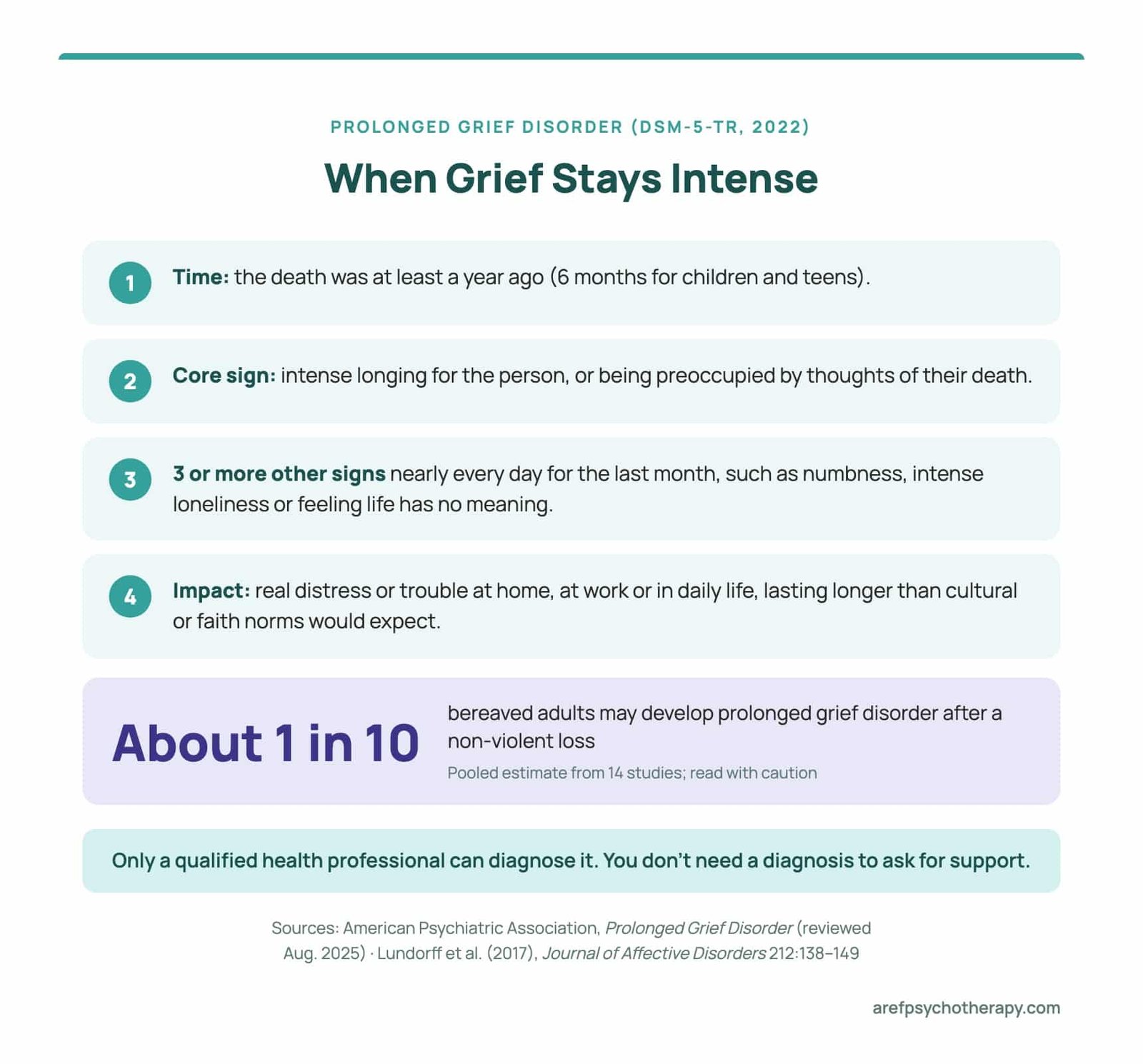
How common is it? A 2017 review of 14 studies by Lundorff and colleagues estimated that about 1 in 10 bereaved adults may develop prolonged grief disorder after a loss that was not violent. The authors say the figure should be read with caution, because the studies were quite different from each other.
Prolonged grief disorder is not a sign of weakness, and it is not something you choose. Only a qualified health professional can diagnose it, after a proper assessment, not an online checklist. If these patterns sound familiar, that is a reason to talk to someone. The American Psychiatric Association notes that treatments with research behind them are available.
Grief that has stayed heavy for a long time deserves support, and you do not need a diagnosis to reach out. Book a free 15-minute consultation to talk it through.
Does grief counselling help? What the research shows
Grief counselling means talking with a trained professional about your loss and how it is affecting you. CMHA describes it as a type of counselling that supports people through difficulties around grief. Psychotherapy, explains the College of Registered Psychotherapists of Ontario (CRPO), is mainly a talk-based therapy that helps people improve and maintain their mental health and well-being.
Two large research reviews give a picture of what the evidence shows:
- Grief therapy in general. In 2019, Johannsen and colleagues combined the results of 31 randomized controlled trials. These are studies that compare people who get a treatment with a comparison group. On average, people who had psychological help had fewer grief symptoms after treatment, and the difference was still there at follow-up. The benefit was smaller once the authors allowed for studies with weaker results that may never have been published.
- Grief-focused CBT. In 2024, Komischke-Konnerup and colleagues combined 22 trials with 2,602 bereaved adults. They looked at grief-focused cognitive behavioural therapy (CBT), a talk therapy that works with the links between thoughts, feelings and actions. It had a medium effect on prolonged grief symptoms after treatment, and a large effect in the 7 trials that checked again later. It also eased posttraumatic stress, depression and anxiety symptoms.
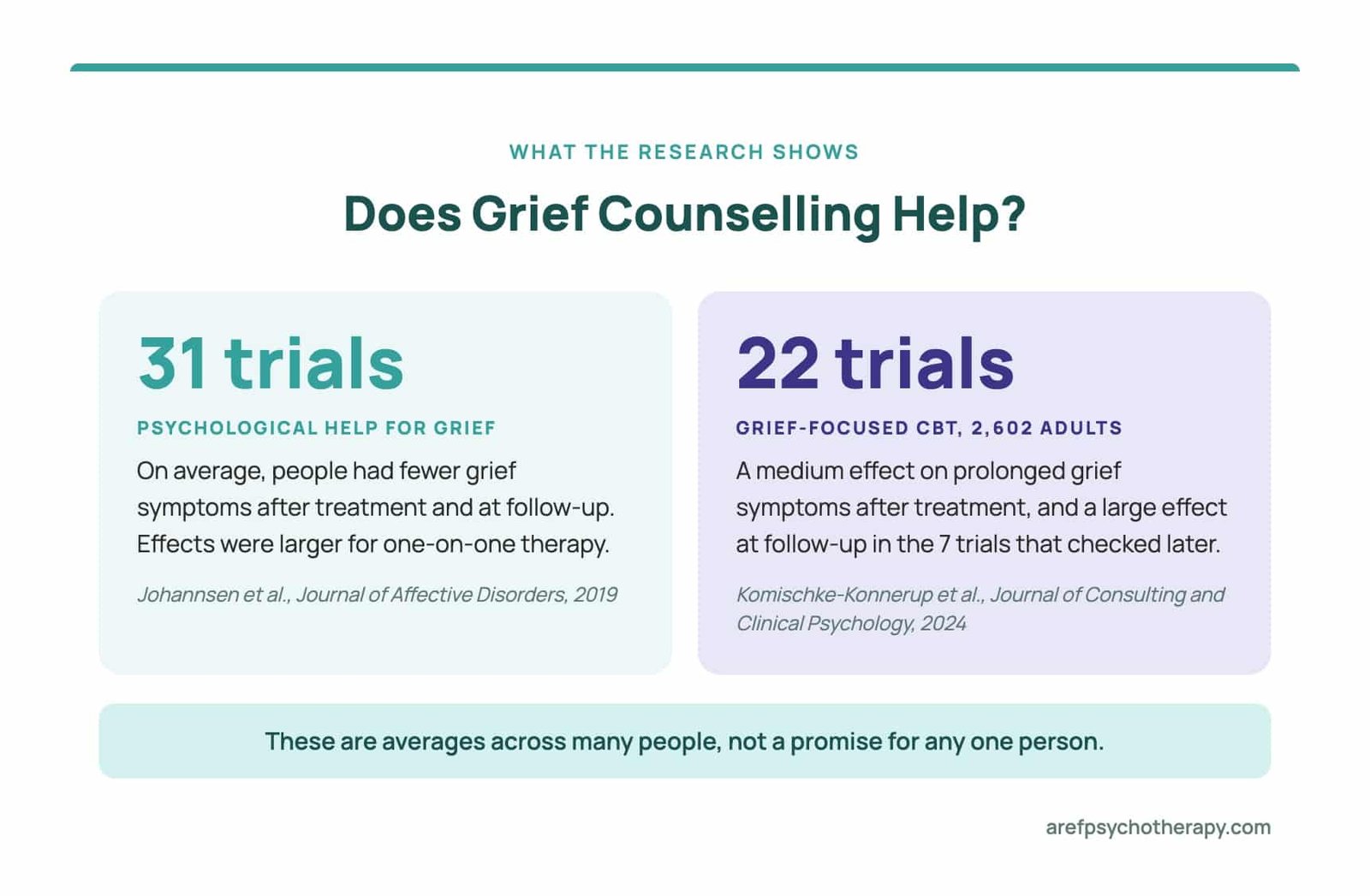
The 2019 review also gives clues about when therapy tends to help more. Effects were larger in studies where therapy was one-on-one, where people were at least 6 months past their loss, and where people started with higher grief symptoms.
These are averages, not promises for any one person, and both teams say the studies varied. Still, they show that grief counselling has real research behind it, especially when grief has become hard to live with.
What happens in grief counselling
Every therapist works a little differently, and your plan is built with you. Here is what grief counselling can look like at AREF Psychotherapy, step by step:
- Getting to know you. In your first session, we focus on your goals, your history and your comfort level. There is no pressure to share more than you want.
- Going at your pace. You decide the pace. We build trust before going deeper.
- Making room for the loss. Sessions are time set aside for your grief: the loss, the relationship, and what you have been carrying.
- Carrying the memory forward. Grief counselling does not ask you to forget. MyGrief.ca, from the Canadian Virtual Hospice, talks about finding ways to carry the memory of the person forward in your life.
- Checking in on progress. We check in on your progress and goals regularly. If the fit is not right, you can ask to change therapists.
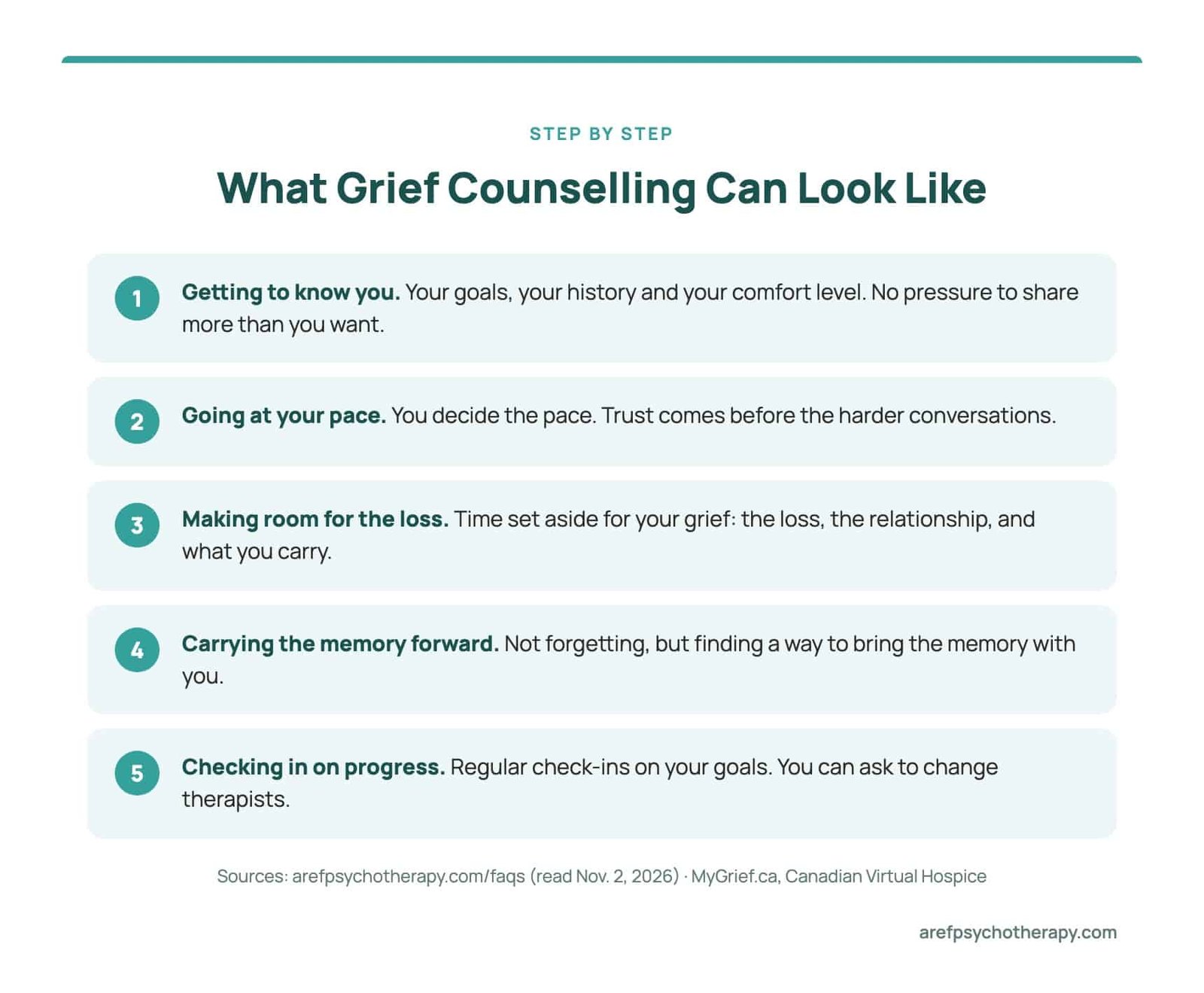
Most sessions are 50 minutes. Healing is not a straight line here either. CAMH notes that results do not happen overnight, and that some people feel worse at the start as things come to the surface. It helps to know this ahead of time, and you still decide the pace.
When grief and trauma overlap
Some losses are traumatic as well as painful: a sudden death, an accident, a suicide, or a death caused by violence. CMHA notes that grief can be more complicated when a loss is sudden or unexpected, frightening, the result of an accident or disaster, or the result of a crime. The American Psychiatric Association also says the risk of prolonged grief disorder is higher when a death is very sudden or happens under unnatural circumstances.
CAMH notes that for some people, grief can last and overlap with traumatic experiences and reactions. When that happens, therapy may need to make room for both. Our team includes therapists trained in trauma-focused approaches such as EMDR therapy and trauma-informed CBT. In the 2024 review above, grief-focused CBT also eased posttraumatic stress symptoms.
If you came to Canada as a newcomer or refugee, you may be grieving several losses at once: people, home, language and community. Our newcomer and refugee support makes room for grief, displacement and cultural identity. Our article on post-migration stress may also help.
Grief across cultures, faiths and languages
Toronto is home to people from many cultures and faiths, and each has its own ways of mourning. CAMH notes that grief and mourning can be expressed individually, as a family, and even as a community. In some families, grief is expressed openly and together. In others, it is held more privately. Neither is wrong.
Language matters too. You may find some feelings easier to name in the language you grew up with. Our therapists offer therapy in 14+ languages, including Arabic, Farsi, Hindi, Spanish and Tamil. You can ask for a therapist from a similar cultural background, and we try to honour cultural, religious and identity-based preferences. If faith or spirituality is part of how you grieve, it is welcome in your sessions.
Grief counselling in Toronto: your options, free and paid
You have more than one place to turn, and some options cost nothing.
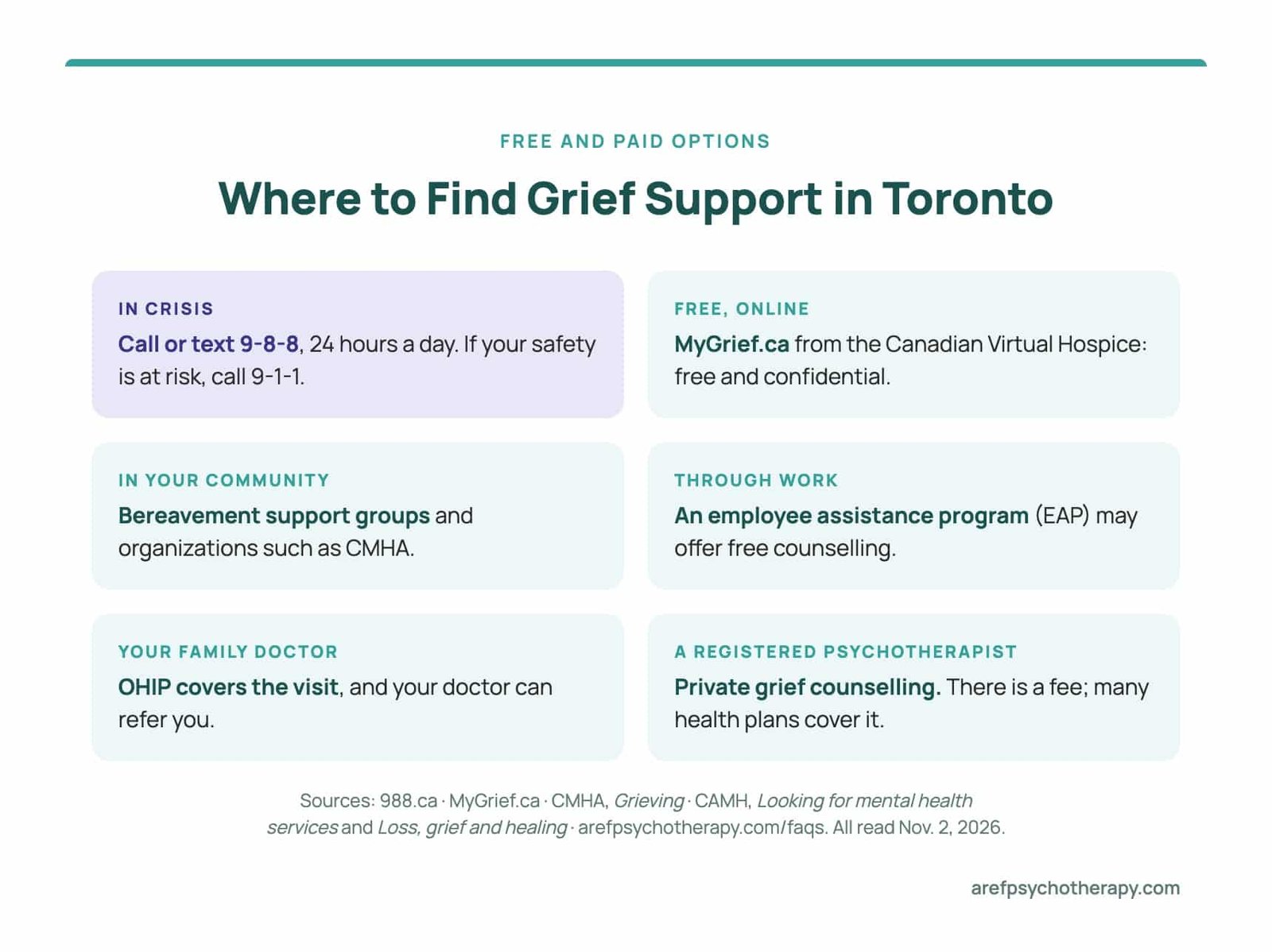
- If you are in crisis, call or text 9-8-8, the Suicide Crisis Helpline, any time of day or night. If your safety is at risk right now, call 9-1-1.
- Free online support. MyGrief.ca is free and confidential, and was developed with grief specialists and people who have been there.
- Community support. CMHA suggests reaching out to caring people, which can include a bereavement support group or a community organization such as CMHA.
- Through work. If your workplace has an employee assistance program (EAP), counselling through it may be free, CAMH notes.
- Your family doctor. OHIP covers the full cost of medically necessary visits to your doctor, in person or by video or phone, according to Ontario’s What OHIP covers page. CAMH suggests asking your doctor for a referral if grief feels overwhelming or stuck.
- Private grief counselling. A psychotherapist in private practice charges a fee, because their services are not covered by public health insurance such as OHIP, says CAMH’s guide Looking for mental health services. Many workplace health plans cover therapy with a Registered Psychotherapist, so check yours. At AREF, some therapists offer sliding-scale rates based on need; ask our intake team.
How to choose a grief counsellor
Fit matters. CAMH says a good relationship with your therapist is important for your recovery, and you may need to try more than one therapist to find someone you are comfortable with. A few things to check:
- Registration. In Ontario, anyone who uses the title Registered Psychotherapist must be registered with CRPO. You can look up a therapist on CRPO’s public register.
- Experience with grief. CRPO suggests asking what type of psychotherapy a therapist provides, and whether they have training and experience with concerns like yours.
- Cost and insurance. Ask what a session costs, how you pay, and whether they accept your health plan.
- Understanding your background. If culture, language or faith matter to you, ask how the therapist will understand your perspective.
A free consultation is a good time to ask these questions and to notice whether you feel heard.
How to start grief counselling with AREF Psychotherapy
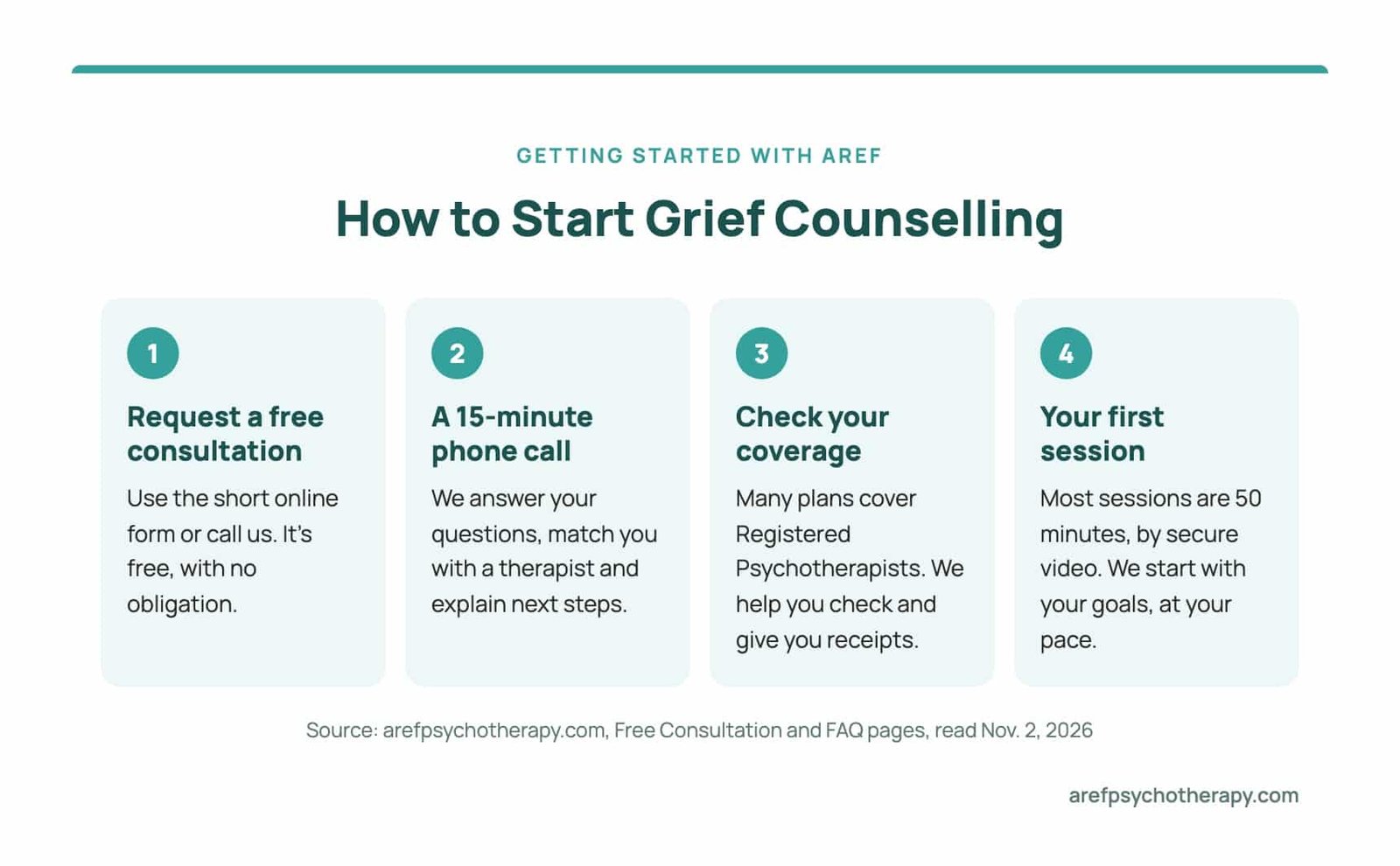
If you live in Toronto or anywhere else in Ontario, here is how to start with us:
- Request a free consultation. Fill in the short form on our free consultation page, or call (437) 830-2088.
- Have a 15-minute phone call. Our intake team sets up a free, no-obligation call. We answer your questions, match you with a therapist and explain next steps, at your pace. Tell us your language and any cultural or faith preferences.
- Check your coverage. Many plans cover Registered Psychotherapists, and we will help you check. We provide detailed receipts for insurance and tax purposes.
- Start your sessions. Our Registered Psychotherapists offer grief counselling by secure video, so you can join from a private space at home. If meeting in person matters to you, ask about it on your consultation call.
Grief has no deadline, and you do not have to wait until it feels serious enough. When you are ready, we are here.
Key takeaways
- Grief is a normal response to any important loss, not only a death.
- Grief does not follow neat stages. Moving between facing the loss and rebuilding daily life, with breaks, is part of healthy coping.
- Prolonged grief disorder was added to the DSM-5-TR in 2022. One review estimated it affects about 1 in 10 bereaved adults after a non-violent loss.
- Research reviews show that grief therapy reduces grief symptoms on average.
- In Toronto, free support includes 9-8-8, MyGrief.ca, community groups and some EAPs. Private counselling has a fee that OHIP does not cover, but many health plans do.
- AREF’s Registered Psychotherapists offer grief counselling by secure video in 14+ languages, starting with a free 15-minute consultation.
Frequently asked questions
Is grief counselling covered by OHIP?
OHIP covers medically necessary visits to a doctor, such as a family doctor or psychiatrist, and your doctor can refer you to support. Grief counselling with a psychotherapist in private practice is not covered by OHIP, so there is a fee. Many workplace health plans cover therapy with a Registered Psychotherapist, and an employee assistance program through work may be free. Check your plan before you book.
How do I know if I need grief counselling?
There is no test you have to pass first. Many people move through grief with help from family and friends. CMHA notes that some people need extra help, especially after a loss that was sudden, frightening, or the result of an accident or a crime. CAMH suggests reaching out if grief feels overwhelming or stuck. If grief makes it hard to sleep, work or connect with people, talking to a professional is a reasonable next step.
How many grief counselling sessions will I need?
There is no set number. It depends on your loss, your goals and how grief is affecting your life. Some people want short-term support, and others want longer-term work. CRPO suggests asking a therapist whether they offer short-term or longer-term therapy, and how you will know it is working. At AREF, we check in on your progress and goals regularly.
Can I do grief counselling online if I live in Toronto?
Yes. Our Registered Psychotherapists offer grief counselling by secure video to people in Toronto and across Ontario. You will need a private space, a phone or computer with a camera, and a steady internet connection. Some people find it easier to join from home on a hard day. If meeting in person matters to you, ask about it during your free consultation.
Can I get grief counselling in my own language?
Yes. Our team offers therapy in 14+ languages, including Arabic, Farsi, Hindi, Spanish and Tamil. You can ask for a therapist from a similar cultural background, and we try to honour cultural, religious and identity-based preferences. If faith or spirituality is part of how you grieve, it is welcome in your sessions. Tell our intake team what matters to you.
This article is for informational purposes only and does not replace professional mental health advice. If you’re in crisis, please contact Canada’s 9-8-8 Suicide Crisis Helpline by calling or texting 9-8-8.
Sources and further reading
Canadian health organizations, government and regulators
- Canadian Mental Health Association, Grieving
- CAMH, Loss, grief and healing
- CAMH, Looking for mental health services
- Ontario, What OHIP covers
- College of Registered Psychotherapists of Ontario, What to Know About Psychotherapy
- CRPO public register of Registered Psychotherapists
Grief and crisis support
Diagnosis
- American Psychiatric Association, Prolonged Grief Disorder (physician review August 2025)
Research
- Stroebe M, Schut H. The dual process model of coping with bereavement: rationale and description. Death Studies, 1999.
- Stroebe M, Schut H, Boerner K. Cautioning health-care professionals. Omega, 2017.
- Lundorff M, et al. Prevalence of prolonged grief disorder in adult bereavement: a systematic review and meta-analysis. Journal of Affective Disorders, 2017.
- Johannsen M, et al. Psychological interventions for grief in adults: a systematic review and meta-analysis of randomized controlled trials. Journal of Affective Disorders, 2019.
- Komischke-Konnerup KB, et al. Grief-focused cognitive behavioral therapies for prolonged grief symptoms: a systematic review and meta-analysis. Journal of Consulting and Clinical Psychology, 2024.