
Reviewed by the AREF Psychotherapy team
You know how to walk into the worst day of someone’s life and do the job. What comes after gets far less attention. So maybe your sleep is going, or your fuse is shorter at home, or one call keeps coming back when you’re trying to think about something else. Maybe you’ve thought about talking to someone, and then you heard the word that stops a lot of people in these jobs.
Getting help doesn’t make you weak: the short answer
Getting help doesn’t make you weak. What you’re carrying may be an injury from the work, and treating an injury says nothing bad about your character. It’s OK to go, and it’s OK to go quietly.
We won’t tell you the fear is all in your head. People in these services do talk, and worrying about who finds out is reasonable. So this article sets out the evidence and lets you judge it. It’s written for dispatchers, correctional staff, paramedics, firefighters and police in Ontario. If you already want to talk to someone, our page on first responder therapy explains how it works.
Where the word “weak” comes from
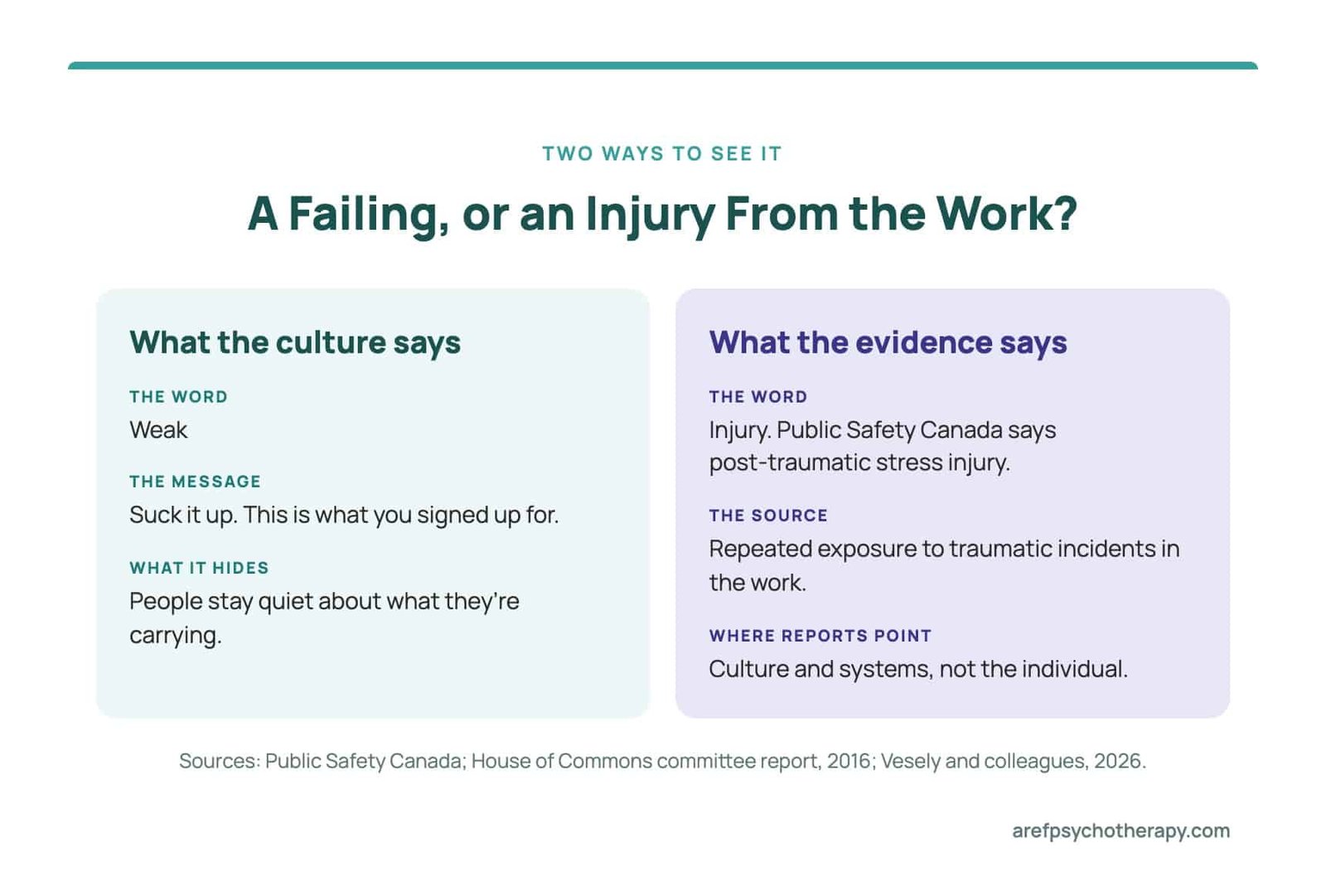
The word comes from the culture of the work. Nobody measured you and found you lacking.
In 2016, a House of Commons committee heard that first responders work in a culture that frowns on weakness and requires them to be constantly stoic. In an Ontario study by Vesely and colleagues, published in 2026, employer representatives from fire, paramedic, police and corrections services described an older belief that people who struggled were emotionally weak. The message was to suck it up, because this is what you signed up for.
This isn’t only about men being tough. Officers in a Canadian police study by Bikos often named traditional masculinity as the largest cultural barrier. But in a 2025 study of 361 Canadian public safety communicators, 78.4 per cent of them women, one respondent summed up the stigma the same way: if it bothers you, you’re weak. The word travels with the job. That makes it a rule of the workplace, and it tells you nothing about what you’re made of.
The harshest version often comes from inside. A police employer representative in the Vesely study said self-stigma may have the biggest impact: feeling you aren’t who you used to be, and that you’ve failed the service and the public. An expert panel for Ontario’s Office of the Chief Coroner, writing about police, said the fear of letting down the team may be greater for the person struggling than for colleagues, who will typically support one another.
What the job asks you to carry
The job asks you to take in a lot and keep moving. Respondents in the 2025 study described being taught to keep going whatever happens and to set their emotions aside. That training is part of why the call gets handled. It has much less to offer once the call is over.
Public Safety Canada says people in these roles are repeatedly exposed to traumatic incidents, which can put them at great risk of stress injuries. For you, that’s a normal shift, repeated for years.
It’s an injury, not a failing
An injury is something that happens to you. Government and Ontario law both use the word.
Public Safety Canada says “post-traumatic stress injuries” because it heard that words like “disorder” can put people off getting help. The term covers PTSD (post-traumatic stress disorder) and also depression, anxiety and problems with drugs or alcohol. Ontario’s Workplace Safety and Insurance Act goes further. A listed first responder diagnosed with PTSD by a psychiatrist or psychologist is entitled to benefits as if it were a personal injury, and it’s presumed to come from the job unless the contrary is shown. Other conditions apply, and this is general information, not legal advice.
A paramedic employer representative in the Vesely study recalled that people used to go off with a back injury or a shoulder strain, and would never admit to a mental health injury. Nobody calls a bad shoulder a character flaw. You get it looked at because you need that shoulder.
Official reports point at culture and systems. The House of Commons committee called for culture change. The coroner’s expert panel called normalizing mental health issues perhaps the most vital step, and it noted that real malingering is quite rare, whatever the rumours say. The Bikos study concluded that officers need policies that treat mental disorder as a job hazard, not a personal failure.
None of this is a diagnosis. What you’re going through might be PTSD, something else or a hard stretch, and a qualified professional is the one to sort that out.
You’re less alone than it looks
From the inside, it can look like everyone else is handling it. The evidence suggests many people aren’t.
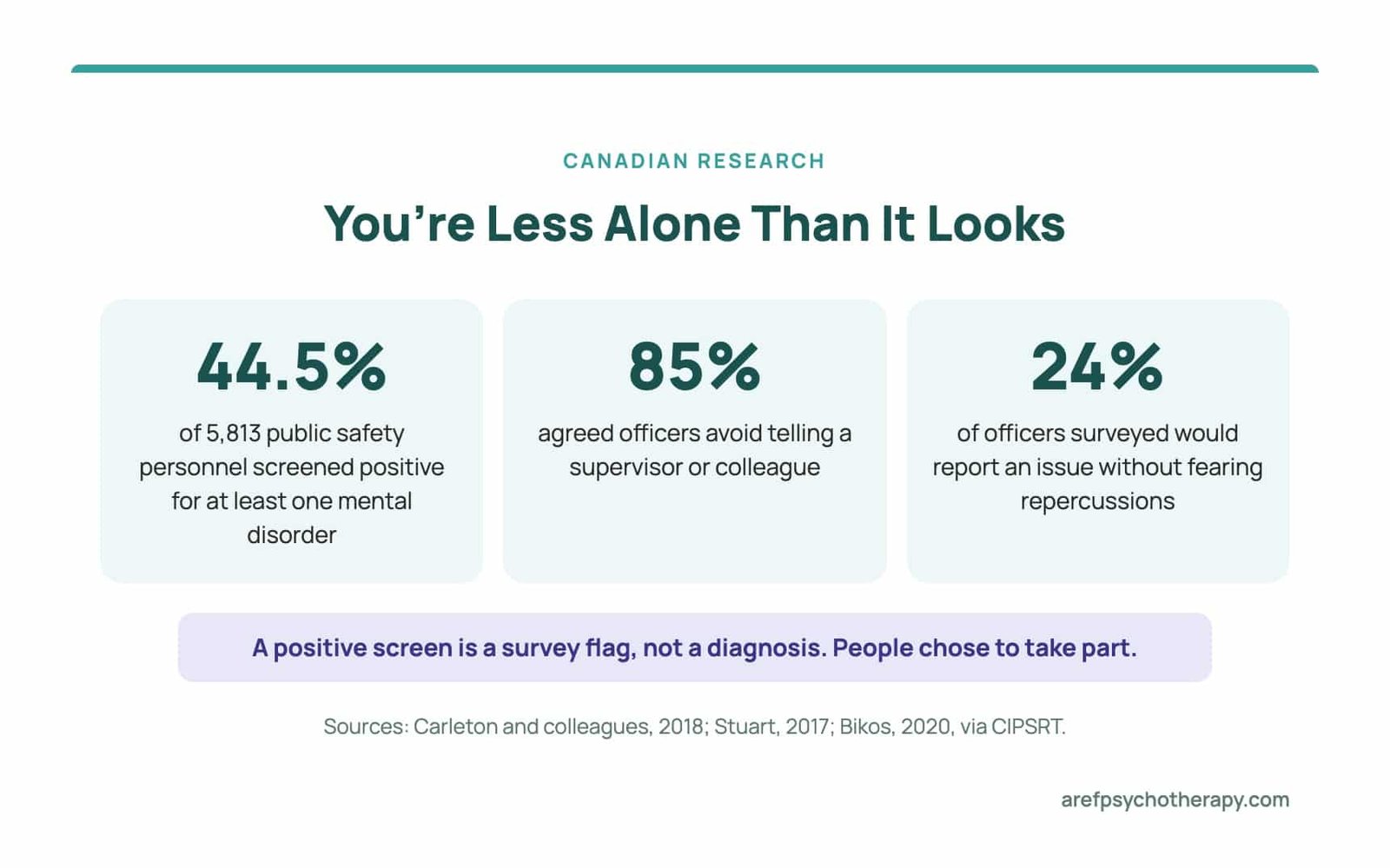
In a national survey led by R. Nicholas Carleton, published in 2018, 44.5 per cent of 5,813 Canadian public safety personnel screened positive for at least one mental disorder. A positive screen is a survey flag, not a diagnosis. People chose to take part and the data come from 2016 and 2017, so nobody can say it’s the true rate. It does suggest that what you’re feeling is far from rare in this work.
Silence hides it. In a police survey by Heather Stuart of Queen’s University, 85 per cent agreed that officers avoid telling a supervisor or a colleague. Our reading: a crew can look fine from the outside while people stay quiet.
Has the culture changed? Employer representatives in the Vesely study said stigma is falling. Officers are less sure: in the Bikos survey of 727 officers, only 24 per cent said they would report a mental health issue without fear of career or social repercussions. So if you’re careful about who you tell at work, the research backs you up. That’s a good reason to choose carefully. It’s a poor reason to tell nobody at all.
Want to ask questions first? Book a free consultation, a no-obligation 15-minute phone call.
What getting help is, and isn’t
Therapy is work on a specific problem with a trained, regulated person. Our team includes Registered Psychotherapists (RPs), who are regulated by the College of Registered Psychotherapists of Ontario (CRPO). RPs assess and treat, but CRPO’s practice manual says they are not authorized to communicate a diagnosis. If you need one, it comes from another professional.
The evidence that it works is encouraging and still thin. Bahji and colleagues, a Canadian team, reviewed eight randomized trials with 402 public safety personnel, and therapy was linked to fewer symptoms of PTSD, anxiety and depression. The trials included cognitive behavioural therapy (CBT), which works on patterns of thinking and behaviour, and EMDR (eye movement desensitization and reprocessing), a structured way of working through distressing memories. Only three trials were rated high quality, and the authors call the evidence preliminary. The Centre for Addiction and Mental Health (CAMH) says people can recover from PTSD and that everyone’s experience is different. Nobody can promise how it will go for you.
Therapy also isn’t:
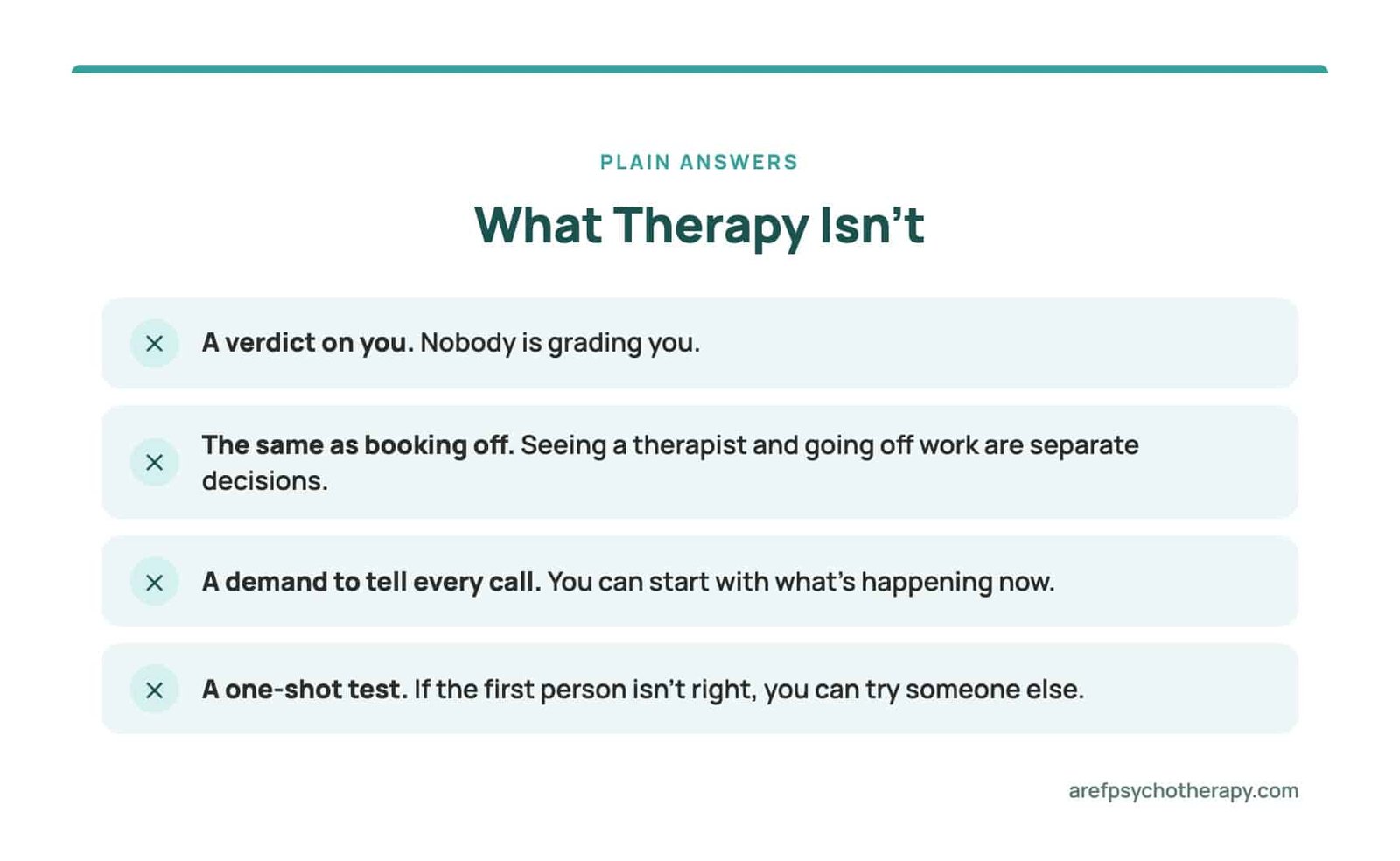
- A verdict on you. Nobody is grading you.
- The same thing as booking off. Seeing a therapist and going off work are separate decisions.
- A demand to tell every call. You can ask to start with what is happening now, such as sleep or things at home.
- A one-shot test. In a small study of 20 RCMP officers, a bad experience with a clinician led to long delays or refusing help. If the first person isn’t right, it’s reasonable to try someone else.
That study found something else. Officers used professional help 89 per cent of the time for personal events, such as divorce, and 53 per cent of the time for work events. Twenty people can’t speak for everyone. It does raise a fair question: if it makes sense to get help with a divorce, why not with what the work has done to you?
It’s your call, and it can stay yours
Whether you go, when you go and who you tell at work are your decisions, within the limits below. For many people, those limits are the real question. A review by Haugen and colleagues found the most common stigma concerns among first responders were confidentiality and harm to a career. More education doesn’t settle that. In a national Canadian study by Krakauer and colleagues, paramedics reported high knowledge and low stigma, and also the lowest intention to seek help, though the gaps were small. You don’t need another awareness talk. You need straight answers.
We can’t promise that nobody will find out, and you should be wary of anyone who does. What is private depends on how you pay, and there are limits:
- Confidentiality has legal limits. CRPO’s standards expect a therapist to explain them. Ask before you start.
- On a WSIB claim, your employer knows there is a claim. The law says you give your employer a copy, and WSIB’s disclosure policy lists details it can generally share without your consent, such as the diagnosis and the clinic’s name.
- Paying privately means no claim. Your therapist still keeps records, and the same legal limits apply.
- A benefits plan has its own rules. Ask what it shares, and with whom.
Online therapy takes one worry off the list. AREF’s sessions are by secure video, so there’s no waiting room to be seen in. That doesn’t make it secret.
Telling your crew is a separate choice. You can make it later, or leave it alone.
One small first step
You don’t have to settle all of this today. Pick the smallest step you can live with.
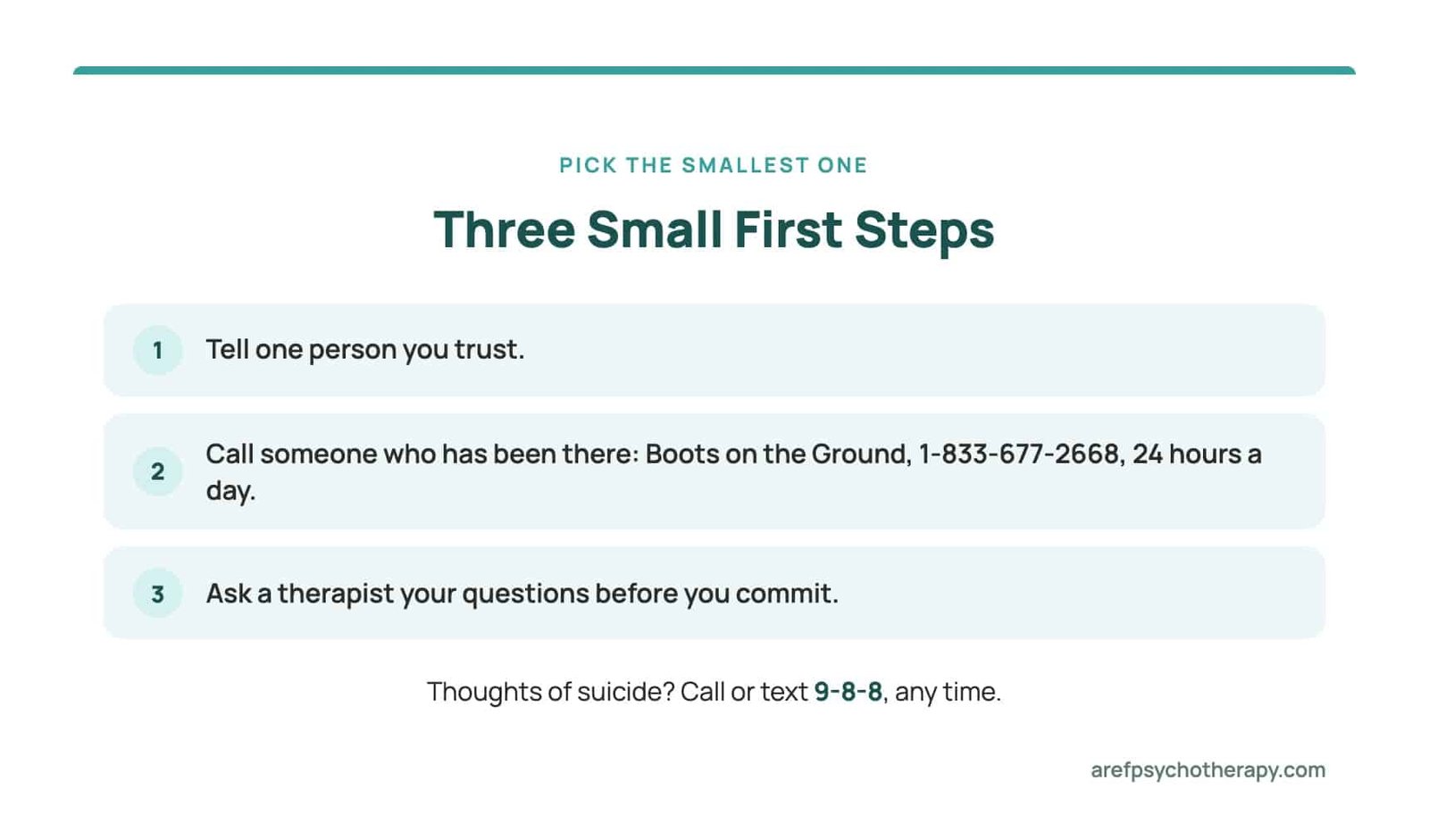
- Tell one person you trust. In the RCMP study, 15 of 20 officers said they wouldn’t have got help when they did without a trusted person stepping in.
- Call someone who has been there. Boots on the Ground describes itself as an anonymous Ontario helpline for first responders, by first responders: 1-833-677-2668, 24 hours a day. They aren’t therapists. They’re there to listen.
- Ask a therapist your questions before you commit. Have you worked with people in my line of work? What do you write down, and who can see it? What are the limits of confidentiality? What happens if this isn’t a good fit? Ask us too.
Key takeaways
- Getting help doesn’t make you weak. That word comes from job culture.
- Public Safety Canada calls these problems injuries, and Ontario’s workplace insurance law treats PTSD in listed first responders as one.
- Being careful at work is reasonable. Privacy depends on how you pay, it has limits, and a therapist should explain them before you start.
Frequently asked questions
Is going to therapy a sign of weakness?
No. That idea comes from job culture, and Canadian research shows how it gets passed along in these services. What you're dealing with may be an injury linked to the work, and looking after an injury says nothing bad about your character. Whether and when you go is up to you.
Why do some people call PTSD an injury?
Public Safety Canada uses the term post-traumatic stress injuries because it heard that words like “disorder” can put people off getting help. The term also covers problems such as depression and anxiety. PTSD itself is a clinical diagnosis that a qualified professional has to make.
Do I need a diagnosis to see a therapist?
No. You can see a Registered Psychotherapist without one. RPs can assess you and can treat a condition someone else has diagnosed, but they can't give you a diagnosis. For Ontario's PTSD presumption on a WSIB claim, the diagnosis must come from a psychiatrist or psychologist. You also don't need to wait for a crisis.
Will my employer find out if I see a therapist?
It depends on how you pay. On a WSIB claim, your employer will know there is a claim and can learn some details. Paying privately or through a benefits plan works differently. Confidentiality is never absolute. A therapist must explain the limits before you start, so ask directly, including what gets written down.
What if I'm not ready yet?
That's fine. You can read, ask questions and come back to this later. If you think you might make a WSIB claim, ask about the time limits early, because they apply. If you ever think about ending your life, call or text 9-8-8 at any hour.
When you’re ready
There’s no test to pass before you reach out. AREF Psychotherapy offers online therapy by secure video for people in Ontario. Our first responder therapy page explains the three ways to pay, and our guide to PTSD for first responders in Ontario covers the WSIB presumption.
If you need help right now
If you’re thinking about suicide, or you’re worried you might hurt yourself, you can reach someone at any hour.
- 9-8-8: Suicide Crisis Helpline. Call or text 9-8-8, 24 hours a day, every day of the year.
- Boots on the Ground. Peer support for first responders at 1-833-677-2668, 24 hours a day.
- If your safety is at risk right now, call 9-1-1.
This article is for informational purposes only and does not replace professional mental health advice. If you’re in crisis, please contact Canada’s 9-8-8 Suicide Crisis Helpline by calling or texting 9-8-8.
Sources and further reading
Research
- Carleton RN, Afifi TO, Turner S, et al. Mental Disorder Symptoms among Public Safety Personnel in Canada. Canadian Journal of Psychiatry, 2018.
- Vesely L, Yanar B, et al. Evolving influence of mental health stigma in Ontario public safety organizations: a qualitative study. Health Promotion and Chronic Disease Prevention in Canada, 2026.
- Howe E, Czarnuch S, et al. Exploring Canadian Public Safety Communicator Mental Health Help-Seeking Behaviors. NEW SOLUTIONS, 2025.
- Bikos LJ. It’s all window dressing: Canadian police officers’ perceptions of mental health stigma in their workplace. Research summary from the Canadian Institute for Public Safety Research and Treatment, of the 2020 paper in Policing: An International Journal.
- Stuart H. Mental Illness Stigma Expressed by Police to Police. Israel Journal of Psychiatry and Related Sciences, 2017.
- Haugen PT, McCrillis AM, Smid GE, Nijdam MJ. Mental health stigma and barriers to mental health care for first responders: a systematic review and meta-analysis. Journal of Psychiatric Research, 2017.
- Krakauer RL, Stelnicki AM, Carleton RN. Examining Mental Health Knowledge, Stigma, and Service Use Intentions Among Public Safety Personnel. Frontiers in Psychology, 2020.
- Burns C, Buchanan M. Factors that Influence the Decision to Seek Help in a Police Population. International Journal of Environmental Research and Public Health, 2020.
- Bahji A, Di Nota PM, Groll D, Carleton RN, Anderson GS. Psychological interventions for post-traumatic stress injuries among public safety personnel: a systematic review and meta-analysis. Systematic Reviews, 2022.
Government, regulators and Canadian health bodies
- House of Commons Standing Committee on Public Safety and National Security. Healthy Minds, Safe Communities. October 2016.
- Government of Ontario. Staying visible, staying connected, for life: report of the expert panel on police officer deaths by suicide. Executive summary and Part 2.
- Post-Traumatic Stress Injuries and Support for Public Safety Officers, Public Safety Canada
- Workplace Safety and Insurance Act, 1997, Government of Ontario
- Disclosure of Claim File Information to Employers (No Issue in Dispute), WSIB Operational Policy Manual
- Professional Practice Standards and Professional Practice and Jurisprudence for Registered Psychotherapists, College of Registered Psychotherapists of Ontario
- Posttraumatic Stress Disorder, Centre for Addiction and Mental Health (CAMH)
Support
- 9-8-8: Suicide Crisis Helpline: call or text 9-8-8
- Boots on the Ground: 1-833-677-2668