
Reviewed by the AREF Psychotherapy team
You’ve already told that call. You wrote it up, you answered the questions, and maybe you went through it again at a debrief. Doing it once more, second by second, in front of someone who might flinch, can be reason enough never to book.
Do you have to retell the call? Or, in plainer words, do I have to retell my trauma in therapy?
We won’t give you a flat no. Some evidence-based trauma therapies do take you back over the memory, in a planned way, at a pace you agree on with your therapist. Others ask for much less detail. In most of them the detail doesn’t come first, and you get a say in the route.
This guide is for dispatchers, correctional staff, paramedics, firefighters, police and anyone else weighing up first responder therapy.
Do you have to retell your trauma in therapy? The short answer
Usually not at the start, and not always in detail.
- Prolonged exposure: yes. Telling the memory in detail is a core part of it.
- Cognitive processing therapy (CPT): you work on what the event made you believe. A full written account is an option.
- EMDR: in most cases you think about the memory and don’t describe the details.
- Written exposure therapy: you go back to the memory on paper.
- Present-centred therapy: you work on today’s problems and don’t have to talk about the trauma.
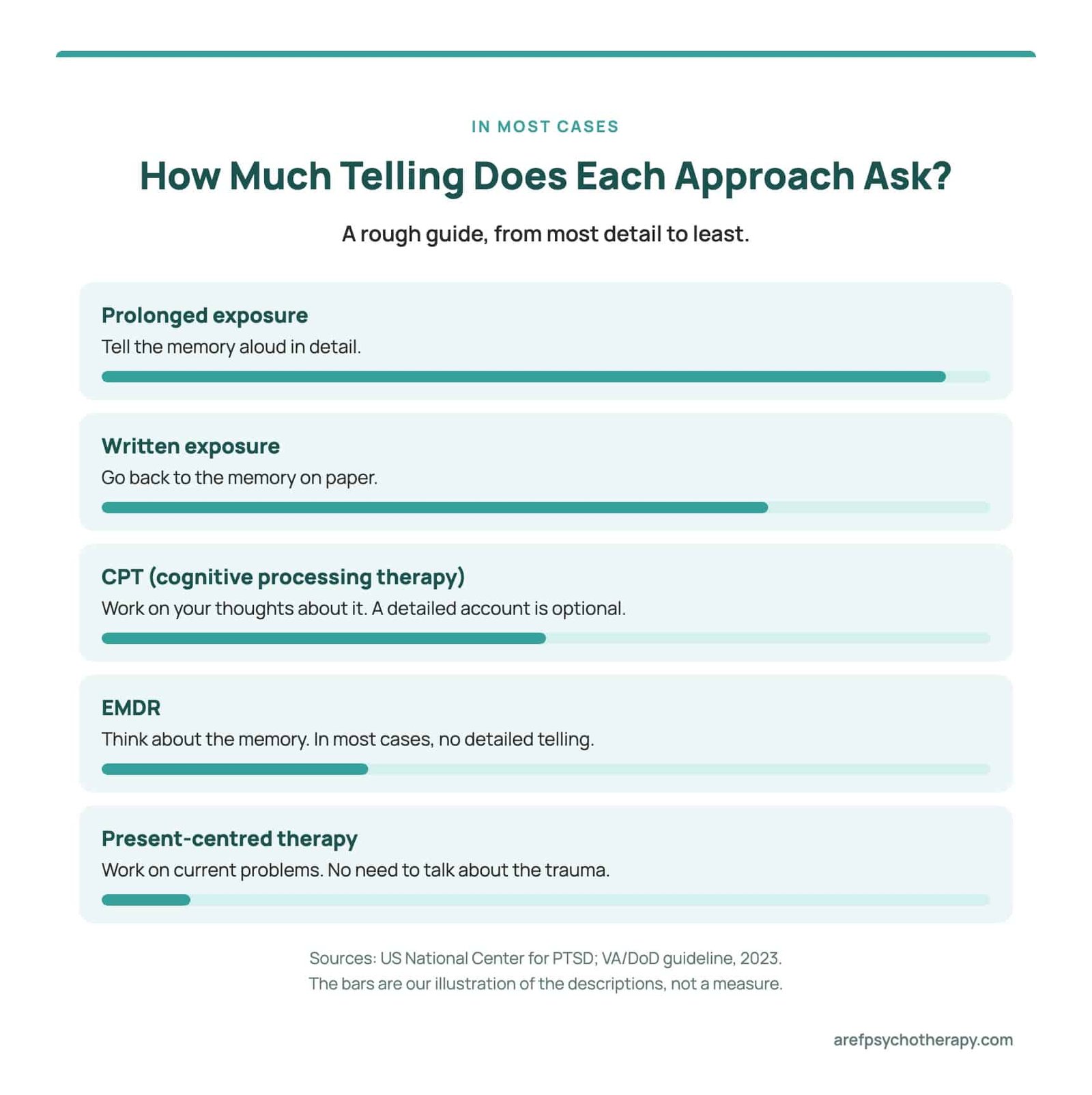
You also keep the right to say no. The College of Registered Psychotherapists of Ontario (CRPO) requires its members to get your consent on an ongoing basis, to seek it again when methods change, and to comply right away if you withhold or withdraw it.
Why go near the memory at all? The US National Center for PTSD explains that avoiding reminders can help in the moment but gets in the way of recovery from PTSD.
How trauma therapy works without a blow-by-blow
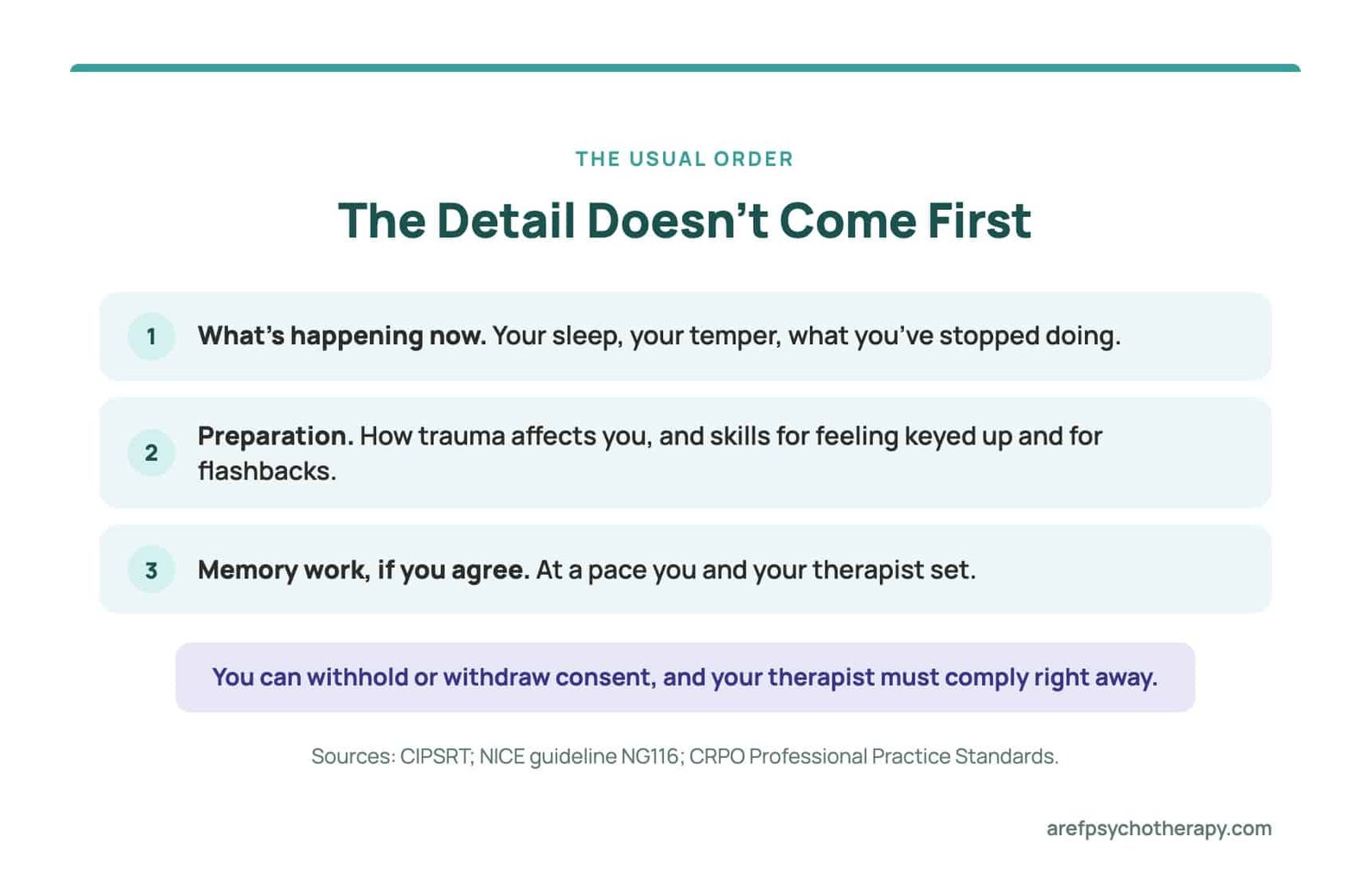
Early sessions tend to be about what’s happening now: your sleep, your temper, what you’ve stopped doing. The Canadian Institute for Public Safety Research and Treatment (CIPSRT) says in its guide to finding a clinician that clinicians typically let you go at your own pace and can help guide a first session.
Preparation comes next. The UK’s NICE guideline on PTSD says trauma-focused cognitive behavioural therapy (CBT) for adults should cover reactions to trauma and how to manage feeling keyed up and having flashbacks. It says EMDR should be done in stages and teach self-calming skills. You should have tools in hand before the memory work starts.
Guidelines back this work, though they don’t fully agree:
- The US VA/DoD guideline (2023) recommends CPT, EMDR and prolonged exposure.
- The American Psychological Association guideline (2025) makes CPT, prolonged exposure and trauma-focused CBT its first choices, and EMDR a second-line choice.
- NICE says to offer trauma-focused CBT, and EMDR for non-combat trauma after three months.
- The International Society for Traumatic Stress Studies guidelines, summarized here, gave CPT, EMDR and prolonged exposure, among others, their strongest recommendation.
“Trauma-focused CBT” is a broad family that can include telling the memory aloud, so ask what a therapist means by it.
None of these guidelines was written for first responders, so read them as a starting point. They’re also about PTSD. A Registered Psychotherapist can’t give that diagnosis, and you don’t need to be sure of the word before you ask these questions.
Would you rather ask a person? AREF’s free consultation is a 15-minute phone call with the intake team, and you can use it to ask who you’d be matched with.
What each approach asks of you
- Prolonged exposure. What you do with the memory: Tell it aloud in detail each session, from about session 3. Between sessions: Listen to a recording, and face avoided situations step by step. Typical course: 8 to 15 weekly sessions.
- CPT. What you do with the memory: Write and talk about your thoughts on it. A detailed account is optional. Between sessions: Worksheets and writing. Typical course: About 12 weekly sessions.
- EMDR. What you do with the memory: Hold it in mind in short sets. In most cases, no detailed telling. Between sessions: No homework. Typical course: About 3 months, weekly.
- Written exposure. What you do with the memory: Write about it in session, about 30 minutes at a time. Between sessions: None. Typical course: 5 weekly sessions.
- Present-centred. What you do with the memory: Work on current problems. No need to talk about the trauma. Between sessions: Ask your therapist. Typical course: 10 to 12 weekly sessions.
These figures come from US guidance and one trial. Your course may differ.
Prolonged exposure: yes, in detail
In prolonged exposure, you start around the third session to talk through the trauma in detail. Your therapist guides you, tracks your anxiety and keeps you at your own pace. That part is recorded so you can listen between sessions, so ask where the recording is kept and who can reach it. You also work through a list of safe situations you’ve been avoiding.
CPT: the full story is optional
Cognitive processing therapy looks at what the event made you believe, such as “it was my fault”. You write and talk about those thoughts, and what happened often comes up along the way, but you won’t need great detail right away. Around the third session you can choose, with your therapist, to write a detailed account and read it aloud.
The VA/DoD guideline notes that one study pulled CPT apart and found no significant difference by the end of treatment in PTSD symptoms rated by a clinician, so the written account became optional.
EMDR: less telling, not less feeling
EMDR stands for Eye Movement Desensitization and Reprocessing. You bring the memory to mind while following a back-and-forth movement or sound for about 30 seconds at a time, then say what came up. The National Center for PTSD says that in most cases you won’t be asked to talk about the details, but you will be asked to think about the trauma. The American Psychological Association adds that it doesn’t include detailed descriptions or homework.
You still pick out the memory with your therapist, and it can still be uncomfortable. AREF’s EMDR therapy page has more.
Written exposure and present-centred therapy
The VA/DoD guideline suggests these two, a weaker rating than a recommendation. In a trial of 169 US service members, people wrote about their trauma for 30 minutes per session, then had a brief check-in. Five sessions held up against 12 sessions of CPT. That’s a military sample, so it may not carry over to your work.
Present-centred therapy doesn’t require talking about the trauma, and the guideline notes lower dropout. It also notes a review that found a small edge for trauma-focused therapy. That trade-off is yours to weigh.
Can a therapist handle what you’ve seen?
It’s a fair worry. Researchers interviewed 24 Ottawa firefighters, paramedics and police. Some described, first-hand or through colleagues, leaving a session feeling they had harmed the clinician by telling the story. All of them said specialized clinicians need to know the work. It’s a small study in one city, so it can’t say how often this happens, but the fear isn’t made up.
A website can’t settle this for you, and that includes ours. What you can do is ask and watch:
- Ask about experience. CIPSRT suggests asking whether they’ve worked with public safety personnel and what they can tell you about it.
- Ask about training. The VA/DoD guideline says CPT, EMDR and prolonged exposure all need therapist training and supervision.
- Ask how they deal with hard stories. A specific answer tells you more than “I can handle anything”.
- Start with a smaller call. See how they take it before you hand them a bigger one.
- Notice how they take your language. Some people in the Ottawa study wanted clinicians who know the lingo and see dark humour as a way of coping.
- Notice who is looking after whom. If you catch yourself softening details to protect them, say so or act on it.
Put the same questions to AREF’s therapists.
It went badly last time
Stopping partway is common. In pooled data from 25 trials of trauma-focused CBT, 221 of 823 people (27%) dropped out. In interviews with 20 RCMP members, a small study, those who had a bad experience described long delays or refusing further help.
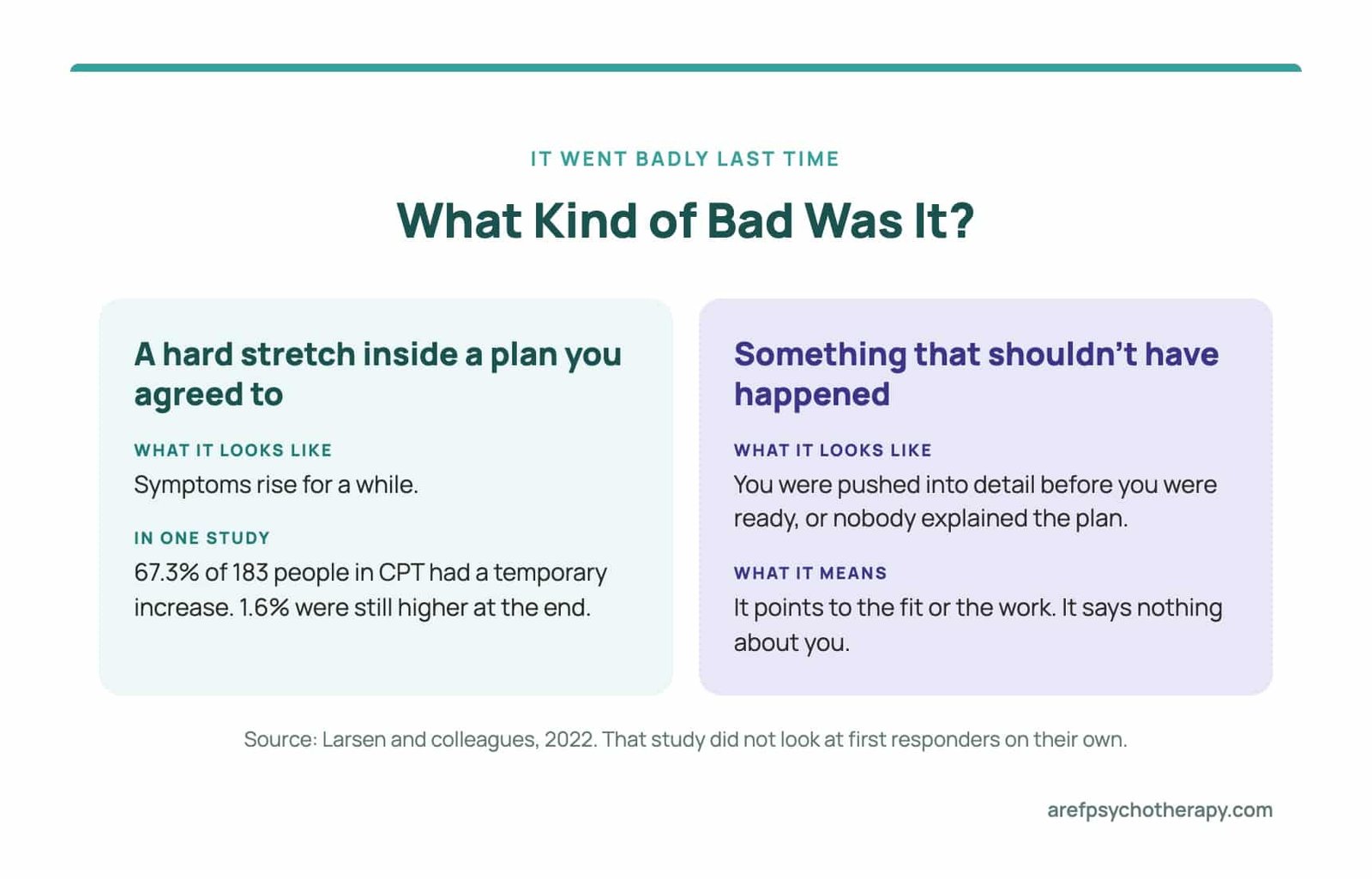
It helps to work out what kind of bad it was.
A hard stretch inside a plan you agreed to. Symptoms can rise for a while. In one study of 183 people in CPT, 67.3% had at least one temporary increase and 1.6% were still higher at the end. A review of nine interview studies found many people felt high distress and thought about quitting, but only a minority did. Neither study looked at first responders on their own.
Something that shouldn’t have happened. You were pushed into detail before you were ready. Nobody gave you skills first or explained the plan. The therapist reacted badly or didn’t know the job. That points to the fit or the work, and it says nothing about you. CIPSRT says it sometimes takes one or two tries to find the right person.
Trying again doesn’t have to mean the same thing again. You can change the approach, the pace or the person.
Questions to ask before you try again
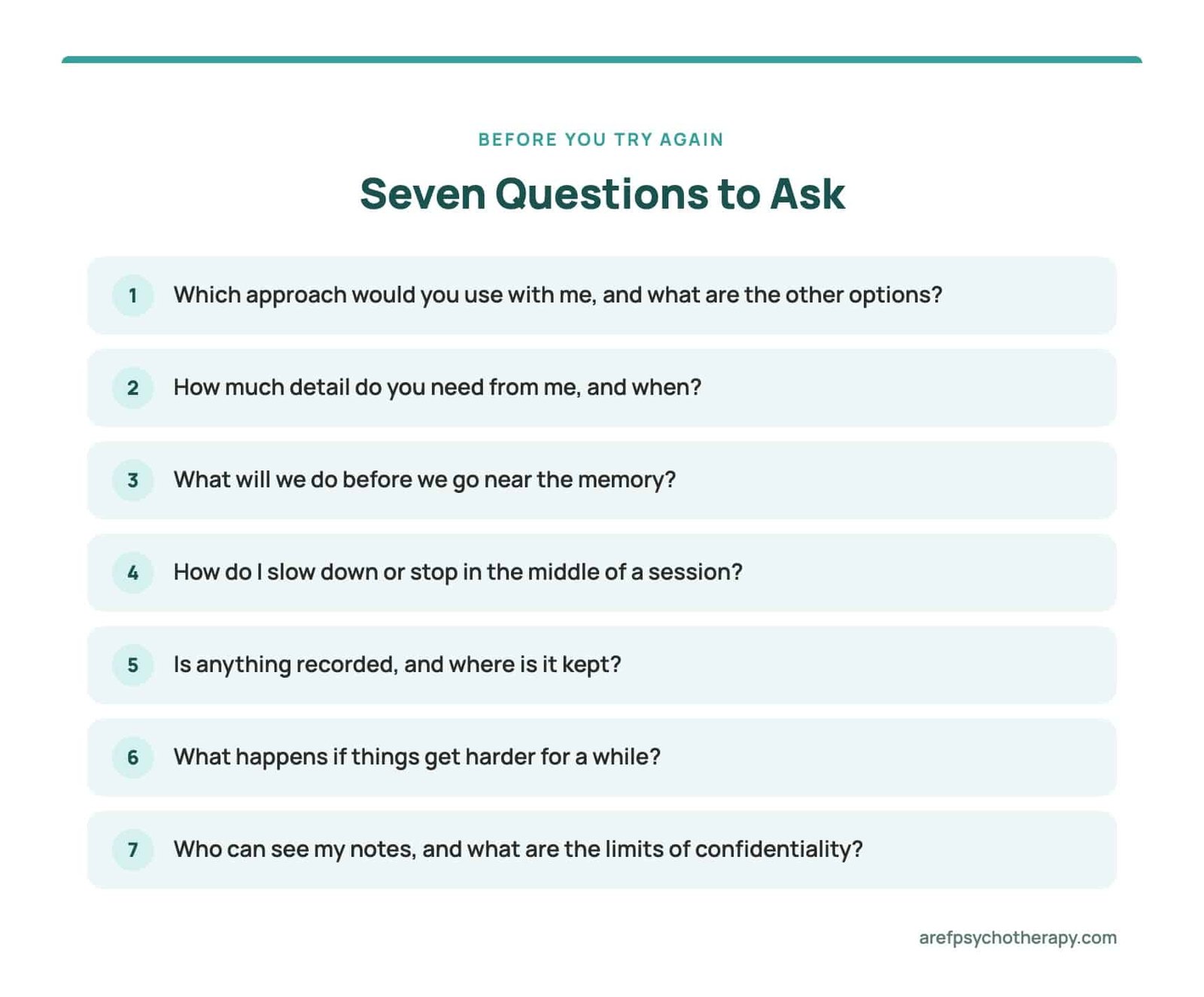
- Which approach would you use with me, and what are the other options?
- How much detail do you need from me, and when?
- What will we do before we go near the memory?
- How do I slow down or stop in the middle of a session?
- Is anything recorded, and where is it kept?
- What happens if things get harder for a while?
- Who can see my notes, and what are the limits of confidentiality?
On that last one, privacy depends on how you pay, and limits exist. A therapist must explain them before you start. If you have a WSIB claim, your employer knows there is a claim.
Key Takeaways
- Some trauma therapies ask you to retell the memory in detail, and others ask for much less.
- Preparation usually comes before the detail.
- EMDR involves less telling, but you still hold the memory in mind.
- A bad experience last time doesn’t decide what happens next.
Frequently Asked Questions
Do I have to talk about my worst call in the first session?
Usually not. Your therapist may ask what kind of event it was, and the National Center for PTSD says that in CPT you won't need to go into great detail right away. In prolonged exposure, detailed talk starts around the third session. You can say early on that you aren't ready.
Is EMDR easier because you don't have to talk about it?
Less talking isn't the same as easier. In EMDR you still bring the memory to mind, along with the thoughts and body feelings that come with it, and you may feel uncomfortable while you do. The National Center for PTSD says those feelings are usually brief. Guidelines also rate it differently from each other.
My therapist cried when I told them about a call. Did I do something wrong?
No. Telling it is what you came to do. A therapist can be moved by a story and still stay steady for you. What matters is whether you ended up looking after them. You can tell them how it landed and see how they respond. If you left feeling you had hurt them, you're allowed to look for someone else.
I have dozens of bad calls. Do we go through all of them?
Not necessarily. You and your therapist usually pick where to start. The American Psychological Association describes CPT's written account as focused on the worst event, and EMDR as working from memories and triggers you identify together. NICE says multiple traumas may need more sessions. If it was never one call, or the hardest part was the job itself, tell your therapist that early.
Can trauma therapy be done online?
Yes, in many cases. The VA/DoD guideline recommends secure video for therapies validated that way, and it found CPT and prolonged exposure by video were not inferior to in-person care. A Canadian scoping review that included public safety personnel called the evidence promising but urged caution. Plan for a private room and some time to settle afterwards.
Ready to Ask These Questions?
You don’t have to decide today how much you’ll ever say. AREF’s Registered Psychotherapists work online with people in Ontario. Read more about first responder therapy at AREF, or take the next step here.
If you need someone right now: call or text 9-8-8, Canada’s Suicide Crisis Helpline, any time of day. For anonymous peer support from other first responders in Ontario, call Boots on the Ground at 1-833-677-2668, 24/7. If your safety is at risk, call 9-1-1.
This article is for informational purposes only and does not replace professional mental health advice. If you’re in crisis, please contact Canada’s 9-8-8 Suicide Crisis Helpline by calling or texting 9-8-8.
Sources
Clinical guidelines
- VA/DoD Clinical Practice Guideline for the Management of PTSD and Acute Stress Disorder (2023)
- APA Clinical Practice Guideline for the Treatment of PTSD in Adults (2025)
- NICE guideline NG116, Post-traumatic stress disorder (2018), Recommendations
- Bisson JI, Olff M. Prevention and treatment of PTSD: the current evidence base. Eur J Psychotraumatol. 2021 (on the ISTSS guidelines)
How each therapy works
- National Center for PTSD: Prolonged Exposure, Cognitive Processing Therapy, EMDR
- American Psychological Association: EMDR Therapy, Cognitive Processing Therapy
Research
- Sloan DM, et al. Written exposure therapy vs cognitive processing therapy among military service members. JAMA Netw Open. 2022
- Testa V, et al. Police, fire and paramedic preferences for accessing mental health care. Health Promot Chronic Dis Prev Can. 2023
- Burns C, Buchanan M. Factors that influence the decision to seek help in a police population. Int J Environ Res Public Health. 2020
- Wright S, et al. Predictors of study dropout in cognitive-behavioural therapy with a trauma focus. BMJ Ment Health. 2024
- Larsen SE, et al. Temporary PTSD symptom increases among individuals receiving CPT. Psychol Trauma. 2020
- Gjerstad SF, et al. How is trauma-focused therapy experienced by adults with PTSD? BMC Psychol. 2024
- Jones C, et al. Virtual trauma-focused therapy for military members, veterans and public safety personnel. JMIR Mhealth Uhealth. 2020
Canadian bodies and support
- CIPSRT: Six Steps to Finding a Clinician
- College of Registered Psychotherapists of Ontario: Professional Practice Standards, Professional Practice and Jurisprudence manual
- 9-8-8 Suicide Crisis Helpline
- Boots on the Ground