
Reviewed by the AREF Psychotherapy team
They come home from the job and don’t really arrive. They sleep badly, snap over small things, or go quiet for days. You’ve said something, and they told you they’re fine. Maybe you typed “my husband refuses therapy” into your phone at 2 a.m., or the same words about your wife, your partner or your son.
Here is the plain answer. You can’t make an adult go to therapy, and we won’t pretend you can. You can say what you see at a good moment, make the first step small, and get support for yourself whether they ever go or not. You deserve that for your own sake.
This page is for you. We’d suggest not forwarding it, because an article from a worried partner can land as pressure. Our page on first responder therapy in Ontario covers how sessions and payment work.
If anyone is in danger right now, call 9-1-1. If you’re worried about suicide, call or text 9-8-8, any hour. If you’re afraid for anyone’s safety, go straight to “If you’re afraid for their safety, or yours” near the end.
Much of the research comes from wives of men in police, fire and paramedic work, so it may not always sound like you.
What you’re seeing at home
Families often notice first. In an Australian study of 25 family members of veterans and emergency responders, emotional distance and anger were common first signs (Lawn and colleagues, 2022). Canadian-led reviews describe much the same (Cox and colleagues, 2022; Richmond and colleagues, 2024):
- Here, but not here. They’re in the room but withdrawn.
- A short fuse. Anger and irritability come home after a hard shift.
- Always on guard. Watchfulness from work turns into overprotecting at home.
- The closed door. They won’t talk about the job, and some hold back to protect you.
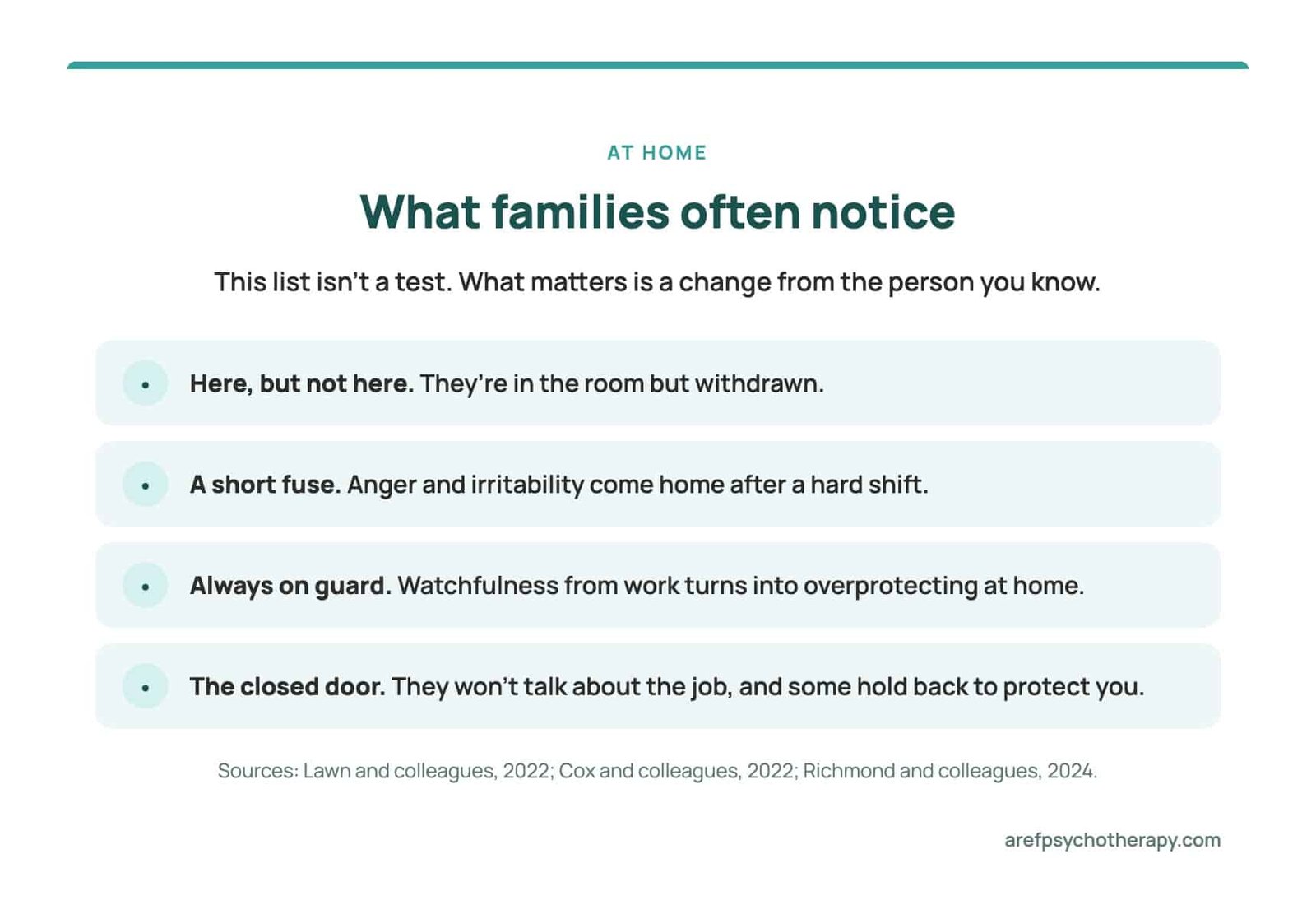
This list isn’t a test, and shift work alone explains some of it. What matters is a change from the person you know.
Why pushing often backfires
If you’ve pushed, it’s because you care and you’re the one living with it.
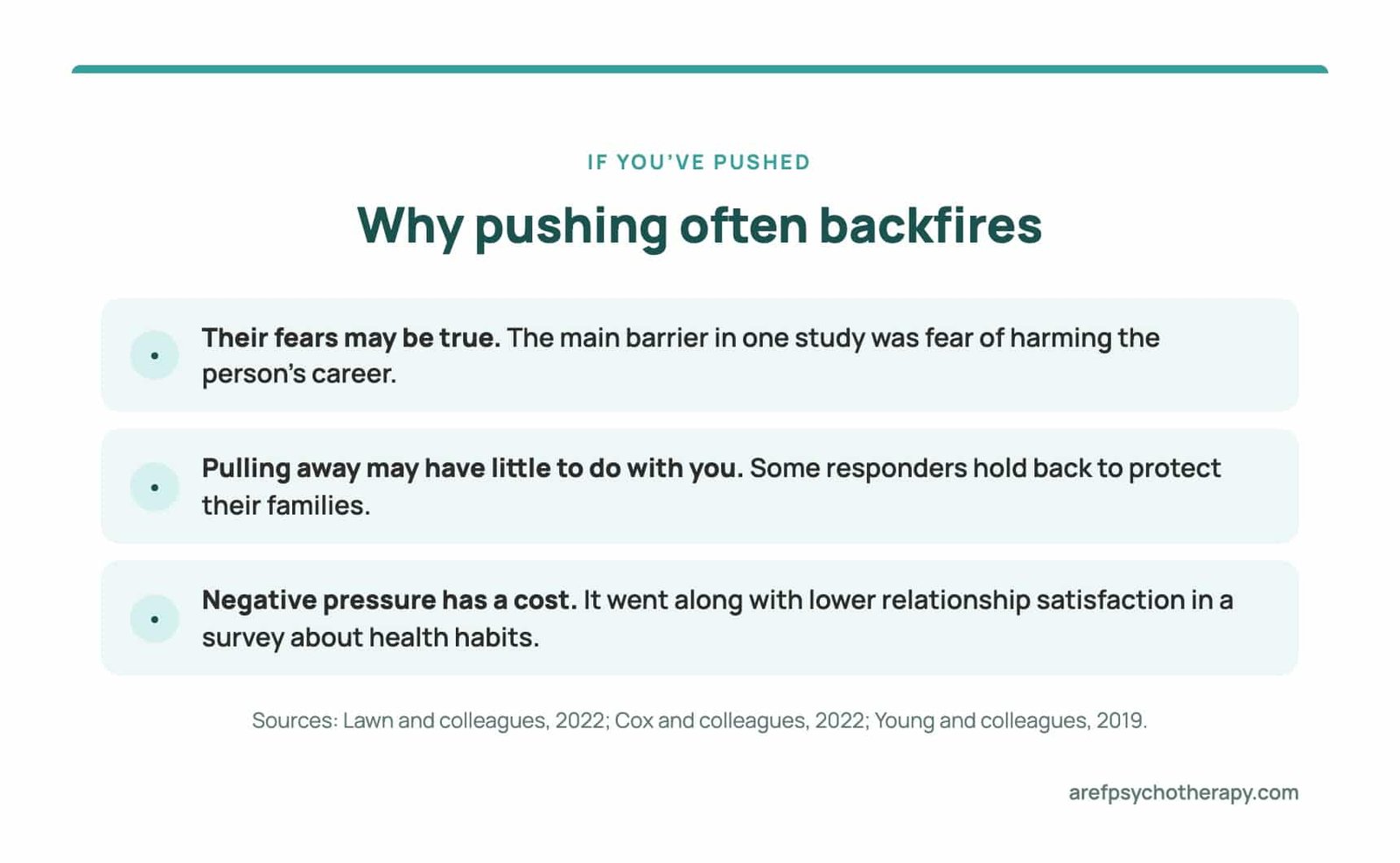
Their fears may be true. In the Australian study, the main barrier was fear of harming the person’s career. In a Canadian survey of emergency communicators, people named fears for their families, finances and careers (Howe and colleagues, 2025). So “nobody will care” can tell them you don’t see the risk.
Pulling away may have little to do with you. Some responders hold back to protect their families. The US National Center for PTSD also notes that withdrawal can be a symptom of PTSD. That doesn’t mean your partner has PTSD.
Negative pressure has a cost. In a survey of couples about everyday health habits, negative attempts to influence a partner went along with lower relationship satisfaction (Young and colleagues, 2019). That study wasn’t about therapy, so treat it as a clue.
Speaking plainly is different from pushing. In a small study of 20 RCMP officers in British Columbia, 15 said they would not have received help when they did without a trusted, respected person stepping in. That ranged from gentle suggestions to very blunt talk (Burns and Buchanan, 2020). Our own reading, which no study has tested, is that honest words from someone they trust land differently from the same demand made for the tenth time.
This can take a long time. In the Australian study, many families could only convince the person once things reached a crisis point. If months have gone by, that doesn’t mean you’ve done it wrong.
What to say, and when
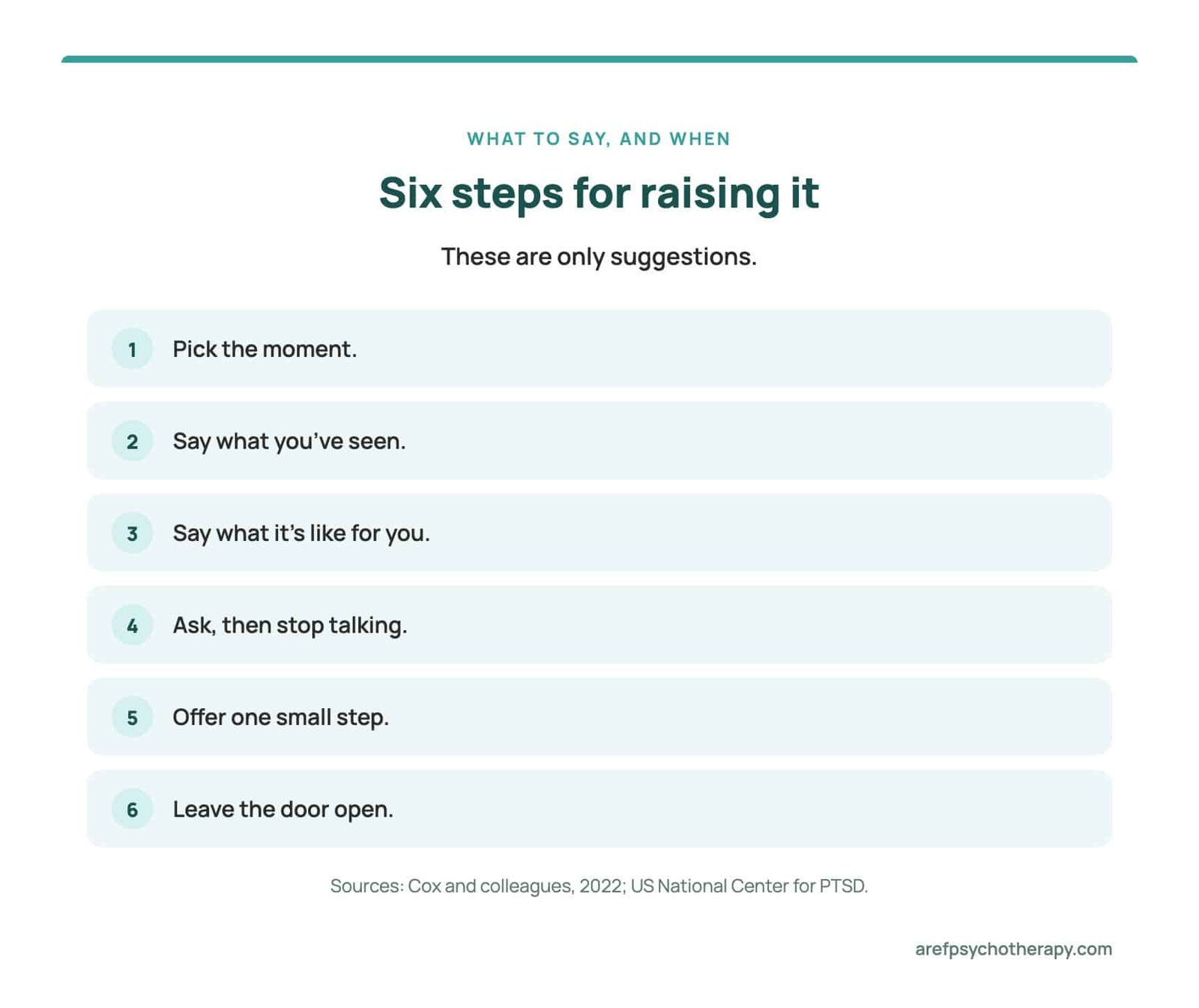
These lines are only suggestions, so make them sound like you.
- Pick the moment. Not at the door. Families in the Canadian review described giving their person space after a shift. Try a day off.
- Say what you’ve seen. Name what happened, not what’s wrong with them. “You’ve been up most nights this month, and you’ve stopped seeing your brother.”
- Say what it’s like for you. “I’m worried, and I miss you.”
- Ask, then stop talking. “What’s it like from your side?” The National Center for PTSD advises listening without arguing, and holding back advice unless you’re asked.
- Offer one small step. “Would you talk to someone who’s done the job?” is smaller than “you need therapy.” Boots on the Ground, at 1-833-677-2668, is an anonymous Ontario helpline where first responders talk to other first responders. They say plainly that they aren’t therapists.
- Leave the door open. “You don’t have to tell me about the calls. I’d just like you to have someone to tell.”
If the answer is no, stop there for now. You can say you’ll be ready to listen when the time is right.
Someone else may be the better messenger. In the RCMP study, the trusted people included family, friends and supervisors. A sibling or a retired member may get further than you can.
You’re allowed to say what you can’t keep living with. Say only what’s true and what you’re prepared to do. If you’re afraid of how they’d react, talk to a helpline first.
If they agree to one small step, a free consultation with our intake team is a 15-minute phone call with no obligation. You can use it for yourself too. AREF’s sessions are online, for people in Ontario.
What you can’t do for them
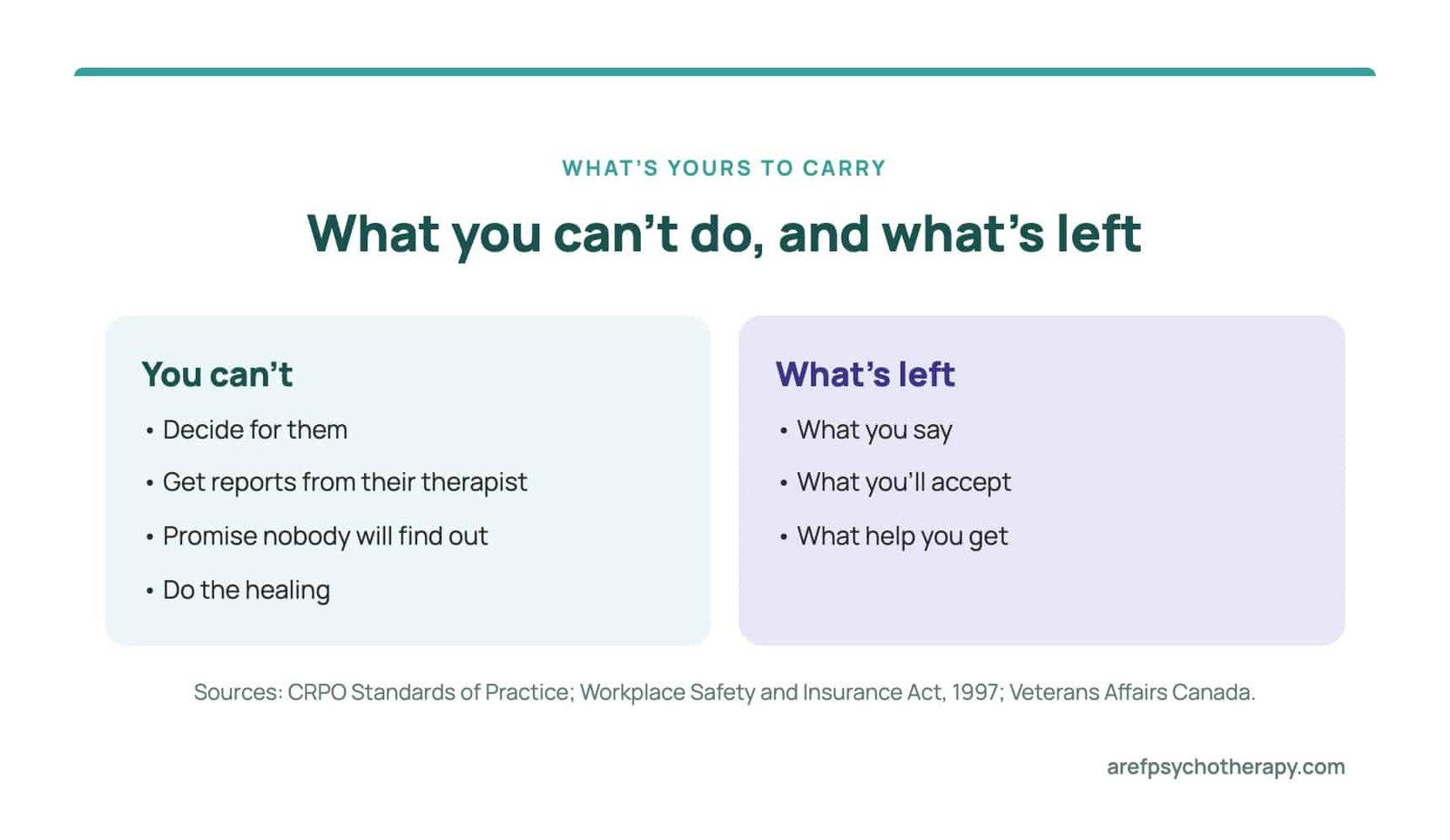
- You can’t decide for them. A Registered Psychotherapist must get a client’s informed consent before working with them, under the College of Registered Psychotherapists of Ontario’s standards.
- You can’t get reports from their therapist. A therapist normally needs their consent to share anything with you.
- You can’t promise nobody will find out. Please don’t say it to win the argument. Who can find out depends on how they pay. On a WSIB claim, the employer knows there is a claim (Ontario’s Workplace Safety and Insurance Act), and other limits exist that a therapist must explain.
- You can’t do the healing. Veterans Affairs Canada’s advice to families fits here too: you can help, but recovery isn’t something you can do for your partner.
What’s left is your own choices: what you say, what you’ll accept, and what help you get.
Who you can call if you’re worried
These are for when you’re worried but nobody is in danger.
- Warrior Health is a provincially funded, anonymous online portal with resources for public safety personnel and their families in Ontario. Its support line is 1-833-866-9929. It doesn’t connect you directly with a clinician.
- ConnexOntario, at 1-866-531-2600, is a free 24/7 line connecting people in Ontario with mental health and addiction services.
- An association or union program. Ask what exists for your partner’s service. In 2021 the OPP Association said family could call its Encompas program (1-866-794-9117) on behalf of a reluctant member.
Not every call helps. The Ontario Ombudsman’s 2012 report describes an officer’s wife who called with concerns and was told nothing could be done because nothing bad had happened. If one door closes, try the next.
Think hard before contacting your partner’s supervisor yourself. In the RCMP study, some supervisors were caring and confidential, and others were openly critical and broke confidences. If someone’s life may be at risk, that changes things, so go to the safety section below.
If you’re worried about family services
One call-taker in the communicators survey named family services as a reason people hide a mental health problem. We can’t say it could never happen. Under Ontario’s rules, everyone, therapists included, must report to a children’s aid society if they have reasonable grounds to suspect a child is or may be in need of protection. That overrides a therapist’s confidentiality. A society worker then assesses the risk and decides whether an investigation is needed.
A therapist should go through limits like this before you start, so ask. This is general information, not legal advice.
Getting support for yourself
You don’t need your partner to agree first. Canadian researchers describe spouses of public safety personnel carrying chronic stress from the job’s risks and the support they give (Hadjistavropoulos and colleagues, 2023). That is reason enough.
- PSPNET Families is a Canadian website for public safety families, with a section for when you’re unsure how to help. Its Spouse or Significant Other Wellbeing Course is self-guided and online, five lessons over eight weeks, with no therapist. In an early evaluation, 23 of the 26 people interviewed believed it was helpful. That is small, early evidence.
- Badge of Life Canada runs a weekly Zoom peer group for families of public safety personnel, on Wednesday evenings, at no cost.
- A therapist of your own. You can see a Registered Psychotherapist about your own stress or decisions, even if your partner never goes. If they’d do something together but not alone, couples therapy is another door. It isn’t the place to start if you’re afraid of them.
If you’re afraid for their safety, or yours
You don’t have to be certain before you call.
If someone is in danger now, call 9-1-1. Tell them what is happening. Ontario’s advice is not to hang up, even if you can’t speak.
If you’re worried about suicide, call or text 9-8-8, any time. The 9-8-8 Suicide Crisis Helpline is also for people worried about someone in their lives. It says it’s better to ask directly whether they’re thinking about suicide, and that they will likely be relieved you brought it up. If you think their life may be at risk, call 9-1-1 right away.
If you’re afraid of your partner, that matters on its own. An injury doesn’t make abuse okay. Abuse can be physical, and it can also be threats, psychological abuse or control of money. It can happen to anyone. Ontario’s helplines are free, confidential and open 24 hours, and can help with a safety plan:
- Assaulted Women’s Helpline: 1-866-863-0511, or #SAFE (#7233) on Bell, Rogers, Fido and Telus mobiles. TTY 1-866-863-7868. For women and their dependents, in more than 200 languages.
- Fem’aide, for women in French: 1-877-336-2433.
- Talk4Healing, for Indigenous women and their families: 1-855-554-4325.
- Victim Support Line, with information and referrals for victims of crime and their families: 1-888-579-2888.
- 211 Ontario, for local services: call 211.
Ontario’s Neighbours, Friends and Families campaign says the danger may be greater if a partner has access to weapons, has threatened to harm or kill you, has threatened your children, or has threatened to kill themselves. If any of that is true, say so when you call, and mention any firearm in the home.
If your partner works in policing, calling the police may feel complicated. In immediate danger, call 9-1-1 anyway. If there is no immediate danger, a helpline can talk through your options with you.
If someone checks your phone or computer, use a device they can’t see. The Assaulted Women’s Helpline warns that computers can be monitored and that tracks can’t be fully cleared.
Key takeaways
- You can’t make an adult go to therapy. You can say what you see and offer one small step.
- Your partner’s fears about work may be true.
- You can get support for yourself whether or not they ever go.
- If you’re afraid for anyone’s safety, you don’t need to be sure before you call.
Frequently asked questions
Can I make my husband go to therapy?
No. Whether it's a husband, wife or partner, an adult has to agree to therapy themselves, and a therapist needs their informed consent. You can say what you've seen and offer one small step. If you're worried about safety, use 9-1-1 or 9-8-8.
Should I tell their supervisor or service?
Think hard first, and talk to your partner if you can. Some supervisors are caring and confidential, and others aren't. Your partner may feel betrayed. A therapist of your own can help you think it through. If you believe someone's life is at risk, call 9-1-1 or 9-8-8.
If they go to therapy, will the therapist tell me what they said?
Normally, no. A therapist needs your partner's consent to share their information with you, apart from limits set by law. Your partner can choose to tell you, and that is up to them. You might find it easier to ask how they're doing than what they said.
Can I go to therapy if my partner won't?
Yes. You can see a Registered Psychotherapist for your own sake, whether or not your partner ever goes. You might talk about your stress, what you can live with, or how to raise hard things at home. You don't need to wait for a crisis.
I'm their parent or adult child. Does this apply to me?
Most of it does. Families in the research included mothers and adult children. The steps stay the same: say what you've seen, offer one small step and look after your own support. A spouse course may not fit, but a family group or a therapist of your own can.
Support for you, and a door for them
AREF Psychotherapy is a private clinic. Our team includes Registered Psychotherapists (RPs), who are regulated by the College of Registered Psychotherapists of Ontario (CRPO). You can read more about how first responder therapy works with us, including the ways to pay.
You can start with a free 15-minute phone consultation, for you or for them. Call us at (437) 830-2088, or book online.
If you need help right now
If you or your partner are thinking about suicide, call or text 9-8-8, the 9-8-8 Suicide Crisis Helpline, 24 hours a day. First responders in Ontario can also call Boots on the Ground at 1-833-677-2668, 24/7, for anonymous peer support. If anyone’s safety is at risk right now, call 9-1-1.
This article is for informational purposes only and does not replace professional mental health advice. If you’re in crisis, please contact Canada’s 9-8-8 Suicide Crisis Helpline by calling or texting 9-8-8.
Sources and further reading
Research
- Lawn S, Waddell E, Rikkers W, et al. Families’ experiences of supporting Australian veterans and emergency service first responders (ESFRs) to seek help for mental health problems. Health & Social Care in the Community, 2022. doi:10.1111/hsc.13856.
- Cox M, Norris D, Cramm H, Richmond R, Anderson GS. Public safety personnel family resilience: a narrative review. International Journal of Environmental Research and Public Health, 2022. doi:10.3390/ijerph19095224.
- Richmond R, Ricciardelli R, Dekel R, et al. Exploring the occupational lifestyle experiences of the families of public safety personnel. Journal of Occupational Rehabilitation, 2024. doi:10.1007/s10926-024-10179-x.
- Howe E, Czarnuch S, Ricciardelli R, Leduc N. Exploring Canadian public safety communicator mental health help-seeking behaviors. NEW SOLUTIONS, 2025.
- Young VJ, Burke TJ, Curran MA. Interpersonal effects of health-related social control. Journal of Social and Personal Relationships, 2019.
- Burns C, Buchanan M. Factors that influence the decision to seek help in a police population. International Journal of Environmental Research and Public Health, 2020. doi:10.3390/ijerph17186891.
- Hadjistavropoulos HD, Reiser SJ, Beahm JD, et al. Internet-delivered cognitive behavioral therapy tailored to spouses and significant others of public safety personnel. JMIR Formative Research, 2023. doi:10.2196/51088.
Government, regulators and public bodies
- “In the Line of Duty”, Ombudsman of Ontario, October 2012
- Standards of Practice, College of Registered Psychotherapists of Ontario (CRPO)
- Workplace Safety and Insurance Act, 1997, Government of Ontario
- Report child abuse and neglect, Government of Ontario
- Violence in the family, Government of Ontario
- Connect with supports for survivors of violence, Government of Ontario
- Support for families and caregivers, Veterans Affairs Canada
- Helping a family member who has PTSD, US National Center for PTSD
- Neighbours, Friends and Families, Centre for Research & Education on Violence Against Women & Children, Western University
Support
- 9-8-8 Suicide Crisis Helpline: call or text 9-8-8
- Boots on the Ground: 1-833-677-2668
- Assaulted Women’s Helpline: 1-866-863-0511
- Victim Support Line: 1-888-579-2888