
Reviewed by the AREF Psychotherapy team
Last checked: November 2026
Someone on your crew has changed. They’ve gone quiet, or they’re short with everyone, and you’ve thought about saying something. You’ve also thought about how it could go wrong.
Maybe you’re their partner, a peer lead, or the sergeant or captain who signs their schedule. If you’ve been wondering how to talk to a coworker about PTSD, or any injury you can’t see, here is the short version. Pick a private moment. Say what you’ve noticed, ask how they’re doing, then mostly listen. Point them toward someone trained and leave the choice with them. Don’t try to fix it, and don’t promise to keep it secret.
If you’re worried about suicide right now, call or text 9-8-8 for advice and go to “When it’s urgent” below.
We are a therapy clinic, not your crew. The wording below is only our suggestion, so change it until it sounds like you. Where this guide touches on the law, it is general information, not legal advice. Our page on first responder therapy in Ontario explains how therapy itself can work.
What you might notice
You aren’t looking for a diagnosis. You’re looking for a change from how this person usually is. A guide from Ontario’s Infrastructure Health & Safety Association and CAMH’s page on PTSD name things you might see, though neither was written for first responders:
- Temper. Getting irritated or angry easily, or sudden mood swings.
- Distance. Pulling back from the crew, family or things they used to enjoy.
- Avoiding. Staying away from places, people or activities that remind them of something.
- Focus. Trouble concentrating or deciding, or doubting themselves.
- Sleep. Looking tired, or mentioning they can’t sleep.
- Drinking or drugs. Using more than usual.
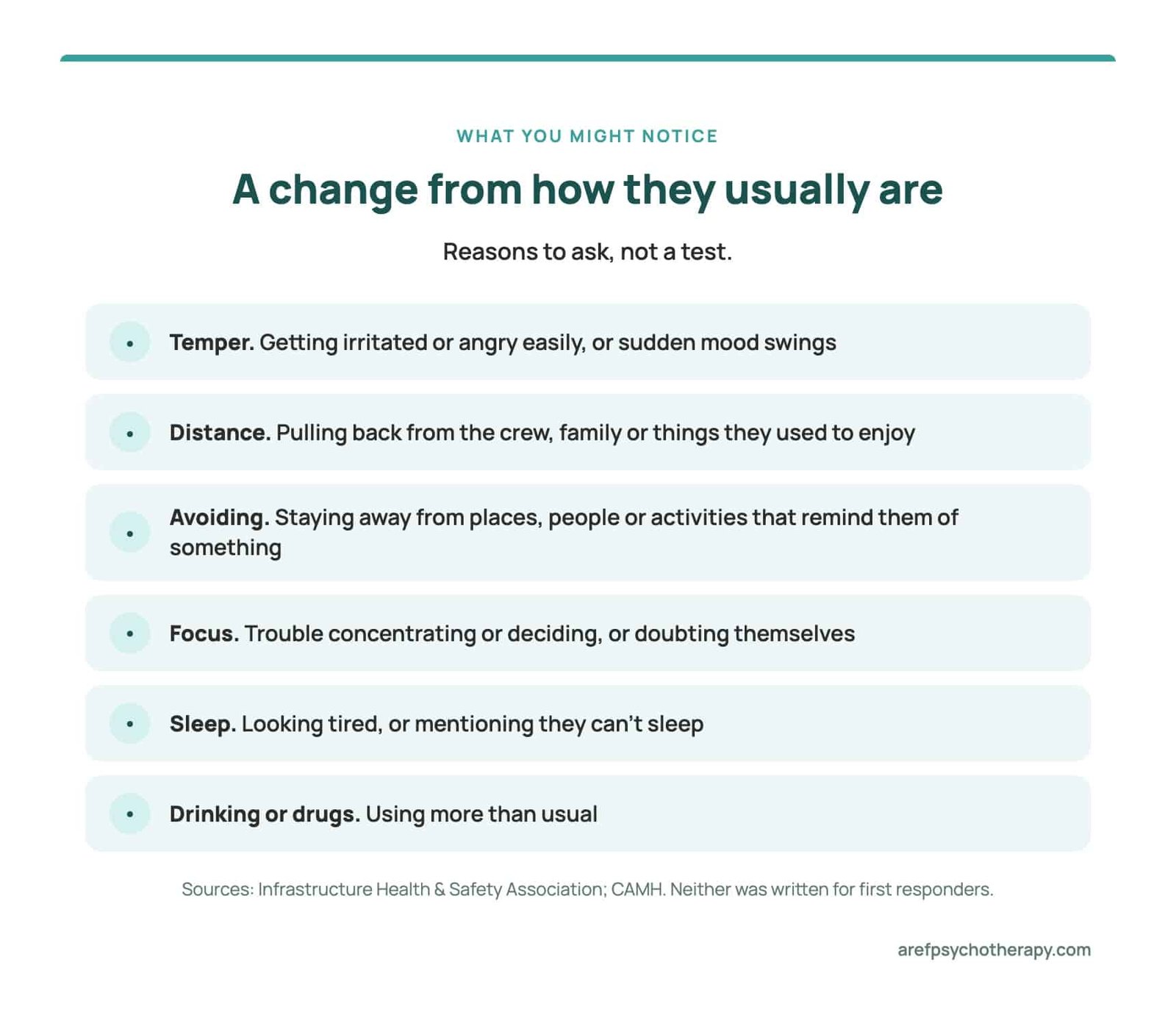
These are reasons to ask, not a test. Some people don’t see it themselves. In a small study of 20 RCMP officers in British Columbia, some were unaware of their own state until someone they trusted pointed it out (Burns and Buchanan, 2020).
How to talk to a coworker about PTSD: words that work, and words that shut it down
Worried you’ll set them off? You have company. Ontario researchers interviewed 33 employer representatives from fire, paramedic, police and corrections services. They said most colleagues and supervisors accept these injuries are real, but are afraid of setting the person off. That is the employers’ view, and the researchers warn this tiptoeing can still isolate someone (Vesely and colleagues, 2026).
Saying something can matter. In the RCMP study, 15 of the 20 officers said they would not have received psychological help when they did without a trusted, respected person stepping in.
So don’t hunt for perfect words. Find a quiet place away from the crew, say what you saw, ask, and stop talking. Our suggested wording, which we wrote and nobody said to us:
- You’ve seemed different the last few weeks. I might have it wrong. How are you doing?
- You don’t have to tell me anything. I just didn’t want to say nothing.
If they wave it off:
- Okay. If that changes, you know where I am.
Then let it go and check in another day. The World Health Organization’s psychological first aid guide, written for helpers after a crisis, says not to be pushy. Someone who refuses help now can still get it later.
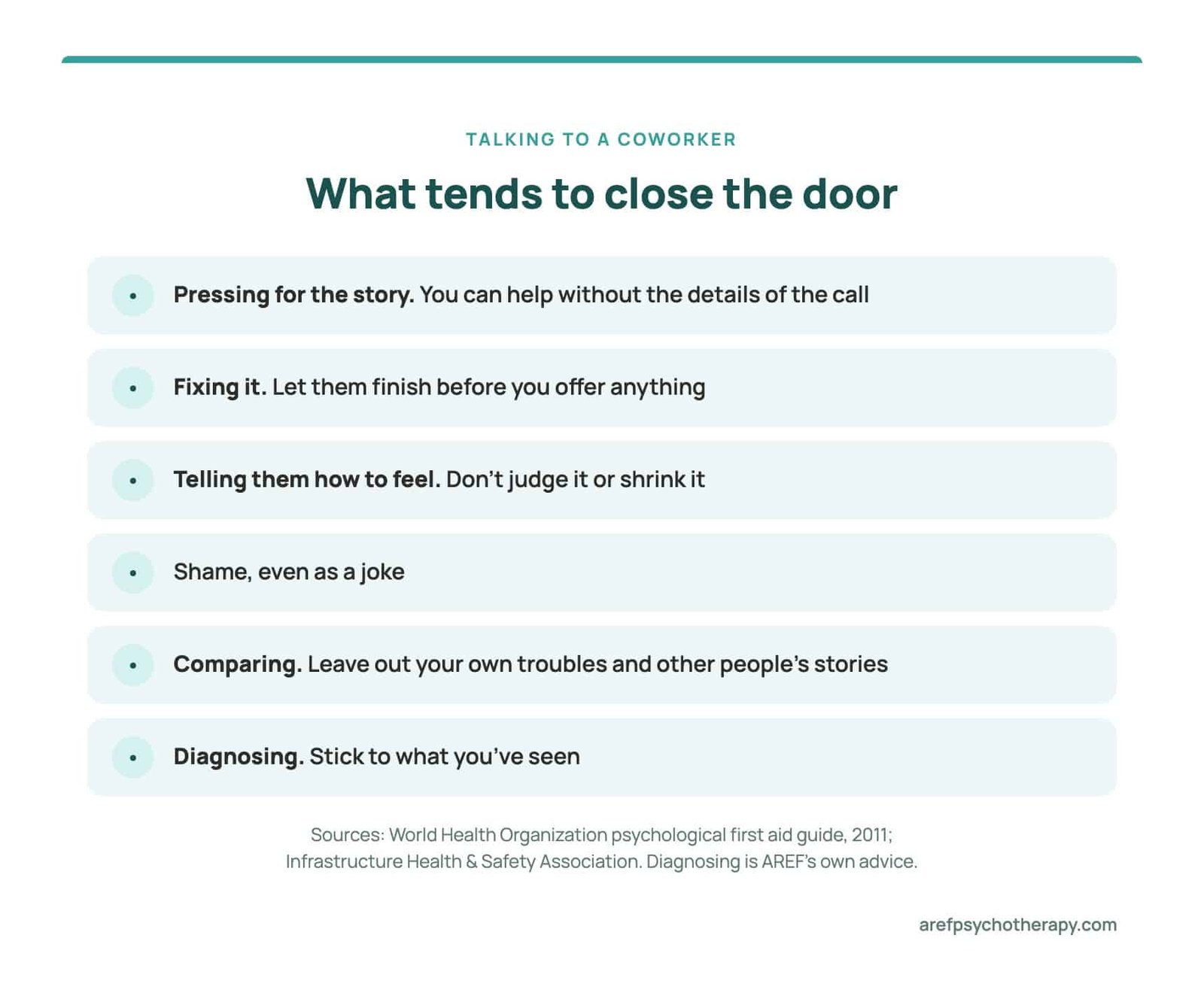
The WHO guide and the Ontario guide warn against most of what tends to close the door:
- Pressing for the story. You can help without the details of the call.
- Fixing it. Let them finish before you offer anything.
- Telling them how to feel. Don’t judge it or shrink it.
- Shame, even as a joke. They’ve heard “suck it up” before.
- Comparing. Leave out your own troubles and other people’s stories.
- Diagnosing. This one is our own advice: stick to what you’ve seen.
“Go talk to someone”: how to say it
Some people hear a threat to their career, and officers in the RCMP study described fearing lost promotions. Talk about what you’ve seen, not what they are. Offer one next step and leave the choice with them. Our suggested wording:
- I think this is a lot for one person to carry. Would you talk to someone who does this for a living?
- I’m not saying you can’t do the job. I’ve noticed a change, and I’d want someone to tell me.
- There’s a phone line run by other first responders. It’s anonymous. Do you want the number?
- If it helps, I’ll sit with you while you make the call.
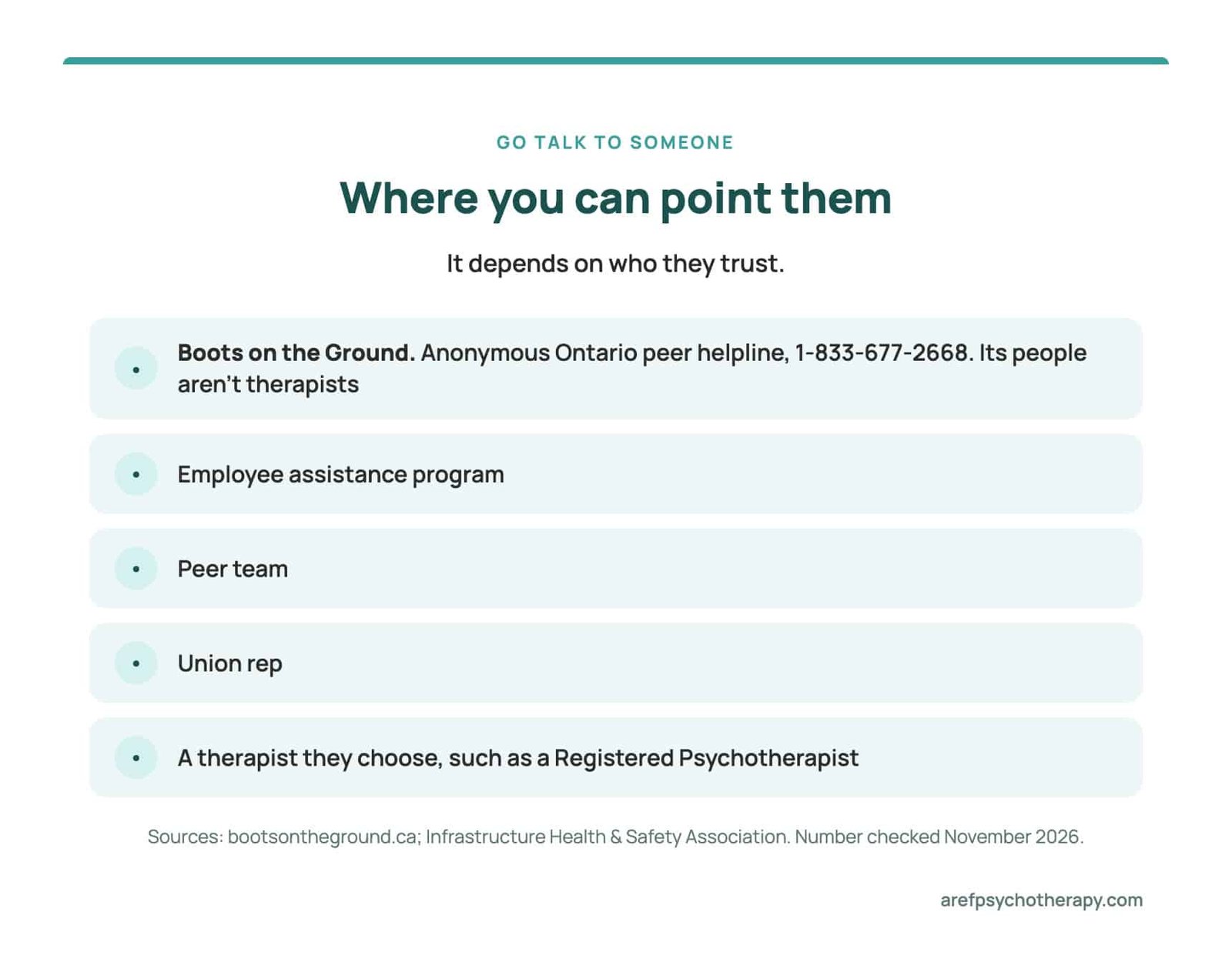
Where you point them depends on who they trust. Boots on the Ground, at 1-833-677-2668, is an anonymous Ontario peer helpline for serving and retired first responders, and it says plainly that its people aren’t therapists. Other routes are an employee assistance program, a peer team, a union rep, or a therapist they choose, such as a Registered Psychotherapist.
If they ask who would find out, don’t guess. It depends on how they get help and how they pay. A therapist regulated by the College of Registered Psychotherapists of Ontario must explain the legal limits of confidentiality.
AREF’s Registered Psychotherapists work online with people in Ontario. Anyone can book a free 15-minute phone consultation with our intake team to ask what gets shared and how payment works.
Someone just told you. Now what?
An order that can help:
- Listen. Put your phone away. Don’t interrupt or rush to fill a pause.
- Take it seriously. Our suggestion: Thanks for telling me. I’m glad you did.
- Be honest about your position. If you can, say what you might have to pass on.
- Ask what they need. How much the crew hears is their decision. Our suggestion: What would help right now?
- Listen for safety. If you’re worried about suicide, ask directly. See “When it’s urgent”.
- Agree on one next step. A number, a name, or a time to talk again.
- Follow up. Keep treating them as the person you worked beside last week, not as their injury.
Don’t pass their story around. This may stay with you too, and 9-8-8 offers advice and support to people supporting someone at risk of suicide.
If you’re their supervisor
In a survey of 4,020 serving Canadian public safety personnel, 67 per cent said they would go to leaders never or only as a last resort (Carleton and colleagues, 2019). If someone comes to you, it probably wasn’t easy. Check these before that talk happens:
- Notice to WSIB. Under Ontario’s Workplace Safety and Insurance Act, an employer must notify WSIB within three days after learning of a work accident that needs health care or stops a worker from earning full wages. WSIB’s policy counts that as three business days. Telling a supervisor may start that clock, even if the person doesn’t want to file a claim. We could not confirm how this works for a mental health injury, so ask HR and your association now.
- What you can ask. The Ontario Human Rights Commission says employers must try to help a person who is clearly unwell, or seems to have a mental health disability, by asking what they need and offering assistance. You aren’t expected to diagnose anyone. Generally, you have no right to know their diagnosis, symptoms or treatment unless these clearly relate to the accommodation. Ask what they need at work, not what’s wrong.
If someone starts to open up, you can pause them. Our suggestion: Before you say more, you should know I’m a supervisor and I may have to pass some things on. You can talk to your rep first if you’d rather. I still want to help.
What you can and can’t promise
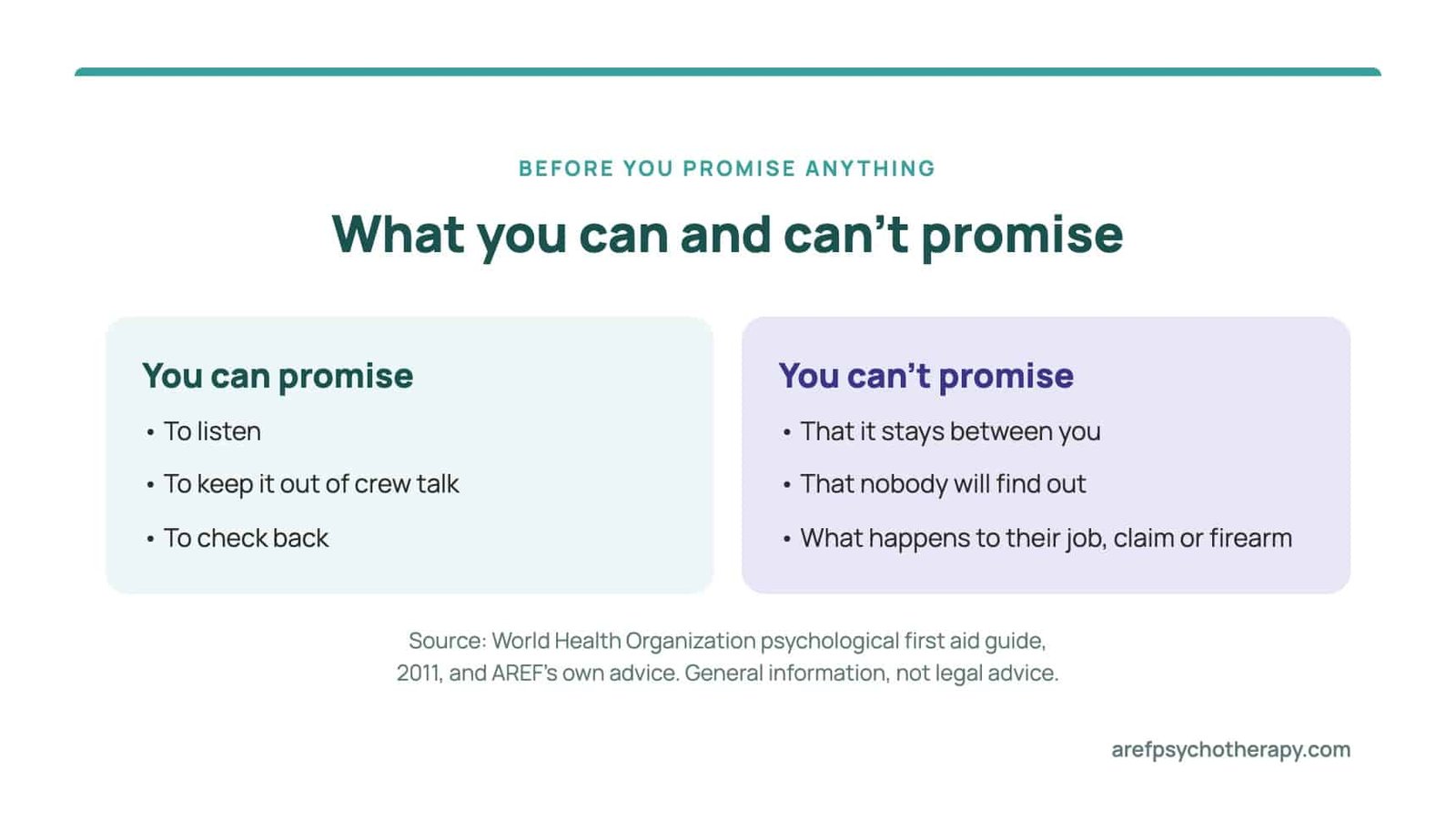
Don’t promise secrecy. It’s the easiest thing to say and often the one you can’t keep. The WHO guide says helpers shouldn’t give false promises.
You can promise to listen, to keep it out of crew talk, and to check back. You can’t promise that it stays between you, that nobody will find out, or what happens to their job, claim or firearm.
- Peer talks may not be protected. Legal privilege can keep a conversation out of court. We looked for a Canadian law or court decision giving peer support talks that protection and didn’t find one, and Ontario’s Evidence Act doesn’t mention it. That isn’t proof none exists, so ask your association or a lawyer. Until then, don’t tell anyone a peer talk is protected.
- Police officers have a duty to report. Ontario’s Code of Conduct for Police Officers says an officer must report another member’s conduct if they reasonably believe, or reasonably ought to believe, it is misconduct. Officers acting as association reps, or taking part in an organized peer support group, don’t have to report what they learn in that role, unless not reporting would pose a serious risk of harm to someone. A talk on shift, outside an organized group, may not fit. The Code doesn’t mention mental health, but it does cover things a person might tell you, such as working while impaired by alcohol or drugs.
- Group talks before SIU interviews carry legal risk. Under section 26 of Ontario’s Special Investigations Unit Act, officials involved in an incident the unit is investigating must not communicate with each other about their involvement, directly or indirectly, until investigators finish their interviews. “Officials” mainly means police officers. A group talk or check-in between involved officers could breach that, and so could passing messages between them. Involved officers can consult a lawyer and their association rep, so start there. The section says nothing about seeing a therapist.
Other services have their own rules. This is general information, not legal advice. A lawyer, your association or union rep, WSIB or the Office of the Worker Adviser can tell you how it applies to you.
When it’s urgent
If you’re worried a coworker may be thinking about suicide, ask them. Use the word. 9-8-8’s guide says it’s usually better to ask directly, and that the person will probably feel relieved. If you’re afraid of planting the idea, a 2020 research review found no harm from asking, though it covered surveys and interviews, not coworkers talking, and its authors want more strong trials.
Our suggested wording, which follows 9-8-8’s guidance:
- I’m worried about you. Are you thinking about suicide?
Stay calm and listen. Don’t argue or judge. Let them know help is available. If they ask you to keep it quiet, MyHealth Alberta’s guide says don’t agree, because they need more support than one person can give.
- If they say yes, or you aren’t sure: Call or text 9-8-8, any time. It’s also for people worried about someone else, so you can reach out with them or on your own. First responders in Ontario can also call Boots on the Ground at 1-833-677-2668.
- If their life may be at risk right now: Call 9-1-1. If they’re willing, you can go with them to the nearest emergency department. Don’t leave them alone if you feel they wouldn’t be safe.
Your part is to ask and to bring in help.
Key Takeaways
- Look for a change from how the person usually is, not a diagnosis.
- Say what you’ve noticed, ask, and listen. You don’t need the details of the call.
- Offer one next step, leave the choice with them, and don’t promise secrecy.
- If you’re worried about suicide, ask directly, and call or text 9-8-8.
Frequently asked questions
What if I say the wrong thing?
You may, and you can recover from it. In one small RCMP study, the people who got officers to help ranged from gentle to very blunt, so there isn't one right script. If a line lands badly, say so and try again another day.
What if they get angry or shut me down?
Don't argue, and don't treat it as a final answer. Tell them you heard them and leave it for now. You can check in another day. If you're worried about their safety, that's different. Ask them directly about suicide, and call or text 9-8-8 for advice.
Should I tell a supervisor what a coworker told me?
Generally, ask them first. How much gets shared is their call, and telling a supervisor may set off duties you can't take back. If their life may be at risk, get help right away. If you think they can't safely do the job today, tell them so, then follow your service's rules.
Is what I hear as a peer supporter confidential?
You can keep a confidence, but as far as we could find, no Canadian law gives peer support talks legal privilege. That isn't proof none exists. Your team may have its own rules too. Say your limits at the start, and ask your association or a lawyer what applies.
Can I get advice before I talk to them?
Yes. 9-8-8 says it is there for people worried about someone in their lives, and you can call or text at any time. First responders in Ontario can also call Boots on the Ground. You don't need your coworker's permission to get support yourself.
If some of this is yours too
Hearing someone out can stay with you. AREF’s Registered Psychotherapists work online with people in Ontario. We don’t give legal advice or fitness-for-duty opinions. Read how first responder therapy works with us, or see our WSIB therapy page if a claim is involved.
If you need someone right now: call or text 9-8-8, Canada’s Suicide Crisis Helpline, any time of day. For anonymous peer support from other first responders in Ontario, call Boots on the Ground at 1-833-677-2668, 24/7. If your safety is at risk, call 9-1-1.
This article is for informational purposes only and does not replace professional mental health advice. If you’re in crisis, please contact Canada’s 9-8-8 Suicide Crisis Helpline by calling or texting 9-8-8.
Sources and further reading
Research
- Burns C, Buchanan M. Factors that influence the decision to seek help in a police population. International Journal of Environmental Research and Public Health, 2020. doi:10.3390/ijerph17186891.
- Vesely L, Mustard CA, Yanar B. Evolving influence of mental health stigma in Ontario public safety organizations: a qualitative study. Health Promotion and Chronic Disease Prevention in Canada, 2026. doi:10.24095/hpcdp.46.4.02.
- Carleton RN, Afifi TO, Turner S, et al. Mental health training, attitudes toward support, and screening positive for mental disorders. Cognitive Behaviour Therapy, 2020 (online 2019). doi:10.1080/16506073.2019.1575900.
- Polihronis C, Cloutier P, Kaur J, Skinner R, Cappelli M. What’s the harm in asking? A systematic review and meta-analysis on the risks of asking about suicide-related behaviors and self-harm with quality appraisal. Archives of Suicide Research, 2022 (online 2020). doi:10.1080/13811118.2020.1793857.
Guidance
- World Health Organization, War Trauma Foundation, World Vision International. Psychological first aid: Guide for field workers, 2011.
- Infrastructure Health & Safety Association. Brave Conversations Toolkit.
- CAMH. Posttraumatic Stress Disorder.
- MyHealth Alberta. Talking About Suicide to Someone You’re Worried About.
- 9-8-8: Suicide Crisis Helpline. Talk to someone you are worried about and I’m worried about someone else.
Ontario law, policy and regulators
- Workplace Safety and Insurance Act, 1997, section 21
- Employers’ Initial Accident-Reporting Obligations, Policy 15-01-02, WSIB Operational Policy Manual
- Special Investigations Unit Act, 2019, sections 1, 26 and 27
- O. Reg. 407/23, Code of Conduct for Police Officers, sections 21 and 22
- Evidence Act, Ontario
- Policy on preventing discrimination based on mental health disabilities and addictions, section 13, Ontario Human Rights Commission, 2014
- Standards of Practice, College of Registered Psychotherapists of Ontario
Support
- 9-8-8 Suicide Crisis Helpline: call or text 9-8-8
- Boots on the Ground: 1-833-677-2668