
Reviewed by the AREF Psychotherapy team
Last checked: November 2026
Before you book anything, you want one answer. Who finds out, and what do they get to see? You have probably read a warm promise that everything stays private, and you probably didn’t believe it.
You were right to be careful. First responder confidentiality in Ontario depends on how you pay. Some routes tell your employer very little. One can tell them quite a lot. Here is each route, bad news included.
This is general information, not legal advice. It covers workers under Ontario’s Workplace Safety and Insurance Board (WSIB). RCMP members and federal workers have different rules. For how care works, see first responder therapy in Ontario.
The short answer
Can your service find out you’re seeing a therapist? On a WSIB claim or an employer-ordered assessment, yes. If you pay privately, a clinic generally needs your consent to tell your employer anything. With a benefits plan or employee assistance program, it depends on the plan, so check yours.
No route is absolute. Each has legal limits, and a Registered Psychotherapist (RP) must explain them.
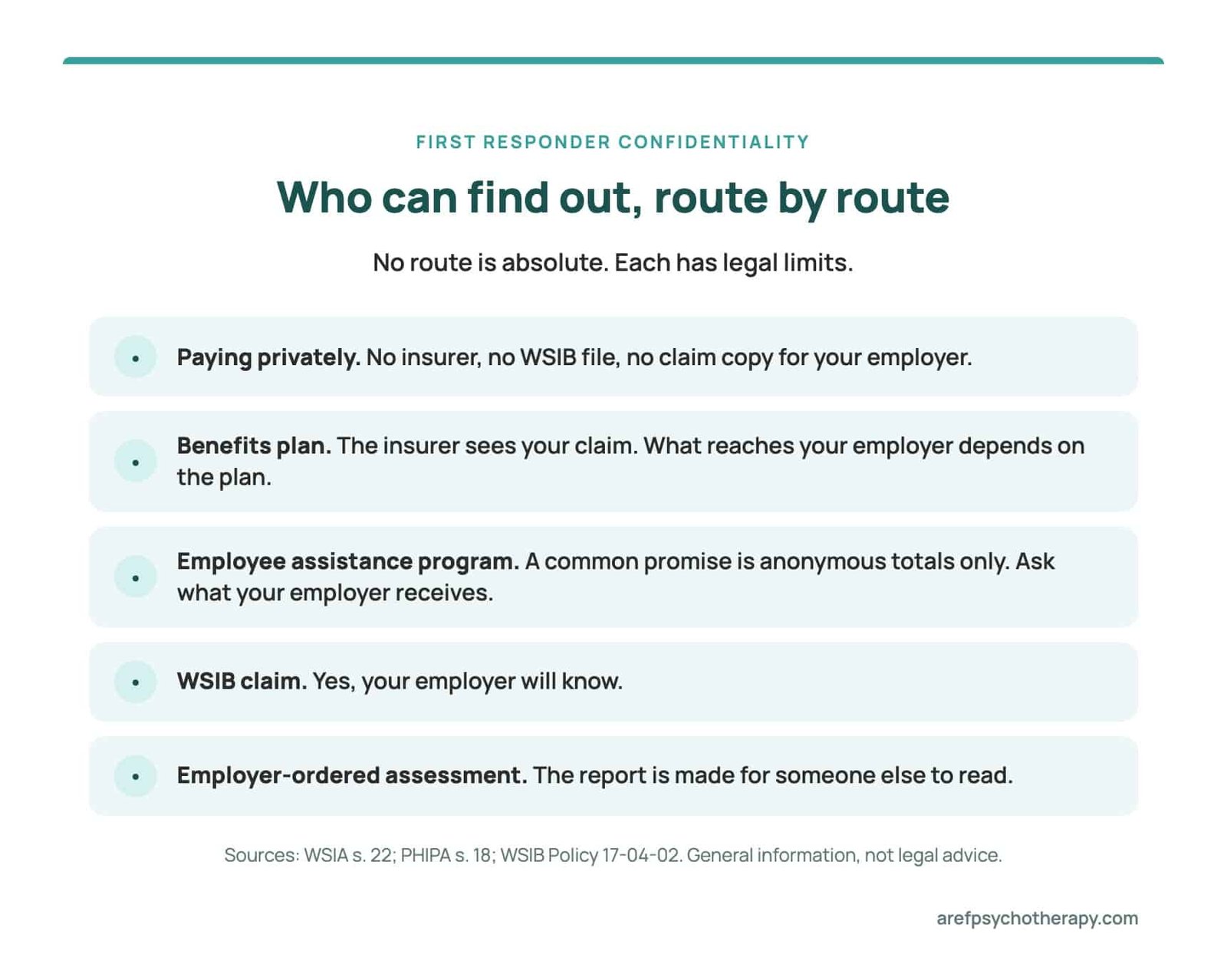
First responder confidentiality, route by route
Paying privately
This route leaves the smallest trail: no insurer, no WSIB file, no claim copy for your employer. A health spending account is still a claim on a plan, though.
Private doesn’t mean off the record. The legal limits below still apply. A firearms licence application asks about your mental health history, and answers must be true however you paid. If you claim WSIB later, your therapist can be required to give WSIB information.
There is also a clock. A claim must be filed within six months, unless WSIB considers it just to allow more time. WSIB’s PTSD policy says that runs from the accident or injury, which may be earlier than a diagnosis. How it works for harm built up over years of calls is unconfirmed. Ask WSIB or your union or association rep early, or the Office of the Worker Adviser if you aren’t in a union.
Using your benefits plan
The insurer sees your claim. What reaches your employer depends on the plan. For example, Sun Life’s plan administrator guide says it doesn’t share personal plan member information with plan sponsors without consent. Its health claim form allows sharing with the plan sponsor if fraud or plan abuse is suspected. Other insurers may differ.
What a self-insured employer sees is unconfirmed. Some employers pay claims themselves and use an insurer only to run the plan. We found no public document showing what they can see about one person’s claim. Ask your union’s benefits rep what the plan contract says before you claim.
Using an employee assistance program
An employee assistance program (EAP) offers short-term counselling through work. A common promise is that your employer sees anonymous totals only. The University of Waterloo, as one Ontario employer, says it isn’t told whether you used its program.
These promises come from contracts and providers. We found no Ontario law that sets them, and we could not confirm what goes back when attendance is mandated. Before your first session, ask the EAP what your employer receives. If attendance is required, ask your rep or a lawyer too.
Making a WSIB claim
Yes, your employer will know. The Workplace Safety and Insurance Act says you must give your employer a copy of your claim when you give it to WSIB. WSIB’s Mental Health Program of Care needs a registered claim. Your therapist must give WSIB the information it requires, and WSIB says your consent isn’t needed. A claim also opens WSIB benefits, and the Act bars employers from acting to discourage you from filing.
An assessment your employer orders
Here the report is made for someone else to read. The assessor isn’t your therapist.
On a WSIB claim, your employer can ask you to see a health professional it selects and pays for. You can object. The employer then has 14 days to ask WSIB to decide. If WSIB directs you to go and you refuse without reasonable cause, it can reduce or suspend your payments. WSIB’s policy on these exams says the exam must relate to your claim and WSIB must get a copy. Expect your employer to have the report.
Outside a claim, the Ontario Human Rights Commission says an employer needs an objective reason to doubt your medical evidence before asking for an independent exam. Nobody can be made to attend, it says, but ignoring a reasonable request may delay your accommodation.
Whether a chief can order a serving Ontario officer to have a psychological assessment is unconfirmed, so ask your association’s lawyer. The RCMP Act lets the Commissioner require an assessment. AREF does not give fitness-for-duty opinions.
Not sure which route fits? Ask us at a free consultation before you decide anything.
What a WSIB claim tells your employer
WSIB Policy 21-02-03 covers what WSIB can tell an employer when nobody is disputing a decision. Employers generally hear this by phone or letter, without copies of file documents.
Can generally be shared without your consent:
- The diagnosis
- Health care providers’ names, including the clinic
- The general type of treatment
- How often you get treatment, and for how long
- Whether you’re co-operating with treatment
- The general prognosis
- Your functional limits
- Whether a referral for counselling was made
Generally can’t be shared:
- Specific clinical findings, such as signs and symptoms
- Particulars of treatment
- Specifics of a referral for psychological counselling
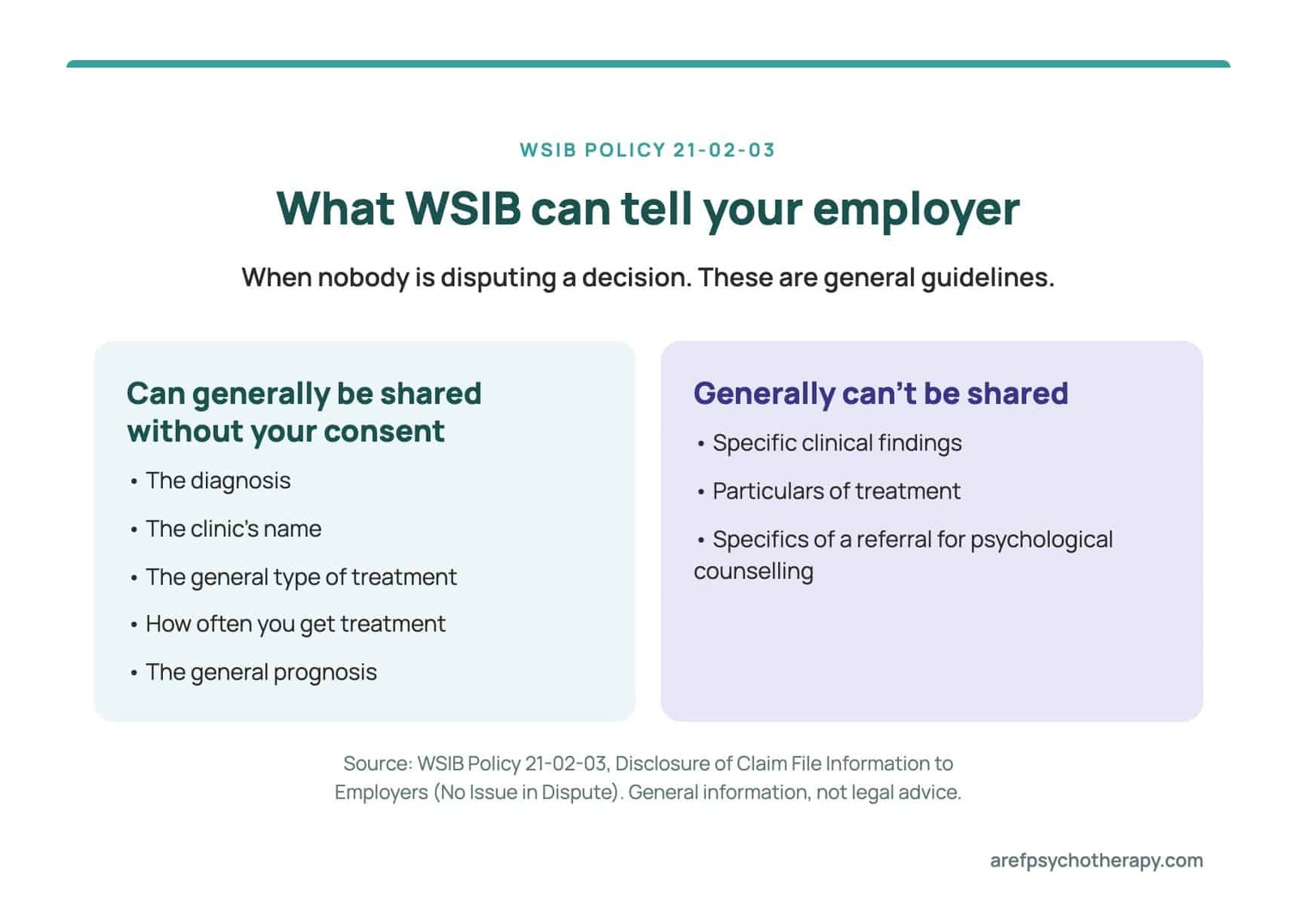
So your employer can learn what the claim is for, where you go and how often. RPs can’t give a diagnosis, so any diagnosis comes from another professional.
WSIB calls these lists general guidelines, and a decision letter can go further. The honest word is “can”. We could not confirm how often WSIB tells employers a PTSD diagnosis, or whether employers paying their own claims under Schedule 2 see more. Ask WSIB’s Privacy Office.
The Functional Abilities Form
You or your employer can ask for this form. A health professional treating you fills it in, and that could be your therapist. It covers what you can and can’t do at work. It goes to you, your employer and WSIB, and filing a claim means consenting to that. WSIB’s guide says a diagnosis must not go on it. Your employer may share it only with people helping you return to work.
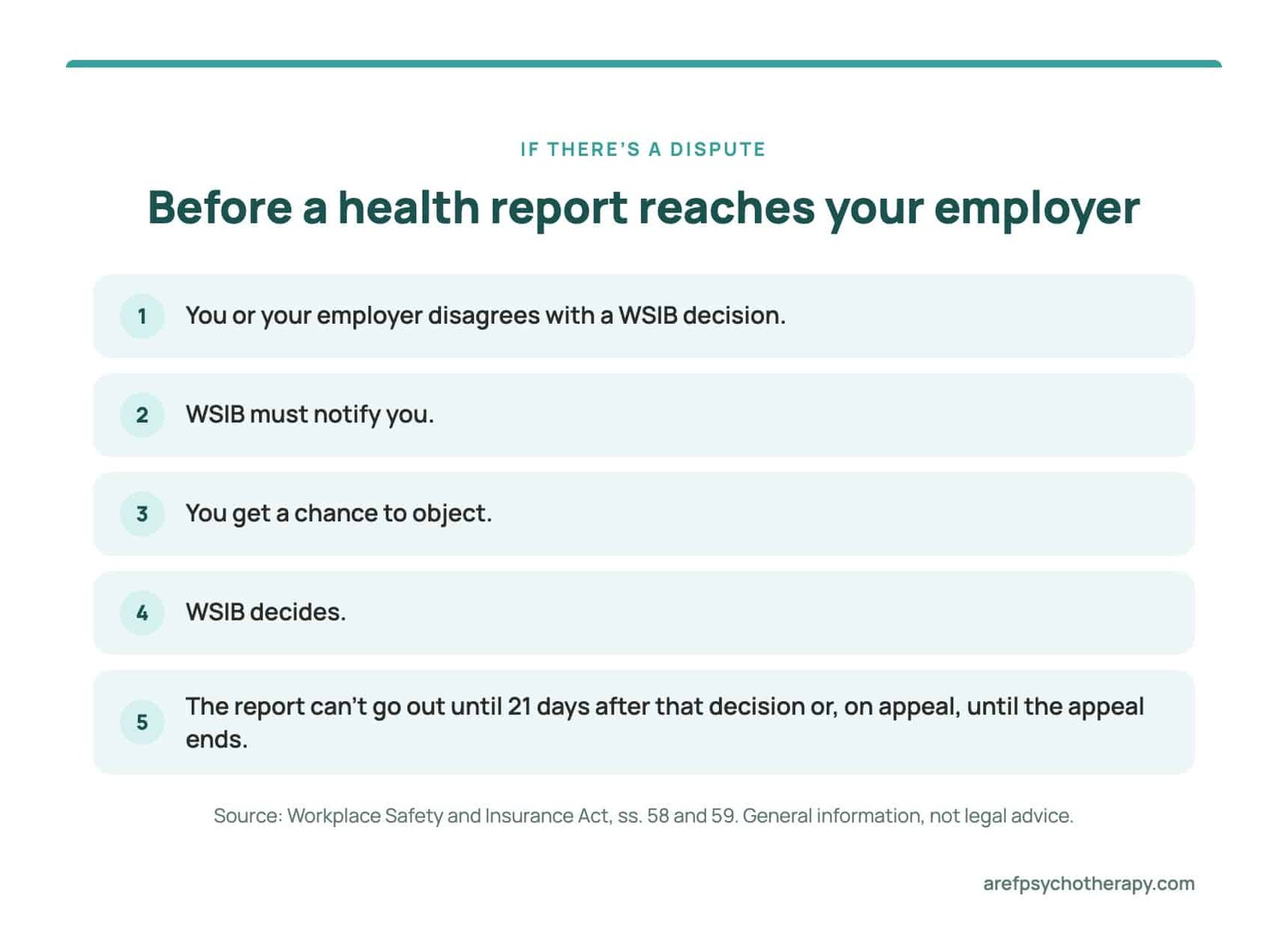
If there’s a dispute
If you or your employer disagrees with a WSIB decision, section 58 of the Act says WSIB must, on request, give your employer the file documents it considers relevant, and tell you. Health reports, which can include your therapist’s, get an extra step under section 59. WSIB must notify you, give you a chance to object, then decide. The report can’t go out until 21 days after that decision or, on appeal, until the appeal ends.
WSIB policy says health information with no bearing on the claim is normally not released. If a notice arrives, show your rep right away.
What your employer generally doesn’t get
This part is good news, and it is real.
- Your information from your clinic. Outside the legal exceptions, a health care provider needs your express consent to share it with an employer, under Ontario’s Personal Health Information Protection Act (PHIPA).
- Your health record. Under the Occupational Health and Safety Act, an employer can’t seek it without your written consent, a court or tribunal order, or another statute requiring it.
- Your diagnosis, when you ask for accommodation. The Human Rights Commission says an employer generally has no right to it unless it clearly relates to the accommodation. In rare, complex cases it may ask for more and must justify that.
- Permission to spread it. The Act bars employers from disclosing health information from WSIB unless identifying details are removed.
These rules limit what an employer can do. They don’t stop a crew noticing time off.
When a therapist must or may break confidentiality
The College of Registered Psychotherapists of Ontario (CRPO) requires RPs to explain the limits of confidentiality. These are the main ones.
- A child at risk: must report. Under Ontario’s child protection law, anyone with reasonable grounds to suspect a child under 16 is being harmed or neglected, or is at risk of it, must report to a children’s aid society. Ask how this applies to calls you’ve attended.
- Sexual abuse by a regulated health professional: must report. The law keeps your name out unless you agree in writing.
- Risk of serious harm: may disclose. PHIPA allows this when a provider believes, on reasonable grounds, it is necessary to reduce a significant risk of serious bodily harm. CRPO names risk to you or anyone else, including suicide or homicide. Where risk is imminent, it says there may be a duty to warn or contact police, and it calls that law complex and evolving. For a police officer, that call could reach your own service. Ask a therapist what they would do first. If you are thinking about ending your life, call or text 9-8-8.
- The College: may disclose, for a complaint or practice review.
Court orders and warrants: no blanket privilege
There is no blanket privilege for what you say in therapy. PHIPA lets a provider comply with a summons or court order, or give information to someone acting under a warrant. CRPO says therapists should make reasonable efforts to tell you, and may be able to object.
Courts decide case by case. In M. (A.) v. Ryan, the Supreme Court of Canada said psychiatrist-patient records can be privileged in appropriate circumstances, and a court can limit what is shared. That is no promise records stay out of court, and we found no decision applying it to an RP’s notes. If you face an investigation, lawsuit or family court case, ask a lawyer first.
What gets written down, and who can see it
CRPO expects a clinical record for each client, including a therapy plan and records of communications and assessments. An RP who holds the record is expected to keep it at least 10 years after your last contact. PHIPA generally lets you see it and ask for corrections. Admin staff and a clinical supervisor may see parts of it.
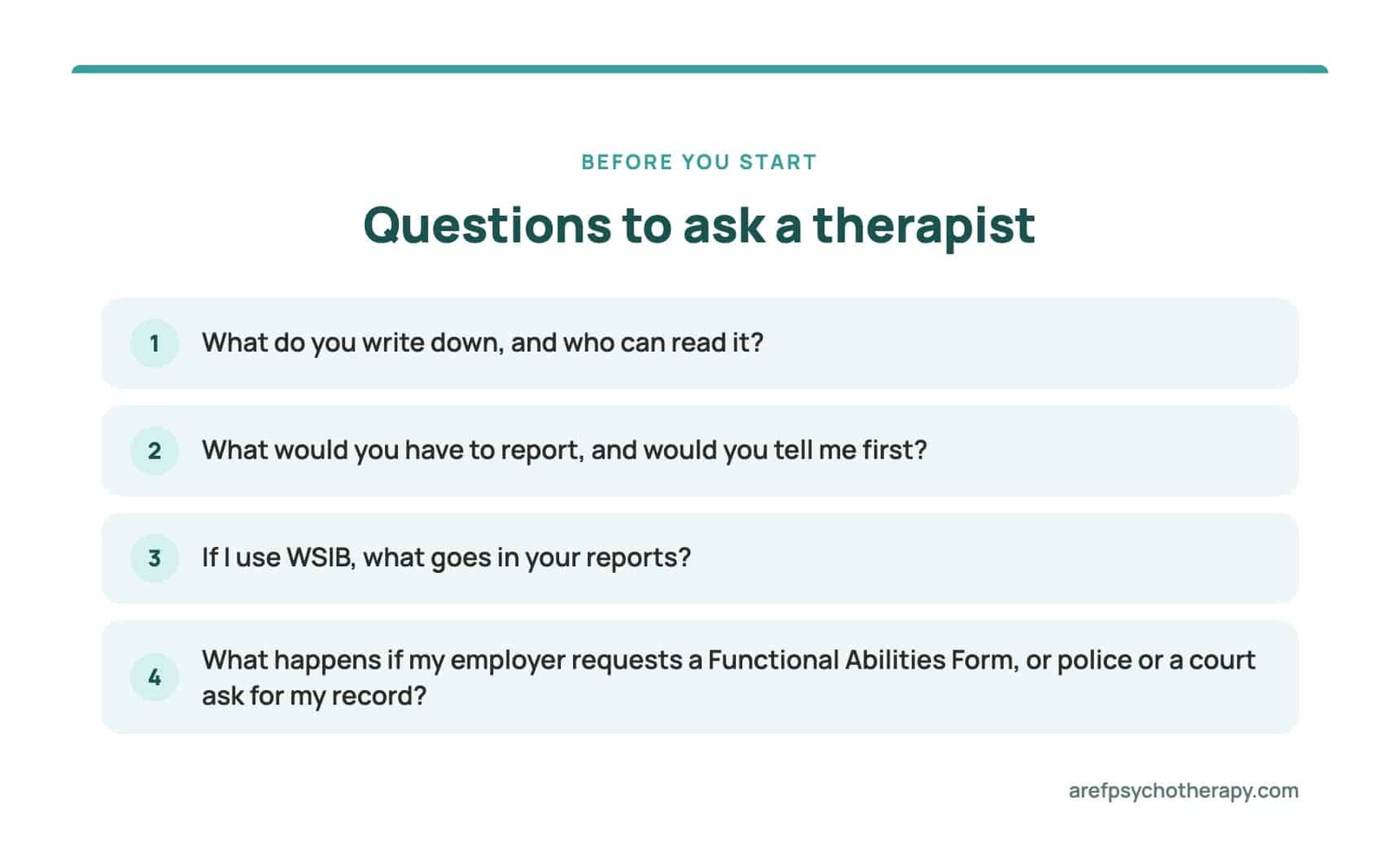
Questions to ask before you start
- What do you write down, and who can read it?
- What would you have to report, and would you tell me first?
- If I use WSIB, what goes in your reports?
- What happens if my employer requests a Functional Abilities Form, or police or a court ask for my record?
Again, this is general information, not legal advice. For your situation, ask your rep, WSIB or a lawyer.
Key Takeaways
- First responder confidentiality depends on how you pay. No route is absolute.
- On a WSIB claim, your employer gets a copy of the claim and can generally be told the diagnosis, clinic name, general type of treatment, frequency and prognosis.
- Particulars of treatment and specific clinical findings generally aren’t shared.
- Outside the legal exceptions, a provider needs your consent to share with your employer.
- What a self-insured employer sees is unconfirmed, so ask first.
Frequently asked questions
Do I have to tell my service I'm in therapy?
We found no such rule in the main Ontario laws we checked for police, paramedics and firefighters. Your service's policies and collective agreement may say more, and many aren't public. Your association or union rep can tell you what applies to you.
Can my employer call the clinic and ask if I'm a client?
A clinic generally needs your express consent to share health information with an employer, and being someone's client counts as health information under Ontario's health privacy law. The legal exceptions in this article still apply. Ask how the clinic handles workplace requests before you start.
Does my therapist send WSIB what I say in session?
A therapist treating you on a claim must give WSIB the information it requires, and your consent isn't needed. What that covers depends on what WSIB asks for. We could not find the program's report templates in public, so ask your therapist what goes in each report.
If I pay privately now, can I still claim WSIB later?
You can file later, but the six-month limit keeps running, and WSIB decides whether to allow a late claim. Your therapist could then be required to give WSIB information. Whether WSIB repays fees you already paid is unconfirmed, so ask a WSIB Case Manager.
Is peer support confidential the way therapy is?
It works differently. We found no Ontario law or court decision giving peer support or group debriefs a legal privilege, but we could not search all case law, so treat that as unconfirmed. In a debrief, colleagues hear you too. Ask your association or a lawyer.
Talk it through before you decide
AREF Psychotherapy is an online clinic for people in Ontario. Our team includes Registered Psychotherapists, regulated by CRPO. Read how first responder therapy works with us, or how WSIB therapy works.
You can start with a free 15-minute phone consultation. Use it to ask what gets shared. Call (437) 830-2088, or book online.
If you need help right now
If you are thinking about ending your life, please reach out now. Call or text the 9-8-8 Suicide Crisis Helpline, any time. First responders in Ontario can also call Boots on the Ground at 1-833-677-2668, 24/7, for anonymous peer support. If your safety is at risk, call 9-1-1.
This article is for informational purposes only and does not replace professional mental health advice. If you’re in crisis, please contact Canada’s 9-8-8 Suicide Crisis Helpline by calling or texting 9-8-8.
Sources and further reading
Ontario law
- Workplace Safety and Insurance Act, 1997, sections 22, 22.1, 36, 37, 58, 59 and 181
- Personal Health Information Protection Act, 2004, sections 4, 18, 29, 40, 41, 43, 52 and 55
- Occupational Health and Safety Act, section 63
- Child, Youth and Family Services Act, 2017, section 125
- Regulated Health Professions Act, 1991, Health Professions Procedural Code, sections 85.1 and 85.3
WSIB
- Disclosure of Claim File Information to Employers (No Issue in Dispute), Policy 21-02-03
- Disclosure of Claim File Information (Issue in Dispute), Policy 21-02-02
- Employer-Requested Health Examinations, Policy 17-04-02
- Posttraumatic Stress Disorder in First Responders and Other Designated Workers, Policy 15-03-13
- Workers’ Requirement to Claim and Consent, Policy 15-01-03
- Functional Abilities Form and guide to completing it
- Mental Health Program of Care
- Questions and answers: claims
- Schedule 2
Regulators, courts and federal law
- Standards of Practice, College of Registered Psychotherapists of Ontario
- Professional Practice and Jurisprudence manual, College of Registered Psychotherapists of Ontario
- Policy on preventing discrimination based on mental health disabilities and addictions, section 13, Ontario Human Rights Commission
- M. (A.) v. Ryan (1997), 1 SCR 157, Supreme Court of Canada
- Royal Canadian Mounted Police Act, section 20.2
- Government Employees Compensation Act, section 3
- Firearms licence application, form 5592e, RCMP
Benefits and employee assistance
- Plan administrator guide and Extended Health Care claim form, Sun Life
- Employee and Family Assistance Program, University of Waterloo
Advice and support
- Office of the Worker Adviser: free for non-union injured workers
- 9-8-8 Suicide Crisis Helpline: call or text 9-8-8
- Boots on the Ground: 1-833-677-2668