
Reviewed by the AREF Psychotherapy team
Last checked: November 2026
If you carry for work, or hold a firearms licence at home, this may be the question you least want to ask out loud. Will a first responder lose their gun over therapy? And if the gun goes, what happens to the job?
In a small study of 20 serving RCMP officers, some saw going to a psychologist as a risk to their career, and some stayed away because of it.
A flat no wouldn’t be true. Seeing a therapist is not an automatic bar to a firearms licence. But the form asks about your past, your answers must be true whoever paid for your care, and a therapist can’t tell you how to answer.
This is general information, not legal advice. Some key rules aren’t public. For how getting help works, see our page on first responder therapy in Ontario.
Will a first responder lose their gun? The short answer
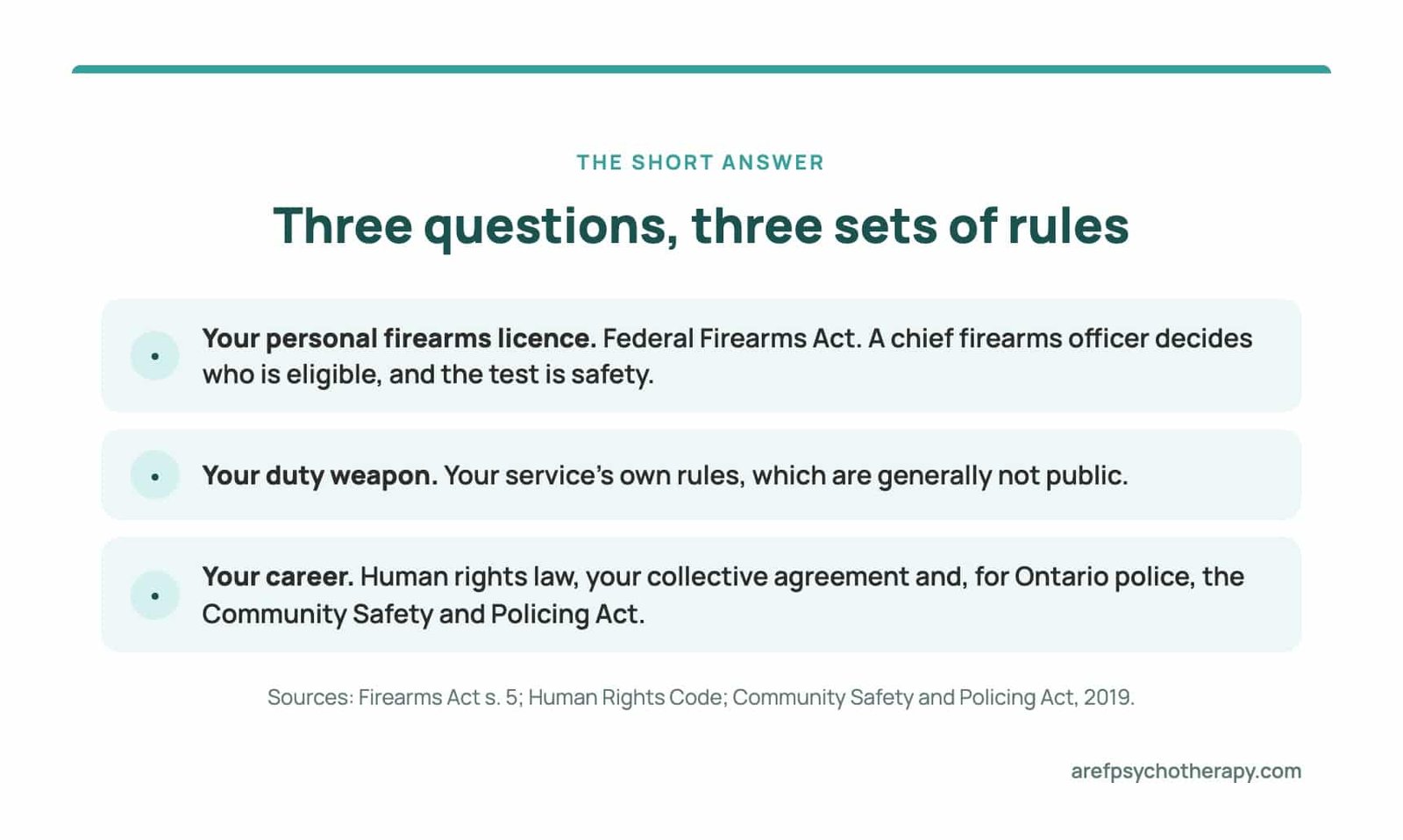
It depends which of three things you mean. Each runs on different rules.
- Your personal firearms licence. The Possession and Acquisition Licence (PAL) falls under the federal Firearms Act. A chief firearms officer decides who is eligible, and the test is safety.
- Your duty weapon. This runs under your service’s own rules, which are generally not public. Treat it as a separate question from your PAL.
- Your career. Keeping your job falls under human rights law, your collective agreement and, for Ontario police, the Community Safety and Policing Act.
Is seeing a therapist reportable?
We read Ontario’s Community Safety and Policing Act and the police Code of Conduct regulation and found no rule that says an officer must report seeing a therapist. That doesn’t prove none exists. Service procedures, collective agreements and corrections policies can add requirements, and many aren’t public.
A therapist starts from consent. Under Ontario’s Personal Health Information Protection Act (PHIPA), your health information generally can’t be shared without it, unless the law permits or requires it. Who can find out depends partly on how you pay. On a WSIB claim, for example, the Workplace Safety and Insurance Act requires a copy of the claim to go to your employer. The College of Registered Psychotherapists of Ontario (CRPO) requires therapists to explain the limits, so ask before you start.
Firearms licences: what the form asks
Under section 5 of the Firearms Act, a person isn’t eligible if it’s desirable, for their safety or anyone else’s, that they not have a firearm. A chief firearms officer must consider treatment for a mental illness “associated with violence or threatened or attempted violence”, which is treatment tied to violence, not treatment alone. The list also has a catch-all: anyone who “for any other reason, poses a risk of harm to any person”.
The PAL application form asks more than that. Question 16(d) reads:
Have you ever threatened or attempted suicide, or have you ever suffered from or been diagnosed or treated by a medical practitioner for: depression; alcohol, drug or substance abuse; behavioural problems; or emotional problems?
If that question touches something live for you today, you can call or text 9-8-8 at any hour.
The renewal form uses the same words. Both say a yes “does not mean your application will be refused but it may lead to further examination”.
Notice three things:
- It says “ever”. It isn’t limited to recent years.
- It doesn’t ask who paid. Private pay and WSIB get the same question.
- It isn’t only about a diagnosis. “Suffered from” sits beside “diagnosed or treated”, and the form doesn’t define “emotional problems”.
We can’t tell you how that applies to you, and a therapist can’t either. AREF gives no advice on what to write on a firearms form, except that answers must be true. Knowingly making a false or misleading statement to get a licence, or knowingly leaving out relevant information, is an offence under section 106. If you’re unsure, the form points you to the Canadian Firearms Program at 1-800-731-4000, and a lawyer can advise you.
After the licence is issued
The 2025 Commissioner of Firearms Report says eligibility is screened over the whole term of a licence. It doesn’t say what sets off a flag, and we could not confirm whether health records play any part.
Now the bad news, in plain words. If a chief firearms officer has reasonable grounds to suspect you’re no longer eligible, the Act says they must suspend your authorization to use, acquire and import firearms for up to 30 days. This is the “yellow flag” law, in effect since March 7, 2025. They may also revoke a licence.
You do have options. A suspension comes with written notice and reasons. A revocation can generally be taken to a provincial court judge. That is the point to get a lawyer.
In 2025, 5,263 licences were revoked in Canada, among about 2.47 million licence holders. Mental health was a listed reason in 507. One case can have several reasons, potential risk to self is counted separately, and some revocations may since have been overturned. The report doesn’t say how many of those people were in therapy, so the number can’t tell you your odds, in either direction.
What a therapist does and doesn’t report
We found nothing in the Firearms Act that requires a therapist to report a client to a chief firearms officer. The Act doesn’t mention psychotherapists at all. It isn’t a closed door, though. The yellow flag section lets an officer act on information from “any person”, including health professionals such as psychologists and psychiatrists.
The limit that matters most here is serious risk. PHIPA allows a disclosure when a therapist believes, on reasonable grounds, that it’s necessary to eliminate or reduce a significant risk of serious bodily harm. CRPO’s Standards of Practice give suicide and homicide as examples. Where a risk is significant and imminent, they say there may be a duty to warn, or to contact police, crisis services or a physician involved in your care.
Firearms and suicide risk are connected. The federal “red flag” laws are aimed in part at people at risk of suicide, and the Government of Canada says police may take firearms if they believe there is a risk to anyone’s safety. So if you have access to a firearm, a therapist may want to talk with you about safety.
The test is significant risk. It isn’t a diagnosis, and it isn’t the fact that you’re in therapy. You can ask about it first: What would make you break confidentiality? Who would you call? Could that reach my service?
If you’re having thoughts of ending your life, call or text 9-8-8 at any hour, or call Boots on the Ground at 1-833-677-2668.
Fitness for duty is a separate process
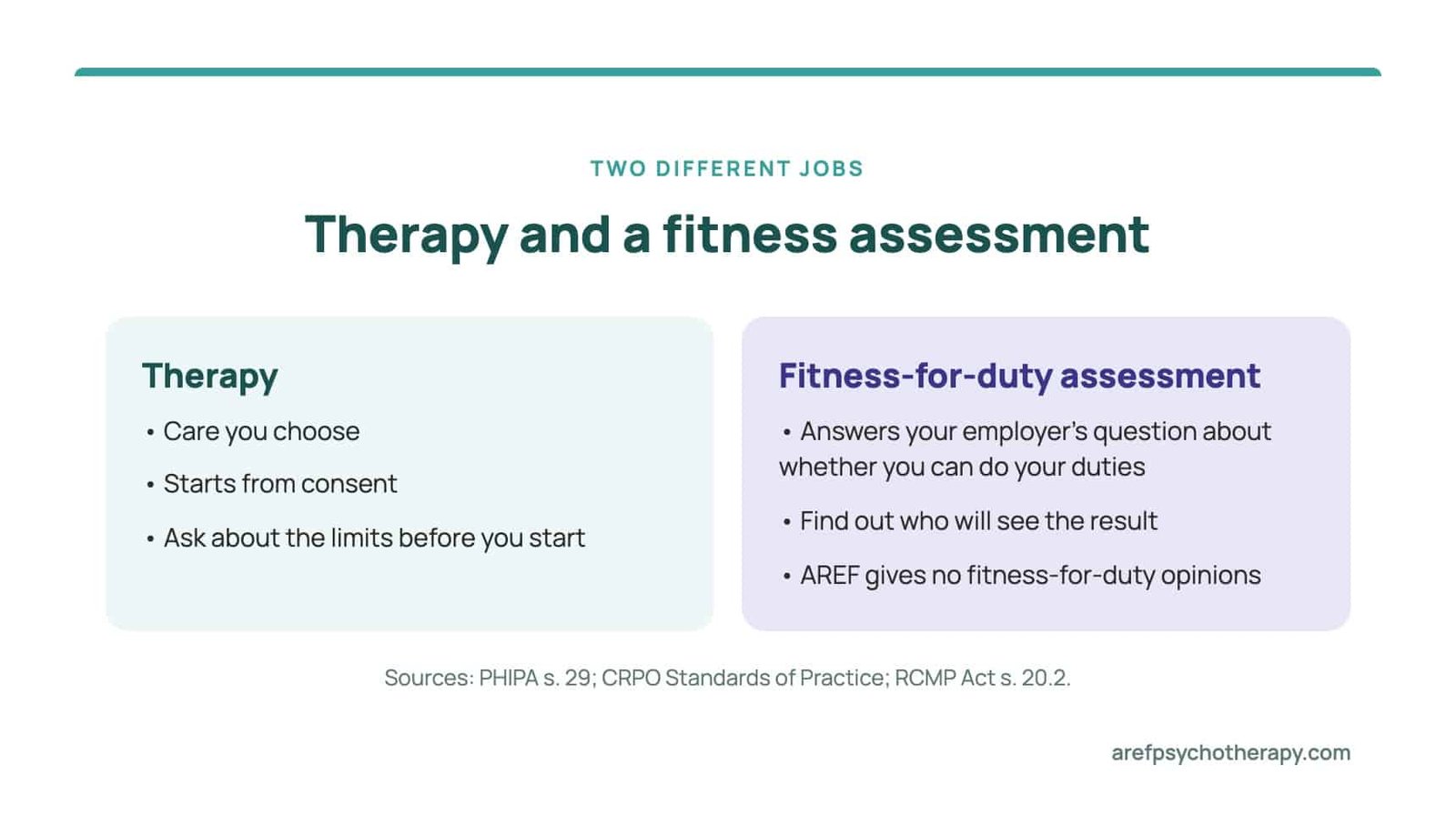
Therapy is care you choose. A fitness-for-duty assessment answers your employer’s question about whether you can do your duties, so find out who will see the result. AREF gives no fitness-for-duty opinions.
- RCMP. The RCMP Act says the Commissioner may require a member to undergo a medical examination or an assessment by a qualified person to establish their ability to do their duties. Under the Commissioner’s Standing Orders, the member must attend, and an appeal doesn’t pause the directive.
- Ontario police. We could not confirm whether a chief can order a serving officer to have a psychological assessment. Ask your association before you agree or refuse.
- Corrections and others who carry. Your employer’s rules and collective agreement apply. Ask your union rep.
The duty weapon sits on its own footing. Ontario’s use of force regulation says a chief must make sure a member is trained and competent before a firearm is issued. We found nothing public on when one can be taken back for health reasons. That doesn’t mean it can’t happen. A 2012 report by Ontario’s Ombudsman describes a committee recommending that one Ontario service continue to remove firearm access for officers off duty with stress-related illness. That example is old. Ask your association.
You don’t have to settle all this first. AREF’s free consultation is a 15-minute phone call with the intake team, and you can ask your questions before you decide anything.
Can they let me go for PTSD?
Generally, being let go because of PTSD is unlawful. But accommodation has limits.
In Ontario, section 5 of the Human Rights Code gives you the right to equal treatment at work without discrimination because of disability, and disability includes a mental disorder.
The hard part is section 17. Your rights aren’t infringed if you can’t perform the essential duties because of disability. But a tribunal or court can’t find you incapable unless your needs can’t be accommodated without undue hardship, considering cost, outside funding and health and safety. So your employer has to try, and there is a point where the law stops requiring more. Health and safety can matter in a job that involves carrying a firearm.
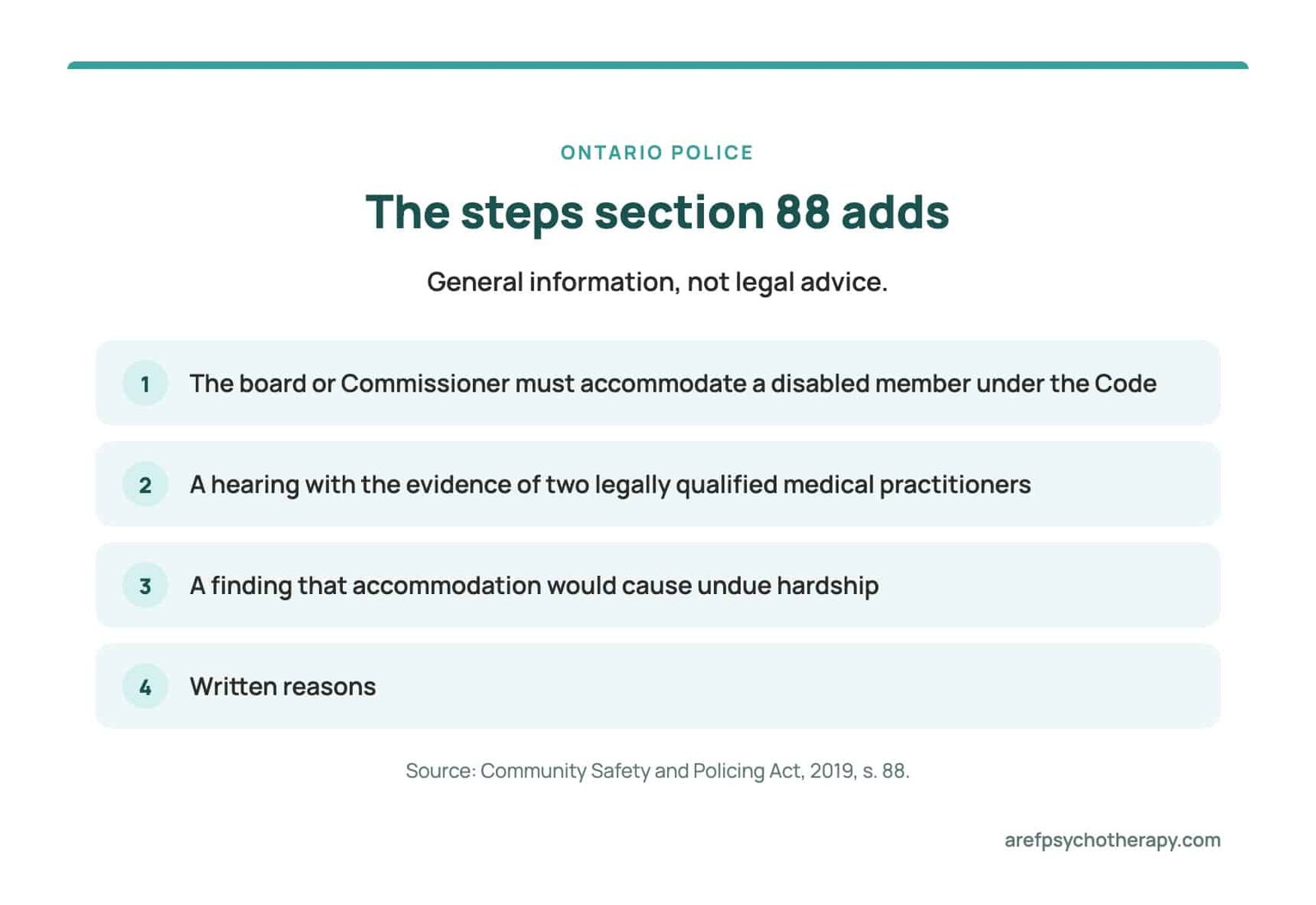
For Ontario police, section 88 of the Community Safety and Policing Act adds steps. The board or Commissioner must accommodate a disabled member under the Code. Ending employment takes a hearing with the evidence of two legally qualified medical practitioners, a finding that accommodation would cause undue hardship, and written reasons.
Federally regulated employers fall under the Canadian Human Rights Act, not the Ontario Code. RCMP members and federal correctional staff can ask their association or union which route fits.
Rights on paper don’t stop every quiet decision. Officers in the RCMP study described being passed over because a supervisor saw them as weak. If that has happened to you, a rep or a lawyer can explain your options.
Who to ask for your service’s rules
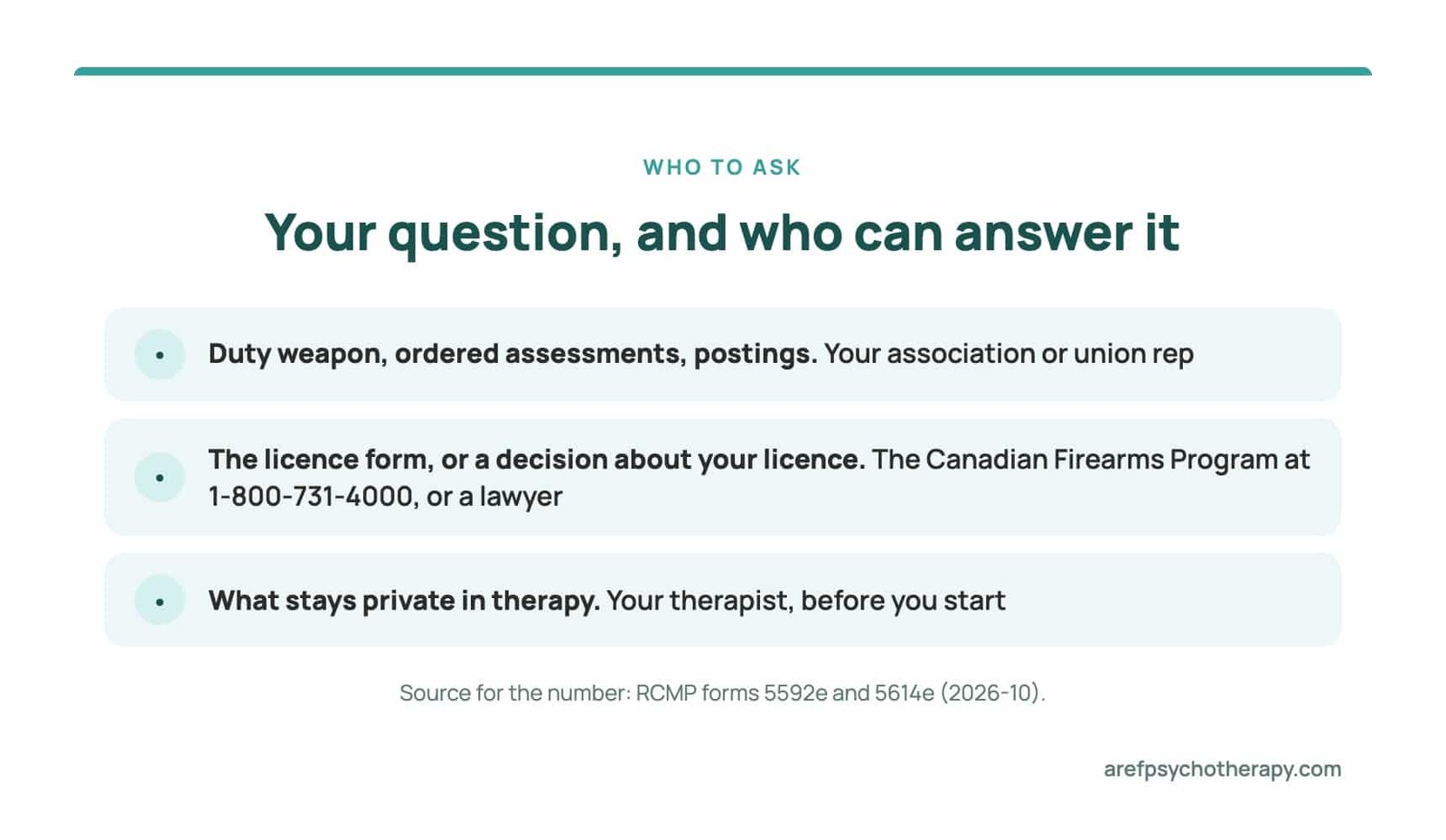
- Duty weapon, ordered assessments, postings: your association or union rep. That may be your local police association, the OPP Association, the National Police Federation for RCMP members, or the Union of Canadian Correctional Officers for federal institutions.
- The licence form, or a decision about your licence: the Canadian Firearms Program at 1-800-731-4000, or a lawyer.
- What stays private in therapy: your therapist, before you start.
Again, this is general information, not legal advice. AREF’s Registered Psychotherapists provide online therapy in Ontario. They don’t give legal advice, and they can’t give a diagnosis. They can offer a place to work on what the job has left you carrying, with the limits explained up front.
Key Takeaways
- Seeing a therapist is not an automatic bar to a firearms licence.
- The form asks about your past, and answers must be true whoever paid.
- We found no Firearms Act duty on therapists to report to a chief firearms officer, but serious risk is a real limit.
- Duty weapon rules are generally not public. Ask your association.
- Being let go because of PTSD is generally unlawful, but accommodation has limits.
Frequently asked questions
Will seeing a therapist automatically cost me my firearms licence?
Seeing a therapist is not an automatic bar. The Firearms Act test is about safety, and the form says a yes answer “does not mean your application will be refused”. It may still lead to further examination. This is general information, not legal advice.
I paid privately. Does the licence form still apply to me?
The question on the form doesn't depend on who paid. It asks about your past, and your answers must be true. A therapist can't tell you how to answer. For help with the form, call the Canadian Firearms Program at 1-800-731-4000 or speak with a lawyer.
Will my therapist tell the chief firearms officer?
We found no duty in the Firearms Act for a therapist to report to a chief firearms officer, and a therapist generally needs your consent to share information. There are limits, including a significant risk of serious bodily harm. Ask your therapist to explain them before you start.
Can my service take my duty weapon if I go to therapy?
We can't answer that for your service. Duty weapons run under the service's own rules, and the rules on removing a firearm for health reasons are generally not public. We could not confirm them. Your association or union rep is the right person to ask.
Can I be fired for having PTSD?
In Ontario, being let go because of a disability, which includes a mental disorder, is generally unlawful. Your employer has to accommodate you up to the point of undue hardship. Federally regulated employers fall under a different Act. A rep or lawyer can look at your situation.
Ready to talk?
When you’re ready, first responder therapy at AREF is online, in Ontario. You can start with a 15-minute phone call and your own questions.
If you are thinking about ending your life, please reach out now. Call or text 9-8-8, the 9-8-8 Suicide Crisis Helpline, 24 hours a day, every day of the year. First responders can also call Boots on the Ground at 1-833-677-2668, 24/7.
This article is for informational purposes only and does not replace professional mental health advice. If you’re in crisis, please contact Canada’s 9-8-8 Suicide Crisis Helpline by calling or texting 9-8-8.
Sources and further reading
Federal law and forms
- Firearms Act, Justice Laws Website, Government of Canada. Sections 5, 68, 69.1, 70, 74 and 106
- Application for a Possession and Acquisition Licence, RCMP 5592e (2026-10), Royal Canadian Mounted Police
- Application for Renewal of a Firearms Licence, RCMP 5614e (2026-10), Royal Canadian Mounted Police
- 2025 Commissioner of Firearms Report, Royal Canadian Mounted Police
- Former Bill C-21: Keeping Canadians safe from gun crime, Public Safety Canada
- Preventing firearm-related harm or misuse, Public Safety Canada
- Royal Canadian Mounted Police Act, section 20.2, Justice Laws Website
- Commissioner’s Standing Orders (Employment Requirements), sections 19 and 20, Justice Laws Website
- Canadian Human Rights Act, sections 3, 7 and 15, Justice Laws Website
- Find out if you are in the right place, Canadian Human Rights Commission
Ontario law and regulators
- Human Rights Code, sections 5, 10 and 17, Government of Ontario
- Community Safety and Policing Act, 2019, section 88, Government of Ontario
- O. Reg. 407/23, Code of Conduct for Police Officers, Government of Ontario
- O. Reg. 391/23, Use of Force and Weapons, section 4, Government of Ontario
- Personal Health Information Protection Act, 2004, sections 29 and 40, Government of Ontario
- Workplace Safety and Insurance Act, 1997, section 22, Government of Ontario
- Standards of Practice, College of Registered Psychotherapists of Ontario (CRPO)
- In the Line of Duty (2012), Ombudsman of Ontario
Research
- Burns C, Buchanan M. Factors that influence the decision to seek help in a police population. International Journal of Environmental Research and Public Health, 2020. doi:10.3390/ijerph17186891
Support
- 9-8-8 Suicide Crisis Helpline: call or text 9-8-8
- Boots on the Ground: 1-833-677-2668