
Reviewed by the AREF Psychotherapy team
Last checked: November 2026
Online couples therapy is a live video session with both partners and a therapist. You join from home or from two private places. Much of the work is the same as in a therapist’s room. The big change is that the therapist isn’t in the room with you, and that affects how you set up, how conflict gets handled and who it’s right for.
Maybe your calendars never line up, one of you works in another city, or neither of you wants to sit in a waiting room. This guide covers the video side. For what the therapy itself involves, see our page on couples therapy.
If you’re afraid of your partner, online couples sessions aren’t the right place to start. Please go to “If you’re afraid of your partner” further down. If anyone is in danger right now, call 9-1-1.
This is general information, not legal or tax advice.
Does online couples therapy work as well as in person?
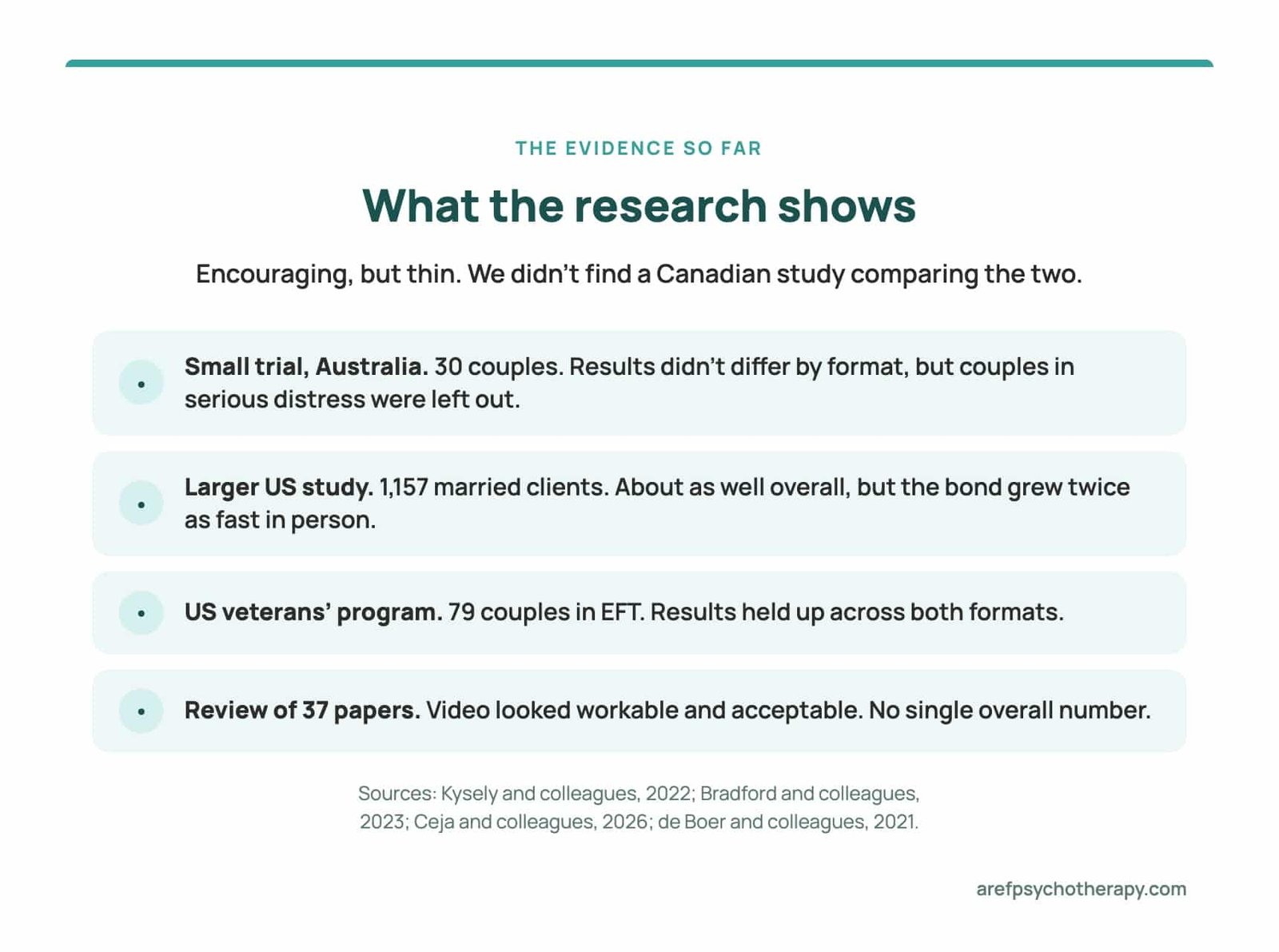
It may, for many couples. The research is encouraging but thin, and we searched for a Canadian study comparing the two and didn’t find one. Here is what we found:
- A small trial in Australia. Thirty couples did the same six-session program, 15 by video and 15 face to face. Results and the bond with the therapist didn’t differ by format (Kysely and colleagues, 2022). But couples in serious distress were left out, and the trial couldn’t test sessions from home.
- A larger US study. Among 1,157 married clients, therapy at a distance did about as well overall as therapy in person. But the bond with the therapist grew twice as fast in person (Bradford and colleagues, 2023).
- A US veterans’ hospital program. Among 79 couples in Emotionally Focused Therapy (EFT), results held up across sessions at a distance and face to face (Ceja and colleagues, 2026). EFT looks at the patterns couples get stuck in. Read about EFT at AREF.
- A review of 37 papers. Video therapy for couples and families looked workable and acceptable. The authors didn’t combine the results into one overall number (de Boer and colleagues, 2021).
Early in the pandemic, most of 166 couples therapists in Israel rated their online work as reasonable or good, and slightly harder than in person (Machluf and colleagues, 2021). In a small survey of 58 therapists, many found conflict harder to read and redirect on video (Hardy and colleagues, 2021). Those are impressions, not results for couples.
Our fair reading: video may give many couples similar results, your bond with the therapist may take longer to build, and conflict needs more planning. So give it a few sessions, and speak up if you don’t feel connected.
How a session runs on video
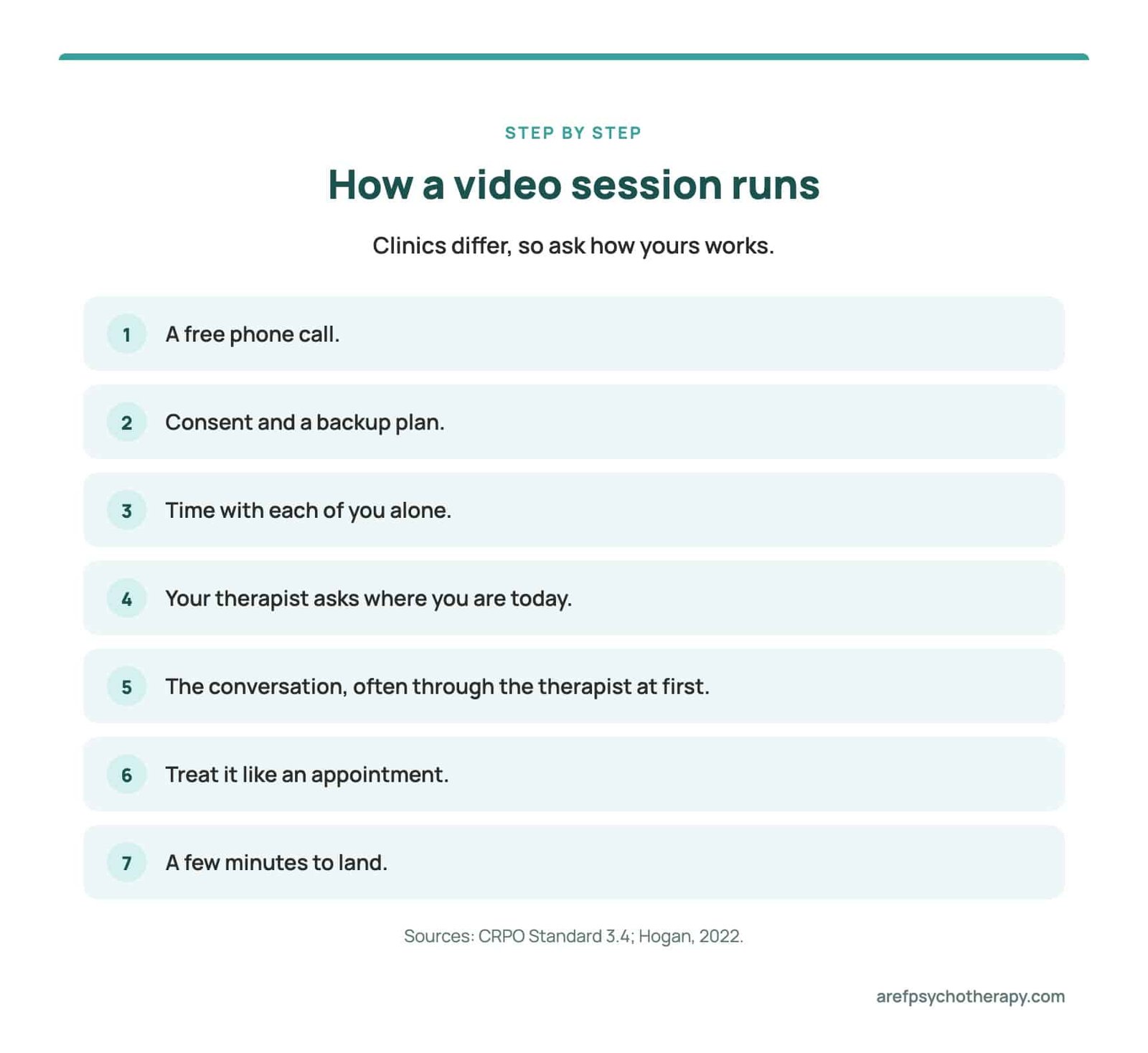
Clinics differ, so ask how yours works. A typical path:
- A free phone call. At AREF this is a 15-minute consultation. You can ask whether video suits you.
- Consent and a backup plan. An Ontario Registered Psychotherapist needs your consent to use the technology. They should explain how privacy differs from an office, and plan what happens if the call drops. That comes from the electronic practice standard of the College of Registered Psychotherapists of Ontario (CRPO).
- Time with each of you alone. One US paper for therapists suggests a short private talk with each partner before the first joint session, so safety can be asked about in private (Hogan, 2022). Ask if your therapist does this.
- “Where are you today?” Expect this question when a session starts. In an emergency, your therapist needs to know.
- The conversation. Early on, you may be asked to speak to the therapist, not each other. It can feel odd, but on video it’s much harder to break in once two people start arguing. Later, you talk to each other more.
- Treat it like an appointment. Phones away, no meals or alcohol, and no lying on the bed. If one of you steps out, the session may pause until you’re back.
- A few minutes to land. When the call ends, you may be in the same kitchen with no drive home in between. Ask for time at the end to agree how the evening goes.
Most sessions at AREF are 50 minutes, and couples sessions may run longer.
One screen or two? Setting up at home
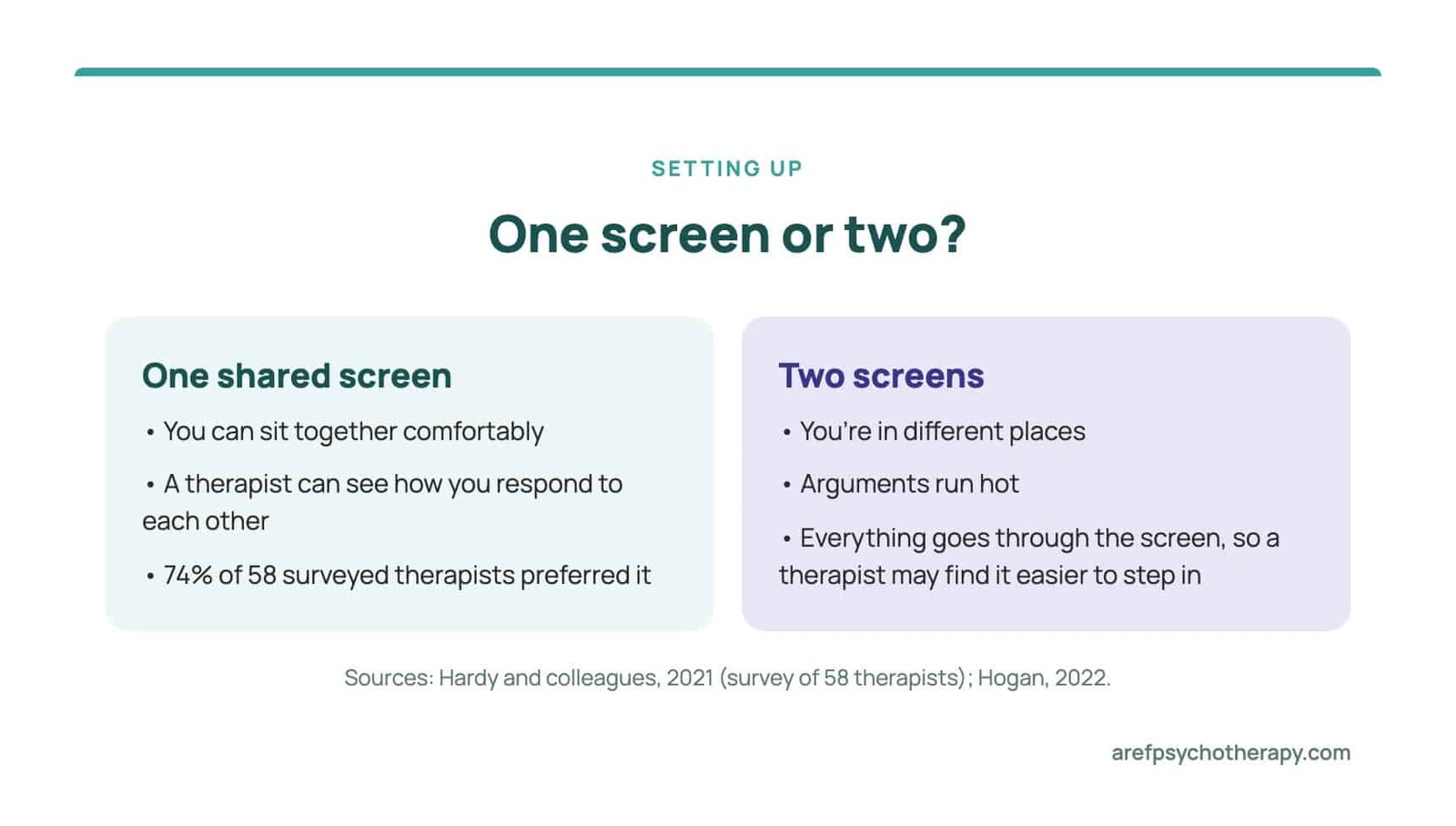
One shared screen is the usual start, if you can sit together comfortably. In the survey of 58 therapists, 74% preferred both partners on the same video. None preferred separate videos as a rule, and 26% said it depends (Hardy and colleagues, 2021). A shared screen lets a therapist see how you respond to each other.
Two screens make sense when you’re in different places, or when arguments run hot. In separate rooms, everything has to go through the screen, so a therapist may find it easier to step in (Hogan, 2022).
The rest is practical, and most of it comes from Hogan’s paper.
- The camera. Rest the device on something steady, and check you’re both in the frame.
- Privacy at home. Think about who can hear you, not only who can see you. A bedroom can work. If the house is full, a garage or a parked car outside may do. A white noise app outside the door helps too.
- Kids in the house. Plan ahead so they can’t overhear something upsetting. Younger kids may need a sitter. Older kids can do an activity with headphones. If a sitter may need you, leave one phone on in a far corner of the room.
- One of you at work. You need a room with a door. Never join while driving. Use your own phone or laptop if you can. Ontario employers with 25 or more employees generally need a written policy on electronic monitoring, so check what yours says.
- One of you in another city. Video may be the only way to meet at all (Lebow and Snyder, 2022). Each of you needs your own private space.
- A test run. Do a 10 to 15 minute tech check before your first session.
Both of you need to be in Ontario
Plan on both of you being physically in Ontario for every session. What counts is where you are that day, not your home address.
Ontario Registered Psychotherapists must follow the licensing rules of the place where a client is located. Other provinces and countries have their own rules. CRPO says a therapist has to check those rules first and make sure their insurance fits. In an emergency, your therapist also needs to know which local services to call.
So a work trip to Calgary, a winter in Florida or a day at an office in Gatineau is worth raising early. Tell us before the session, not after you log on. We may need to move it.
Who online couples therapy suits, and who it may not suit
It can be a good fit if:
- Schedules, childcare or distance are what’s stopping you.
- You’d rather not sit in a waiting room.
- You can each find a private spot and a steady connection.
- Your arguments can stop when someone asks you to stop.
It may not be a good fit if:
- Either of you is afraid of the other, or can’t speak freely.
- You can’t get away from being overheard. A therapist has to weigh whether you can join from a safe, private setting.
- Your arguments are so intense you can’t stop them during a session.
- Either of you is in crisis or having thoughts of suicide. Call or text 9-8-8 first.
- One of you can’t stay sober for sessions.
Hearing or vision problems, a past brain injury or a language barrier don’t rule video out, but they may take some planning (Hogan, 2022).
AREF works online only. If you’d rather sit in a room with a therapist, pick a clinic that sees couples in person. CAMH’s guide to couples counselling is one place to start.
Not sure where you land? Talk it through on a free 15-minute phone consultation, alone or together.
What if a session gets heated on video?
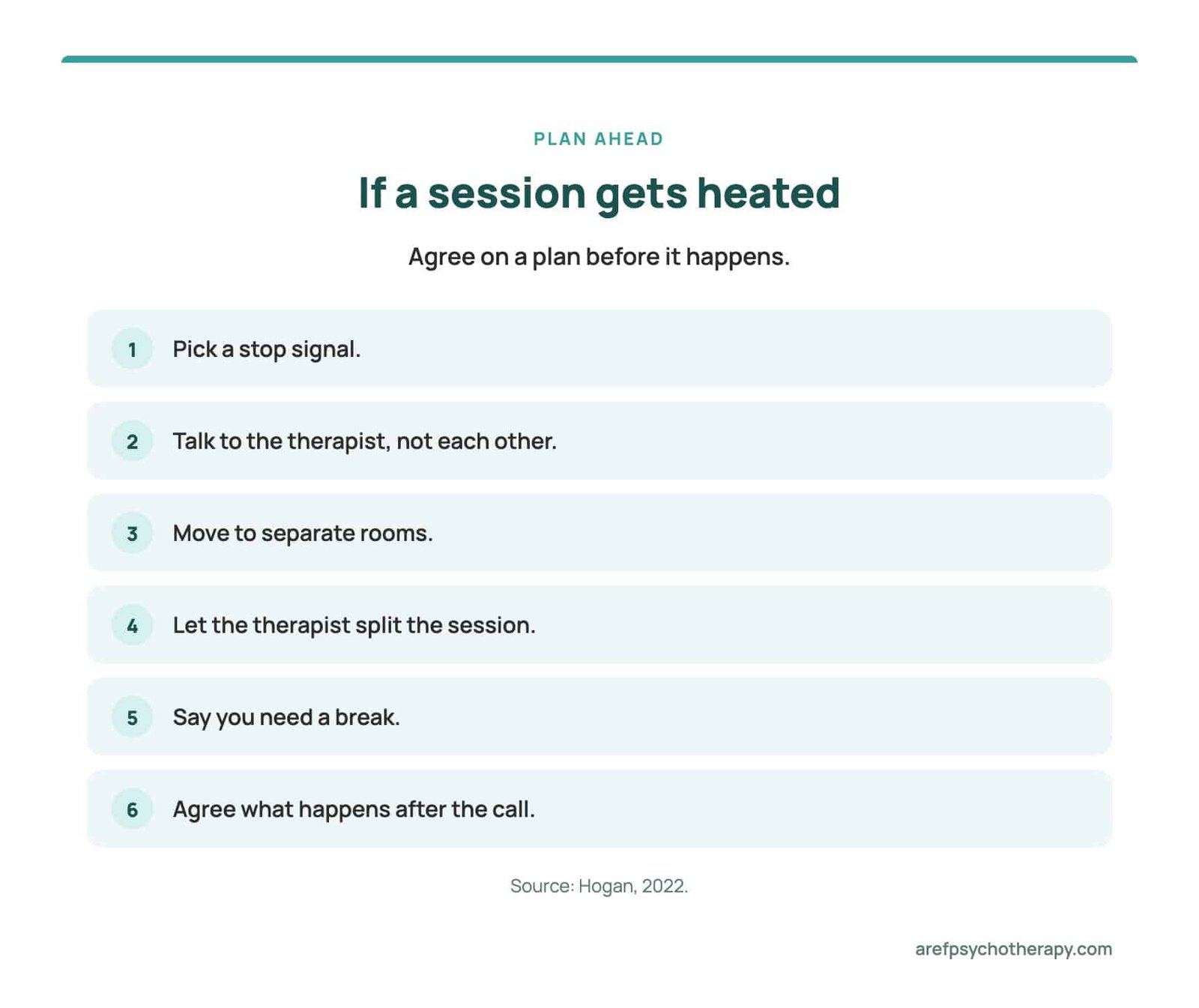
Agree on a plan before it happens. Hogan’s paper says the main difference from an office is that the therapist has less control over a room they aren’t in. So most of what helps gets set up ahead of time:
- Pick a stop signal. Agree on a hand sign, a word or a sound. When it comes, all talk stops and you both look at the screen.
- Talk to the therapist, not each other. Go back to this habit from early sessions.
- Move to separate rooms. If the signal isn’t enough, join from two rooms so everything goes through the screen.
- Let the therapist split the session. They may speak with each of you alone, usually the more upset person first, then offer the other person equal time.
- Say you need a break. It takes less to shut a laptop than to walk out of an office. Agree that “I need a minute” is always allowed, and make sure your therapist has a number for each of you.
- Agree what happens after the call. It might be a time out before you talk again, or a walk around the block for one of you.
If the call drops at a hard moment, stop there and follow your backup plan. Sound alone may not be enough, because some people show they’re upset only through their face and body. Your therapist may choose to rebook.
If sessions keep going this way, video may not be right for now. AREF works online only, so your therapist would talk with you about seeing each of you separately, or a referral to someone who sees couples in person.
Getting heated is one thing. Being scared is another. If anyone feels unsafe, stop the session and read “If you’re afraid of your partner” below.
Privacy when there are two of you
Your therapist must keep your information confidential, within limits set by law, and must explain those limits. They include a serious risk of harm to you or someone else, reports the law requires, and some legal proceedings (CRPO’s standards). Couples add a few wrinkles:
- Your file. If you always attend together, a therapist may keep one shared file. A solo session generally goes in a separate file.
- Asking for records. You can see the whole shared record if you both agree. If only one of you asks, you get what’s about you, plus general themes that can’t be tied to your partner.
- Secrets. Policies vary. Some therapists won’t keep secrets between partners and may raise what you said alone (Hogan, 2022). Ask before any solo talk.
- Recording. CRPO lists recording without consent as a risk of online work. Don’t record unless everyone has agreed.
How to pay for online couples therapy
OHIP doesn’t cover therapy with a Registered Psychotherapist in private practice (CAMH; Ontario). So you pay the clinic, then claim what you can.
Work or private benefits. Many plans cover Registered Psychotherapists, and part or all of your fees may be covered. Ask your plan in writing:
- Does it cover couples sessions, or individual therapy only?
- Whose name needs to be on the receipt?
- What’s the yearly limit, and can we use both of our plans?
Employee assistance programs. CAMH notes that a therapist through one of these may be free.
Paying AREF. We take e-transfer and credit card, and we give detailed receipts. With most private plans, you send in the receipt yourself. If your plan is with Sun Life, we bill Sun Life directly. Ask our intake team for the current fee, and about the sliding scale some therapists offer. We need 24 hours’ notice to cancel, and late cancellations may carry a fee.
Taxes. The Canada Revenue Agency lists psychotherapists in Ontario as authorized practitioners for the medical expense tax credit. You can claim only the part of an eligible expense that wasn’t reimbursed, as its medical expenses guide explains. Ask the CRA or an accountant whether couples sessions count for you.
This is general information, not legal or tax advice.
Questions to ask before you book
- What training do you have in couples therapy? One US paper notes that many clinicians offer it, and few have formal training (Hogan, 2022).
- Do you talk with each of us alone first?
- What’s our stop signal, and who calls who if the video drops?
- If one of us tells you something privately, what do you do with it?
- What video platform do you use, and what are its privacy risks?
If you’re afraid of your partner
Online couples therapy isn’t the right setting if you’re afraid of your partner. That includes being afraid of what they’d do after you spoke honestly in a session. On video, your partner may be sitting beside you. The therapist can’t see what’s off camera. When the call ends, the therapist is gone and you’re still at home.
Hogan’s paper says a couple with moderate violence who might be seen in an office could feel too risky to see on video. Luke’s Place, an Ontario organization that supports women leaving abuse, says joint counselling is less likely to be appropriate where there’s coercive control and fear of a partner.
Abuse can be physical, and it can also be psychological, sexual or financial (Ontario). It can affect anyone. You don’t need to be sure, or put a name to it, before you reach out. You can talk to someone on your own, and that can come first.
Ontario’s helplines are free and confidential, and you can reach them 24 hours a day:
- Assaulted Women’s Helpline, for women and their dependents: 1-866-863-0511, or #SAFE (#7233) on Bell, Rogers, Fido and Telus mobiles. TTY 1-866-863-7868.
- Fem’aide, for French-speaking women: 1-877-336-2433.
- Talk4Healing, for Indigenous women and their families: 1-855-554-4325.
- Victim Support Line, for victims of crime and their families: 1-888-579-2888.
- 211 Ontario, for local services: call 211.
If the women’s lines don’t fit you, start with the Victim Support Line or 211.
If you’re in danger, call 9-1-1. If you can’t speak, Ontario’s advice is to stay on the line.
If someone checks your phone or computer, use a device they can’t see. The Assaulted Women’s Helpline warns that computers can be monitored and that tracks can’t be fully cleared.
Key takeaways
- The main difference online is that the therapist isn’t in the room.
- Research is encouraging but thin, and the bond with a therapist may take longer.
- One shared screen is the usual start. Two can help if you’re apart or arguments run hot.
- Plan on both of you being in Ontario for every session.
- Agree on a stop signal and on what happens after the call.
- If you’re afraid of your partner, start with support for yourself.
Frequently asked questions
Is online couples therapy as effective as in-person therapy?
It may be, for many couples. One small trial and one larger US study found results close to face-to-face sessions, though in the larger study the bond with the therapist grew more slowly. Neither was Canadian, and the small trial left out couples in serious distress. Your therapist can help you judge whether video suits you.
Can we do online couples therapy from two different cities?
Yes, if both of you are in Ontario during the session and each of you has a private space and a steady connection. You'd each join from your own device. If one of you will be out of province, tell us before the session so we can check whether it can go ahead.
Can one of us start alone if the other isn't ready?
Yes. One partner can book the free phone consultation alone, and you can see a Registered Psychotherapist for your own sake while your partner decides. If your partner joins later, ask first how anything you said on your own will be handled, because therapists have different policies on this.
Does insurance cover online couples therapy in Ontario?
OHIP doesn't cover a Registered Psychotherapist in private practice. Many work benefit plans do cover Registered Psychotherapists, but coverage varies. Ask your plan in writing whether couples sessions count and whose name must be on the receipt. AREF gives detailed receipts you can use for insurance and tax purposes.
What happens if the internet cuts out during a session?
You follow the backup plan you made with your therapist at the start, which is often a phone call. Treat it as a pause, especially if things were tense, and try not to carry on the argument while you wait. If sound alone won't work for what you were discussing, your therapist may suggest rebooking.
Starting online couples therapy with AREF
AREF Psychotherapy is an Ontario clinic, and our sessions are online. Our team includes Registered Psychotherapists (RPs), regulated by CRPO. Read more about our couples therapy.
Start with a free 15-minute phone consultation, alone or together. Call us at (437) 830-2088, or book online.
If you need help right now
If you or your partner are thinking about suicide, call or text 9-8-8, the 9-8-8 Suicide Crisis Helpline, 24 hours a day. If anyone’s safety is at risk right now, call 9-1-1.
This article is for informational purposes only and does not replace professional mental health advice. If you’re in crisis, please contact Canada’s 9-8-8 Suicide Crisis Helpline by calling or texting 9-8-8.
Sources and further reading
Research
- Kysely A, Bishop B, Kane RT, McDevitt M, De Palma M, Rooney R. Couples therapy delivered through videoconferencing: effects on relationship outcomes, mental health and the therapeutic alliance. Frontiers in Psychology, 2022. doi:10.3389/fpsyg.2021.773030.
- Bradford AB, Johnson LN, Anderson SR, et al. Call me maybe? In-person vs. teletherapy outcomes among married couples. Psychotherapy Research, 2023.
- Ceja A, et al. Effectiveness of emotionally focused couple therapy in a multidisciplinary veterans health care setting. Family Process, 2026.
- de Boer K, Muir SD, Silva SSM, et al. Videoconferencing psychotherapy for couples and families: a systematic review. Journal of Marital and Family Therapy, 2021.
- Machluf R, Abba Daleski M, Shahar B, Kula O, Bar-Kalifa E. Couples therapists’ attitudes toward online therapy during the COVID-19 crisis. Family Process, 2021. doi:10.1111/famp.12647.
- Hardy NR, Maier CA, Gregson TJ. Couple teletherapy in the era of COVID-19: experiences and recommendations. Journal of Marital and Family Therapy, 2021. doi:10.1111/jmft.12501.
- Hogan JN. Conducting couple therapy via telehealth: special considerations for virtual success. Journal of Health Service Psychology, 2022. doi:10.1007/s42843-022-00060-x.
- Lebow J, Snyder DK. Couple therapy in the 2020s: current status and emerging developments. Family Process, 2022. doi:10.1111/famp.12824.
Regulators and government
- Standard 3.4: Electronic Practice, College of Registered Psychotherapists of Ontario (CRPO)
- Professional Practice Standards, CRPO
- Electronic Practice Guideline, CRPO
- Out of Province: I practise in Ontario but have a client outside of Ontario, CRPO
- What OHIP covers, Government of Ontario
- Written policy on electronic monitoring of employees, Government of Ontario
- Violence in the family, Government of Ontario
- Connect with supports for survivors of violence, Government of Ontario
- Authorized medical practitioners for the medical expense tax credit, Canada Revenue Agency
- Medical expenses guide (RC4065), Canada Revenue Agency
Canadian health and support organizations
- Couples counselling: where to go when you’re looking for help, Centre for Addiction and Mental Health (CAMH)
- Luke’s Place, “Is conjoint counselling ever appropriate in situations of woman abuse?”, 2018
- 9-8-8 Suicide Crisis Helpline: call or text 9-8-8
- Assaulted Women’s Helpline: 1-866-863-0511
- Victim Support Line: 1-888-579-2888