
Reviewed by the AREF Psychotherapy team
Maybe you found the messages last week. Maybe you had the affair, and now you don’t know how to act in your own home. Maybe it came out years ago and the two of you still can’t get through a calm dinner. Whichever is closest, you want to know if couples therapy after infidelity is worth trying, and what actually happens when you go.
Couples therapy after infidelity gives you a regular time, with a trained third person, to deal with what happened without it turning into the same fight. Early sessions usually focus on calming things down, checking that everyone is safe, and working out what each of you needs. Nobody is put on trial. Therapy can help you understand what happened and decide what comes next. It can’t make anyone forgive, and no honest therapist can promise your relationship will survive. Some couples rebuild. Some part ways with less damage, and that can be a good outcome too.
This guide is for the partner who was hurt, the partner who strayed, and couples still deciding. If you are afraid of your partner, please read “If you’re afraid of your partner” below before you book anything.
What infidelity therapy can and can’t do
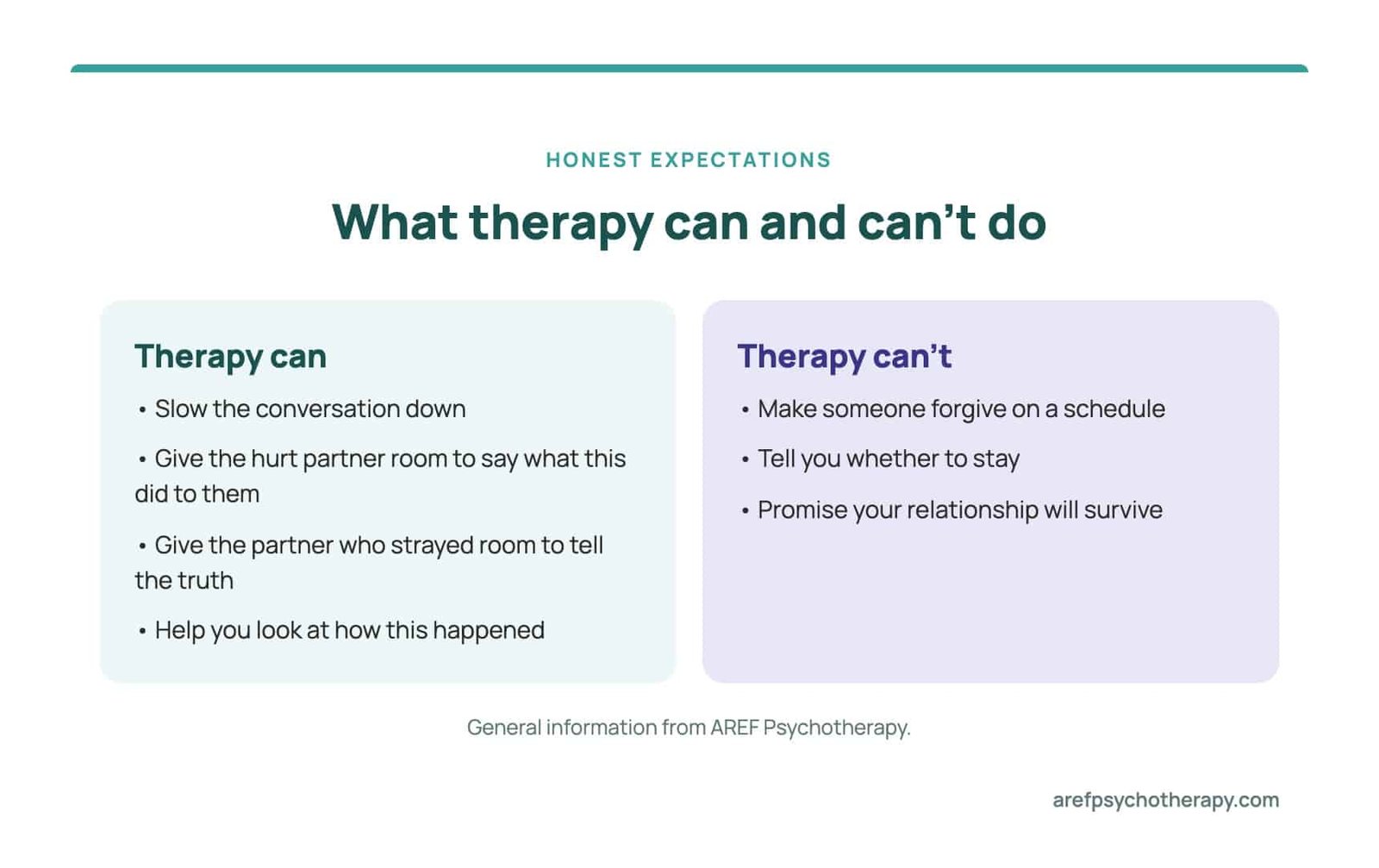
Therapy can slow the conversation down so each of you gets to finish a sentence. The hurt partner gets room to say what this did to them without being told to move on. The partner who strayed gets room to tell the truth without being shouted down or let off the hook. In time, you can look at how this happened. Understanding why doesn’t excuse it.
Therapy can’t make someone forgive on a schedule, and it can’t tell you whether to stay. It is also very hard to rebuild anything while the affair is still going.
The research is hopeful and sobering at once:
- Many couples improve. In a study from Germany and Austria, 145 couples dealing with infidelity started out more distressed than 385 couples in therapy for other reasons. Six months after therapy, the two groups could no longer be told apart statistically. Much of the data was missing, though the authors’ checks suggested that didn’t explain the result.
- Many don’t finish. In a 2012 German trial of 89 couples, about half dropped out, for reasons such as an ongoing affair or separation. Anxiety improved for both partners, but relationship satisfaction didn’t improve enough.
- Couples can go two ways. A small American study followed 19 couples for up to five years. Some did as well as couples with no affair. Others got worse and divorced.
We didn’t find a Canadian study of couples after infidelity, and none of this can say what will happen to the two of you.
Staying together isn’t the only good outcome
Most pages on this topic are quietly about saving the relationship. You may want that. You may also not know yet, and you don’t need to know before your first session.
Leaving is common. A 2026 paper in the Journal of Marital and Family Therapy, citing earlier research, says more than half of hurt partners end the relationship after an affair. If that’s where you land, therapy hasn’t failed. A good outcome could be staying, with far more honesty than before. It could also be separating with both of you clear on why, and raising your kids without every handoff turning into a fight.
Often one partner wants to repair things while the other has a foot out the door. Some therapists use a short approach called discernment counselling for this, with much of the talking done one-on-one. If separation becomes real, legal and money questions belong with a family lawyer.
What early sessions usually look like
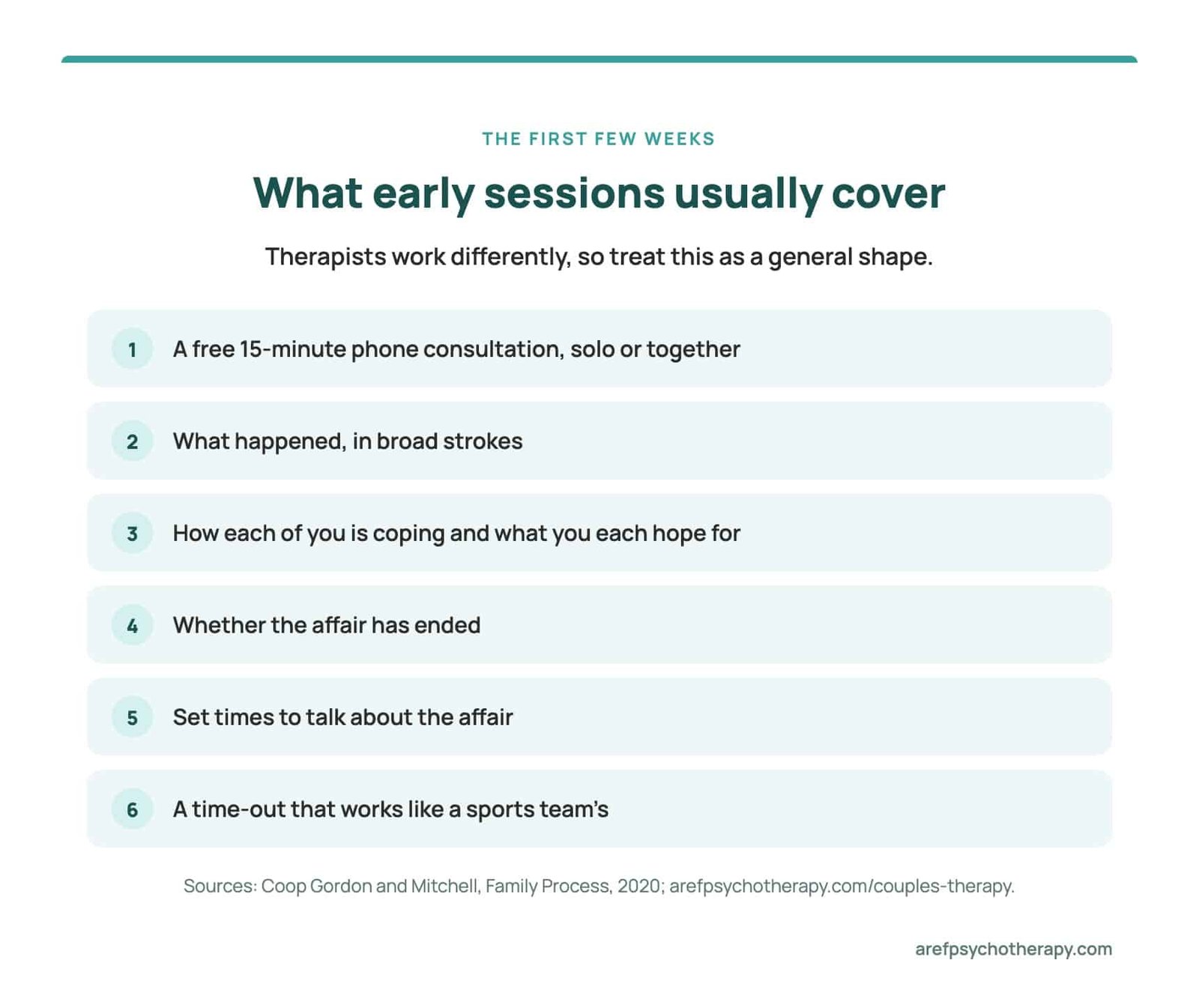
Therapists work differently, so treat this as a general shape. At AREF it starts with a free 15-minute phone consultation, which our couples therapy page says can be solo or together.
The first session or two
Expect questions about what happened in broad strokes, how each of you is coping, and what you each hope for. Expect to be asked whether the affair has ended and whether anyone feels unsafe. Some therapists meet each partner alone early on. Our couples page says we may begin with individual context, depending on your comfort, so ask what your therapist plans.
Calming things down at home
Early work is often about stopping new damage. In a 2020 paper on affair recovery, researchers Kristina Coop Gordon and Erica Mitchell suggest setting times to talk about the affair, so it doesn’t take over every evening. They also suggest agreeing on a time-out that works like a sports team’s, so you can stop a fight and come back as a team. Keep these talks somewhere children can’t overhear.
The questions and the details
The hurt partner will have questions, and that makes sense. Gordon and Mitchell warn that talking before you’re both ready can bring out details that hurt the healing, so a therapist can help you pace it. They also note that the partner who had the affair often carries a lot of shame and may avoid the subject because of it.
Pacing shouldn’t mean being shut down. In a small 2026 interview study of 11 hurt partners who stayed, eight tried therapy, and half of those didn’t find couples therapy helpful. One felt the subject was closed too soon. Others called therapy essential. All 11 were women and most were mental health workers themselves, so this wasn’t a typical group. If something isn’t working, say so, or ask about a different therapist.
Should you go together or alone?
Either can be right, and plenty of people do both.
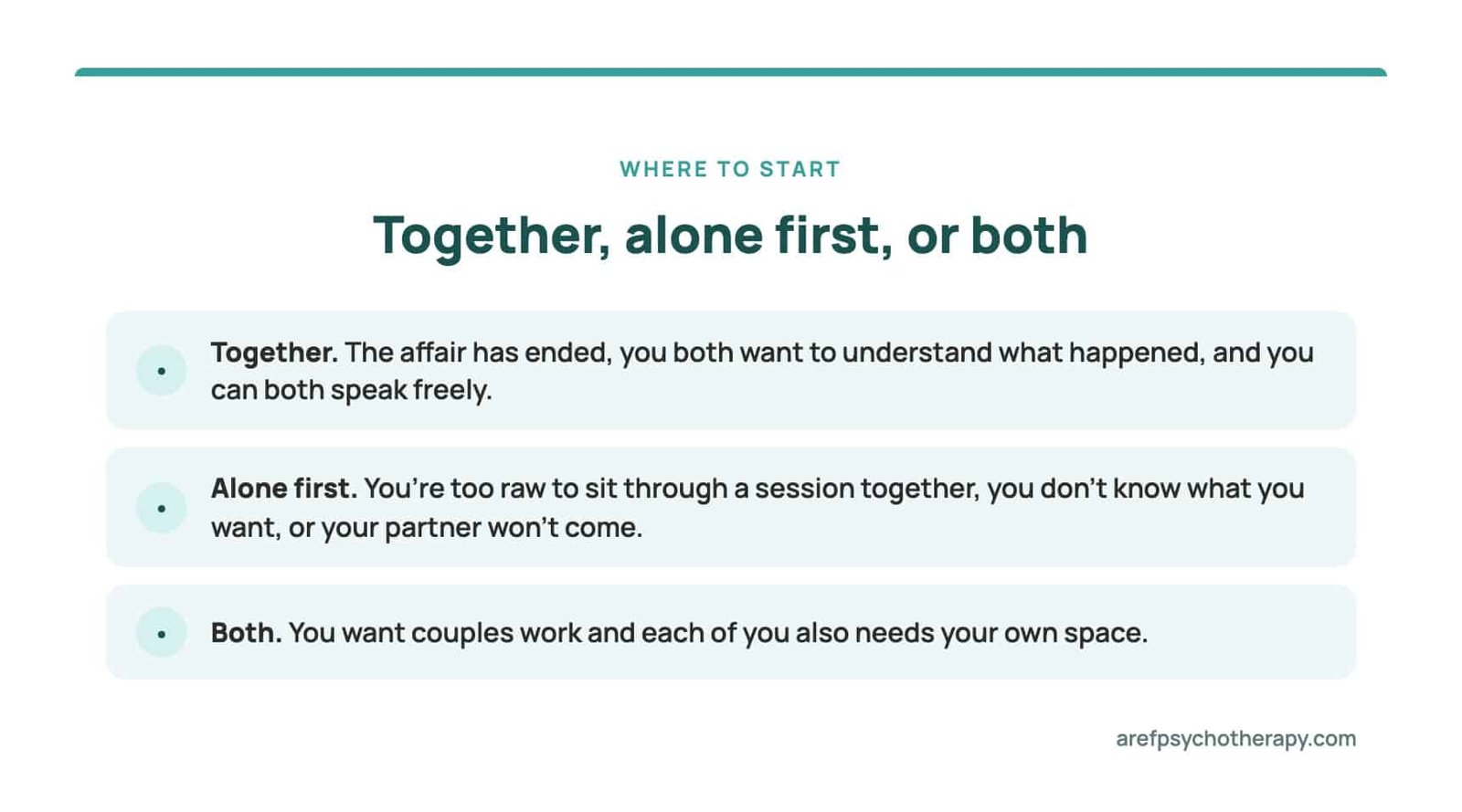
Together tends to fit when the affair has ended, you both want to understand what happened, and you can both speak freely.
Alone first may fit when you’re too raw to sit through a session together, you don’t know what you want, your partner won’t come, or you’re carrying something your partner doesn’t know. Individual therapy for adults gives you somewhere to think without managing your partner’s reaction.
Both may fit when you want couples work and each of you also needs your own space. Ask whether your individual therapist and your couples therapist should be different people, because that affects how secrets are handled.
Not sure which fits? Raise it in a free consultation, and you can call on your own.
Secrets: what a couples therapist will and won’t hold
Ask this first: “If I tell you something alone, what happens to it?”
In couples work, the therapist is working with both of you. Confidentiality protects you from the outside world, within legal limits. It doesn’t always mean one partner can tell the therapist something and have it kept from the other.
Therapists handle this differently. Some work on an open basis: anything you tell them alone can come up with your partner, and they may ask you to say it yourself first. Others keep private talks private, but may say they can’t continue couples work while something big stays hidden. A 2010 US survey of relationship therapists found they judged disclosure better for healing, as long as it is informed and voluntary.
In the five-year study above, four of the five couples whose affair stayed secret divorced, compared with six of the 14 whose affair was out in the open. Those numbers are tiny and prove nothing about cause.
In Ontario, the Standards of Practice from the College of Registered Psychotherapists of Ontario (CRPO) get specific on a few points:
- Your therapist must explain confidentiality and its legal limits.
- An individual session should generally sit in a separate file from the couple’s file.
- If only one of you asks for a shared record and the other doesn’t consent, you’re entitled only to information about yourself and general themes that can’t be tied to your partner.
The Standards don’t set one rule for what a therapist does with a secret, which is why you have to ask before anyone has a private conversation.
Privacy also has limits. Your therapist may have to share information without consent to reduce a significant risk of serious harm, to report a child in need of protection, or in some legal proceedings, such as a subpoena. This is general information, not legal advice.
If you’re carrying a secret, ask the question before you share it, then decide. If you’re the hurt partner, a therapist can’t tell you whether you’ve heard everything. They can help you say what you need in order to trust again.
If you’re afraid of your partner
Couples therapy isn’t the place to start if you’re afraid of your partner. That includes being afraid of what they might do after a session if you spoke honestly. This applies to anyone, in any relationship, and it doesn’t have to be physical. Ontario’s page on intimate partner violence includes psychological abuse and controlling behaviours.
The reason is practical. Couples therapy asks both people to speak openly, and that only works if speaking openly is safe at home. Luke’s Place, an Ontario organization that supports abused women through the family law process, says joint counselling is less likely to be appropriate where there is coercive control and fear. Gordon and Mitchell also note that infidelity is linked with more conflict and aggression, which can escalate into violence.
Start with individual support instead. You can ask AREF for a call on your own, and you don’t have to say why.
Ontario lists these helplines as free and confidential, open 24 hours a day:
- Assaulted Women’s Helpline: 1-866-863-0511, or #SAFE (#7233) from a Bell, Rogers, Fido or Telus mobile phone. For women, in more than 200 languages.
- Fem’aide: 1-877-336-2433 by phone or text. For women who speak French.
- Victim Support Line: 1-888-579-2888. For victims of crime and their families.
- 211 Ontario: call or text 211 to find local services.
The last two aren’t limited to women. Ontario’s page also lists support for Indigenous women and for male survivors of sexual abuse.
If you’re in immediate danger, call 9-1-1. If someone may be checking your phone or computer, use a device they can’t reach. The Assaulted Women’s Helpline warns that a computer can be monitored and that you can’t fully clear your tracks.
How online sessions work for a couple
All AREF sessions are online, by secure video. A 2021 systematic review of 37 papers found video therapy for couples and families feasible and acceptable, but we found no research on video therapy after an affair.
A few details make the difference:
- Find real privacy. A bedroom with the door closed works, and so does a parked car. Gordon and Mitchell suggest white noise, and early or late times when children won’t hear.
- Sort out your screens. Ask whether to share one screen or join separately, especially if you’re living apart.
- Plan for someone leaving the call. Gordon and Mitchell advise agreeing from the start what happens if one partner walks away from the screen, since a therapist has less control on video.
- Check before you travel. Therapists must follow licensing rules where a client is located, so ask first if either of you will be outside Ontario.
- Protect the hour after. There’s no drive home. You close the laptop and you’re in the same kitchen. Decide ahead of time what comes next, such as a walk or separate rooms.
Video isn’t the right fit if you can’t get privacy, or if it isn’t safe to speak honestly at home.
What to ask before you book
A good therapist won’t mind any of these. The 2026 paper above notes that many couple therapists find this work hard, often for lack of specific training, so the first one matters.
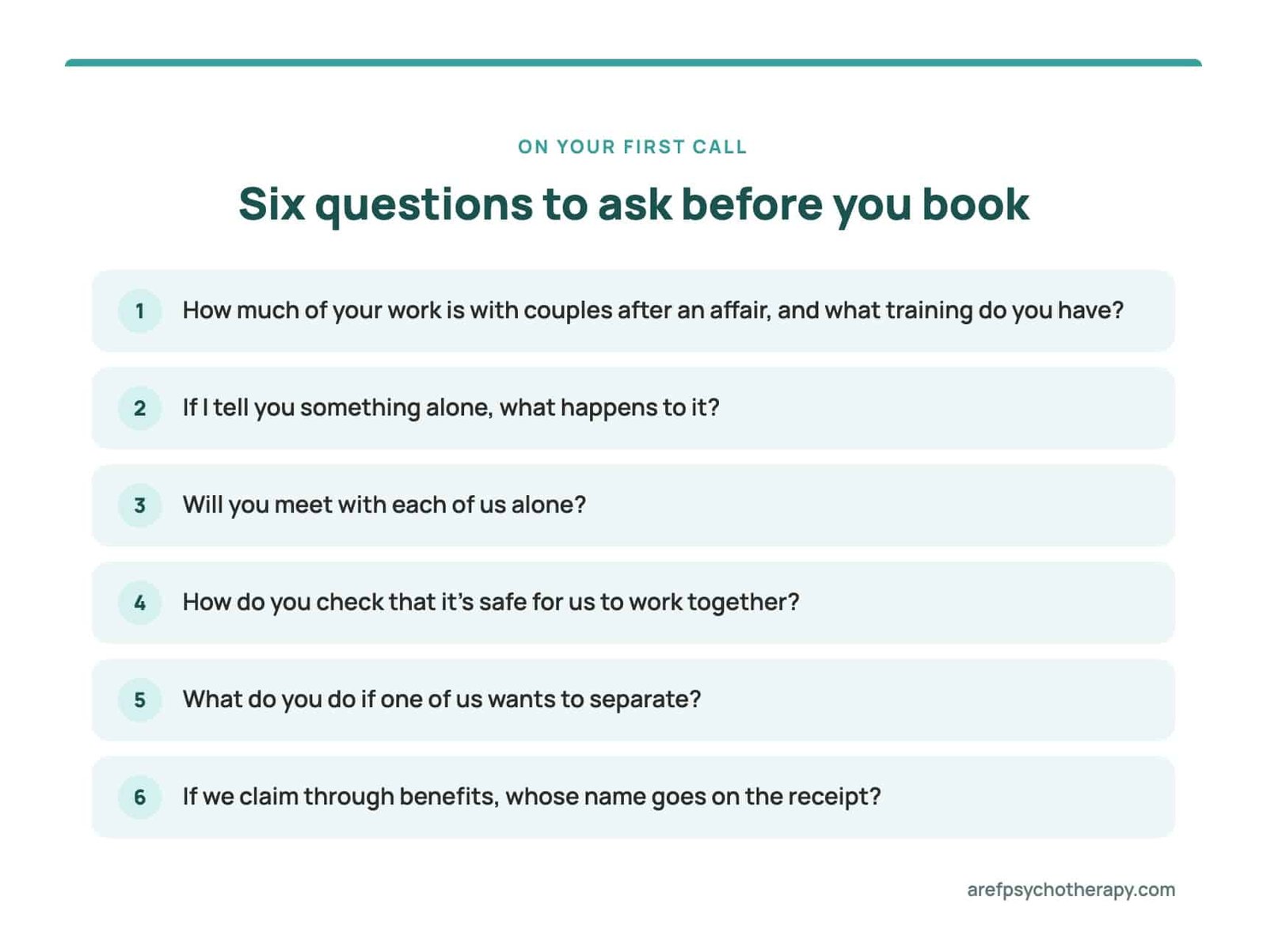
- How much of your work is with couples after an affair, and what training do you have?
- If I tell you something alone, what happens to it?
- Will you meet with each of us alone?
- How do you check that it’s safe for us to work together?
- What do you do if one of us wants to separate?
- If we claim through benefits, whose name goes on the receipt?
Key Takeaways
- Couples therapy after infidelity gives you a structured place to deal with what happened. It can’t promise your relationship will survive.
- Many couples improve and many drop out, and staying together isn’t the only good outcome.
- Ask how secrets are handled before anyone has a private conversation with the therapist.
- If you’re afraid of your partner, start with individual support instead of couples therapy.
- Online sessions need real privacy, a plan for someone leaving the call, and time to settle afterwards.
Frequently asked questions
How long does couples therapy after infidelity take?
There's no set length, and nobody can honestly promise a timeline. It depends on what happened, whether the affair has ended, and what you both want. AREF's couples sessions are usually weekly or every two weeks, with a check-in along the way to look at progress and goals. If anyone quotes you a fixed number of weeks to heal, ask what that's based on.
What if my partner won't come to therapy?
You can still start on your own. Individual therapy can help you steady yourself and work out what you want, whatever your partner decides. If your partner is unsure, not opposed, AREF can offer an initial session to talk through their concerns.
Will the therapist tell us to stay together or split up?
No. That decision belongs to the two of you. A therapist's job is to help you see things clearly, and they don't get a vote. They may tell you what they notice, such as when one of you seems to have already left. They may also say when couples work doesn't look safe or useful right now. If you feel pushed either way, say so.
Do I have to tell my partner everything?
Therapy can't decide this for you, and the answer depends on what you're carrying. A therapist can help you think through what to share, when, and why. A big secret can make couples work very hard, and some therapists won't continue around one. Ask how your therapist handles this before you tell them anything privately. The choice stays with you.
Does an emotional or online affair count?
If it broke the agreement between you, it's worth taking seriously, and you can bring it to therapy. Partners often disagree about what counts, and that disagreement can be the first thing you work on. You don't have to settle on a word for it before you come. A therapist can start from what it means to each of you.
Talk to a therapist
AREF Psychotherapy works online with couples and adults in Ontario. Our team includes Registered Psychotherapists (RPs), who are regulated by CRPO. You can read more about how couples therapy works with us and Emotionally Focused Therapy, an approach built around the emotional bond between partners.
You can start with a free 15-minute phone consultation, on your own or together. Use it to ask about secrets, safety and fit. Call us at (437) 830-2088, or book online.
If you need help right now
If you are thinking about ending your life, please reach out now. Call or text 9-8-8, the 9-8-8 Suicide Crisis Helpline, 24 hours a day, every day of the year. If you or someone else is in immediate danger, call 9-1-1.
This article is for informational purposes only and does not replace professional mental health advice. If you’re in crisis, please contact Canada’s 9-8-8 Suicide Crisis Helpline by calling or texting 9-8-8.
Sources and further reading
Research
- Atkins DC, Marín RA, Lo TTY, Klann N, Hahlweg K. Outcomes of couples with infidelity in a community-based sample of couple therapy. Journal of Family Psychology, 2010.
- Kröger C, Reißner T, Vasterling I, Schütz K, Kliem S. Therapy for couples after an affair: a randomized-controlled trial. Behaviour Research and Therapy, 2012.
- Marín RA, Christensen A, Atkins DC. Infidelity and behavioral couple therapy: Relationship outcomes over 5 years following therapy. Couple and Family Psychology: Research and Practice, 2014.
- Mitchell EA, Brown KS, Spencer J, Harris K. Staying together after infidelity: an exploration of the decision-making process of recovery from the perspective of the injured partner. Journal of Marital and Family Therapy, 2026.
- Coop Gordon K, Mitchell EA. Infidelity in the time of COVID-19. Family Process, 2020.
- Doherty WJ, Harris SM, Wilde JL. Discernment counseling for “mixed-agenda” couples. Journal of Marital and Family Therapy, 2016 (online 2015).
- Butler MH, Rodriguez MKA, Roper SO, Feinauer LL. Infidelity secrets in couple therapy: therapists’ views on the collision of competing ethics around relationship-relevant secrets. Sexual Addiction & Compulsivity, 2010.
- de Boer K, Muir SD, Silva SSM, et al. Videoconferencing psychotherapy for couples and families: a systematic review. Journal of Marital and Family Therapy, 2021.
Ontario regulators, government and support
- Standards of Practice, College of Registered Psychotherapists of Ontario (CRPO)
- Intimate partner violence, Government of Ontario
- Connect with supports for survivors of violence, Government of Ontario
- Is conjoint counselling ever appropriate in situations of woman abuse?, Luke’s Place
- Assaulted Women’s Helpline: 1-866-863-0511
- 9-8-8 Suicide Crisis Helpline: call or text 9-8-8