
Reviewed by the AREF Psychotherapy team
Last checked: November 2026
The return date is on the calendar, or it soon will be. You’ve probably run the first shift in your head already.
Going back to work after stress leave can be harder than leaving was. You left because you had to. Now you’re walking back in on purpose, in front of people who may have opinions.
The short version: you don’t owe your crew an explanation. Your employer can ask about your limits and your return date. It generally has no right to your diagnosis, though there are exceptions, and a WSIB claim changes what it can learn. You can ask for a gradual return, and your therapy doesn’t have to end when your leave does.
For how sessions and payment work with us, see our page on first responder therapy in Ontario.
This is general information, not legal advice. It covers Ontario rules. Your collective agreement may add to them, and federally regulated employers fall under different law. The WSIB rules below are for work-related injuries covered by WSIB. Short-term and long-term disability plans weren’t researched here, so ask your plan or your association.
Why going back to work after stress leave can be harder than leaving
Part of it is the job itself. Researchers at Ontario’s Institute for Work & Health interviewed 33 employer representatives from fire, paramedic, police and corrections services (Vesely and colleagues, 2026). Their paper notes that the work and the setting can set off trauma responses, and some reminders are in the building itself. This is the employers’ view, so read it that way.
Part of it is the crew. Those employers described ongoing suspicion that some people are dishonest about an injury to get paid time off. In comments from more than 828 Canadian public safety personnel, researchers found widespread suspicion that co-workers who took mental health time were abusing the system. Understaffing may increase scrutiny from the people left to cover (Ricciardelli and colleagues, 2018). If you expect comments, you aren’t being paranoid, and we can’t tell you they won’t come.
Modified work can sting too. Employers said returning with accommodations can be seen as a downgrade, and some supervisors think in all-or-nothing terms: fully fit, or not fit at all.
Then there’s your own voice. One police employer said self-stigma is probably what hits hardest: the thought that you aren’t who you used to be. Having that thought doesn’t make it true, but your plan has to cover more than a start date.
What you do and don’t have to tell people
Your crew isn’t owed a reason. What your employer gets depends on what it needs to accommodate you, and on whether there’s a WSIB claim. Nobody can promise that no one will find out.
- Your crew. Telling them is your call. The Ontario Human Rights Commission’s policy on mental health disabilities talks about discussing a disability only with people who need to know. People may still notice modified duties and guess.
- Your supervisor. They generally need to know what you can and can’t do. The policy says medical paperwork may be better sent to human resources or a health department. Ask who will see what.
- On a WSIB claim. Your employer knows there’s a claim. WSIB’s disclosure policy lists the diagnosis and the names of your care providers among details it can generally share. Specific clinical findings and particulars of treatment generally can’t be shared.
What to say when they ask
You’ll probably get asked. These are our suggested lines, not anyone’s real words, so change them until they sound like you.
- If someone asks where you’ve been: “Good to be back. What did I miss?”
- If someone asks about your duties: “That’s the plan for now. What’s on the list?”
- If someone covered your shifts: “Thanks for covering. I know it landed on you.”
- If a supervisor digs for details: “I can tell you what I can and can’t do. The medical side goes through HR.”
- If it’s someone you trust: “This week’s harder than I expected. Can I check in with you after shift?”
These lines are for the hallway. Anything formal from your employer, WSIB or an insurer needs a true answer.
A gradual return: what to settle before your first shift
A gradual return means building back up in steps. WSIB’s Functional Abilities Form has a box for graduated hours. Employers in the Ontario study described plans shaped around the person and reviewed regularly for pace, work and support. The Human Rights Commission says a set plan that ignores your circumstances may be discriminatory.
Before your first shift, try to pin down:
- Your start date and hours, and how they build
- Which shifts you’ll work, and when nights come back
- Which duties you’ll do, and which are off for now
- What exposure is off the table, in plain job terms
- Who you call if a shift goes badly
- Who gets told what
- When the plan gets reviewed
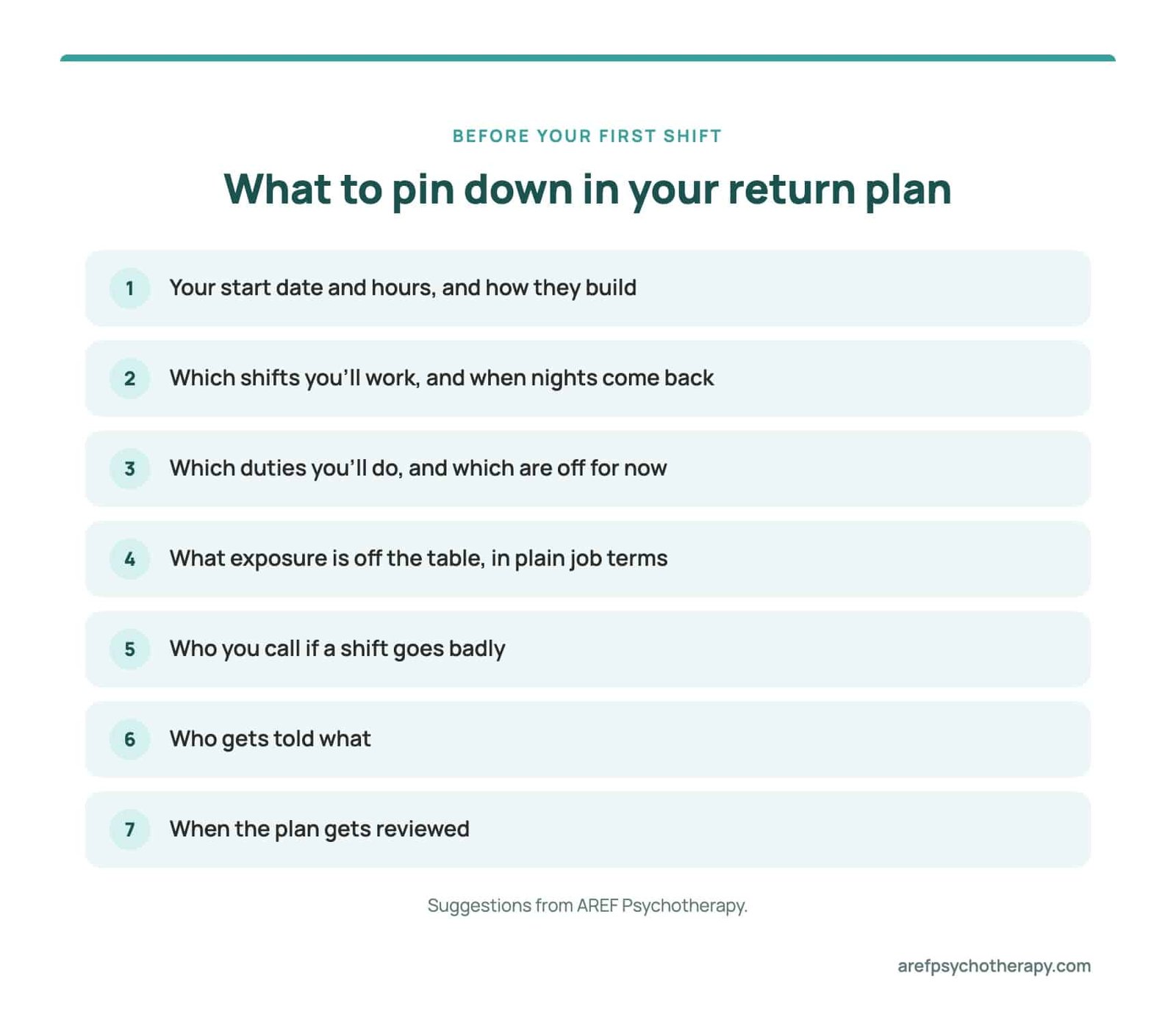
Number four matters. A police employer in the study said a limit like no exposure to traumatic content can leave them unsure if that means an investigation or the news on the TV. Limits in job terms are easier to match to real work.
Options can be thin, especially in smaller organizations, corrections and paramedic services, the employers said. WSIB says return-to-work teams can include your union or employee representative, so ask for yours.
You can work on that first shift before you’re standing in the doorway. AREF’s sessions are online, for people in Ontario. Book a free consultation with our intake team to ask questions first.
What your employer can ask for
Under the Human Rights Commission’s policy, you can generally be expected to provide:
- That you have a disability or medical condition
- Your limitations or needs
- Whether you can do the essential duties, with or without accommodation
- The type of accommodation you may need
- Regular updates on when you expect to be back
An employer generally has no right to your diagnosis, its cause, your symptoms or your treatment. It must not ask for more because of its own impression of what a mental health disability should look like. The policy is guidance, not a statute, though Ontario’s Human Rights Tribunal may consider it.
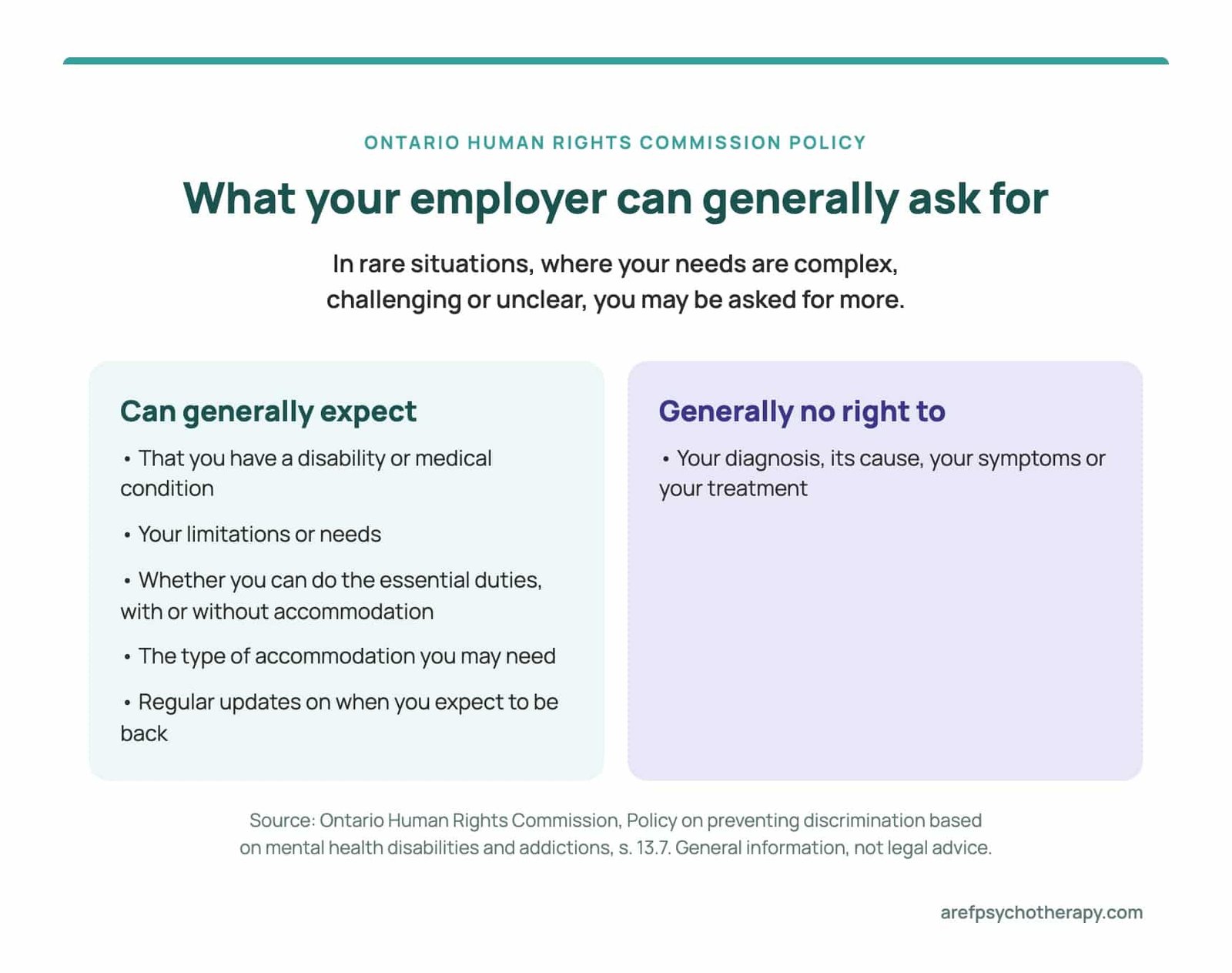
Now the exceptions. In rare situations, where your needs are complex, challenging or unclear, you may be asked for more, up to a diagnosis, and the employer must be able to justify why. You may be asked to attend an independent medical exam if there’s an objective reason to doubt the first evidence. Nobody can be made to attend, but not responding to reasonable requests can delay your accommodation or derail it. Safety counts: the policy’s example of a justified exam is a lifeguard who struggles after being cleared. Your service may also have its own fitness-for-duty process, so ask your association.
The Functional Abilities Form
On a WSIB claim, you or your employer can ask your treating health professional for this form. WSIB calls it optional, but the Workplace Safety and Insurance Act says the professional must provide the information when asked. Filing a claim also means consenting to that information reaching your employer, for return-to-work purposes.
WSIB’s guide to the form says diagnostic information must never go on it. That covers the form only. WSIB’s disclosure policy, above, is a separate route.
AREF doesn’t give fitness-for-duty opinions. If a form may be part of your return, raise it before you start.
Your rights when you go back
Human Rights Code section 17. Ontario’s Code treats a mental disorder as a disability. A tribunal can’t find you incapable of the essential duties unless your needs can’t be accommodated without undue hardship, considering cost, outside funding, and health and safety. So there is an end point: if you can’t do the essential duties even with accommodation, the Code may not protect that job. The Commission’s policy says employee morale isn’t a valid consideration, so an annoyed crew generally isn’t enough.
WSIA section 40: co-operation. On a WSIB claim, your employer must stay in contact and attempt to provide suitable work. You must stay in contact too, and help identify that work. WSIB’s policy says not co-operating can mean reduced or suspended benefits. Disputing whether a job is suitable isn’t non-co-operation, but if WSIB finds the job suitable, you’re expected to return.
WSIA section 41: re-employment. Generally, an employer must offer to re-employ you only if all three of these are true:
- You’ve been unable to work because of the injury
- On the date of injury, you’d worked for that employer continuously for at least one year
- The employer regularly employs 20 or more workers
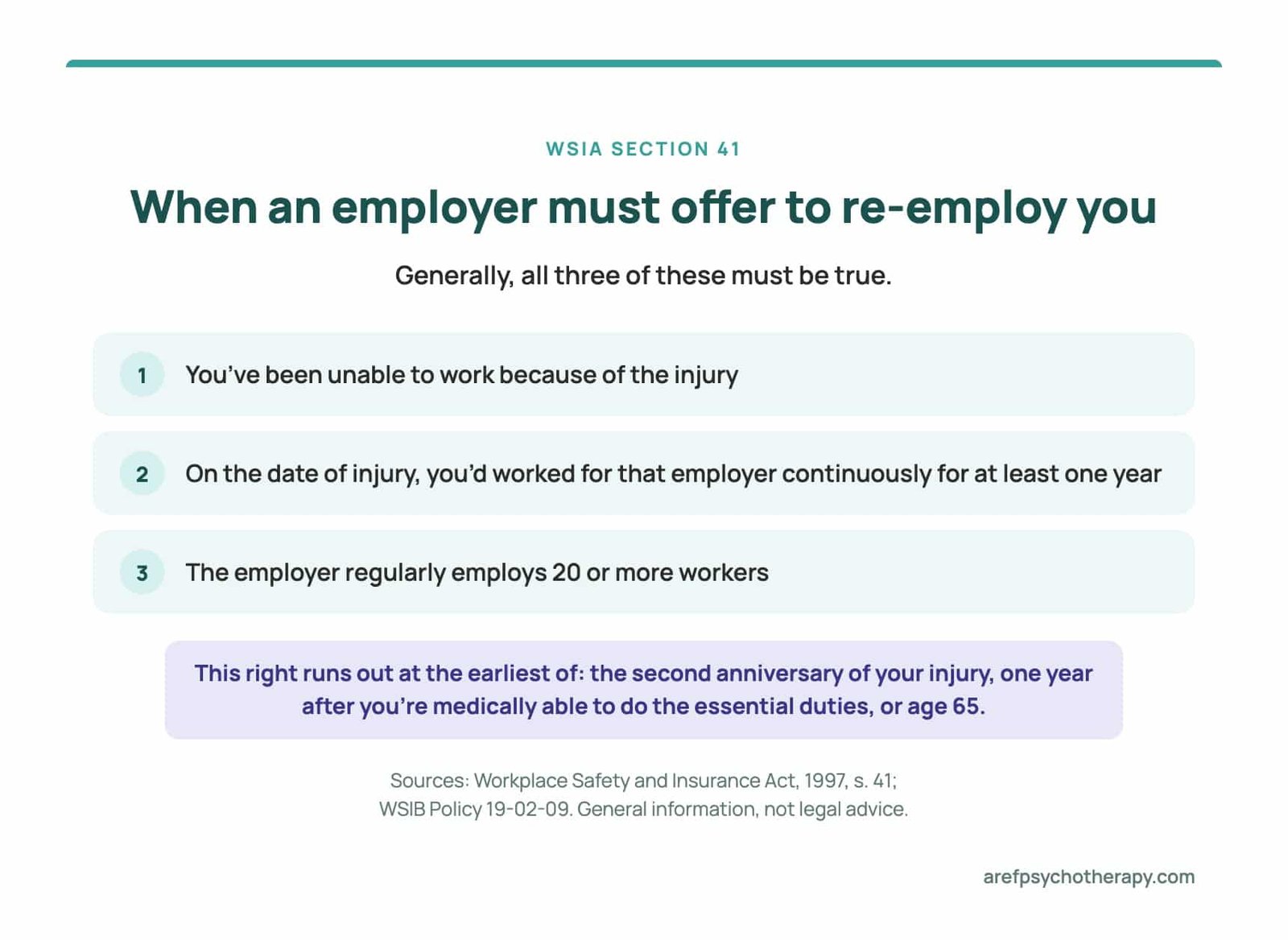
With less than a year, section 41 doesn’t apply, though section 40 and the Code still can. If you can do the essential duties, the employer must offer your old job or a comparable one. If you can only do suitable work, it must offer you the first opportunity at suitable work that becomes available.
This right runs out at the earliest of the second anniversary of your injury, one year after you’re medically able to do the essential duties, or age 65 (WSIB’s re-employment policy). If your employer re-employs you and ends your job within six months, it’s presumed to have breached this duty unless it shows the reason wasn’t related to the injury. Time limits apply, so get advice quickly.
When it’s not working
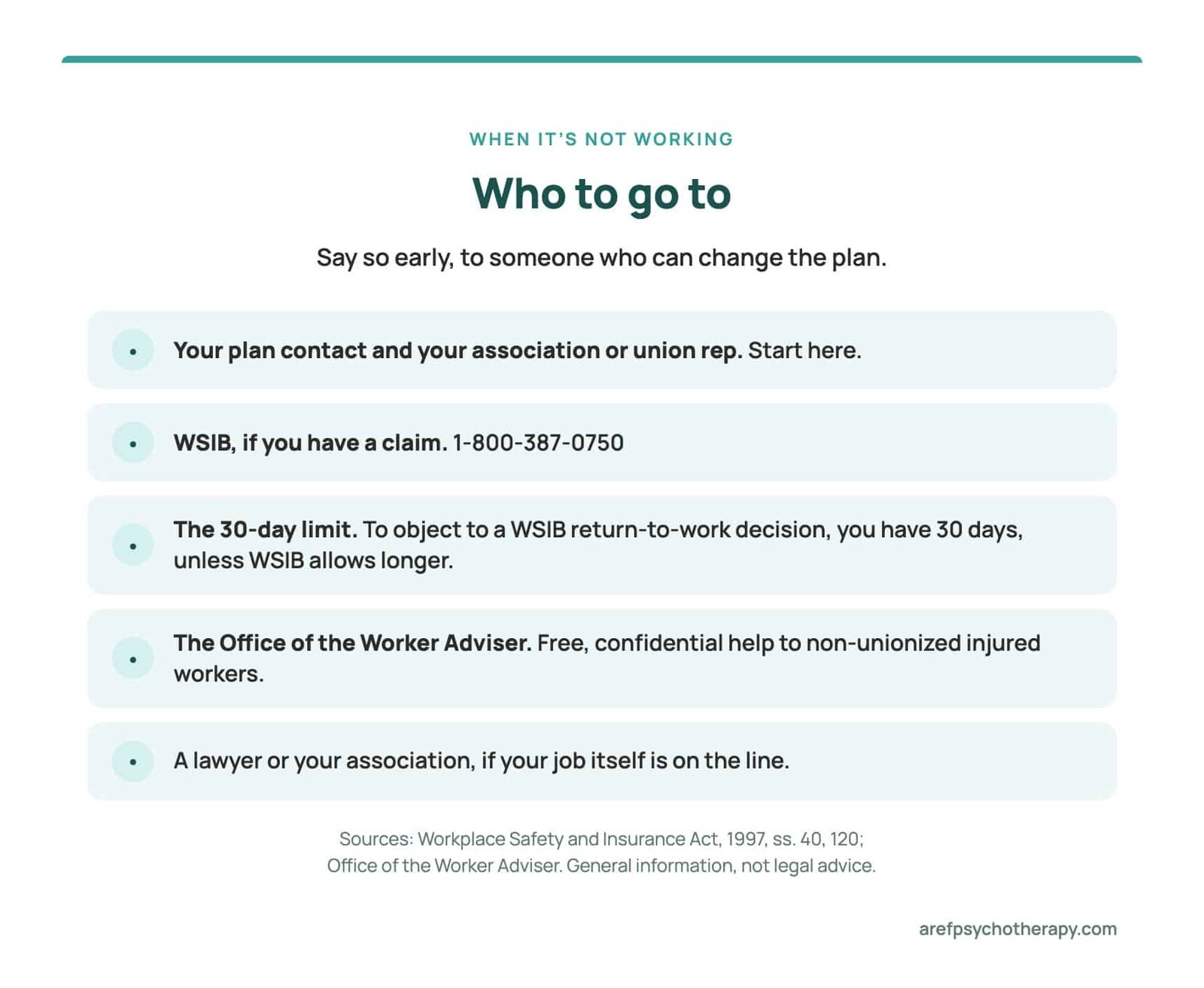
Say so early, to someone who can change the plan. WSIB’s policy expects fitness to change over time.
- Your plan contact and your association or union rep. Start here.
- WSIB, if you have a claim. You and your employer must report a co-operation problem. WSIB tries mediation, then decides. Call 1-800-387-0750.
- The 30-day limit. To object to a WSIB return-to-work decision, you have 30 days, unless WSIB allows longer.
- The Office of the Worker Adviser. It gives free, confidential help to non-unionized injured workers. Unionized workers go to their union.
- A lawyer or your association, if your job itself is on the line. That’s beyond this guide.
Everything in these rights sections is general information, not legal advice.
Keeping therapy going
Going back doesn’t have to mean stopping. Some people find the first weeks back are when they most want someone outside the building to talk to. A therapist can help you rehearse the first day and check whether the pace is working.
Time for appointments can be part of your accommodation. In a Human Rights Commission example, an employee needs medical appointments every Wednesday morning, and her employer offers flexible hours.
Privacy depends on how you pay, and limits exist. On a WSIB claim, your therapist must give WSIB the information it requires. The College of Registered Psychotherapists of Ontario’s standards say a therapist must explain those limits, so ask if nobody has.
Key takeaways
- Expecting talk is reasonable, and a clear plan helps.
- You don’t owe your crew a reason.
- Your employer can generally ask about limits and timing, and rarely more.
- On a WSIB claim, your employer knows there’s a claim.
- Section 41 needs one year of service and 20 or more workers, and it ends.
Frequently asked questions
Do I have to tell my crew why I was off?
No. Telling your crew is your choice. People may still guess, especially if your duties have changed, and nobody can promise they won't talk. If co-workers have a role in your accommodation, they may need to know one exists, but the Human Rights Commission says no more should be revealed than necessary.
Can my employer ask for my diagnosis?
Generally not, under the Ontario Human Rights Commission's policy. In rare cases where your needs are complex or unclear, it may ask for more, up to a diagnosis, and must be able to justify why. On a WSIB claim, WSIB's own disclosure policy lists the diagnosis among details it can generally share with your employer.
What if I'm on short-term or long-term disability, not WSIB?
We didn't research how disability plans handle forms, updates or what gets shared, so ask your plan or your association. The Human Rights Code can still apply to your return. The WSIB rules are for work-related injuries covered by WSIB.
Will AREF tell my employer I'm fit to go back?
AREF doesn't give fitness-for-duty opinions. If your employer or WSIB wants that kind of opinion, ask them who provides it. If you expect a form to be part of your return, raise it at your free consultation so you know how it would be handled.
Should I stop therapy once I'm back at work?
That's your decision, and it's worth talking through with your therapist first. If WSIB or a benefits plan is paying, ask how much support is left once you're back. Sessions at AREF are online, so ask our intake team about times that fit your shifts.
Talk to someone before that first shift
AREF Psychotherapy is a private clinic, separate from your service. Our team includes Registered Psychotherapists, regulated in Ontario. Read more about how therapy for first responders works with us, and about WSIB therapy if you have a claim.
Start with a free 15-minute phone consultation. Ask what gets shared, how forms are handled, and whether a therapist has worked with first responders. Call (437) 830-2088 or book online.
If you need help right now
If you are thinking about ending your life, please reach out now. Call or text 9-8-8, the 9-8-8 Suicide Crisis Helpline, 24 hours a day, every day of the year. First responders in Ontario can also call Boots on the Ground at 1-833-677-2668, 24/7, for anonymous peer support. If your safety is at risk right now, call 9-1-1.
This article is for informational purposes only and does not replace professional mental health advice. If you’re in crisis, please contact Canada’s 9-8-8 Suicide Crisis Helpline by calling or texting 9-8-8.
Sources and further reading
Research
- Vesely L, Mustard CA, Yanar B. Evolving influence of mental health stigma in Ontario public safety organizations: a qualitative study. Health Promotion and Chronic Disease Prevention in Canada, 2026. doi:10.24095/hpcdp.46.4.02.
- Ricciardelli R, Carleton RN, Mooney T, Cramm H. “Playing the system”: Structural factors potentiating mental health stigma, challenging awareness, and creating barriers to care for Canadian public safety personnel. Health, 2020 (online 2018). doi:10.1177/1363459318800167.
Ontario law
- Workplace Safety and Insurance Act, 1997, Government of Ontario: sections 22, 37, 40, 41 and 120
- Human Rights Code, Government of Ontario: sections 5, 10, 17, 30 and 45.5
Ontario Human Rights Commission
- Policy on preventing discrimination based on mental health disabilities and addictions: duty to accommodate
- Same policy: undue hardship
WSIB
- Functional Abilities Form and guide to completing it
- RTW Overview and Key Concepts, Policy 19-02-07
- RTW Co-operation Obligations, Policy 19-02-08
- Re-employment Obligations, Policy 19-02-09
- Disclosure of Claim File Information to Employers (No Issue in Dispute), Policy 21-02-03
- Returning to work
Other bodies
- Office of the Worker Adviser: getting help
- Standards of Practice, College of Registered Psychotherapists of Ontario (CRPO)
Support
- 9-8-8 Suicide Crisis Helpline: call or text 9-8-8
- Boots on the Ground: 1-833-677-2668