
Reviewed by the AREF Psychotherapy team
You’re still showing up. You take the calls, you do the work, and nobody on shift has said a thing. So you tell yourself it’s not that bad, even though you’re sleeping badly and home has got harder.
Is that enough of a reason to talk to someone? Our answer is yes. First responders, don’t wait until you can’t cope. You don’t have to hit a wall first.
This guide is for people in Ontario who do this work: dispatchers, correctional staff, paramedics, firefighters and police, serving or retired. For the practical side, such as how to pay for care, see our page on first responder therapy.
If you’ve had thoughts of ending your life, you don’t need to read any further first. Call or text 9-8-8, any time. There’s a section for you further down this page.
Don’t wait until you can’t cope: the short answer
If you’re asking “should I get help for PTSD?”, or for whatever this is, a good time to reach out is when something has changed and stayed changed. That could be your sleep, your temper, how much you drink, or how you are at home. You can still be doing the job well, and you don’t need a diagnosis first.
Public Safety Canada uses the term post-traumatic stress injury. It covers PTSD (post-traumatic stress disorder) and other problems linked to the work, such as depression and substance use.
So why is it serious enough to reach out? Because of what this can reach: your sleep, your partner, your family, your health and your work. Those are the things you’re looking after when you pick up the phone.
Why people wait
Waiting makes sense when you look at what the work teaches. In a Canadian study of 361 public safety communicators, Howe and colleagues (2025) heard that people are trained to keep going and push emotions aside. Some felt their needs weren’t serious enough for help. Others said symptoms can feel normal when the people around you have them too.
You may also have heard that this is what you signed up for. That belief came up in Vesely and colleagues’ 2026 Ontario study, based on interviews with 33 representatives from 28 public safety employers.
For many, a professional is the last stop. In a survey of 4,020 serving Canadian public safety personnel, Carleton and colleagues (2019) found 43% to 60% would use professional support never, or only as a last resort.
Then there’s what it could cost you. A 2012 Ontario Ombudsman report, summarized in Burns and Buchanan’s 2020 study, described officers holding back for fear of being transferred, losing a service pistol or missing a promotion. Those worries aren’t imaginary, and we won’t tell you they are. Who can find out depends on how you pay, and there are limits to privacy. The College of Registered Psychotherapists of Ontario’s standards say a therapist must explain those limits, so ask before you start. If you file a WSIB claim, your employer will know there is a claim: Ontario’s workplace insurance law says you give your employer a copy.
Is it just the job? What people in this work notice
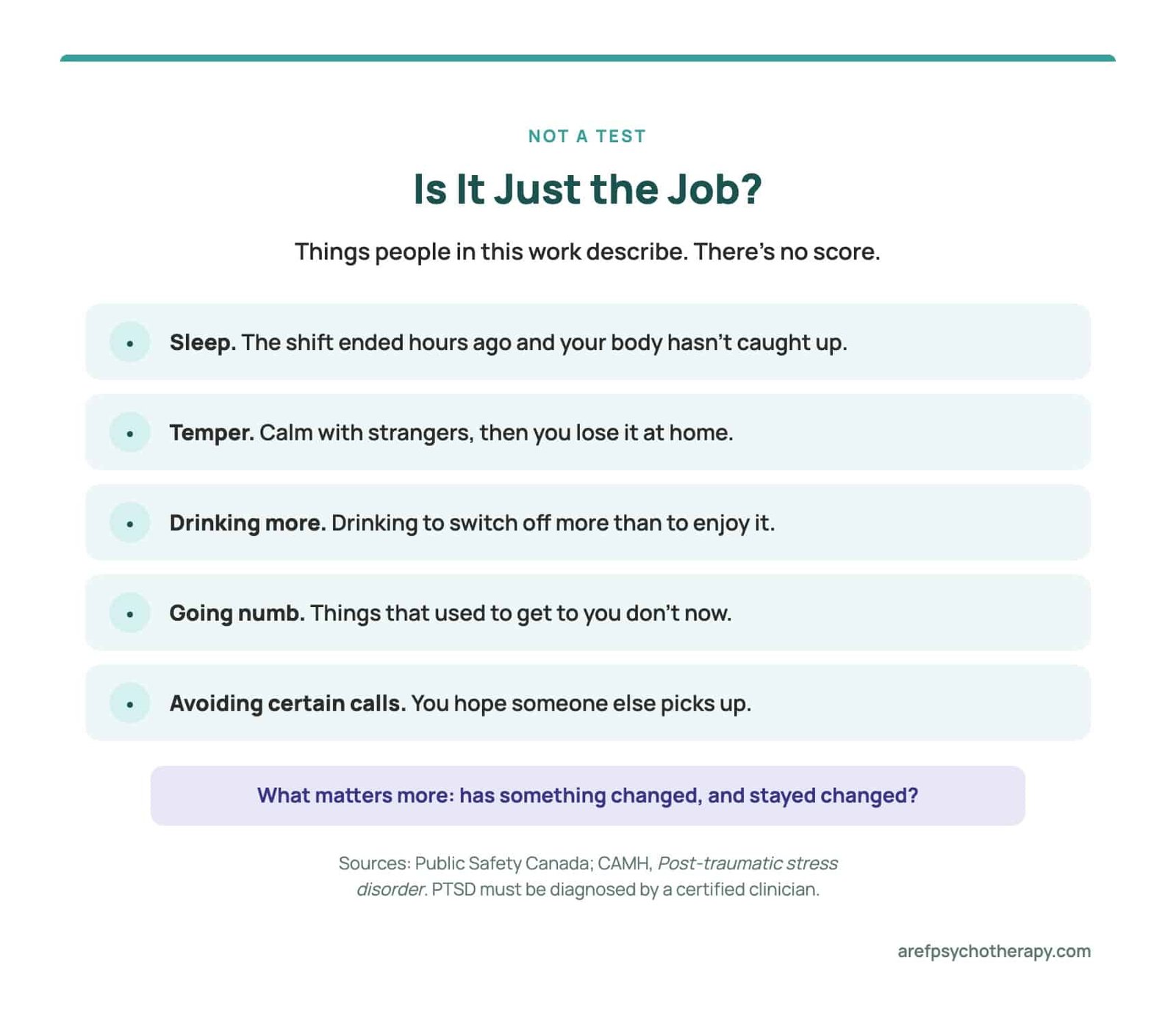
“Is this PTSD or just the job?” is a fair question, and a web page can’t answer it. This section isn’t a test. There’s no score, and no number of signs means anything. Public Safety Canada says PTSD must be diagnosed by a certified clinician. These are simply things people describe.
Sleep. The shift ended hours ago and your body hasn’t caught up. You run a call over again at night, or wake from bad dreams. In a Canadian survey of 5,813 public safety personnel, 49% to 60% in each group reported symptoms consistent with clinical insomnia. That is a survey screen, not a diagnosis.
Temper. You stay calm with strangers on their worst day, then lose it over shoes in the hallway. The Centre for Addiction and Mental Health (CAMH) lists getting angry easily among the signs of PTSD.
Drinking more. One beer after shift has turned into a few, and you’re drinking to switch off more than to enjoy it.
Going numb. Things that used to get to you don’t touch you now. Neither does your kid’s game. Public Safety Canada mentions feeling numb, and CAMH mentions losing interest in things you used to enjoy.
Avoiding certain calls. You hope someone else picks up. You trade a shift, or brace when a certain kind of call comes in. CAMH describes this as staying away from reminders of what happened.
Any one of these can have many causes, and none of them tells you what’s going on. What matters more is whether something has changed, stayed that way, and bothers you or the people you live with. If it does, that’s reason enough for a conversation.
What it reaches at home
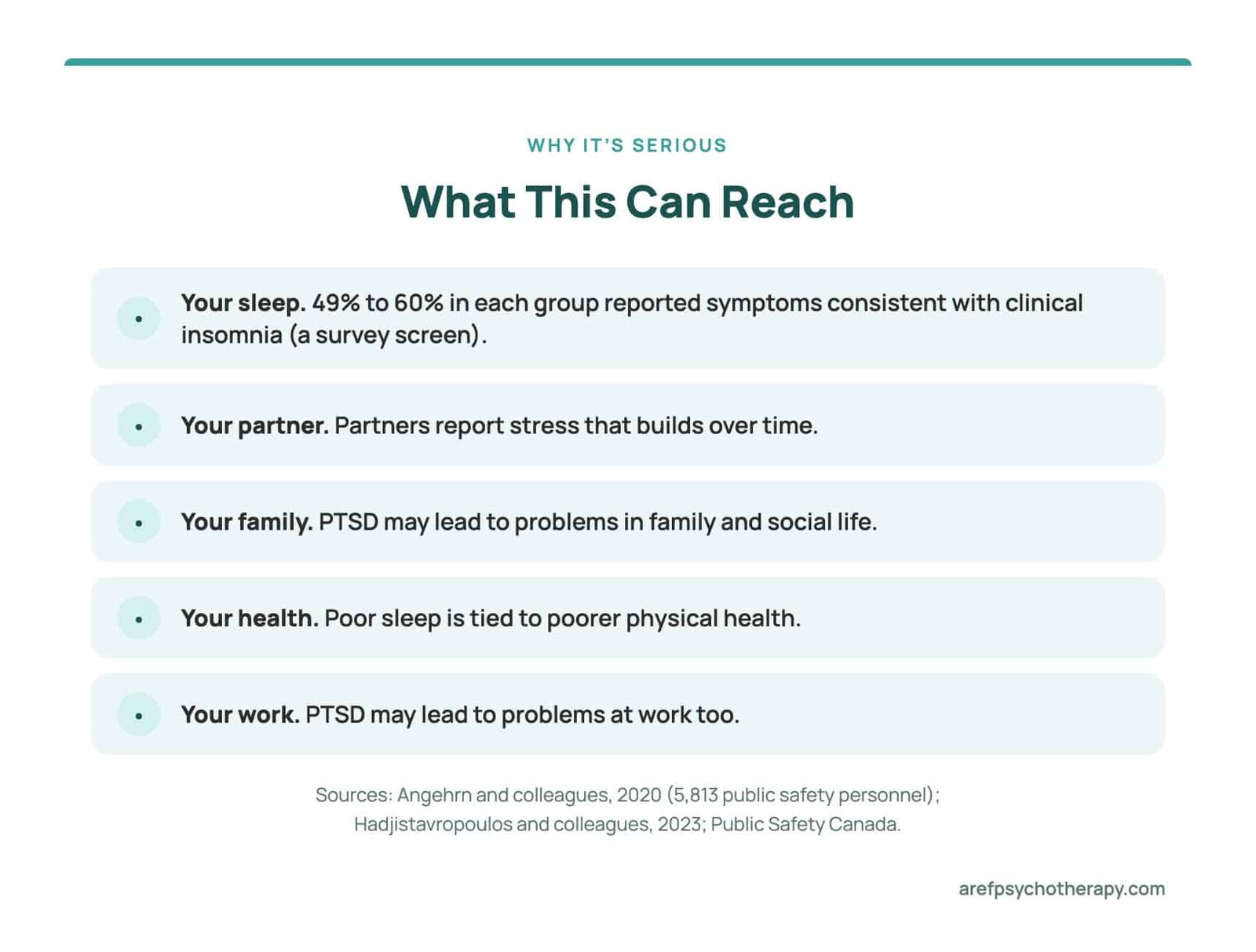
This is the part that makes it serious. Public Safety Canada notes that PTSD may lead to problems in family and social life, and at work. Hadjistavropoulos and colleagues (2023), who studied support for spouses and partners of public safety personnel in Canada, wrote that the demands of this work affect couples and family life, and that partners report stress that builds over time. Your partner may be carrying more than they’ve said. If you have kids, they live in that house too.
Your health is part of this too. The authors of the survey of 5,813 note that poor sleep is tied to poorer physical health.
The people around you are also part of what protects you. In a Canadian survey of public safety personnel, Vig and colleagues (2020) found that people who reported more social support were less likely to screen positive for depression and, in most groups, for PTSD. That’s a link, not proof of cause. CAMH also lists avoiding friends and family as a sign of PTSD. So when you start pulling away, you may be stepping back from the same people who help hold you up.
If home is where you feel this first, couples therapy is one option. CAMH says family counselling and individual treatment can help with relationship troubles.
Not sure it’s bad enough to call? You can still book a free consultation. It’s a 15-minute phone call with our intake team, with no obligation, and you don’t have to decide anything on the call.
You don’t need a crisis to deserve help
Not everyone waits. In Burns and Buchanan’s study of 20 serving RCMP officers, some saw early that they needed help, or used services before things got hard.
You can start therapy without a diagnosis. Our team includes Registered Psychotherapists, regulated by the College of Registered Psychotherapists of Ontario. A Registered Psychotherapist can’t give you a diagnosis, but can look at what’s going on and what might help. If you need one later for a claim, our WSIB therapy page explains your options.
This counts too if you’ve retired, if you volunteer, or if the hard part was years ago. CAMH says PTSD usually appears within three months of an event, but sometimes symptoms may not appear for years. Our guide to PTSD in Ontario first responders has more.
In one small study, most people needed a push
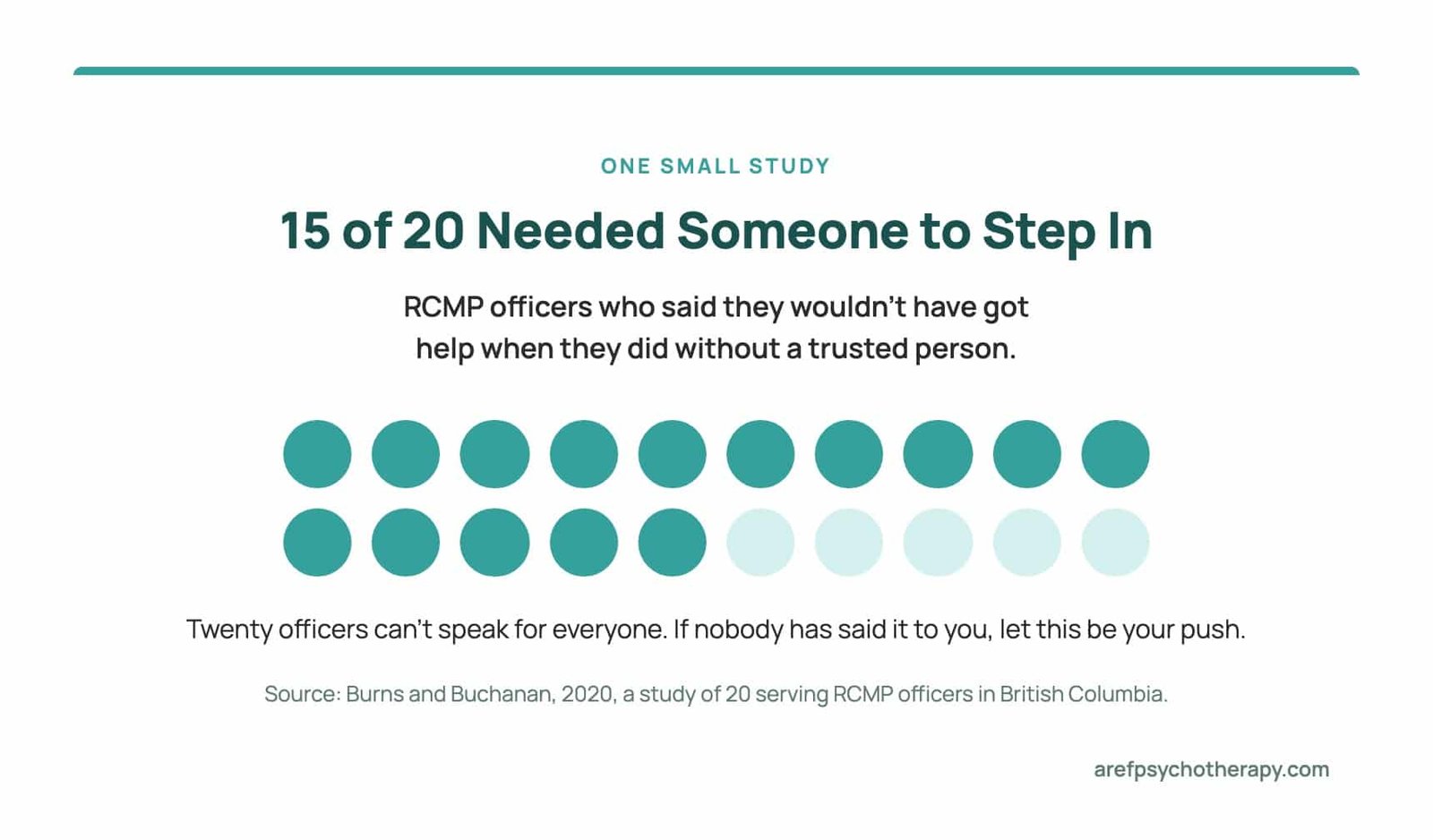
In the same RCMP study, 15 of the 20 officers said they would not have got help when they did without a trusted, respected person stepping in. Some had no idea how they were doing until that person said something. Others knew they weren’t coping, but seeing a professional hadn’t crossed their mind. Twenty officers from one part of British Columbia can’t speak for everyone, but some people clearly don’t get there alone.
A partner, a crew-mate or a supervisor may already have said something to you. That may be worth listening to. If nobody has, let this be your push.
If you’ve thought about ending your life
If you’ve had thoughts of ending your life, you can talk to someone about it today. You don’t have to be sure how serious it is, and you don’t have to be at your lowest point.
Call or text 9-8-8. The 9-8-8 Suicide Crisis Helpline is open 24 hours a day, every day of the year. If you’re not sure you need it, 9-8-8 says to reach out anyway, and a responder will listen and talk things through with you. It also has steps for feeling safer in the moment. If your safety is at risk right now, or you’ve already tried to hurt yourself, call 9-1-1 or go to your nearest emergency department.
Boots on the Ground, 1-833-677-2668, is a 24/7 Ontario peer support line for first responders, serving or retired. They say plainly that they aren’t therapists, and that there is no call display. They also publish exceptions to their anonymity and confidentiality, and a serious risk of harm is one of them.
CAMH’s guide to talking about suicide says talking to someone about suicide won’t cause or increase suicidal thoughts, and that it can help a person feel less isolated and scared. It also says people can and do get better.
Suicide is complex, and it can affect anyone. Having these thoughts says nothing about your character or how good you are at your job. If there’s someone you feel safe with, telling them counts. A therapist can talk about this with you too, and can explain what they would need to do if your safety were at serious risk, since that is one of the limits to confidentiality.
If you’re worried about someone else, on your crew or at home, 9-8-8 is there for that as well.
One small first step
You don’t have to decide about therapy today. You could tell one person you trust what you’ve noticed: “I haven’t been sleeping, and I think it’s the job.” Or you could book a free 15-minute phone consultation and ask your questions first.
Before you start with any therapist, ours included, it’s fair to ask:
- Have you worked with people in my kind of job? What training do you have in it?
- What are the limits of confidentiality, and do they change with how I pay?
- What do you write down, and who can see it?
- Will I have to talk about my worst calls?
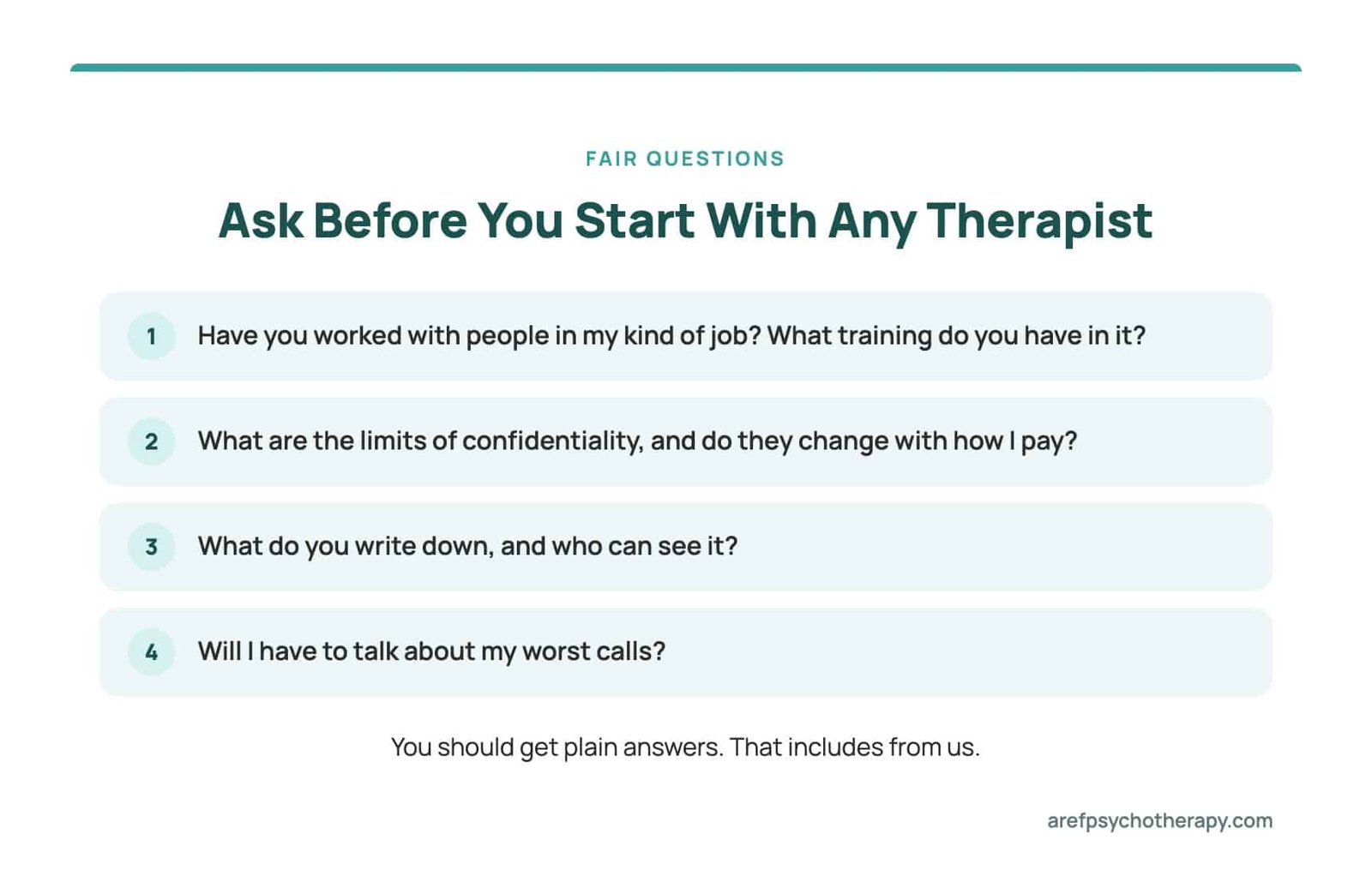
You should get plain answers. Therapy with our clinical team is online, by secure video, from wherever you feel safe in Ontario, so there’s no waiting room to sit in.
Key takeaways
- A change that has stayed is reason enough to talk to someone. You don’t need a crisis or a diagnosis.
- It’s serious because of what it can reach: your sleep, your partner, your family, your health and your work.
- The signs here aren’t a test. PTSD must be diagnosed by a certified clinician.
- If you’ve thought about ending your life, call or text 9-8-8.
Frequently asked questions
When should a first responder get help for PTSD symptoms?
You can reach out as soon as something has changed and stayed changed, such as your sleep or your temper. You don't need a diagnosis, and you don't need to be in crisis. If it's bothering you or the people you live with, that's enough.
How can I tell if it's PTSD or just the job?
You can't settle that from a list. PTSD must be diagnosed by a certified clinician. Registered Psychotherapists can't give a diagnosis, but they can talk through what you've noticed and what might help. You can have that conversation before you know the answer.
Will my service find out if I see a therapist?
It depends on how you pay. If you file a WSIB claim, your employer will know there is a claim. There are also legal limits to confidentiality, such as a serious risk of harm. A therapist must explain those limits, so ask before you start.
Is therapy a waste of time if I'm not that bad?
Some people in this work feel nothing will help. CAMH says people can recover from PTSD, though the time varies, and that trauma counselling or therapy can be very helpful. No therapist can promise a result. A first conversation can help you decide whether it's worth trying.
I retired years ago. Does this still apply to me?
Yes. CAMH says PTSD symptoms sometimes don't appear for years. Boots on the Ground is open to retired and serving people, and you can talk to a therapist at any point. If you're thinking about a WSIB claim, there are time limits, so ask early.
Talk to someone when you’re ready
You don’t have to know what this is before you call. You can read how first responder therapy works at AREF, including the ways to pay, or call us at (437) 830-2088.
If you need support right now
- 9-8-8 Suicide Crisis Helpline: call or text 9-8-8, 24 hours a day, every day of the year.
- Boots on the Ground: 1-833-677-2668, peer support for first responders, 24/7.
- If your safety is at risk: call 9-1-1 or go to your nearest emergency department.
This article is for informational purposes only and does not replace professional mental health advice. If you’re in crisis, please contact Canada’s 9-8-8 Suicide Crisis Helpline by calling or texting 9-8-8.
Sources and further reading
Research on first responders and public safety personnel
- Burns C, Buchanan M. Factors that Influence the Decision to Seek Help in a Police Population. International Journal of Environmental Research and Public Health, 2020.
- Howe E, et al. Exploring Canadian Public Safety Communicator Mental Health Help-Seeking Behaviors. New Solutions, 2025.
- Vesely L, Mustard CA, Yanar B. Evolving influence of mental health stigma in Ontario public safety organizations. Health Promotion and Chronic Disease Prevention in Canada, 2026.
- Carleton RN, et al. Mental health training, attitudes toward support, and screening positive for mental disorders. Cognitive Behaviour Therapy, 2020 (online 2019).
- Angehrn A, et al. Sleep Quality and Mental Disorder Symptoms among Canadian Public Safety Personnel. International Journal of Environmental Research and Public Health, 2020.
- Vig KD, et al. Mental health and social support among public safety personnel. Occupational Medicine, 2020.
- Hadjistavropoulos HD, et al. Internet-Delivered Cognitive Behavioral Therapy Tailored to Spouses and Significant Others of Public Safety Personnel. JMIR Formative Research, 2023.
Canadian health and government information
- Post-Traumatic Stress Injuries and Support for Public Safety Officers, Public Safety Canada
- Posttraumatic Stress Disorder, Centre for Addiction and Mental Health (CAMH)
- Words Matter: Language Guidelines, Centre for Addiction and Mental Health (CAMH)
- Standards of Practice, College of Registered Psychotherapists of Ontario
- Workplace Safety and Insurance Act, 1997, Government of Ontario
Support
- 9-8-8 Suicide Crisis Helpline: call or text 9-8-8
- Boots on the Ground: 1-833-677-2668