
Reviewed by the AREF Psychotherapy team
You’ve thought about talking to someone. Then you picture the schedule change, the comments on the floor, and the look when you walk back in. You remember what got said about the last person who went off work. You don’t want to be next.
That worry has a name, first responder stigma, and it isn’t in your head. Whether you work in dispatch, corrections, fire, paramedics or policing, you have probably heard people talk.
So we won’t tell you nobody will talk, and we won’t tell you nobody will find out. We will say this: your crew’s opinion shouldn’t be what decides whether you get help. They are working from guesses. You and the people at home are the ones living with it. And you have more say than you might think over who knows what.
If you want the practical side first, our page on first responder therapy in Ontario covers how sessions and payment work.
You’re not imagining it: people talk
Yes, people talk, and the research backs you up.
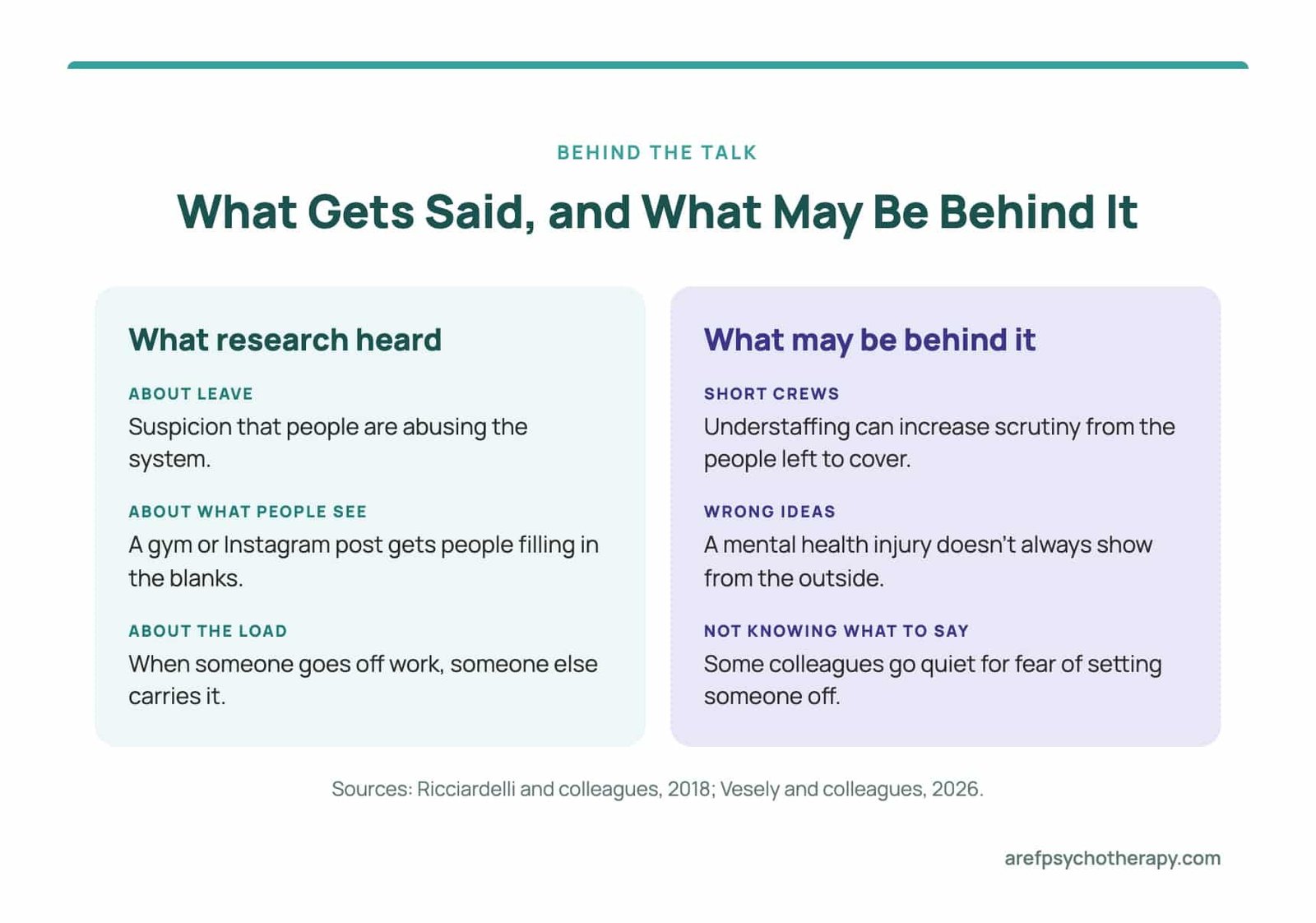
Researchers at Ontario’s Institute for Work & Health interviewed 33 employer representatives from fire, paramedic, police and corrections services. They report ongoing suspicion that some people are being dishonest about an injury to get paid time off. One police employer described how seeing someone at the gym or on Instagram can get people filling in the blanks, and called the rumour mill brutal (Vesely and colleagues, 2026).
A Canadian online survey shows the same pattern from the frontline side. In open comments from more than 828 public safety personnel, researchers found widespread suspicion that co-workers who took time for their mental health were abusing the system (Ricciardelli and colleagues, 2018).
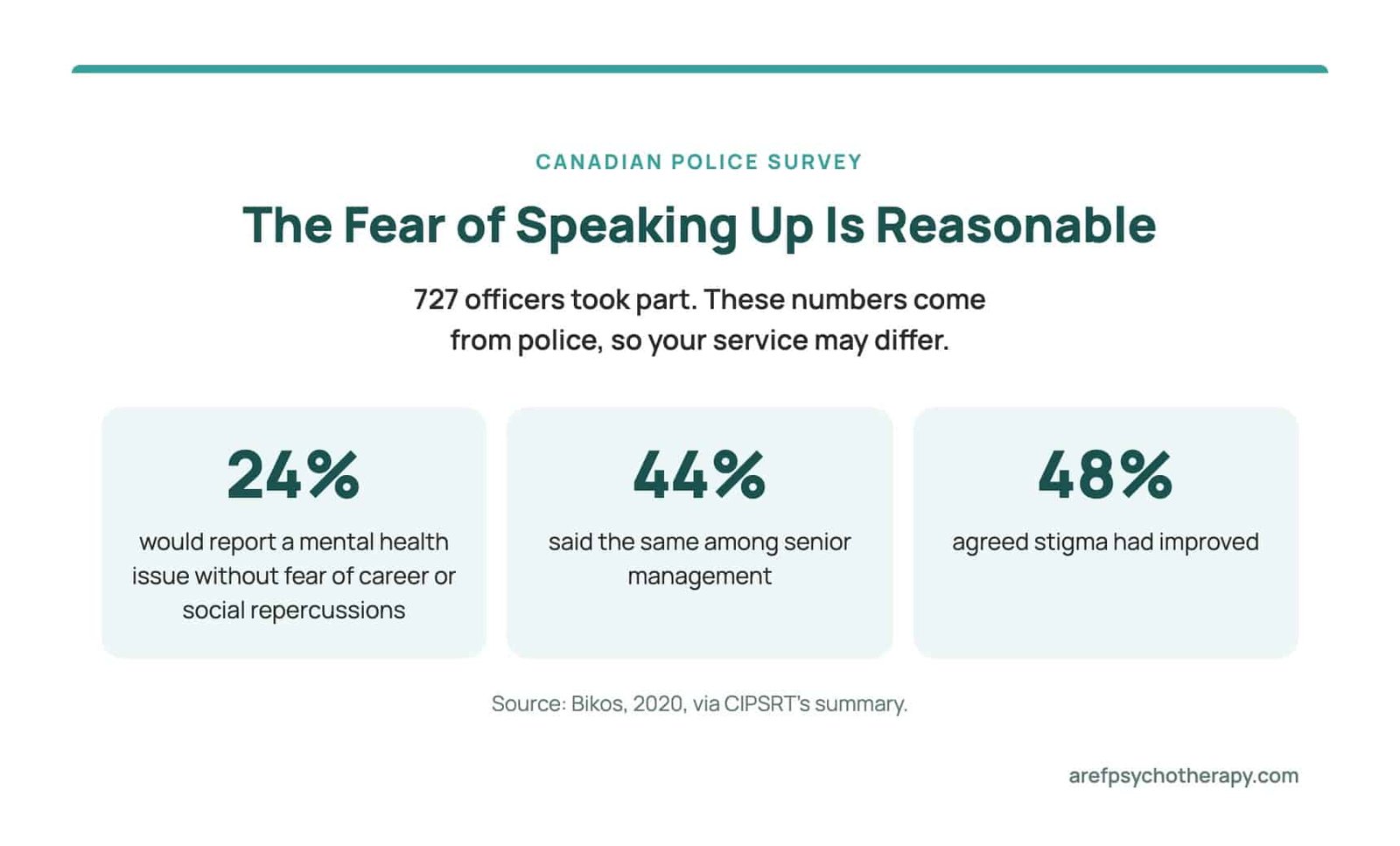
The fear of speaking up makes sense too. In a national study of Canadian police officers, only 24 per cent of those surveyed said they would report a mental health issue without fear of career or social repercussions. Among senior management it was 44 per cent (CIPSRT’s summary of Bikos, 2020). Those numbers come from police, so they may not match your service. They do show this isn’t paranoia.
Why first responder stigma gets louder on a short crew
Part of the talk comes from staffing. When someone goes off work, someone else carries the load. The study of those survey comments found that understaffing may increase scrutiny of an injured worker by the people left to cover. So when you worry about being called the weak link on your shift, that worry has a real source.
None of this excuses what gets said. But our own reading, which no study has measured, is that some of what sounds like a verdict on you is a tired person’s complaint about staffing.
The other part is what people think an injury looks like. The Ontario study notes that suspicion can come from wrong ideas about how a mental health injury shows up. A trip to the gym tells your crew nothing about how you slept.
The crew is quieter than it looks
The silence on your crew may hide more than you think, though nobody can prove that for your crew.
A separate study of Canadian police officers ran a stigma survey at a mandatory workshop, and 90.5 per cent responded. The most agreed-with items were about avoiding telling a supervisor or a colleague, at 85 per cent agreement (Stuart, 2017). A 2022 study of the same scale shows these items ask what most officers would do. So the number tells us what officers expect of each other. It isn’t a count of people hiding something.
Here is our inference, and it is ours, not the study’s. If most officers expect each other to stay quiet, then a quiet crew can’t tell you how many people are struggling. Some of the people you think would judge you may be carrying something too.
Other research points the same way. A small Ottawa study interviewed 24 firefighters, paramedics and police officers. Participants described a paramedic culture of hiding symptoms. One police officer described taking it all in, then feeling like the only one (Testa and colleagues, 2023).
Some silence may not be judgement at all. The Ontario employers said most colleagues now accept the injury is real, but are afraid to talk to the person in case they set them off. That is the employers’ view, and in the national police study only 48 per cent agreed stigma had improved. The Ontario researchers warn this awkwardness can still leave a person isolated. Even so, the co-worker who goes quiet when you walk in may simply not know what to say.
Who actually has to know
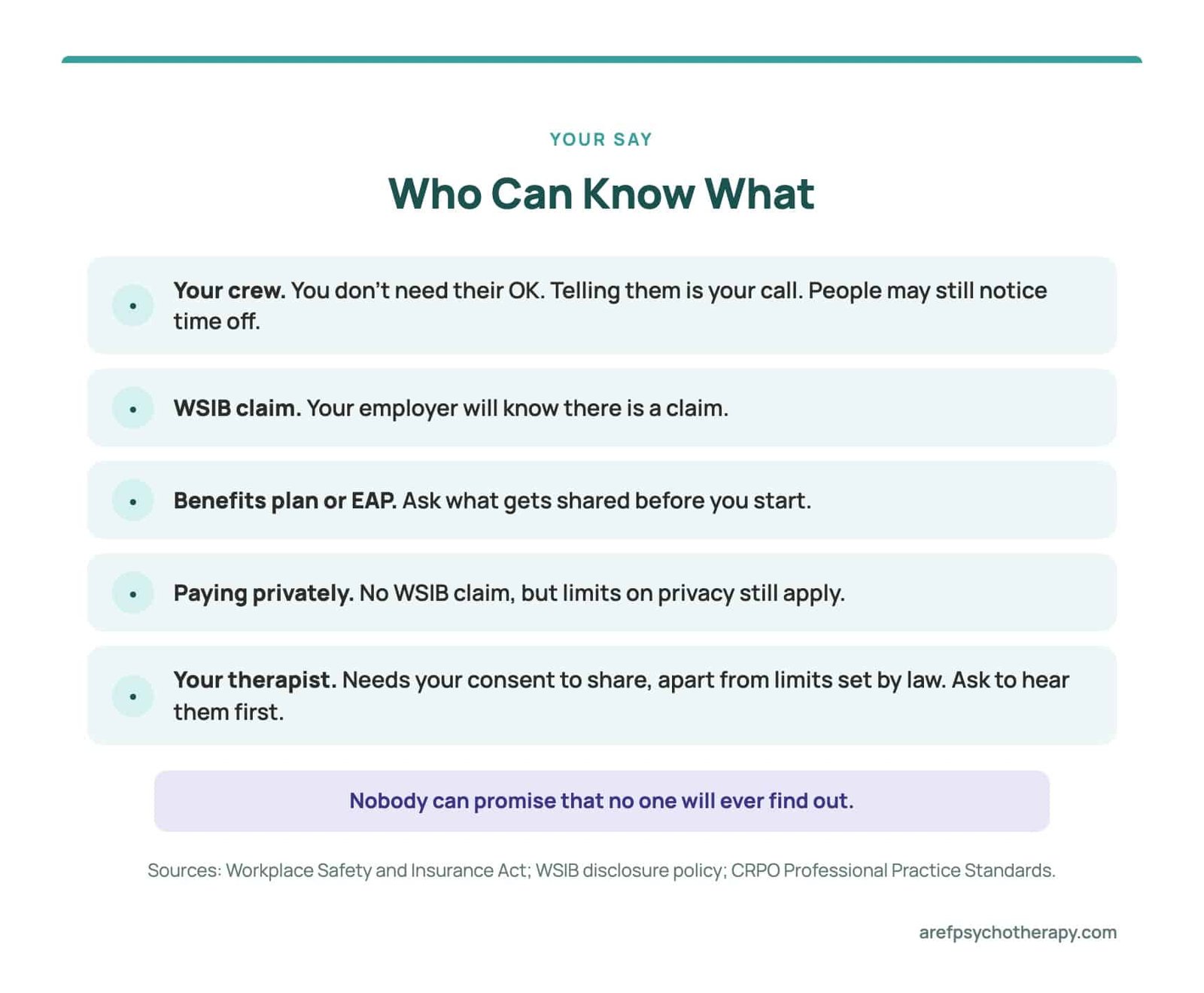
Who can find out depends on how you get help and how you pay. Nobody can promise you that no one will ever find out, and we won’t either.
- Your crew. You don’t need your crew’s OK to book a session, and telling them is your call. People may still notice time off and guess. You can decide what you confirm.
- Your employer. This depends on the route. If you file a WSIB claim, your employer will know there is a claim. Ontario’s Workplace Safety and Insurance Act says you give them a copy, and WSIB’s disclosure policy lists claim details that can generally be shared with them. Our page on WSIB therapy explains how that route works. With a benefits plan or an employee assistance program, ask what gets shared before you start. If you pay privately there is no WSIB claim, but limits on privacy still apply.
- Your therapist’s limits. A therapist normally needs your consent to share your information. The College of Registered Psychotherapists of Ontario’s standards name exceptions, such as a significant risk of serious harm and some legal proceedings. Those standards also call for informed consent before work begins, and for explaining the limits of confidentiality. If a therapist doesn’t go through this with you before you start, ask.
Whose opinion should count
You don’t have to stop caring what your crew thinks. You trust these people on the worst calls, and their respect matters. You can care and still refuse to hand them this one decision.
Start with who lives with it. Your crew sees you for a shift. They aren’t there when you’re awake at 3 a.m. Whoever shares your life is. In a survey of 4,020 Canadian public safety personnel, 74 per cent said they would go to a spouse first, and many said they would use professional support never or only as a last resort (Carleton and colleagues, 2019). For many people, then, the person at home is the first one asked to help carry this.
Then look at what an opinion costs the person giving it. Someone who tells you to suck it up goes home after shift. They pay nothing for being wrong about you.
Some opinions do deserve weight. In a small study of 20 RCMP officers in British Columbia, 15 said they would not have received psychological help when they did without a trusted, respected person stepping in. Those people included family, friends and supervisors (Burns and Buchanan, 2020). So pick your people on purpose. Look for someone who knows you and has kept a confidence before.
Talk has a real cost, and so does carrying this alone. Only you can weigh those two. Just don’t leave the weighing to the people with the least at stake.
In the Ottawa study, first responders worried about running into someone they knew at a clinic. AREF’s sessions are online, for people in Ontario, so there is no waiting room to sit in. That doesn’t make therapy invisible, and the limits above still apply. If you want to ask questions first, book a free consultation with our intake team.
What to say if someone asks
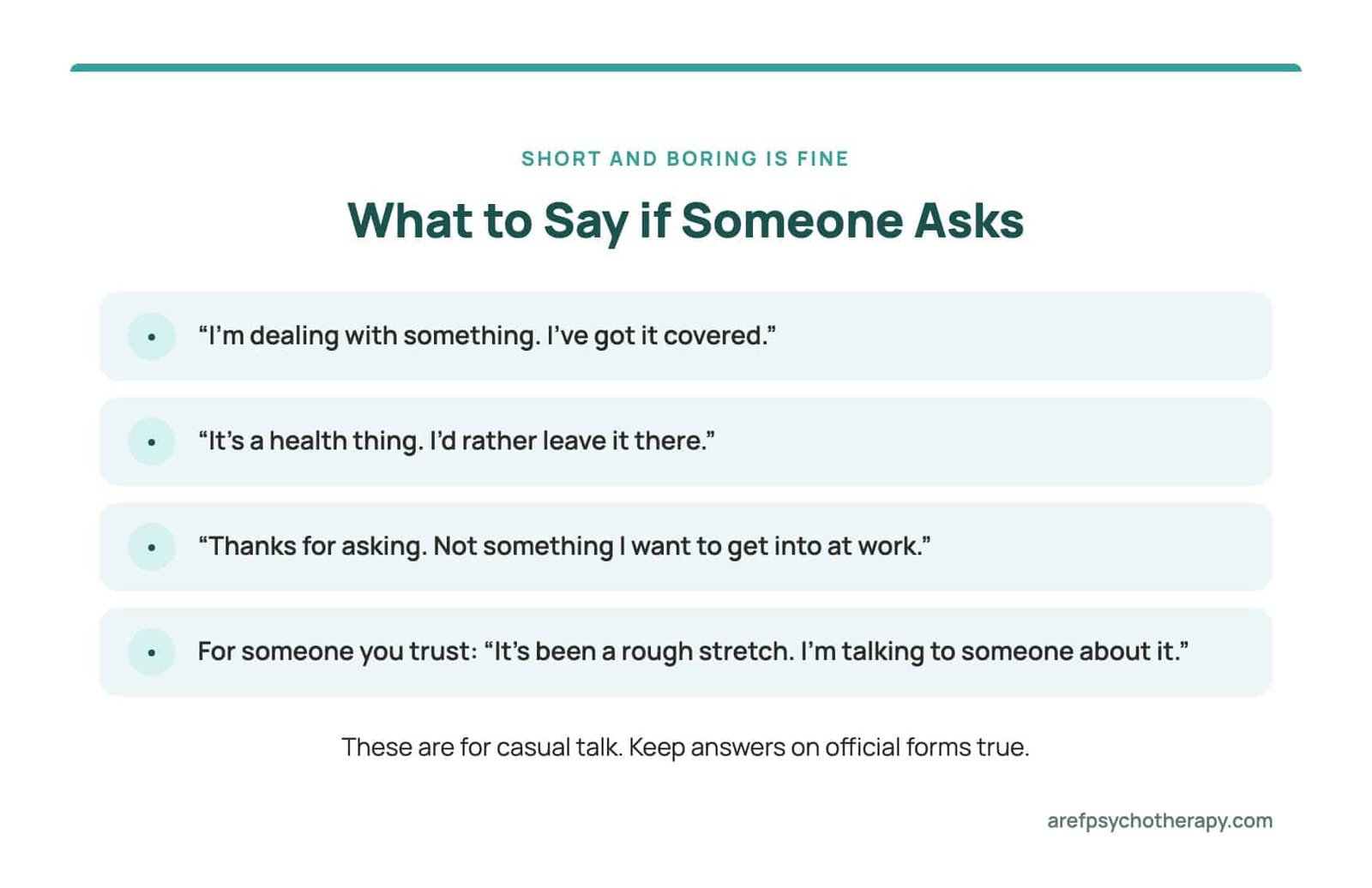
You don’t owe the hallway an explanation. A short, boring answer is a fair answer. Here are some lines to borrow, change or ignore:
- “I’m dealing with something. I’ve got it covered.”
- “It’s a health thing. I’d rather leave it there.”
- “Thanks for asking. Not something I want to get into at work.”
- For someone you trust: “It’s been a rough stretch. I’m talking to someone about it.”
If it comes up as a joke, you don’t have to answer it. You can let it pass without laughing and without explaining.
One caution: these lines are for casual talk. A form or an official question from your employer or an insurer is different. Keep those answers true, and ask your association or a lawyer if you aren’t sure.
If your workplace really is that bad
Sometimes the fear is right about the place. In the national police study, officers who reported a mental disorder to their employer described management behaviour that stigmatized them further. In the RCMP study, some officers described supervisors who were openly critical and broke confidences, while others described supervisors who were caring and discreet.
If that is your workplace, you can be careful and still get help:
- Look outside your service. You can choose someone with no connection to your workplace, and choose how to pay once you know what each route shares.
- Talk to a peer outside your workplace. Boots on the Ground is an anonymous Ontario helpline where first responders talk to other first responders. They say plainly that they aren’t therapists.
- Ask your association or union rep about your own service’s rules.
Key takeaways
- First responder stigma is real, and being careful is reasonable.
- Some of the talk comes from short staffing and wrong ideas about what an injury looks like.
- A quiet crew may hide more than it shows. That is our reading of the research, not a proven fact.
- Who can find out depends on how you pay. On a WSIB claim, your employer will know there is a claim, and no route comes with a promise that nobody will ever know.
- Your crew’s opinion matters to you, and it still shouldn’t be what decides this.
Frequently asked questions
Will my crew find out if I go to therapy?
We can't promise they won't. A therapist normally needs your consent to share your information, apart from limits set by law. But people can notice time off, and on a WSIB claim your employer will know there is a claim. Who can find out depends on how you pay. Ask a therapist to walk you through it first.
Why do I care so much what my crew thinks?
These people matter to your work and your safety. One Canadian study of police help-seeking notes that the need to belong and be accepted can be critical to officer safety. Caring is not a flaw. It only becomes a problem when it is the one thing keeping you from help you want.
Will people think I'm faking?
Some might. Research with Canadian public safety personnel found suspicion of this kind, and short staffing can add to it. You can't control that. A mental health injury doesn't always show from the outside. What people assume is a guess, and you don't have to answer it.
Should I tell one person at work?
You don't have to. Some people find it helps to have one person who knows, and a small RCMP study suggests a trusted person can matter a lot. Choose someone who has kept a confidence before. A supervisor may have duties of their own, so ask what they would pass on first.
What if my crew finds out anyway?
That can happen, and it is fair to plan for it. Decide ahead of time what you are willing to say, and keep it short. You don't have to confirm a rumour or explain your care. If it goes badly, your association or union rep can tell you your options. A therapist can help you work through it too.
Talk to someone outside the crew
AREF Psychotherapy is a private clinic, separate from your service. Our team includes Registered Psychotherapists (RPs), who are regulated by the College of Registered Psychotherapists of Ontario (CRPO). You can read more about how first responder therapy works with us, including the ways to pay.
You can start with a free 15-minute phone consultation. Use it to ask what gets shared, who can see it, and whether a therapist has worked with first responders. Call us at (437) 830-2088, or book online.
If you need help right now
If you are thinking about ending your life, please reach out now. Call or text 9-8-8, the 9-8-8 Suicide Crisis Helpline, 24 hours a day, every day of the year. First responders in Ontario can also call Boots on the Ground at 1-833-677-2668, 24/7, for anonymous peer support. If your safety is at risk right now, call 9-1-1.
This article is for informational purposes only and does not replace professional mental health advice. If you’re in crisis, please contact Canada’s 9-8-8 Suicide Crisis Helpline by calling or texting 9-8-8.
Sources and further reading
Research
- Vesely L, Mustard CA, Yanar B. Evolving influence of mental health stigma in Ontario public safety organizations: a qualitative study. Health Promotion and Chronic Disease Prevention in Canada, 2026. doi:10.24095/hpcdp.46.4.02.
- Ricciardelli R, Carleton RN, Mooney T, Cramm H. “Playing the system”: Structural factors potentiating mental health stigma, challenging awareness, and creating barriers to care for Canadian public safety personnel. Health, 2020 (online 2018). doi:10.1177/1363459318800167.
- Bikos LJ. “It’s all window dressing”: Canadian police officers’ perceptions of mental health stigma in their workplace. Policing: An International Journal, 2020. doi:10.1108/PIJPSM-07-2020-0126. Research summary, Canadian Institute for Public Safety Research and Treatment (CIPSRT).
- Stuart H. Mental illness stigma expressed by police to police. Israel Journal of Psychiatry and Related Sciences, 2017.
- Burzee Z, Bowers CA, Beidel DC. A re-evaluation of Stuart’s police officer stigma scale. Frontiers in Public Health, 2022.
- Testa V, Bennett A, Jutai J, et al. Applying the Theoretical Domains Framework to identify police, fire, and paramedic preferences for accessing mental health care. Health Promotion and Chronic Disease Prevention in Canada, 2023.
- Carleton RN, Afifi TO, Turner S, et al. Mental health training, attitudes toward support, and screening positive for mental disorders. Cognitive Behaviour Therapy, 2020 (online 2019). doi:10.1080/16506073.2019.1575900.
- Burns C, Buchanan M. Factors that influence the decision to seek help in a police population. International Journal of Environmental Research and Public Health, 2020.
Ontario law and regulators
- Workplace Safety and Insurance Act, 1997, Government of Ontario
- Disclosure of Claim File Information to Employers (No Issue in Dispute), Policy 21-02-03, WSIB Operational Policy Manual
- Standards of Practice, College of Registered Psychotherapists of Ontario (CRPO)
Support
- 9-8-8 Suicide Crisis Helpline: call or text 9-8-8
- Boots on the Ground: 1-833-677-2668