
Reviewed by the AREF Psychotherapy team
Someone asks about your worst call, and you don’t have one to give them. There was no single night. There were years on the headset or on the unit, and somewhere along the way you stopped sleeping well.
Most talk about first responder trauma starts with one terrible call. That story leaves people out: dispatchers who never learn the ending, correctional staff for whom there may be no “call” at all, women who already feel they have to prove themselves, and anyone for whom it simply built up.
The short answer is yes, this counts. An injury can build over years, and you don’t need a worst call to take it seriously. For the practical side, see our page on first responder therapy in Ontario.
Why the one-terrible-call story of first responder trauma leaves people out
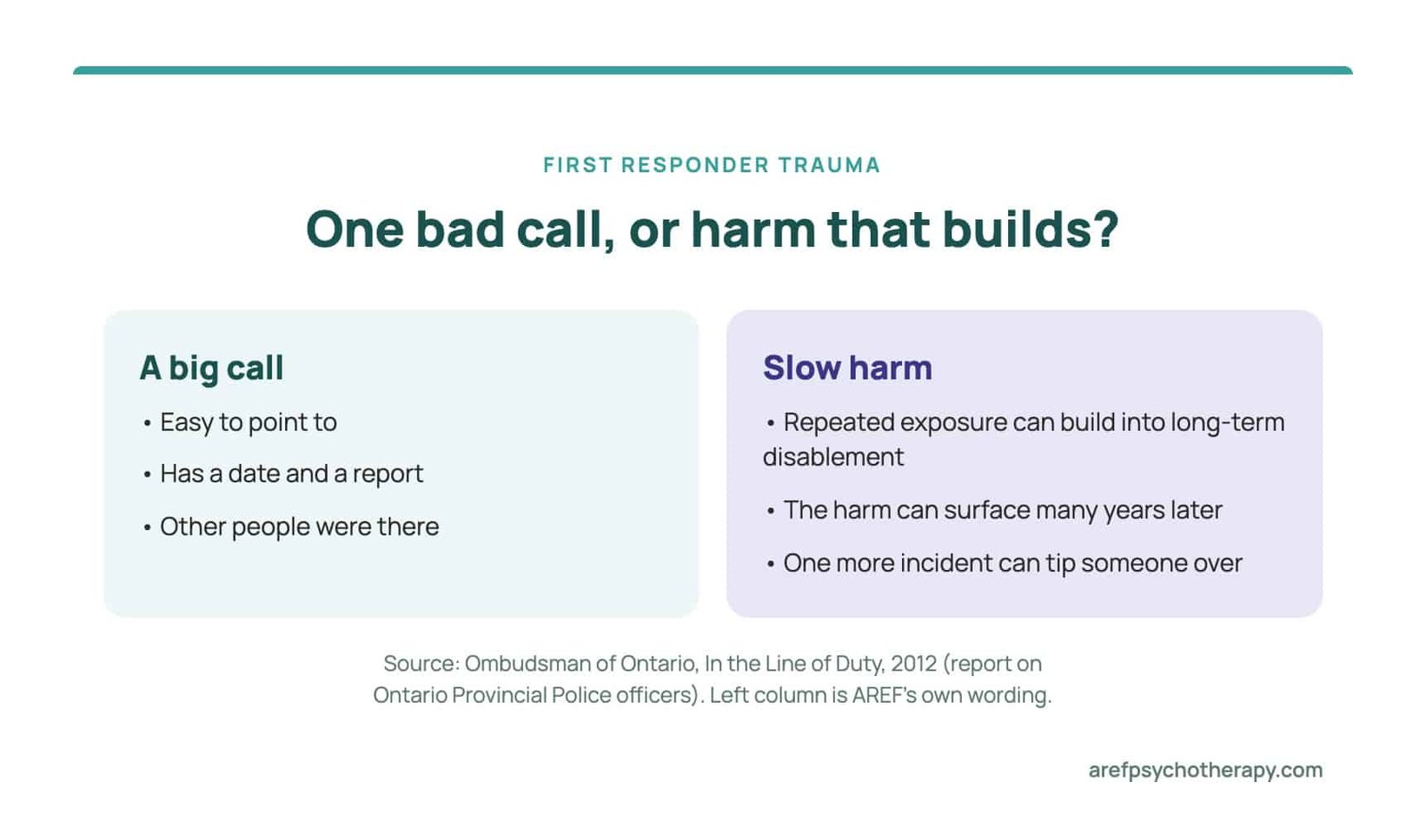
A big call is easy to point to. It has a date and a report, and other people were there. Slow harm has none of that, so it is easy to wave away.
Ontario’s Ombudsman described the slower path in 2012, in In the Line of Duty, a report on Ontario Provincial Police officers. Repeated exposure, it says, can build into long-term disablement, and the harm can surface many years later. Someone can seem to come through a series of events untouched until one more incident tips them over. So if a small call finally did it, the years before it still count.
Workplaces have been slower to accept this. Burns and Buchanan (2020), writing about that report, describe more tolerance for reactions after major incidents and far less for long-term cumulative stress. That comes from policing, so your service may differ.
Dispatch: hearing it and never knowing how it ended
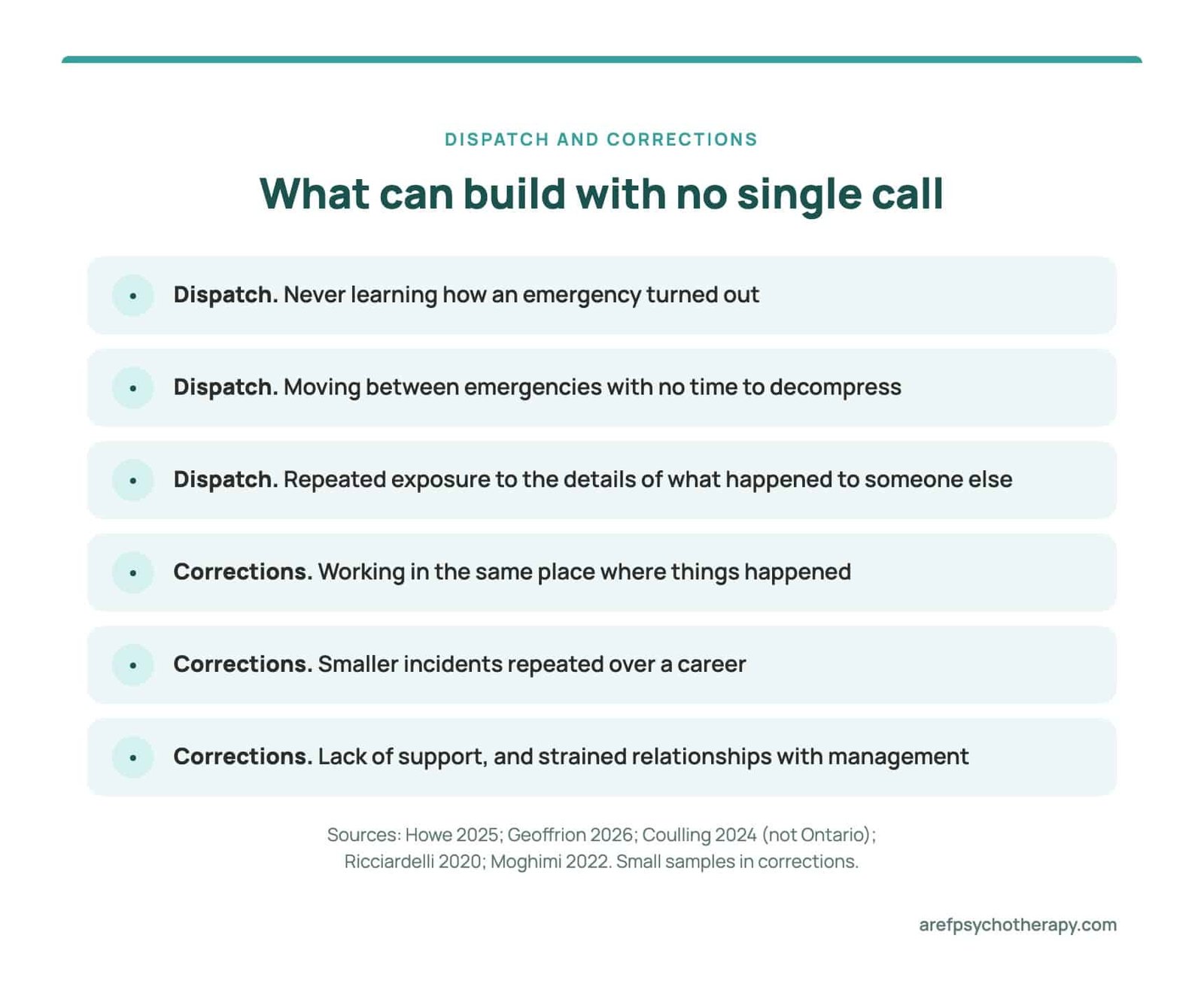
Too often, dispatchers and call-takers never learn how an emergency turned out, say Howe and colleagues (2025), who surveyed 361 Canadian communicators. A 2026 study of 508 Canadian communicators adds that moving between emergencies with no time to decompress creates a stress cycle that field staff rarely face.
Some people will say you weren’t at the scene. That 2026 study explains that the definition of a traumatic exposure in psychiatry’s diagnostic manual includes repeated or extreme exposure to the details of what happened to someone else. Exposure doesn’t have to mean being there.
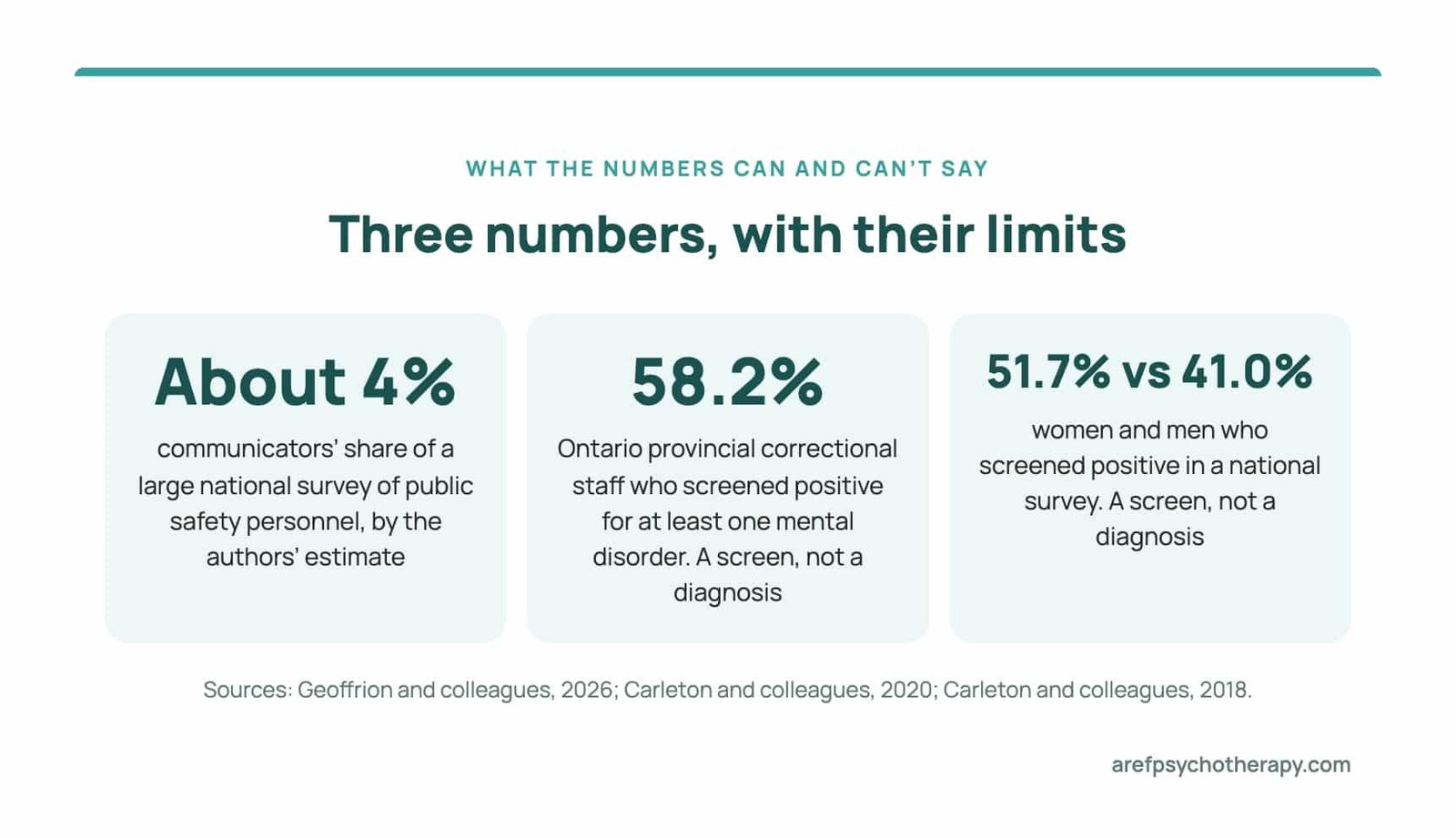
The same study says communicators often feel invisible and are frequently left out of post-incident support and recognition ceremonies. By its authors’ estimate, they were only about 4 per cent of the large national survey of public safety personnel. In Howe’s survey, one call-taker had seen a manager tell an employee in an email that this was the job “you signed up for”.
It is also hard to spot from inside. When everyone around you is worn down, one dispatcher noted, feeling that way can seem normal. The researchers add that symptoms creep up in intensity. These are people’s own words from a pandemic-era online survey, so read them as a picture, not a count.
Corrections: when the job itself wears you down
For many correctional staff there is no “call”. There is the unit, shift after shift, in the same place where things happened, as Coulling and colleagues (2024) point out.
An Ontario survey of provincial correctional staff found that 58.2 per cent of 1,032 respondents screened positive for at least one mental disorder. A screen is a self-report flag, not a diagnosis, and people chose to answer. Staff with over 15 years of service were more likely to screen positive than those with under four, though a survey like this can’t show cause.
Many of the 21 current and former workers in a small Ontario study described effects that were slow and cumulative. Comments from 67 Ontario staff carry the same idea: one officer said smaller incidents repeated over a career can do real damage and tend to get brushed aside.
Some of the wear has nothing to do with the people in custody. One participant in the small Ontario study said lack of support had hurt her mental health more than dealing with violence. Coulling’s study points the same way: about a third of 192 written comments named relationships with management as a source of stress or a barrier to recovery. That study did not include Ontario, and those comments came mostly from Manitoba.
The left-out feeling is here too. One participant in the small Ontario study said officers are rarely included in things like a law enforcement day. Most participants wanted a therapist who knew corrections, which is a fair thing to ask about.
This section is about Ontario. Federal corrections sit outside the research and rules here, apart from some federal staff in that small study. If you work for Correctional Service Canada, ask your union.
Women in the services: asking for help when you already have to prove yourself
First, a warning. Most of this evidence comes from police, and much of it from small studies. Treat it as a pattern, not a measurement.
Burns and Buchanan studied 20 RCMP officers in British Columbia, eight of them women. Some of the women said they had to prove themselves more than the men. Most put off help until they could no longer cope, compared with few of the men. The authors say results from so few people can’t be generalized.
A national study of Canadian police officers found women reported a stronger belief that stigma exists, while men reported more avoidance and self-stigma. A national survey of public safety personnel, published in 2018, found 51.7 per cent of women and 41.0 per cent of men screened positive for a mental disorder. That is a survey screen, not a diagnosis, and the gap was significant only among municipal and provincial police and firefighters.
Outside policing the picture is thinner. Women in the small Ontario corrections study described harassment from colleagues and people in custody, and said constant boundary-setting was draining. Interviews with 41 frontline workers described gendered bullying and male peer supporters who didn’t understand. A string of comments never gets an incident report, which is, in our reading, one more way harm builds with no date on it.
One finding cuts the other way. A national study of 3,740 provincial and territorial correctional staff found women reported less stigma and more intent to use services than men. So being willing isn’t always the hard part.
You don’t have to sort out the whole history before you call. AREF’s sessions are online, for people in Ontario, which can help when you’re drained after a block of shifts. Who can find out still depends on how you pay. To ask questions first, book a free consultation with our intake team.
Yes, this counts
You may still be arguing with yourself.
- “There was no worst call.” You don’t need one. The research above describes harm that builds.
- “Others have had it worse.” People in Howe’s survey described playing down their own problems this way. Comparing doesn’t measure what you’re carrying.
- “I signed up for this.” Ontario employers in a 2026 study described that line as part of how their services used to think. WSIB’s own policy says a chronic stress claim in a high-stress job shouldn’t be denied simply because everyone in that job faces high stress.
Therapy doesn’t have to start with a worst call. You can start with what’s going on now, and you don’t need a name for it first. If you’d rather talk to a peer, Boots on the Ground is an anonymous Ontario helpline that names emergency dispatch and corrections and welcomes civilian staff.
Who’s covered in Ontario
This is general information, not legal advice. Last checked: November 2026.
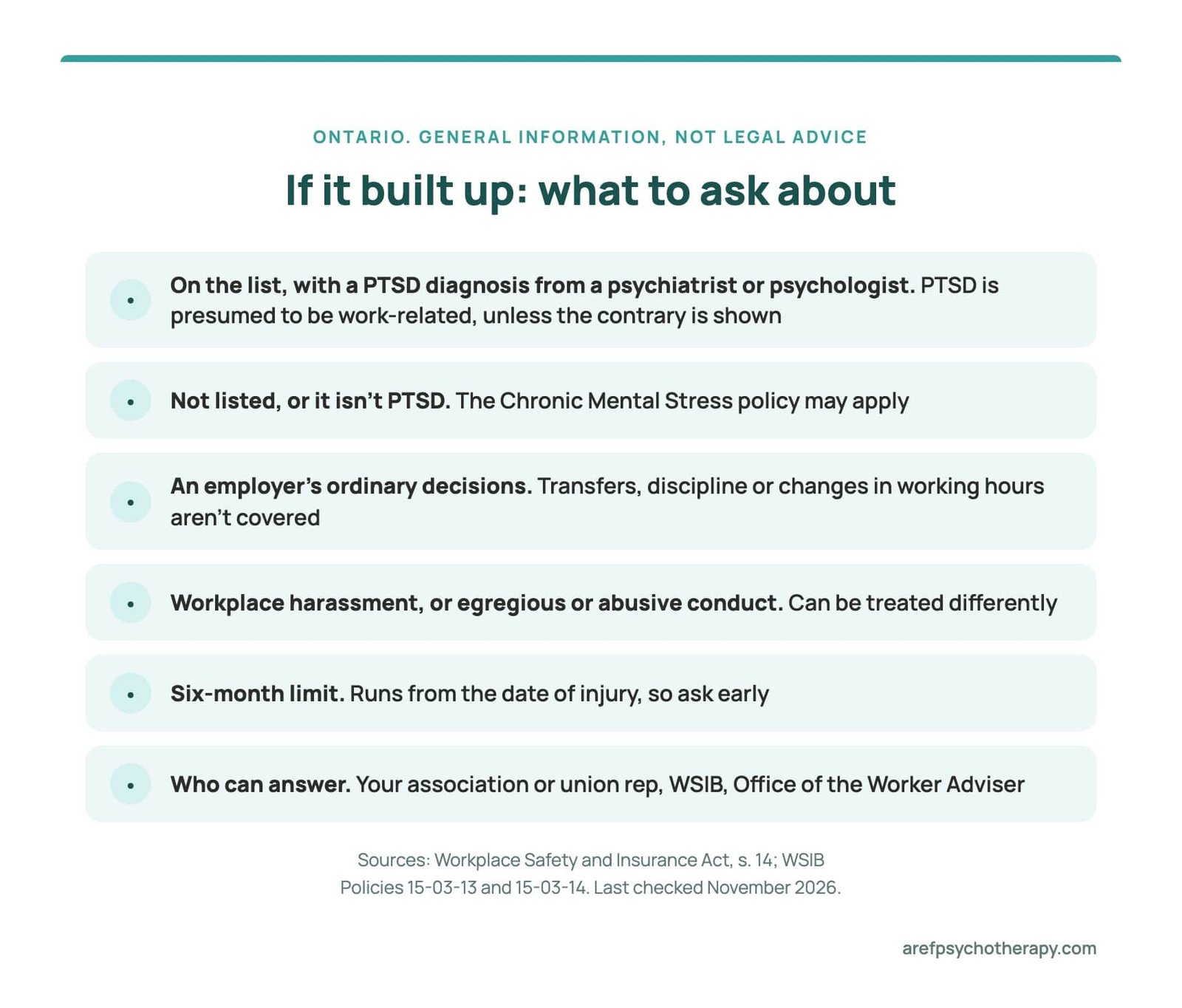
Section 14 of Ontario’s Workplace Safety and Insurance Act and WSIB Policy 15-03-13 list 20 groups of workers whose PTSD is presumed to be work-related, unless the contrary is shown, when the conditions are met. Our guide to first responder PTSD in Ontario has more.
- Who’s named. Workers involved in dispatch, workers in correctional institutions, workers in youth custody and detention, probation officers, paramedics, firefighters and police officers, among others. Duties matter. In a correctional institution, the list means correctional services officers, the managers who directly supervise them, and staff who give inmates direct health care.
- What it takes. A PTSD diagnosis from a psychiatrist or psychologist, which a Registered Psychotherapist can’t give. The section doesn’t name a single event as a condition, though WSIB can look at whether the job involved a traumatic event or exposure that could have contributed.
- If you’re not listed, or it isn’t PTSD. WSIB’s Chronic Mental Stress policy may apply, and it counts a “cumulative series of work-related stressors”. The stressor generally has to be substantial and the main cause, and you need a diagnosis.
- The hard part. Stress caused by an employer’s ordinary decisions, such as transfers, discipline or changes in working hours, isn’t covered. Workplace harassment and egregious or abusive conduct can be treated differently. If management is a big part of this, get advice before you file.
- Timing. WSIB’s six-month limit for filing runs from the date of injury, which may be earlier than your diagnosis. WSIB can extend it if it decides that is just. How that date is set for an injury that built up isn’t spelled out for PTSD in the policies we read, so ask early.
Your association or union rep, WSIB or, if you aren’t in a union, the Office of the Worker Adviser can answer for your own job. On a WSIB claim your employer gets a copy of the claim, so ask what each route shares first. Our WSIB therapy page explains how that route works with us. Again, this is general information, not legal advice.
Key takeaways
- First responder trauma doesn’t have to come from one terrible call. Harm can build over years.
- Dispatchers, correctional staff and women in the services are often missed by the one-call story. That says nothing about whether the injury is real.
- The evidence on women is mostly police and small.
- In Ontario, dispatch and correctional roles are on the WSIB list, subject to your duties, a diagnosis and time limits.
- You don’t need a worst call before you talk to someone.
Frequently asked questions
Does it count as trauma if there was no single bad call?
It can. Ontario's Ombudsman described how repeated exposure can add up to long-term harm, sometimes years later, and Canadian studies of dispatch and corrections describe a similar slow pattern. Only a qualified professional can say what you are dealing with, but you can ask for help without a worst call.
Can hearing calls affect a dispatcher the way being on scene can?
Research suggests hearing it can take a real toll. A 2026 Canadian study explains that exposure can include repeated details of what happened to someone else. That doesn't mean every dispatcher is injured. It does mean “I wasn't there” isn't a reason to dismiss what you notice in yourself.
Does Ontario's PTSD presumption cover correctional staff?
For some roles, yes. Ontario's list names correctional services officers, the managers who directly supervise them, staff who give inmates direct health care, and probation officers. Other jobs in the same building may not be named. Federal corrections sit outside this article. Your union rep or WSIB can tell you where you stand.
What if most of my stress comes from management, not the work itself?
That pattern shows up in corrections research, and it can still affect your health. WSIB is stricter. Ordinary employer decisions such as transfers, discipline or changes in hours aren't covered, while harassment can be treated differently. Talk to your union rep, WSIB or the Office of the Worker Adviser before you file anything.
Do women in the services have it harder?
The evidence suggests added pressures for some women, but it is mostly police and often small. One police study found women reported a stronger belief that stigma exists. In provincial corrections, women reported less stigma than men. Survey screens aren't diagnoses, and your own experience matters more than any average.
Talk to someone about the whole of it
AREF Psychotherapy is a private clinic, separate from your service. Our team includes Registered Psychotherapists (RPs), who are regulated by the College of Registered Psychotherapists of Ontario. You can read more about how first responder therapy works with us, including the ways to pay.
You can start with a free 15-minute phone consultation. Ask what gets shared, who can see it, and whether a therapist has worked with dispatch or corrections. Call us at (437) 830-2088, or book online.
If you need help right now
If you are thinking about ending your life, please reach out now. You can call or text 9-8-8, the 9-8-8 Suicide Crisis Helpline, 24 hours a day, every day of the year. First responders in Ontario can also call Boots on the Ground at 1-833-677-2668, 24/7, for anonymous peer support. If your safety is at risk right now, call 9-1-1.
This article is for informational purposes only and does not replace professional mental health advice. If you’re in crisis, please contact Canada’s 9-8-8 Suicide Crisis Helpline by calling or texting 9-8-8.
Sources and further reading
Research
- Howe E, Czarnuch S, Ricciardelli R, Leduc N. Exploring Canadian public safety communicator mental health help-seeking behaviors. New Solutions, 2025. doi:10.1177/10482911251326648.
- Geoffrion S, Boulé C, Rapisarda F, Czarnuch S, Ricciardelli R. Prevalence of post-traumatic stress injuries among Canadian public safety communicators: a nationwide comparative study. Canadian Journal of Psychiatry, 2026. doi:10.1177/07067437261468881.
- Carleton RN, Ricciardelli R, Taillieu T, et al. Provincial correctional service workers: the prevalence of mental disorders. International Journal of Environmental Research and Public Health, 2020. doi:10.3390/ijerph17072203.
- Moghimi E, Knyahnytska Y, Zhu Y, et al. A qualitative exploration of the mental health challenges and therapeutic needs of Canadian correctional workers. Frontiers in Psychiatry, 2022.
- Ricciardelli R, Carleton RN, Gacek J, Groll DL. Understanding needs, breaking down barriers: examining mental health challenges and well-being of correctional staff in Ontario, Canada. Frontiers in Psychology, 2020.
- Coulling R, Johnston MS, Ricciardelli R. “We must be mentally strong”: exploring barriers to mental health in correctional services. Frontiers in Psychology, 2024.
- Ricciardelli R, Dorniani S, Johnston MS, Taillieu TL. A national study of provincial and territorial correctional service providers in Canada: a comparison of mental health knowledge, stigma, and service use intentions. BMC Psychology, 2026. doi:10.1186/s40359-026-05103-2.
- Burns C, Buchanan M. Factors that influence the decision to seek help in a police population. International Journal of Environmental Research and Public Health, 2020.
- Bikos LJ. “It’s all window dressing”: Canadian police officers’ perceptions of mental health stigma in their workplace. Policing: An International Journal, 2020. doi:10.1108/PIJPSM-07-2020-0126. Research summary, Canadian Institute for Public Safety Research and Treatment.
- Carleton RN, Afifi TO, Turner S, et al. Mental disorder symptoms among public safety personnel in Canada. Canadian Journal of Psychiatry, 2018. doi:10.1177/0706743717723825.
- Allen LP. Gender, indigeneity, and intersectional considerations: the mental health of frontline public safety and healthcare workers in Canada. Dialogues in Health, 2026.
- Vesely L, Mustard CA, Yanar B. Evolving influence of mental health stigma in Ontario public safety organizations: a qualitative study. Health Promotion and Chronic Disease Prevention in Canada, 2026.
Ontario law, regulators and reports
- Workplace Safety and Insurance Act, 1997, Government of Ontario
- Posttraumatic Stress Disorder in First Responders and Other Designated Workers, Policy 15-03-13, WSIB Operational Policy Manual
- Chronic Mental Stress, Policy 15-03-14, WSIB Operational Policy Manual
- Determining the Date of Injury, Policy 11-01-04, WSIB Operational Policy Manual
- Professional Practice and Jurisprudence manual, College of Registered Psychotherapists of Ontario
- In the Line of Duty, Ombudsman of Ontario, 2012
- Office of the Worker Adviser, Government of Ontario
Support
- 9-8-8 Suicide Crisis Helpline: call or text 9-8-8
- Boots on the Ground: 1-833-677-2668