
Reviewed by the AREF Psychotherapy team
You handle other people’s worst days for a living. Talking to a stranger about your own is a different job, and nobody briefs you on it. If you have never been to therapy, not knowing what happens can be enough to stop you from booking.
Your first therapy session is mostly a conversation, and it usually runs under an hour. The therapist explains how consent and privacy work, asks what brought you in, and talks with you about what you want to work on. You choose how much you say. You do not have to tell the worst call. You can ask your own questions, and you can decide afterwards not to go back.
Most of this guide applies to anyone starting therapy. The parts about calls and shifts are for police, firefighters, paramedics, dispatchers, corrections staff and others in this work. Every therapist works a little differently, so treat it as a map. For how therapy can fit around the job, see AREF’s page on first responder therapy.
What actually happens in a first therapy session
A typical session lasts 45 to 50 minutes, says the American Psychological Association (APA). The first one can feel like a game of 20 questions. The therapist leads, so you don’t need to know how therapy works.
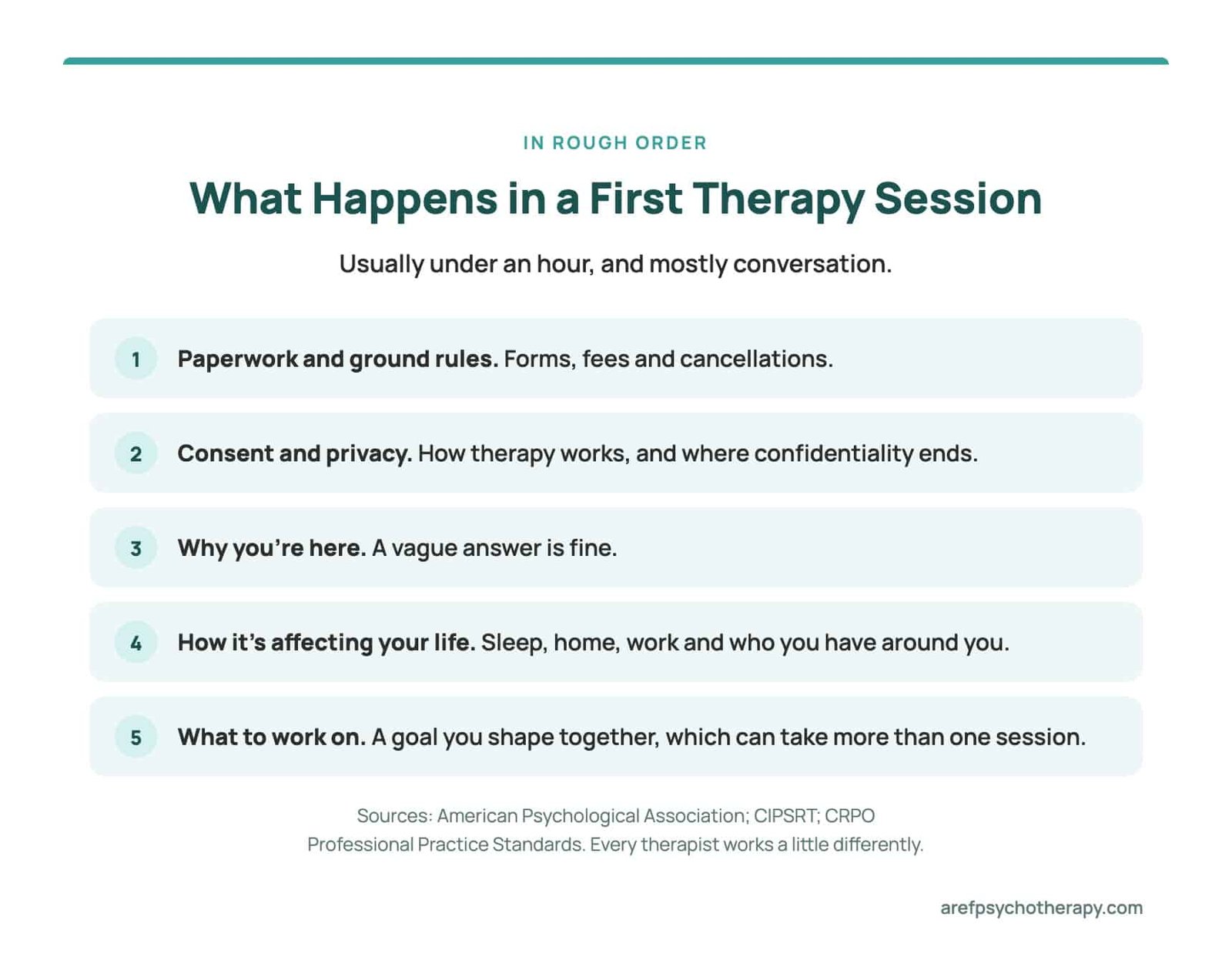
Here is what commonly happens, in rough order:
- Paperwork and ground rules. Forms, fees and cancellations. A guide from the Canadian Institute for Public Safety Research and Treatment (CIPSRT) says first meetings often come with questions and paperwork.
- Consent and privacy. How therapy works, and where confidentiality ends.
- Why you’re here. Expect “What brought you in?” or “Why now?” A vague answer is fine.
- How it’s affecting your life. Sleep, appetite, home, work and who you have around you.
- What to work on. You start to shape a goal together, which can take more than one session.
Consent and privacy: what a therapist has to explain
Registered Psychotherapists in Ontario are regulated by the College of Registered Psychotherapists of Ontario (CRPO). Its Professional Practice Standards say a therapist seeks your consent only after making sure you understand the process of therapy, its possible benefits and risks, your other options, and what it means if you don’t go ahead. A signature on a form is not enough by itself.
A therapist must also explain confidentiality and its legal limits. It is a strong duty with real exceptions. CRPO’s notable limits include:
- A significant risk of serious harm to you or someone else
- A mandatory report, such as a child in need of protection
- Some legal proceedings, such as a subpoena, and investigations under a warrant or a law
- The regulator’s own work, such as a complaint about the therapist
Under Ontario’s health privacy law, the Personal Health Information Protection Act (PHIPA), consent can’t be gained through deception or coercion. When your consent is needed to share information with someone who isn’t a health care provider, it has to be given directly, not assumed.
How you pay also changes who learns what. On a WSIB claim, your employer knows there is a claim, because the Workplace Safety and Insurance Act says you must give them a copy, and your therapist must give WSIB the information it requires. Benefits plans and employee assistance programs have their own rules. Ask your therapist to walk you through your route before you start.
What you’ll be asked, and what you can skip
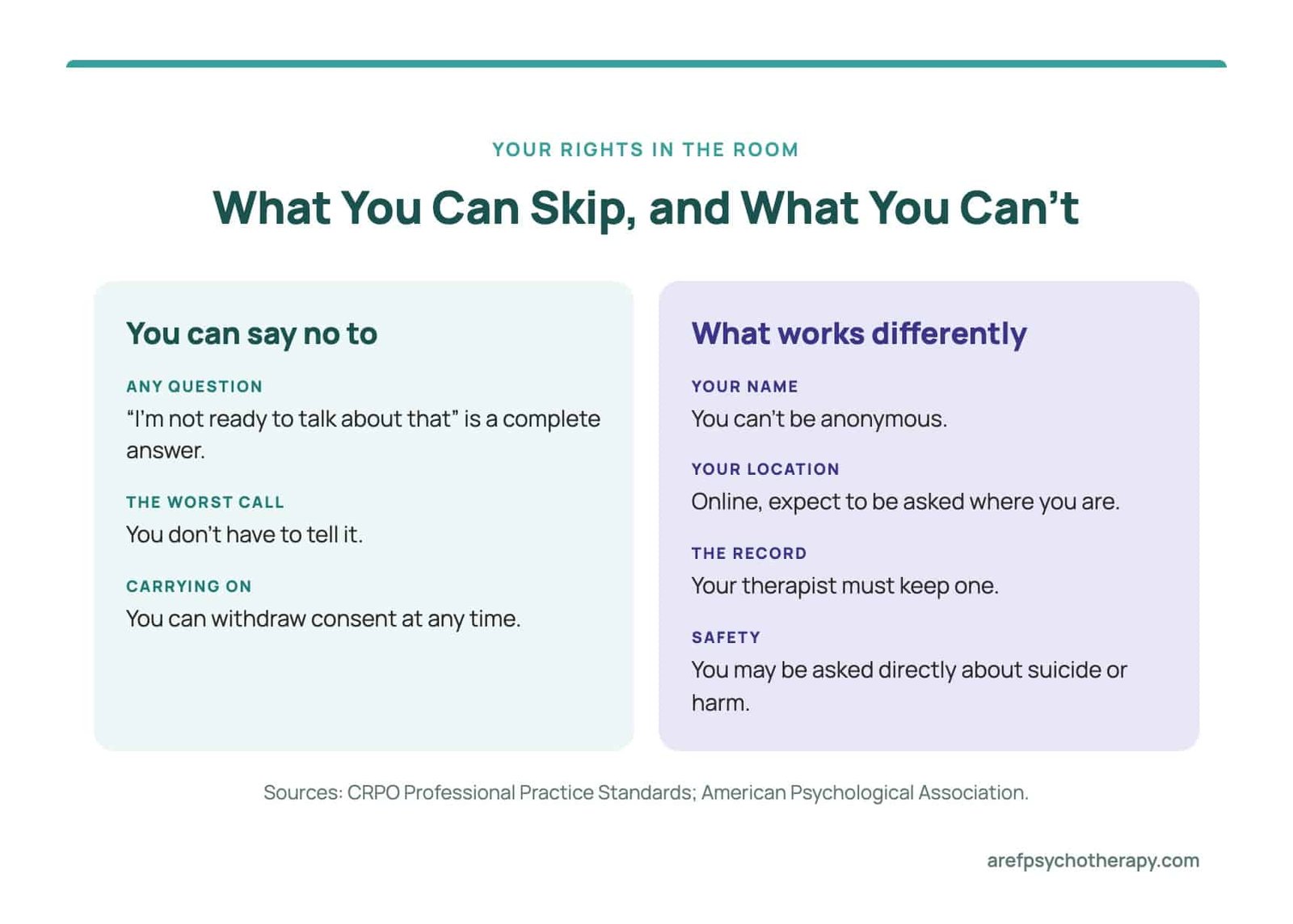
You can say no to any question. Under CRPO’s standards, consent has to be voluntary, you can withdraw it at any time, and a therapist must comply right away. The APA says it’s fine to say you aren’t ready to talk about something.
You may be asked about past therapy, mental health history in you or your family, medications and who you can lean on. Broad strokes are fine. CRPO says therapists should collect only what is reasonably required, so you can leave out coworkers’ names, call details and anything else you aren’t ready for. “I’m not ready to talk about that” is a complete answer. So is “Why do you need to know?”
Holding back gives a therapist less to go on, but the APA notes people often share more as trust grows.
A few things work differently:
- Your name. CRPO says therapists must not provide psychotherapy to anonymous clients.
- Your location. Online, therapists follow licensing rules where you are and need to know crisis services in your area, so expect to be asked.
- The record. Therapists must keep an accurate, complete record. Under PHIPA, you have a right to see yours, with some exceptions.
- Safety. A therapist may ask you directly about suicide or harm to yourself or others. CRPO’s practice manual lists risk assessment and safety planning as part of the work, and 9-8-8 says talking about suicide does not make someone more suicidal. You can ask first what would make your therapist act. If you are having these thoughts now, don’t wait for a session. Call or text 9-8-8.
You don’t have to tell the worst call
You may be bracing for a debrief. It doesn’t have to be one. CIPSRT’s guide for public safety personnel says mental health professionals typically let you go at your own pace. The Public Health Agency of Canada says disclosure is not the goal of trauma-informed approaches, and that providers don’t necessarily need to know someone’s history to offer appropriate support.
One line can cover it: “There was a call last spring. I’m not going into it today.” That gives a therapist enough to start.
Some trauma therapies do work with the memory, usually later on. EMDR (eye movement desensitization and reprocessing) is one example. CRPO’s standards say a therapist seeks consent when methods change, so ask what a method involves before you agree to it.
You may also be thinking about the person on the other end of the call. In a University of Ottawa thesis based on interviews with 24 first responders, participants described feeling, or knowing colleagues who felt, they had harmed a clinician by describing the job. That is one small study, but the worry is fair. Ask outright, or start with a mid-sized story and watch what happens. You should not have to look after them.
Not ready to book a session? A smaller step is AREF’s free consultation, a no-obligation 15-minute phone call where you can ask questions first.
Online from home: what that’s like between shifts
AREF’s sessions are online, so there is no waiting room to be seen in. That doesn’t make you invisible, though. People at home can hear you.
Does video work? A 2022 review of 13 trials found no differences between real-time telehealth and face-to-face care in post-traumatic stress disorder (PTSD) severity or in the relationship with the therapist. Its authors called for trials beyond veterans, so it doesn’t speak directly to first responders. A 2024 review found in-person care did better for depression, on low-quality evidence.
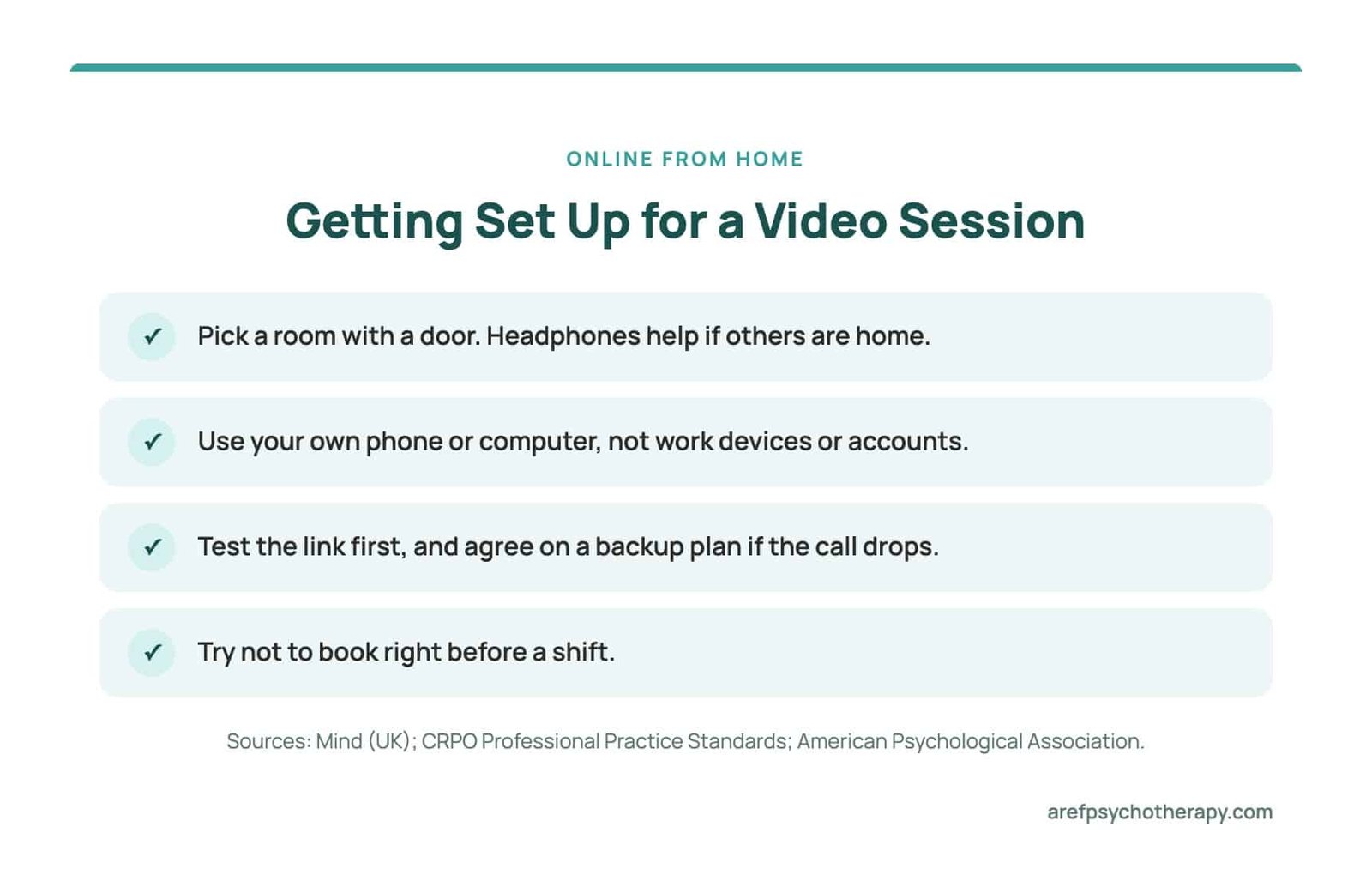
A few things make it easier:
- Pick a room with a door. Mind, the UK mental health charity, suggests headphones if others are home.
- Use your own phone or computer, not work devices or accounts.
- Test the link first. CRPO expects therapists to set a backup plan with you in case the call drops.
- Try not to book right before a shift. The APA notes you may feel tired or distracted afterwards.
What to ask your therapist in the first ten minutes
You are allowed to interview this person. CRPO publishes questions for clients to ask, and says a Registered Psychotherapist will understand if you meet with different therapists to find your fit. All 24 first responders in a 2023 Ottawa study said clinicians who treat them need to know the work, and CIPSRT says to ask.
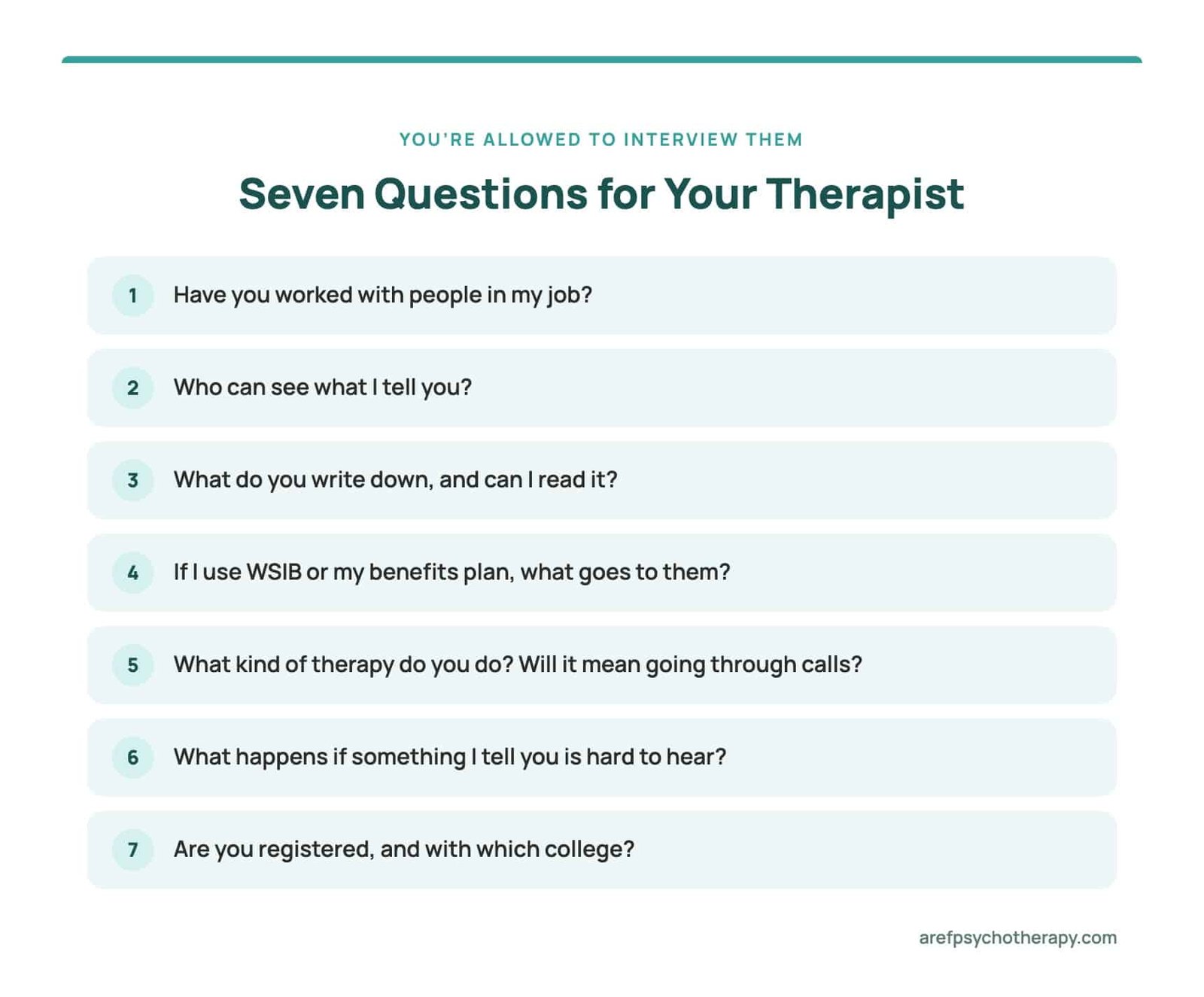
Try these:
- “Have you worked with people in my job? What did that look like?” Listen for specifics about shifts, rank or what a call involves. “I don’t know much about it, so tell me” is an honest answer too.
- “Who can see what I tell you?” You want named limits. If you hear “everything here is confidential” and nothing more, ask again.
- “What do you write down, and can I read it?” Ask whether sessions are recorded while you’re there.
- “If I use WSIB or my benefits plan, what goes to them?” Get this before you share much.
- “What kind of therapy do you do? Will it mean going through calls?” Ask what say you’d have.
- “What happens if something I tell you is hard to hear?” Notice how calm and direct the answer is.
- “Are you registered, and with which college?” You can check a Registered Psychotherapist on CRPO’s public register.
Plain, specific answers are a good sign. Vague comfort is worth noting.
If it doesn’t feel right
Say so, ask for something to change, or stop. Consent can be withdrawn at any time, and CIPSRT says it sometimes takes one or two tries to find the right person.
Fit matters. A meta-analysis of 295 studies covering more than 30,000 people linked a stronger working relationship with better results in therapy. A link doesn’t prove cause, but your read on the relationship counts.
In a study of 20 serving RCMP officers, those who had a negative experience with a clinician described long delays or refusing to seek help again. A poor session tells you about that session with that therapist, and little else.
If you want to try again, ask for someone else. When therapy ends and a client wants more care, CRPO’s standards say the therapist makes reasonable efforts to refer. A concern about a therapist’s conduct can go to CRPO as a complaint.
After the session
You may feel relieved, drained, flat or some of each.
You probably won’t leave with a label. CRPO’s manual says Registered Psychotherapists can assess you, but they are not authorized to communicate a diagnosis. If you need one, ask who can provide it, such as your family doctor.
Note what felt okay, what didn’t and what to ask next time. The decision about a second session can wait a day. What you tell your partner or your crew is up to you.
Key takeaways
- A first therapy session usually runs under an hour and is mostly conversation.
- A therapist has to explain consent and the limits of confidentiality, and how you pay affects who learns what.
- You can decline any question, and you don’t have to tell the worst call.
- You can’t be anonymous, and a record is kept.
- You can test a therapist with direct questions, and stop if the fit is wrong.
Frequently asked questions
What should I say in my first therapy session?
Start with what is happening now. One or two plain sentences are enough, such as “I'm not sleeping, and I'm short with everyone at home.” You don't need a neat story, because the therapist will guide you with questions. If someone else pushed you to come, you can say exactly that.
How should I prepare for my first therapy session?
Write down your questions beforehand, since they are easy to forget. CIPSRT also suggests keeping something handy for notes and allowing a few minutes for forms. For an online session, find a private spot and test your connection. Check how the session will be paid for, too.
Do I need a diagnosis before I start therapy?
No. You can start therapy without one, and you don't have to know what is wrong before you book. Registered Psychotherapists don't give a diagnosis, though they can treat a condition someone else has diagnosed. Some WSIB claims do need a diagnosis, so if a claim is part of your plan, ask about that early.
Will my employer find out I went to therapy?
It depends on how you pay and what comes up. Therapists need your consent to share information, apart from legal exceptions such as a serious risk of harm. On a WSIB claim, your employer knows there is a claim. No one can promise that nobody will ever know, so ask about your route before you start.
What if I freeze up or can't talk?
That can happen, and the session can still go on. The APA says it's normal to feel a little anxious in the first few sessions. Try “I don't know where to start,” or ask the therapist to lead with questions. Asking for a pause is fine too.
Ask your questions before you commit
AREF Psychotherapy offers online therapy in Ontario with Registered Psychotherapists. Fill out a short form and the intake team will contact you to set up a free, no-obligation 15-minute phone consultation. Or read more about therapy for first responders first.
If you need help now: call or text 9-8-8, the Suicide Crisis Helpline, 24 hours a day, every day of the year. If your safety is at risk, call 9-1-1. First responders can also call Boots on the Ground at 1-833-677-2668, an anonymous Ontario peer support line open 24/7 and run by first responders.
This article is for informational purposes only and does not replace professional mental health advice. If you’re in crisis, please contact Canada’s 9-8-8 Suicide Crisis Helpline by calling or texting 9-8-8.
Sources and further reading
Ontario rules for therapists
- Professional Practice Standards for Registered Psychotherapists, College of Registered Psychotherapists of Ontario (CRPO), revised December 2025
- Professional Practice and Jurisprudence for Registered Psychotherapists, CRPO
- What to Know About Psychotherapy, CRPO
- Public Register, CRPO
- Filing a Complaint, CRPO
- Personal Health Information Protection Act, 2004, Government of Ontario
- Workplace Safety and Insurance Act, 1997, Government of Ontario
First responder research and guidance
- Six Steps to Finding a Clinician, Canadian Institute for Public Safety Research and Treatment (CIPSRT)
- Testa V, et al. Applying the Theoretical Domains Framework to identify police, fire, and paramedic preferences for accessing mental health care in a First Responder Operational Stress Injury Clinic: a qualitative study. Health Promotion and Chronic Disease Prevention in Canada, 2023.
- Testa V. Implementation of a First Responder Operational Stress Injury Clinic Using the TDF-II and CFIR Frameworks: A paramedic perspective. Master’s thesis, University of Ottawa, 2021.
- Burns C, Buchanan M. Factors that Influence the Decision to Seek Help in a Police Population. International Journal of Environmental Research and Public Health, 2020.
Therapy research and general guidance
- Flückiger C, et al. The alliance in adult psychotherapy: A meta-analytic synthesis. Psychotherapy, 2018.
- Scott AM, et al. Real-Time Telehealth Versus Face-to-Face Management for Patients With PTSD in Primary Care: A Systematic Review and Meta-Analysis. Journal of Clinical Psychiatry, 2022.
- Kelber MS, et al. Evidence-based telehealth interventions for post-traumatic stress disorder, depression, and anxiety: A systematic review and meta-analysis. Journal of Telemedicine and Telecare, 2024.
- Trauma and violence-informed approaches to policy and practice, Public Health Agency of Canada
- Understanding psychotherapy and how it works, American Psychological Association
- How to get the most out of therapy and counselling, Mind (UK)
Support
- 9-8-8 Suicide Crisis Helpline: call or text 9-8-8
- Facts about suicide, 9-8-8 Suicide Crisis Helpline
- Boots on the Ground: 1-833-677-2668