
Reviewed by the AREF Psychotherapy team
Loneliness therapy means working with a therapist on the feeling of being cut off from other people. Loneliness is not a diagnosis, so you don’t have to be “sick enough” to ask for help. Therapy can work on the fears and habits that keep you apart from people. It can’t hand you a friend or a community. Research shows a real but modest benefit on average, and therapy works alongside contact with people, not instead of it.
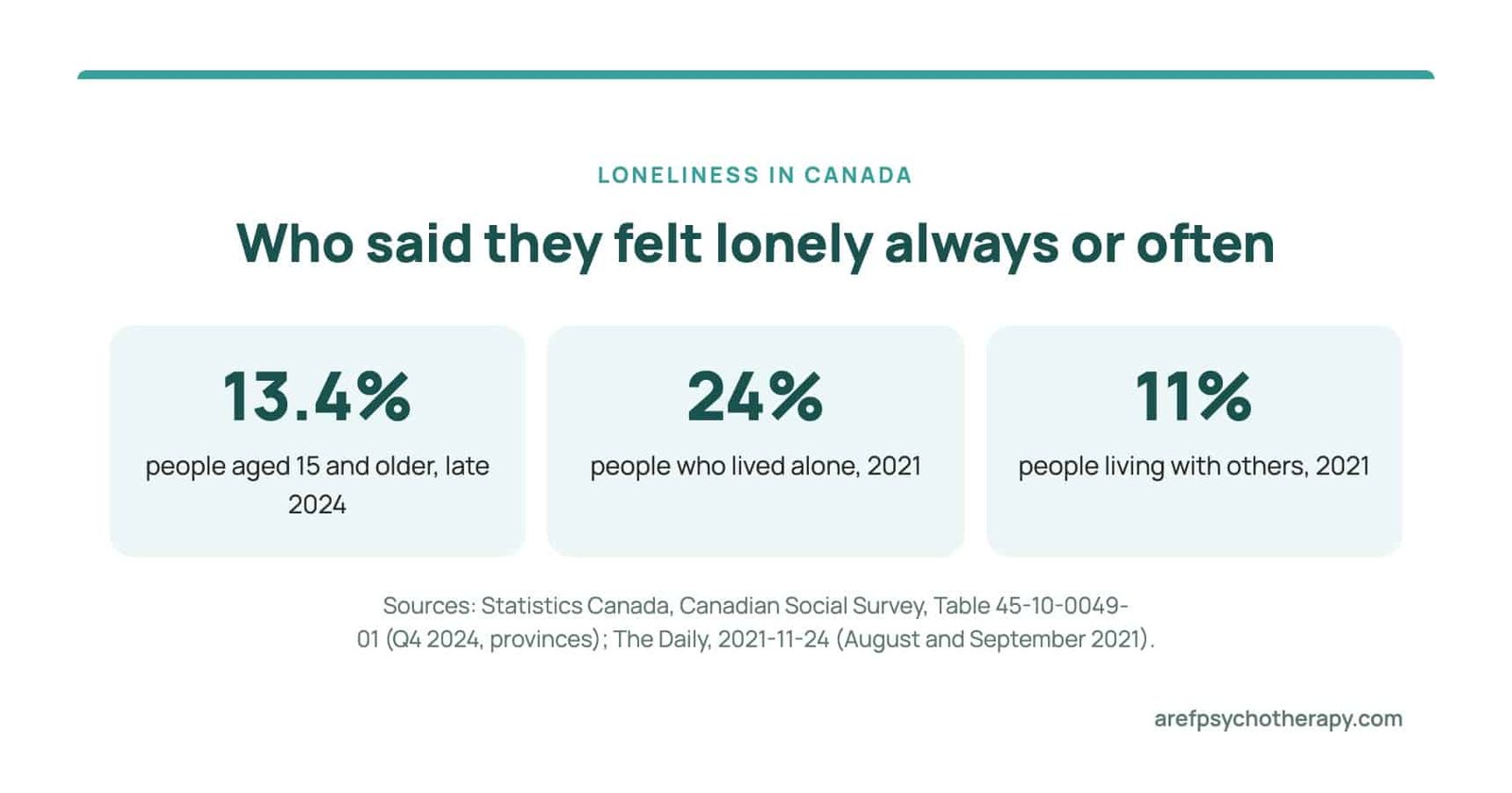
You might live alone. You might also have a partner, a busy job and a full house, and still feel that nobody really knows you. A lot of adults find this embarrassing to admit, as if they should have it sorted by now. Yet in late 2024, Statistics Canada’s survey data showed that 13.4% of people aged 15 and older in the provinces, about 4.6 million, felt lonely always or often.
This guide is for adults in Ontario. It covers what therapy can and can’t do, what to try first, and what to ask before you book.
Being alone and feeling lonely are different things
The World Health Organization describes loneliness as a distressing feeling that comes from a gap between the connections you have and the ones you want or need. Social isolation is something else. It means having too few relationships and too little contact, which someone could count from the outside.
The two don’t always travel together. In Statistics Canada’s 2021 survey, 24% of people who lived alone said they felt lonely always or often, compared with 11% of people living with others. So most people who lived alone did not say that, and plenty of people with others in the house did. That survey ran during the pandemic, so treat those numbers as a rough guide. Having a job doesn’t settle it either. In late 2024, 13.3% of people with paid work felt lonely always or often, almost the same as everyone else.
Statistics Canada researchers also separate two kinds. Emotional loneliness is missing someone close. Social loneliness is missing a wider circle. Knowing which fits you can change what you do next.
What is loneliness therapy?
It is ordinary talk therapy with loneliness as the main focus. Researchers have tested several approaches, including mindfulness, social skills training and cognitive behavioural therapy (CBT), which looks at how your thoughts and actions feed each other.
The UK’s Mental Health Foundation says loneliness isn’t, in itself, a mental health condition, although it has real effects on mental health. So you can work on it without a label. A Registered Psychotherapist does not give a diagnosis. If you wonder whether depression or anxiety is part of the picture, your family doctor or nurse practitioner can talk that through with you.
What therapy can work on
One well-known theory, described in a 2021 research review, says loneliness can feed itself. When it lasts, people may start to expect bad interactions and remember the negative ones more. They can come across as prickly or pessimistic, and the reaction they get seems to prove the fear right. Over time, they may want to avoid people altogether.
Therapy tries to interrupt that loop. Depending on what’s going on, it can work on:
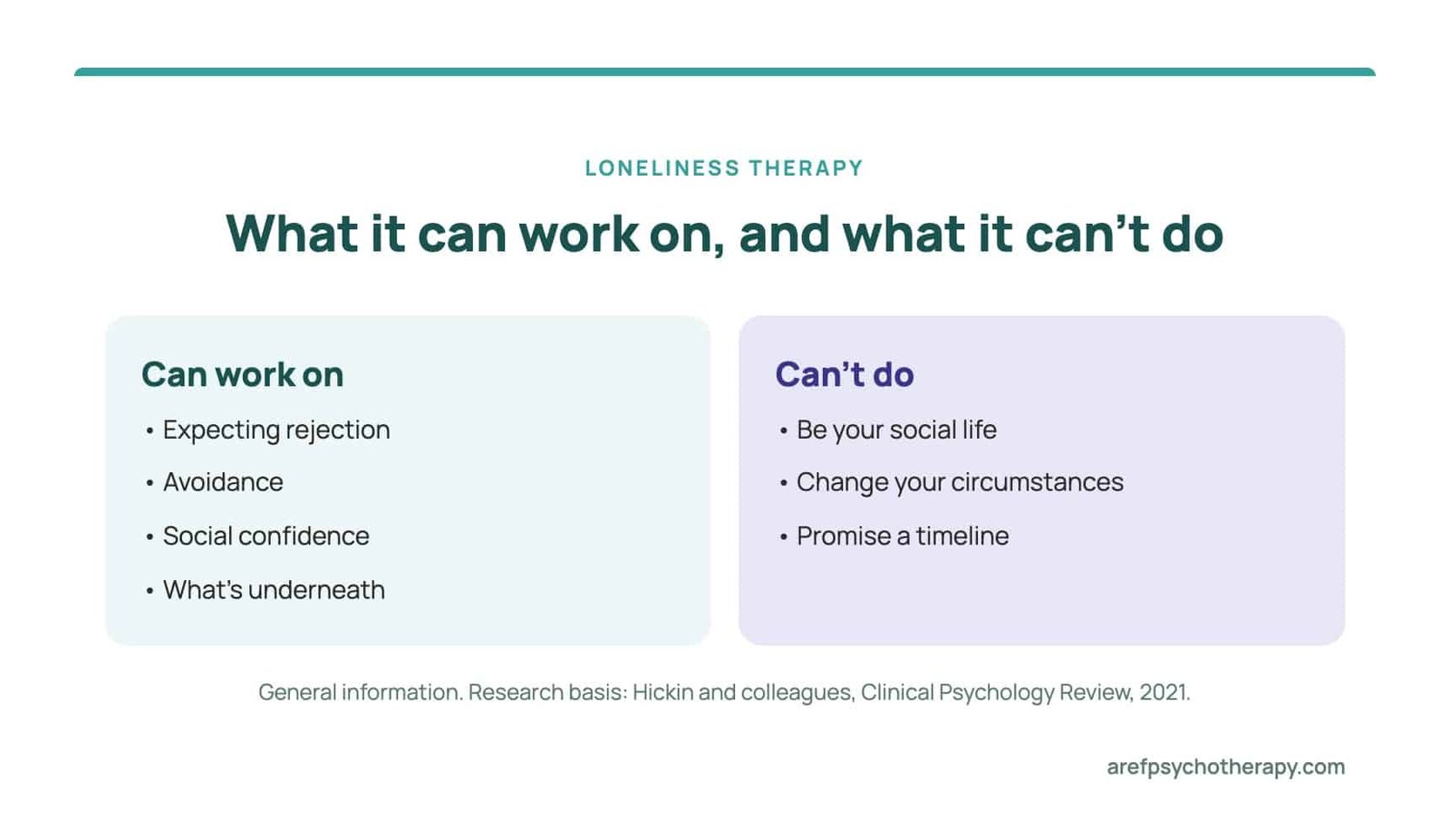
- Expecting rejection. You look at what you assume people think of you, then check it against what really happens.
- Avoidance. Cancelling plans, staying quiet, leaving messages unanswered. You plan small steps back toward people.
- Social confidence. Starting a conversation, keeping in touch, saying something real about yourself. You can practise in session first.
- What’s underneath. A breakup, a death, a move, retirement. Sometimes grief needs attention before the loneliness can shift.
- Low mood and worry. A 2022 review of 32 studies linked loneliness with later depression, though it couldn’t show that one causes the other. If both are there, therapy can look at them together.
At AREF, CBT and mindfulness-based therapy are two of the approaches our therapists use. Our adult mental health page lists other concerns we work with.
What the research says, and what it doesn’t
That 2021 review, in Clinical Psychology Review, pooled 28 randomized trials with about 3,000 people. Psychological help reduced loneliness more than control groups did. The average effect was small to medium, results varied a lot, and no single type of therapy clearly came out ahead. Most programs were in person and in groups. Of the 31 studies reviewed, only 8 were one-to-one, and only 7 ran by phone or internet.
Online help has been tested too, mostly as written courses with support:
- Guided online CBT. A Swedish trial of 170 people compared 9 weeks of therapist-guided online CBT with a wait-list. Loneliness dropped more with CBT, and the gains held 4 months later. An online version of interpersonal therapy did no better than waiting.
- A person in the loop. In a study of 243 adults in German-speaking countries, a 10-week online CBT course helped more when a trained coach sent feedback, about 17 minutes a week, than when people got automated emails. Most participants were women with a lot of schooling, and people with severe depression were left out.
- Quick tools. A trial of 908 people tested short self-guided online exercises. Loneliness fell in every group, but the loneliness exercises did no better than a brief supportive comparison.
Together, these hint that having a person involved adds something. None of the three tested one-to-one video sessions, which is how we work. So online therapy is a reasonable thing to try, but direct evidence for it is thin.
If you’d like to ask whether this fits you, AREF offers a free 15-minute phone consultation. You don’t need the right words for it.
What therapy can’t do
A therapist is not a replacement for connection. We’d rather say that plainly than have you find out after months of sessions.
- It can’t be your social life. Most sessions at AREF are 50 minutes, and your therapist won’t be at your birthday dinner. The aim is to help you build things outside that hour.
- It can’t change your circumstances. Night shifts, low income, caregiving or discrimination can all cut people off. Therapy can help you plan around them. It can’t remove them.
- It asks something of you. Much of the work happens between sessions, and reaching out can feel awkward. The Centre for Addiction and Mental Health (CAMH) notes you may even feel worse at the start, as issues come to the surface.
- It has no set timeline. Results vary, and nobody can promise you one.
Sometimes therapy isn’t the first thing you need. If you feel fine in yourself and simply don’t know anyone in a new city, a class, a club or a settlement agency may do more for less money.
First steps you can try this week
You don’t need a therapist for these.
- Name what’s missing. Someone close? A wider circle? People who share your language?
- Send one small message. The World Health Organization suggests simple everyday steps, such as checking on a friend, greeting a neighbour, joining a group or volunteering. Ask about one thing the person mentioned last time.
- Go back to the same place. A weekly class or group gives you familiar faces over time.
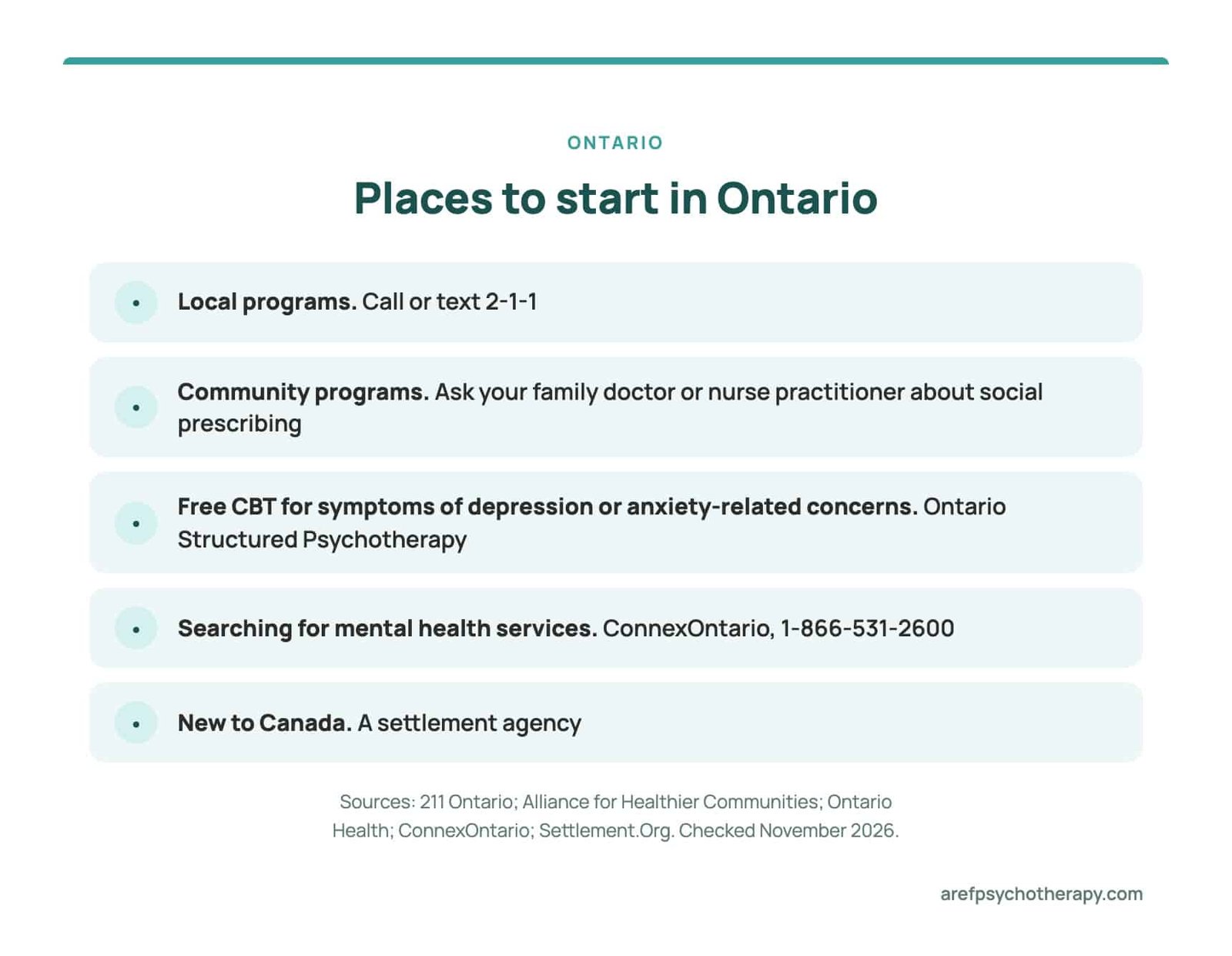
- Call or text 2-1-1. 211 Ontario is free and answered by real people 24/7, in more than 150 languages by phone. Ask what programs are near you.
- Ask about social prescribing. Some Ontario health care providers can refer you to community programs, such as an art class or a community garden. Ask your family doctor or nurse practitioner whether they can.
- Know the free options. Ontario Structured Psychotherapy offers free CBT for adults with symptoms of depression or anxiety-related concerns, though it isn’t suitable for everyone. ConnexOntario can help you search for mental health services at 1-866-531-2600, free, 24/7.
We are a private clinic, and we’d still rather you knew these exist. If today feels too heavy for any of this, you can call or text 9-8-8 at any hour.
If you’re new to Canada
Moving often breaks up the network you had. A Statistics Canada study of 2018 survey data found immigrants aged 15 to 64 scored higher on loneliness than people born in Canada. Those here more than 10 years scored about the same as recent arrivals, so the feeling didn’t simply fade with time. Married immigrants and those with a university degree also scored higher than Canadian-born people in the same groups, so a spouse or a degree doesn’t settle this.
Newer numbers are rougher. In late 2024, 15.8% of immigrants here 10 years or less felt lonely always or often, compared with 12.0% of those here longer. The margins of error overlap, so read that as a hint only.
Settlement agencies in Ontario offer free services, including referrals to community programs, and each agency sets its own rules. The federal newcomer services finder lists “connecting with the local community” as a service type. Since April 1, 2026, economic class permanent residents can use these services only for a limited time, so check early.
Some people find feelings easier to say in their first language. Ask whether a therapist works in yours, and whether they have worked with newcomers.
If you live alone
About 4.4 million people lived alone in Canada in 2021, or 15% of adults. Living alone isn’t a problem in itself. But contact doesn’t happen by accident, so it can help to build it into your week. A standing phone call or a weekly class both count. This isn’t only a seniors’ issue, either: in late 2024, 17.4% of people aged 25 to 34 felt lonely always or often, compared with 9.2% of people 65 and older.
Online therapy has an upside when you live alone. There’s nothing to travel to, and you likely have a private room. The downside is that it’s one more hour on a screen, and when the call ends you’re in the same quiet room. It can help to plan something small for afterward, like a walk.
What to ask before you start
CAMH also says you may need to try more than one therapist to find one you’re comfortable with. These questions can help:
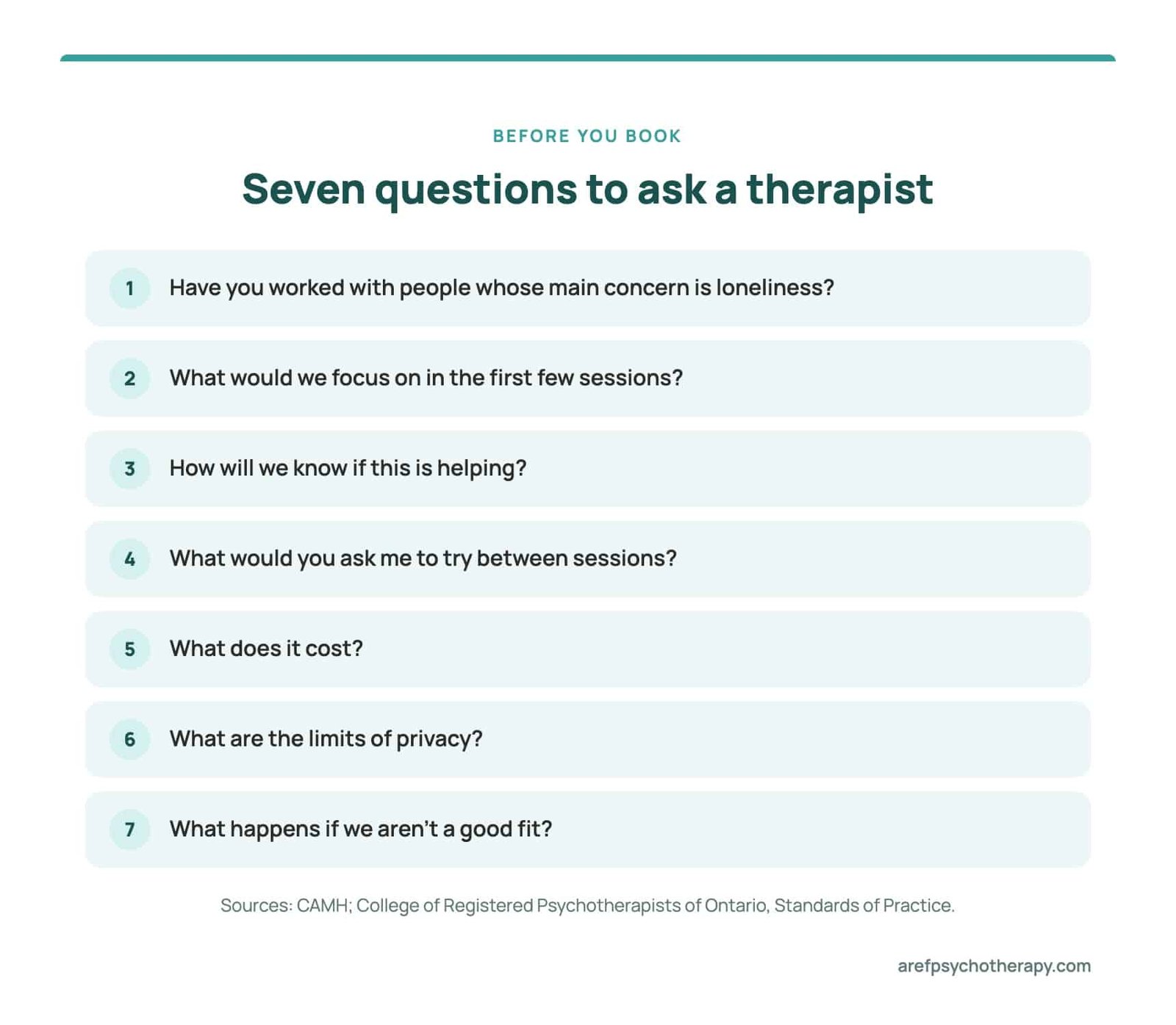
- Have you worked with people whose main concern is loneliness?
- What would we focus on in the first few sessions?
- How will we know if this is helping?
- What would you ask me to try between sessions?
- What does it cost? Therapists in private practice aren’t covered by public health insurance, though an employer or private plan may cover it.
- What are the limits of privacy? Privacy in therapy has limits, and your therapist must explain them.
- What happens if we aren’t a good fit?
Key Takeaways
- Loneliness is a feeling, not a diagnosis. You can feel it alone or in a full house.
- Therapy can work on expecting rejection, avoidance, social confidence and whatever sits underneath.
- On average, research shows a small to medium benefit, and results vary a lot.
- A therapist is not a replacement for connection. The aim is more contact outside sessions.
- Ontario has free places to start, including 211 and Ontario Structured Psychotherapy.
Frequently asked questions
Is loneliness a mental illness?
No. Loneliness is a feeling, and on its own it is not a mental health condition or a diagnosis. It can still hurt a lot, and it can sit alongside low mood or anxiety. You don't need a label to talk to a therapist about it. If you want to know whether something else is going on, your family doctor or nurse practitioner can talk that through with you.
Isn't therapy just paying someone to be my friend?
It's a fair question. A therapist isn't a friend, and the relationship has clear limits. What you're paying for is time and skill: someone who looks at the patterns that keep you apart from people and helps you try something different. The aim is more connection in your own life, so that over time you lean on the therapist less.
Can online therapy help with loneliness?
It may. Trials of guided online programs have reduced loneliness for some people, though those were mostly written courses with support, not live video. Online sessions can be easier if travel is hard or if the idea of walking into a waiting room puts you off. The trade-off is that you are still at home on a screen, so plan some contact outside sessions too.
How long does therapy for loneliness take?
There is no set length, and nobody can promise you a timeline. Two of the online trials above ran for about 9 or 10 weeks, but those were research programs, and real life is messier. It depends on what is behind the loneliness and what else is going on. Your therapist should set goals with you and check regularly whether things are moving.
Is loneliness therapy covered in Ontario?
Therapists in private practice aren't covered by public health insurance, so you would usually pay a fee. An employer or private health plan may cover the cost, so check your plan first. Ontario Structured Psychotherapy offers free cognitive behavioural therapy for adults with symptoms of depression or anxiety-related concerns, though it isn't suitable for everyone.
Talk to someone
AREF Psychotherapy works online with adults in Ontario. Our team includes Registered Psychotherapists (RPs), who are regulated by the College of Registered Psychotherapists of Ontario (CRPO).
You can start with a free 15-minute phone consultation. You don’t have to explain it well. You can just say you’ve been feeling lonely, and use the call to ask the questions above. Call us at (437) 830-2088, or book online.
If you’re having thoughts of harming yourself
Loneliness can get very heavy. If you are having thoughts of harming yourself or ending your life, please reach out now. You can call or text 9-8-8, the 9-8-8 Suicide Crisis Helpline, 24 hours a day, every day of the year. If your safety is at risk right now, call 9-1-1.
This article is for informational purposes only and does not replace professional mental health advice. If you’re in crisis, please contact Canada’s 9-8-8 Suicide Crisis Helpline by calling or texting 9-8-8.
Sources and further reading
Canadian data and government
- Statistics Canada. Loneliness by gender and other selected sociodemographic characteristics, Table 45-10-0049-01. Canadian Social Survey, data to the fourth quarter of 2024, released 2025-02-19.
- Statistics Canada. Canadian Social Survey: Loneliness in Canada. The Daily, 2021-11-24.
- Stick M, Hou F, Kaida L. Self-reported loneliness among recent immigrants, long-term immigrants, and Canadian-born individuals. Statistics Canada, Economic and Social Reports, 2021.
- Statistics Canada. Home alone: More persons living solo than ever before. The Daily, 2022-07-13.
- Immigration, Refugees and Citizenship Canada. Find free newcomer services near you.
- Ontario Health. Ontario Structured Psychotherapy Program.
Canadian health bodies and regulators
- Centre for Addiction and Mental Health (CAMH). Looking for mental health services.
- Centre for Addiction and Mental Health (CAMH). Psychotherapy: Finding a therapist, resource sheet, September 2025.
- College of Registered Psychotherapists of Ontario. Standards of Practice.
- Alliance for Healthier Communities. Social prescribing.
Research
- Hickin N, Käll A, Shafran R, et al. The effectiveness of psychological interventions for loneliness: a systematic review and meta-analysis. Clinical Psychology Review, 2021.
- Käll A, Bäck M, Welin C, et al. Therapist-guided internet-based treatments for loneliness: a randomized controlled three-arm trial. Psychotherapy and Psychosomatics, 2021.
- Seewer N, Skoko A, Käll A, et al. Efficacy of an internet-based self-help intervention with human guidance or automated messages to alleviate loneliness. Scientific Reports, 2024.
- Kaveladze BT, Gastelum SF, Ngo DC, et al. A randomized controlled trial comparing brief online self-guided interventions for loneliness. Journal of Consulting and Clinical Psychology, 2025.
- Mann F, Wang J, Pearce E, et al. Loneliness and the onset of new mental health problems in the general population. Social Psychiatry and Psychiatric Epidemiology, 2022.
International bodies
- World Health Organization. Social connection: questions and answers.
- World Health Organization. Social connection linked to improved health and reduced risk of early death, 2025.
- Mental Health Foundation (UK). All the lonely people: exploring the realities of loneliness and mental health, 2022.
Support in Ontario
- 9-8-8 Suicide Crisis Helpline: call or text 9-8-8
- 211 Ontario: call or text 2-1-1
- ConnexOntario: 1-866-531-2600
- Settlement services in Ontario, Settlement.Org