
Reviewed by the AREF Psychotherapy team
You keep going back over the last few months. Maybe you cried in the car before work again, or checked their profile at 1 a.m. and felt worse. Part of you thinks you should be over this by now. Another part thinks a breakup isn’t a good enough reason to see anyone.
The short answer: therapy for a breakup can help when the pain stays heavy, gets in the way of your days, or keeps running on the same loop. You don’t need a crisis or a diagnosis to go. Heartbreak is also normal, and lots of people get through it with time and good people around them, without ever seeing a therapist.
This guide is for adults in Ontario. It covers when to talk to someone, what therapy works on, what the first sessions are like and how to pay.
Is a breakup bad enough for therapy?
Nobody has to earn a session by falling apart. The more useful questions are how much this is costing you, and whether it’s easing.
The pain is real grief. The Canadian Mental Health Association (CMHA) says people grieve the loss of a relationship, and that there is no normal grieving period. How fast your friend moved on tells you nothing about you.
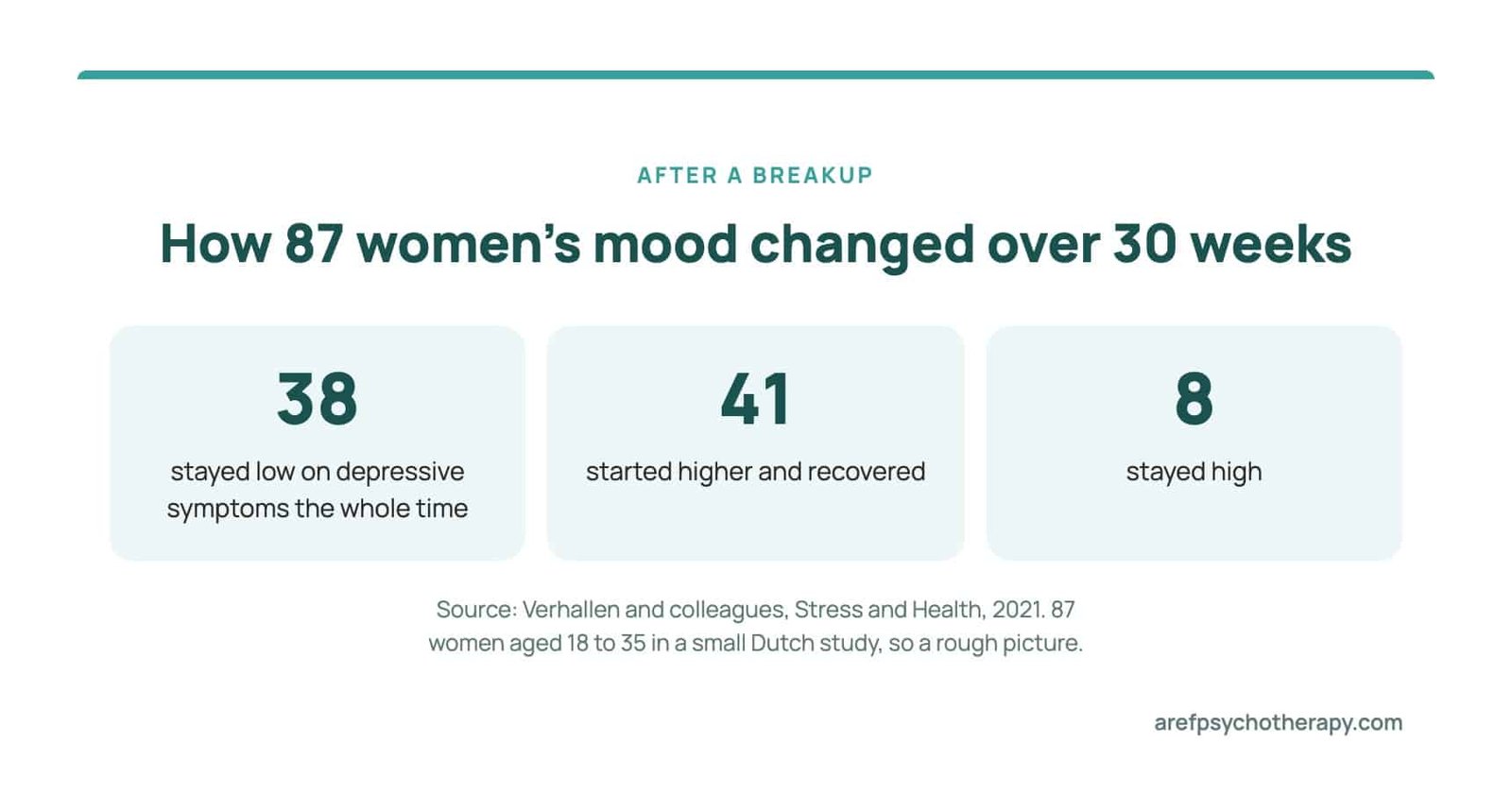
Most people do improve. In a small Dutch study by Verhallen and colleagues, 87 women aged 18 to 35 tracked their mood every two weeks for 30 weeks after a breakup. Thirty-eight stayed low on depressive symptoms the whole time, 41 started higher and recovered, and 8 stayed high. It was small and included only women, so treat it as a rough picture.
Canada’s own numbers are older. A 2007 Statistics Canada analysis followed adults aged 20 to 64 who were married or living with a partner, using survey data from 1994 to 2005. Among people with no recent depression, 12% of those whose relationship had ended reported a new depressive episode two years later, compared with 3% of those still together. So the risk went up, and most people still didn’t have one.
You may not need therapy
Some breakups hurt a lot and still run their course. If you’re sleeping most nights, getting through work or school, and have a person or two you can be honest with, waiting is a fair choice.
Ordinary things count. A large German study by Tran and colleagues looked at 3,734 separations among 2,709 adults. People felt less negative when more time had passed, when they were the one who ended it, when they had a new partner, and when they were happy with their social circle. In a small interview study by Oliffe and colleagues, about half of 47 men in Canada and Australia went to a professional after a breakup. The rest leaned on friends, family, books or men’s groups.
Therapy has costs too. It takes money and time. It can stir things up before they settle. It won’t bring anyone back, and it can’t put a date on when you’ll feel better.
When a breakup is worth talking to someone about
These are signs to notice, not a test. Only a qualified health professional can diagnose depression or anxiety.
- Low mood that isn’t lifting. The Centre for Addiction and Mental Health (CAMH) describes depression as symptoms that last most of the day, on most days, for more than two weeks, and get in the way of work, school or relationships. Sleep, appetite and focus can all be affected.
- The loop won’t stop. You replay conversations or keep checking on your ex. In the Dutch study, the women who recovered slowly or stayed high tended to go over things more.
- Something is getting you through the day. Some of the men in the Oliffe study described their drinking or cannabis use climbing once they were on their own.
- The grief feels stuck. CAMH says that when grief feels overwhelming and seems stuck, it’s time for professional support.
- You have little support, or the ending was sudden. CMHA says grief can be more complicated when a loss is sudden or unexpected.
If you have thoughts of harming yourself, you don’t need to wait for an appointment. Call or text 9-8-8, any time, day or night. If your safety is at risk right now, call 9-1-1.
If the relationship wasn’t safe
If your ex hurt, threatened, tracked or controlled you, your safety comes first. Women in Ontario can call the Assaulted Women’s Helpline at 1-866-863-0511, 24/7, in over 200 languages. Ontario’s Victim Support Line is 1-888-579-2888, also 24/7, with interpreters if you need one. A therapist can help with what comes after. If your ex may have access to your phone, email or accounts, tell the clinic at the start so you can plan how to stay in touch safely.
What therapy for a breakup actually works on
The research here is thin. Farber and Roe wrote in 2026 that breakups have been “surprisingly neglected” in the therapy literature, and we did not find a large trial of therapy for breakups. The closest evidence is a 2024 survey of 1,846 people by Farber and colleagues, mostly from the United States. Those who went to therapy after a breakup rated it moderately to very helpful on average. A survey of volunteers can’t prove therapy caused the change, but it shows what people found useful.
Making sense of it, and self-blame
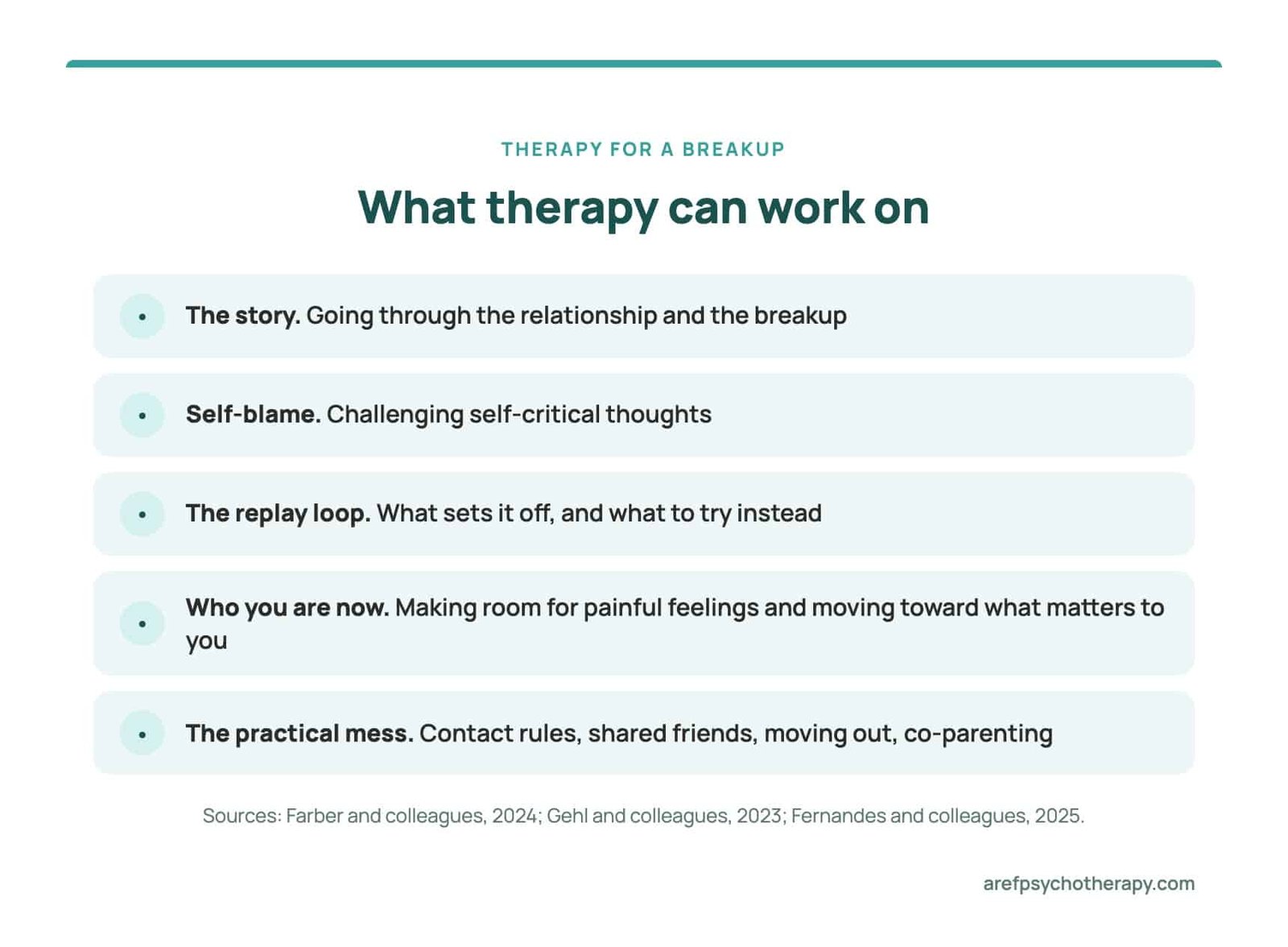
People in that survey valued going through the story of the relationship and having their feelings treated as normal. In a Quebec study of 196 young adults by Gehl and colleagues, people who leaned on self-blame and going over and over things one month after a breakup had more depression and anxiety symptoms, then and at three months. Those who leaned more on acceptance and reframing had fewer depressive symptoms. The study was small, mostly women, and ran during the pandemic. People in the 2024 survey also said challenging self-critical thoughts helped.
The replay loop
Cognitive behavioural therapy (CBT) is a talk therapy that looks at how thoughts, feelings and actions feed each other. Our online CBT page lists intrusive thoughts and rumination, which means going over the same thing again and again, among what it’s used for. In practice, that may mean mapping what sets off the 1 a.m. profile check, then trying something else in that moment.
Who you are now
A 2025 review of 47 studies by Fernandes and colleagues, all in young adults, found breakups can change how people see themselves and how they approach closeness. It also said the long-term effects aren’t settled. If your friends, routines and plans ran through this relationship, you may be rebuilding a lot at once. Acceptance and commitment therapy (ACT) helps you make room for painful feelings and take steps toward what matters to you. Our page lists identity struggles and life transitions.
The practical mess
Contact rules, shared friends, moving out, co-parenting. A therapist can help you think these through, but doesn’t replace a lawyer on money or custody. If you and your ex both want help ending things well, and you feel safe together, couples therapy is another route. Our page names separation as one reason couples come.
Not sure where you stand? A short call can help you decide. Book a free 15-minute phone consultation. There’s no commitment.
What the first few sessions look like
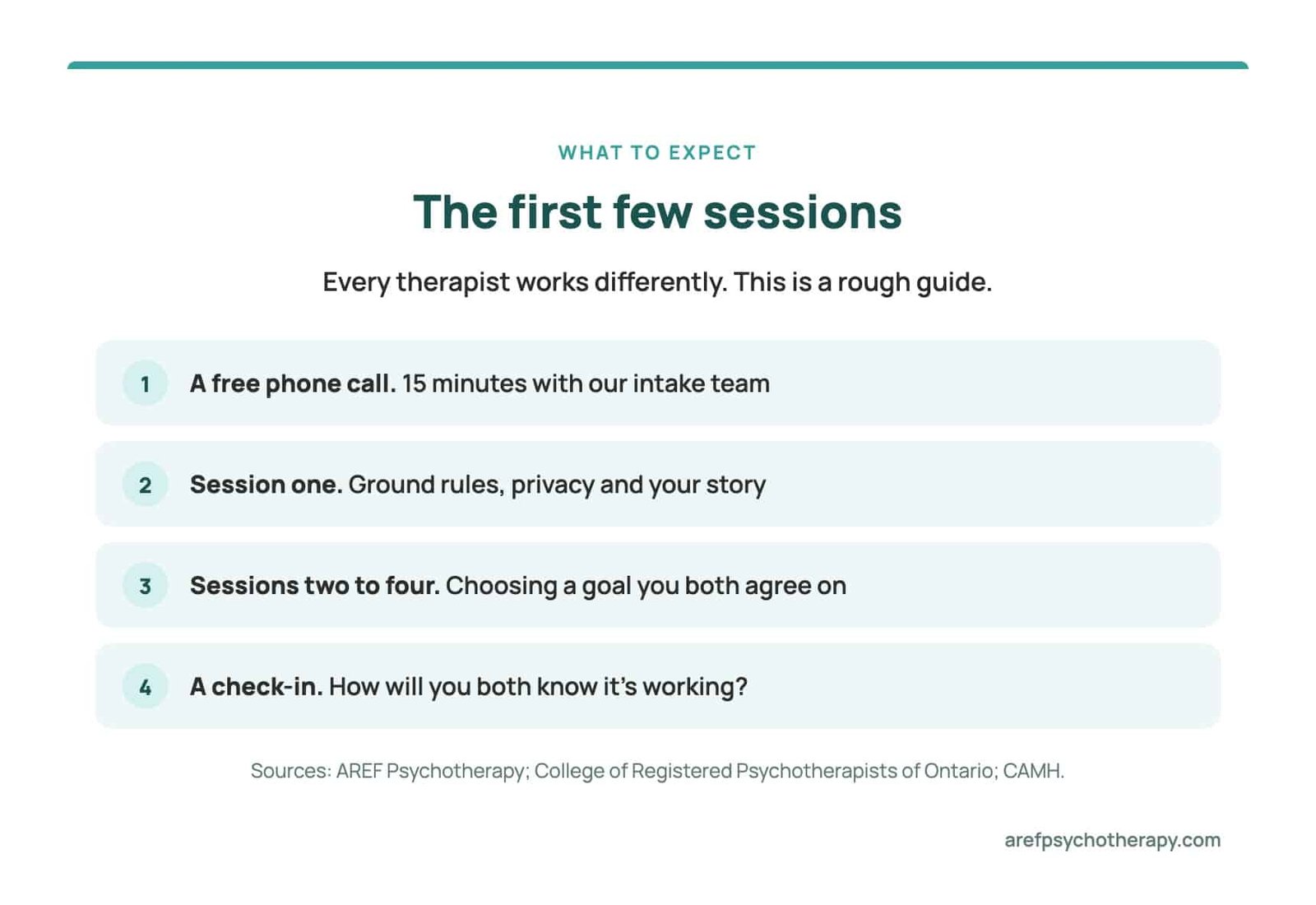
Every therapist works differently, so treat this as a rough guide.
- A free phone call. At AREF this is a 15-minute call. Our intake team answers your questions, matches you with a therapist and explains next steps.
- Session one: ground rules and your story. Most sessions are 50 minutes. Before you begin, a Registered Psychotherapist has to make sure you understand how therapy works, its possible benefits and risks, and your other options. The standards of the College of Registered Psychotherapists of Ontario (CRPO) also require them to explain confidentiality and its limits. Privacy does have limits, for example if there’s a significant risk of serious harm to you or someone else, so ask them to walk you through it. Then expect questions about what happened, how you’re sleeping and who’s around you. You decide how much to say.
- Sessions two to four: choosing a goal. CRPO says you should see a clear plan or goal that you both agree on. It can be small: sleeping through the night, a week without checking their profile, getting through a shared event. Sessions are usually weekly or every two weeks.
- A check-in. Ask how you’ll both know it’s working. CAMH notes that results don’t happen overnight, and that you may feel worse at the start as things come to the surface. If you’re not sure you’re making progress, say so.
Doing this online when home is the hard part
AREF sessions are online, by secure video, so you need a private spot. If you still live with your ex, a parked car or a friend’s place can work, with headphones. Book with an email address your ex can’t read.
Online isn’t the right match for everyone. A 2024 review by Kelber and colleagues found little or no difference between video and in-person care for PTSD. For depression, in-person did somewhat better, though the evidence was low quality. If being in a room with someone matters a lot to you, that’s a fair reason to look for in-person care.
What to ask a therapist
CRPO suggests asking questions before you start. These fit a breakup:
- Have you worked with people after a breakup or separation?
- What would we work on first, and how will we know it’s helping?
- Do you tend to work short-term or long-term?
- What does a session cost, and can I see your fee schedule?
- What are the limits of privacy, and what happens to your notes?
- What happens if this isn’t the right fit?
Fit counts. CAMH says therapy depends on a supportive, comfortable relationship with your therapist, and CRPO says a Registered Psychotherapist will understand if you meet with more than one person to find the right fit.
How to pay for therapy after a breakup in Ontario
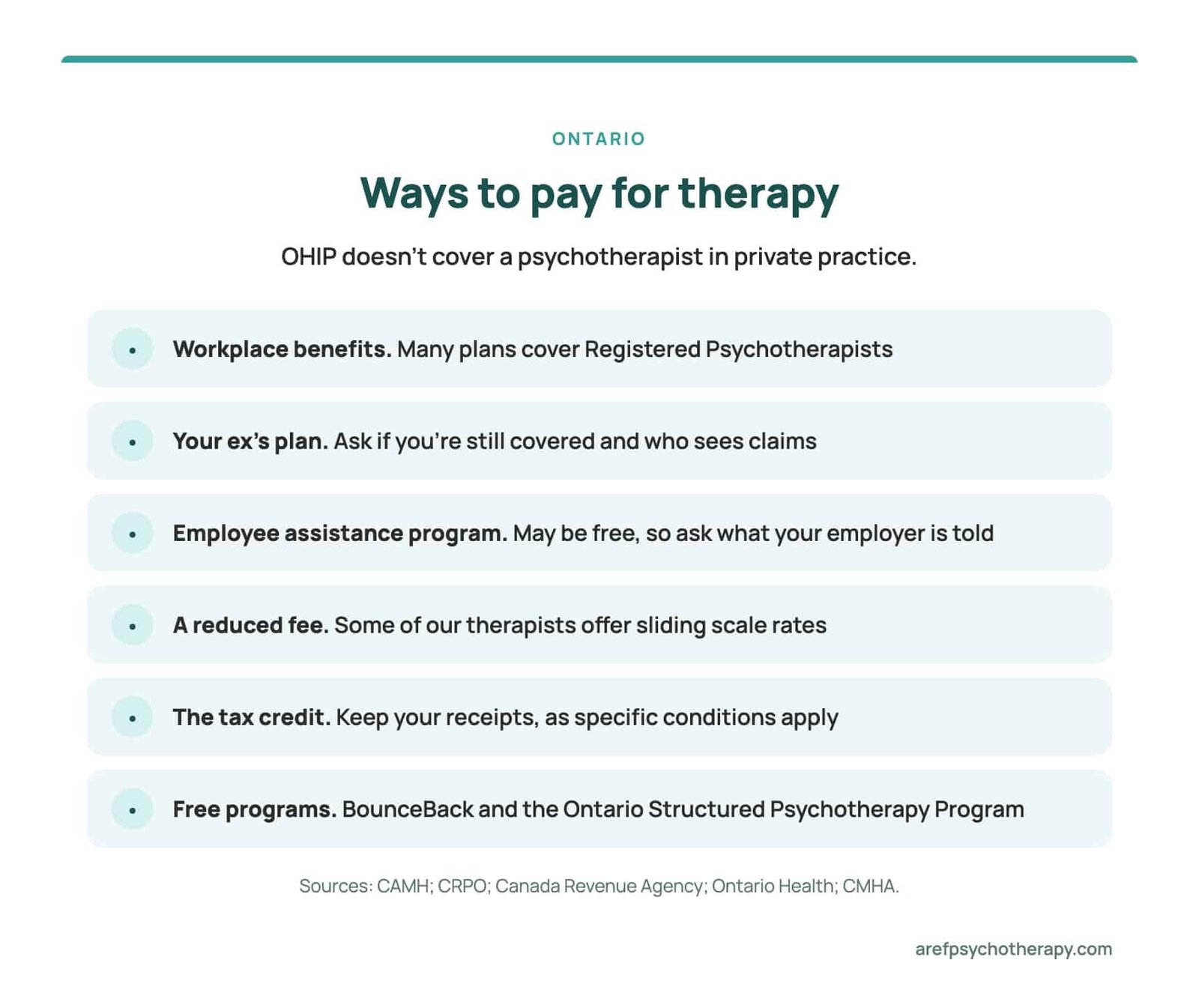
CAMH explains that public health insurance such as OHIP doesn’t cover a psychotherapist in private practice, so you pay a fee. CRPO’s standards say a Registered Psychotherapist must tell you their fees before services start, so ask to see the schedule. How you pay can change who sees what, so ask about that too.
- Workplace benefits. Many plans cover Registered Psychotherapists, and we can help you check. You usually send in your receipts yourself. Ask about your yearly limit and whether you need a referral.
- Your ex’s plan. If you’re covered through your ex, ask whether that’s still true, when it ends, and who can see your claims, before you send the first one.
- Employee assistance program. Services through one may be free. Ask how many sessions you get and what your employer is told.
- A reduced fee. Some of our therapists offer sliding scale rates. Ask our intake team.
- The tax credit. The Canada Revenue Agency lists Registered Psychotherapists in Ontario as authorized practitioners for the medical expense tax credit. CRPO notes that specific conditions apply, so keep your receipts and check with a tax preparer.
- Free programs. BounceBack is free phone coaching from CMHA for low mood, stress and worry, with up to six sessions and no referral. The Ontario Structured Psychotherapy Program offers free cognitive behavioural therapy to adults with symptoms of depression or anxiety. Most people start with self-led resources. In some areas you can refer yourself. Elsewhere, ask your family doctor, whose care OHIP covers.
Key takeaways
- Heartbreak is normal, and not everyone needs therapy for it.
- It’s worth talking to someone if low mood lasts, daily life is slipping, or the same thoughts won’t let up.
- Therapy can work on self-blame, replay loops and who you are now. It can’t bring anyone back.
- OHIP doesn’t cover private psychotherapy, but benefits, sliding scales and free Ontario programs may help.
Frequently asked questions
How long after a breakup should I wait before seeing a therapist?
There's no set waiting period. Some people book in the first week because they can't sleep or work. Others try friends and time first, then book months later. If you're wondering whether it's time, a short consultation can help you think it through.
Is it normal to still hurt months after a breakup?
It can be. CMHA says there is no normal grieving period. Pain on its own isn't a problem you have to fix. What's worth noticing is whether it's easing at all, and whether it's getting in the way of your work, your sleep or the people around you.
Can I go to therapy if I was the one who ended it?
Yes. Ending a relationship can bring guilt, doubt or relief mixed in with sadness. You don't need to be the one who got hurt to want help. You might work on the guilt, on why you left, or on handling the people around you who took sides.
Will a therapist tell me to get back together or to move on?
No. That choice stays with you. A therapist can help you look at what you want, what happened and what you're afraid of, so the decision feels like your own. If you keep going back and forth, that can be the work.
How many sessions will I need after a breakup?
Nobody can say for sure. CAMH says some concerns can be addressed in a few sessions, and describes short-term therapy as up to 16 sessions. More complicated issues can take longer. You and your therapist can review this as you go, and you can decide to stop.
Talk it through with someone
AREF Psychotherapy offers online therapy for adults in Ontario. Our team includes Registered Psychotherapists (RPs), who are regulated by CRPO. Our adult mental health page lists relationship issues, grief and major life transitions among the things we help with. You can also read our guide to grief counselling.
You can start with a free 15-minute phone consultation. Call us at (437) 830-2088, or book online.
If you need help right now
If you are having thoughts of harming yourself or ending your life, please reach out now. Call or text 9-8-8, the 9-8-8 Suicide Crisis Helpline, 24 hours a day, every day of the year. You don’t have to be sure it’s serious enough. If your safety is at risk right now, call 9-1-1.
This article is for informational purposes only and does not replace professional mental health advice. If you’re in crisis, please contact Canada’s 9-8-8 Suicide Crisis Helpline by calling or texting 9-8-8.
Sources and further reading
Research on breakups
- Farber BA, Roe D, Dickstein S, et al. “After the thrill is gone”: The role of psychotherapy in coping with romantic breakups. Psychotherapy, 2024. doi:10.1037/pst0000531.
- Farber BA, Roe D. Clinical perspectives on the nature and treatment of romantic breakups. Journal of Clinical Psychology, 2026. doi:10.1002/jclp.70118.
- Gehl K, Brassard A, Dugal C, et al. Attachment and breakup distress: The mediating role of coping strategies. Emerging Adulthood, 2023. doi:10.1177/21676968231209232.
- Verhallen AM, Alonso-Martínez S, Renken RJ, et al. Depressive symptom trajectory following romantic relationship breakup and effects of rumination, neuroticism and cognitive control. Stress and Health, 2022 (online 2021). doi:10.1002/smi.3123.
- Tran K, Castiglioni L, Walper S, Lux U. Resolving relationship dissolution: What predicts emotional adjustment after breakup? Family Process, 2024 (online 2023). doi:10.1111/famp.12914.
- Oliffe JL, Kelly MT, Gonzalez Montaner G, et al. Mapping men’s mental health help-seeking after an intimate partner relationship break-up. Qualitative Health Research, 2022. doi:10.1177/10497323221110974.
- Fernandes JG, Santos C, Martins MV. Psychosocial effects of romantic breakups during emerging adulthood: A systematic review. Clinical Psychology and Psychotherapy, 2025. doi:10.1002/cpp.70139.
- Statistics Canada. Marital breakdown and subsequent depression. Health Reports, Vol. 18 No. 2, 2007.
Research on online therapy
- Kelber MS, Smolenski DJ, Boyd C, et al. Evidence-based telehealth interventions for post-traumatic stress disorder, depression, and anxiety: A systematic review and meta-analysis. Journal of Telemedicine and Telecare, 2024. doi:10.1177/1357633X231224491.
Canadian health bodies, regulators and government
- Grieving, Canadian Mental Health Association
- Depression, Centre for Addiction and Mental Health (CAMH)
- Loss, grief and healing, CAMH
- Psychotherapy, CAMH
- Looking for mental health services, CAMH
- Professional Practice Standards, College of Registered Psychotherapists of Ontario (CRPO)
- What to Know About Psychotherapy, CRPO
- Are CRPO registrants required to charge HST?, CRPO
- Authorized medical practitioners for the purposes of the medical expense tax credit, Canada Revenue Agency
- Ontario Structured Psychotherapy Program, Ontario Health
- Find mental health and addiction services in your community, Government of Ontario
- Victim services in Ontario, Government of Ontario
Support
- 9-8-8 Suicide Crisis Helpline: call or text 9-8-8
- BounceBack Ontario, Canadian Mental Health Association
- Assaulted Women’s Helpline: 1-866-863-0511