
Reviewed by the AREF Psychotherapy team
Last checked: November 2026
You’ve decided to talk to someone, or you’re close. Then the practical questions show up. Who pays? Who finds out?
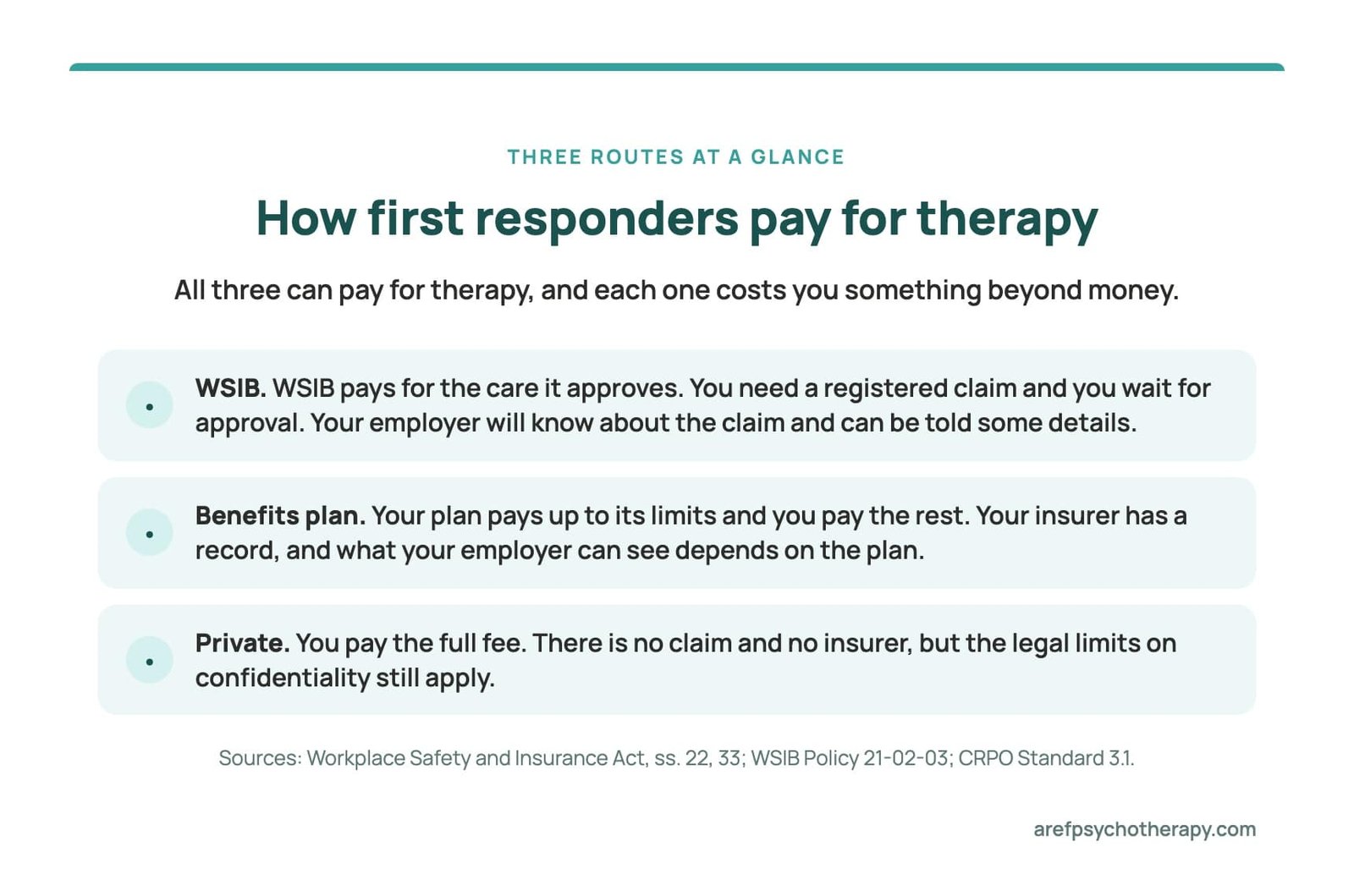
In Ontario you have three routes: a first responder WSIB claim, your benefits plan, or paying privately. All three can pay for therapy, and each one costs you something beyond money.
The short version: through WSIB, approved care costs you nothing, but your employer will know there is a claim. You can start on one route and move to another, but WSIB’s six-month clock keeps running while you decide.
This is general information, not legal advice. For how each route works with us, see our page on first responder therapy in Ontario.
Three routes at a glance
- WSIB. WSIB pays for the care it approves. You need a registered claim and you wait for approval. Your employer will know about the claim and can be told some details.
- Benefits plan. Your plan pays up to its limits and you pay the rest. Your insurer has a record, and what your employer can see depends on the plan.
- Private. You pay the full fee. There is no claim and no insurer, but the legal limits on confidentiality still apply.
What a first responder WSIB claim gets you, and what it shares
WSIB’s Mental Health Program of Care is for people with a registered claim or recurrence. WSIB has to approve your care first, and only contracted providers can deliver it. AREF is one of them. With no claim, you can still see a therapist, but through a plan or privately.
On an approved claim, WSIB pays approved health care costs, even if you haven’t missed work and even if you have insurance. WSIB’s mental stress page also lists wage-loss benefits and return-to-work help. Extending treatment takes more approval.
Now the cost. Under section 22 of the Workplace Safety and Insurance Act, you must give your employer a copy of your claim. You must also consent to your functional abilities information going to them for your return to work. WSIB says it will reach out to your employer and may speak with witnesses. If that worries you, talk to your union or association rep before you file.
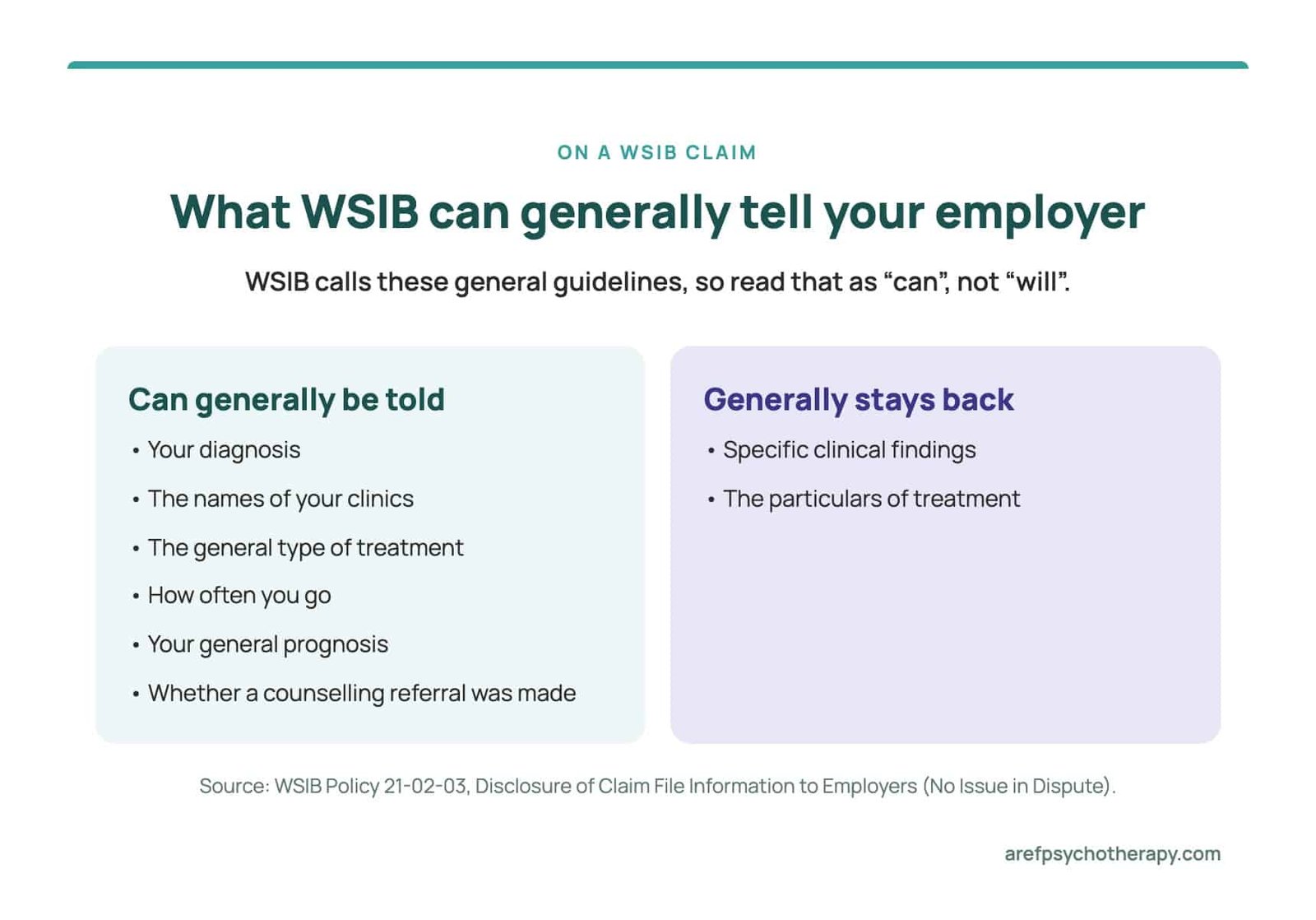
WSIB Policy 21-02-03 lists what it can generally tell your employer without your consent. The list includes your diagnosis, the names of your clinics, the general type of treatment, how often you go, your general prognosis and whether a counselling referral was made. WSIB calls these general guidelines, so read that as “can”, not “will”.
Specific clinical findings and the particulars of treatment generally stay back. WSIB’s privacy questions and answers say your employer can get relevant file documents when it objects to a decision or joins your appeal, and you can object first to releasing health information you feel isn’t relevant. Your therapist must give WSIB the information it requires.
This page skips the filing steps. For those, read how to file a WSIB mental stress claim, WSIB benefits for mental stress and PTSD and WSIB therapy at AREF.
Who can diagnose for the presumption
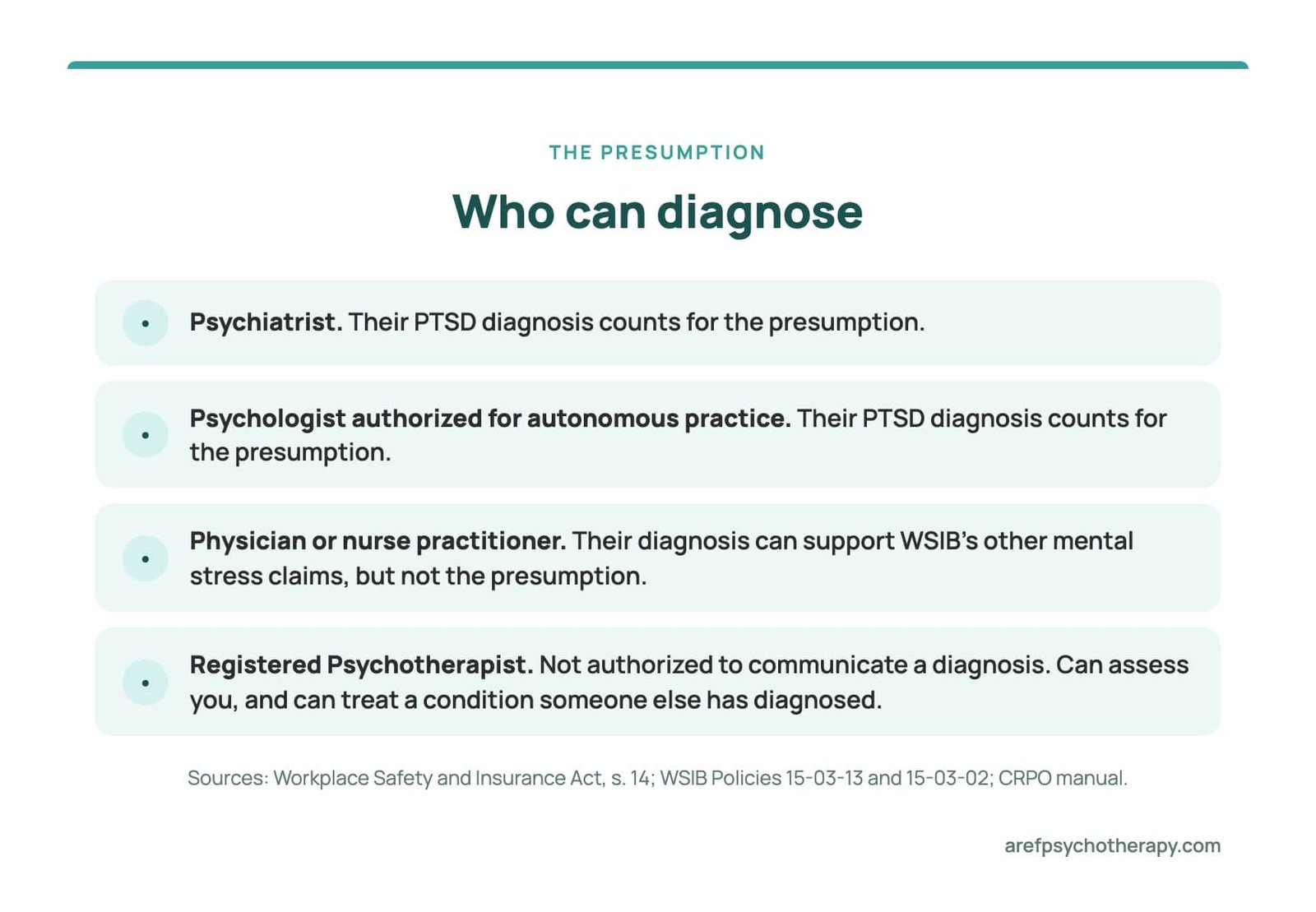
Under section 14 of the Act, PTSD in a listed first responder is presumed to come from the job unless the contrary is shown. To use it, you need a PTSD diagnosis from a psychiatrist or a psychologist authorized for autonomous practice. WSIB Policy 15-03-13 says the same.
A Registered Psychotherapist cannot give you that diagnosis. The College of Registered Psychotherapists of Ontario (CRPO) manual says registrants are not authorized to communicate a diagnosis to clients. They can assess you, and they can treat a condition someone else has diagnosed. A physician’s or nurse practitioner’s diagnosis can support WSIB’s other mental stress claims, but not the presumption.
You don’t need a diagnosis to start therapy through a plan or privately. On a claim, WSIB says it may ask you to see a psychologist or other qualified professional for an assessment. If you have no diagnosis yet, ask how to handle that before you file, because a denied PTSD claim may not be refiled under the presumption. Policy 15-03-13 says WSIB may reconsider it under its traumatic mental stress policy if there is new information.
Not sure which route fits? Use a free consultation to ask how each route works with us and who on our team does what. We don’t give legal advice, and we can’t tell you whether to claim.
Benefits plans and session limits
Your plan may cover a Registered Psychotherapist. We work with all insurance providers, and what’s covered depends on your plan. If your plan is with Sun Life, we bill Sun Life directly and you pay only the part your plan doesn’t cover. With other insurers, you pay at your session and we give you a detailed receipt to submit.
Check your yearly maximum and how much your plan pays per session. Those numbers tell you roughly how many sessions you have before you pay the rest. Ask us about current session fees, and ask your plan whether it needs a referral.
On privacy, your insurer sees what you claim. Sun Life’s guide for plan administrators says it doesn’t give plan sponsors personal member information without the member’s consent. Its health care claim form adds a limit: if fraud or plan abuse is suspected, claim information may go to the plan sponsor. If your employer funds its own plan, we could not confirm what it can see, so ask your union benefits rep.
The same form asks whether the expenses come from a work injury, and whether you claimed through workers’ compensation. Keep any answer like that true. We could not confirm how a yes affects payment, so ask first.
Paying privately: what stays private and what doesn’t
You pay per session by e-transfer or credit card, and you get a receipt after each session. Some of our therapists offer sliding-scale fees, so ask about that too.
With no claim, there is no claim copy for your employer and no reports to WSIB. With no insurer, there is no insurer record, unless you later send a receipt to a plan or spending account. Here is what doesn’t change:
- Confidentiality has limits. The CRPO standards name limits such as a significant risk of serious harm, mandatory reports and some legal proceedings. They apply however you pay. A therapist must explain them, so ask before you start.
- Health questions on forms. The federal firearms licence application asks about things like depression and emotional problems. Ontario’s Insurance Act requires people applying for life or sickness insurance to disclose material facts. Paying privately doesn’t change that. Your answers must be true.
- WSIB benefits. With no claim, WSIB pays nothing toward therapy or lost wages.
The clocks: six months from the injury, 24 months after leaving
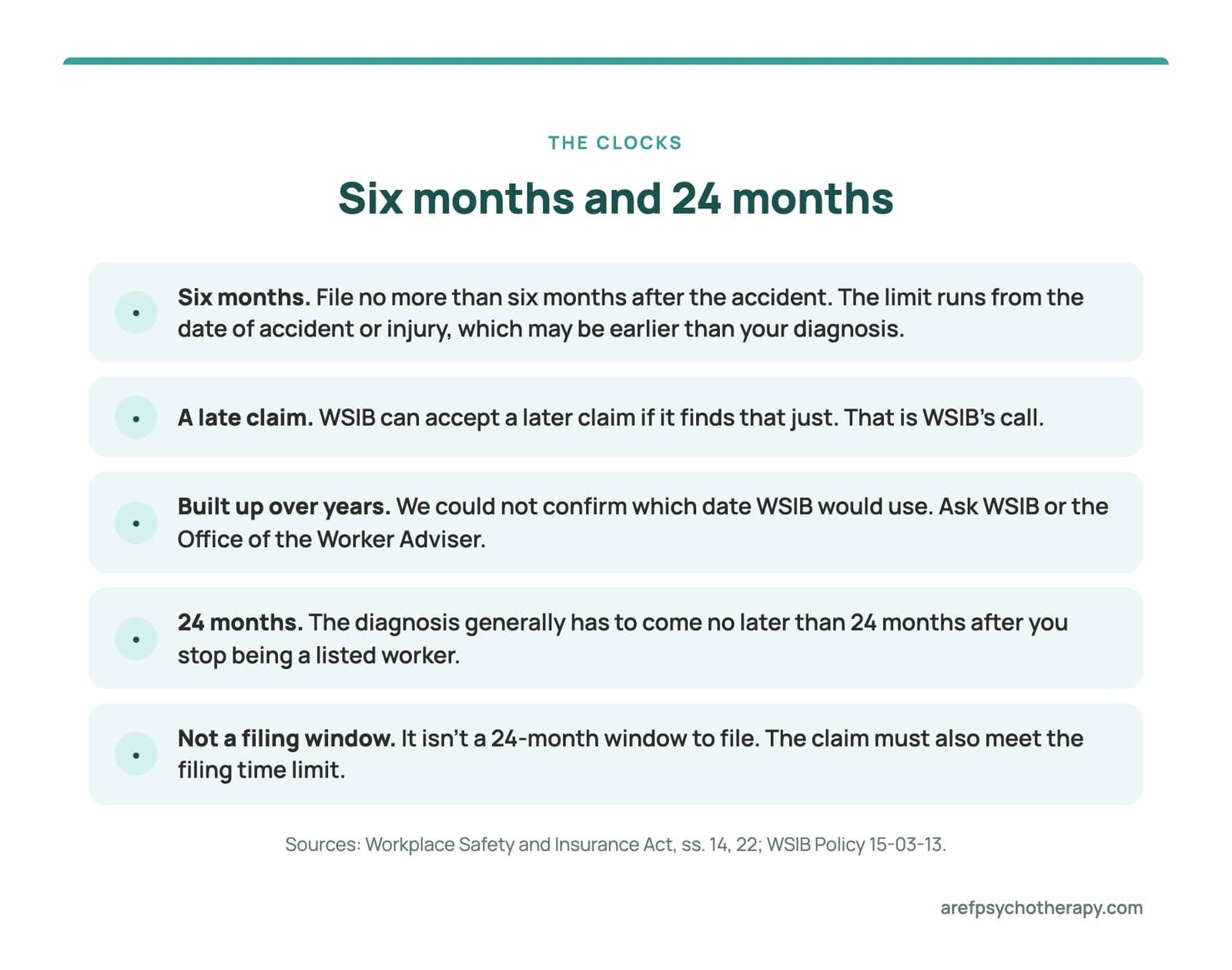
Six months. Section 22 says to file as soon as possible, and no more than six months after the accident. Policy 15-03-13 applies that limit to PTSD claims and says it runs from the date of accident or injury, which may be earlier than your diagnosis. Depending on the claim, WSIB Policy 11-01-04 says that date can be an incident, first medical attention or diagnosis. So don’t count six months from your diagnosis.
WSIB can accept a later claim if it finds that just. Policy 15-01-03 talks about exceptional circumstances, such as serious health problems. That is WSIB’s call.
If your injury built up over years of calls, we could not confirm which date WSIB would use. Ask WSIB or the Office of the Worker Adviser.
24 months. If you’ve left the role, the diagnosis generally has to come no later than 24 months after you stop being a listed worker. It isn’t a 24-month window to file. The claim must also meet the filing time limit.
If you’ve retired. Both limits apply. You also need at least one day in the role on or after a set date, which our first responder page lists by role. Past 24 months the presumption generally isn’t available, though the Act leaves other mental stress claims in place. Check any retiree plan, or pay privately.
If you volunteer. Volunteer firefighters and members of emergency response teams are on the list. For a municipal volunteer fire brigade, the Act treats the municipality or the body running it as your employer. If you also have a day job, ask WSIB what that employer could hear. Coverage may come through that job or a family member’s plan.
If you’re RCMP or in federal corrections. This page covers Ontario’s system. The federal compensation Act excludes RCMP members, and we did not check federal corrections, so ask your association or union.
If you start private and claim later
If you file a WSIB claim later, we can move your therapy over to WSIB once WSIB approves it. Four things to know first:
- The clock keeps running. Private sessions don’t pause it.
- Your earlier care can come up. WSIB says its claim form needs information about health care you received. Once you claim, the Act says practitioners must give WSIB the information it requires.
- Delay can be looked at. WSIB can investigate a significant delay in reporting, and Policy 21-02-03 lists investigation results among what an employer can generally be told.
- Repayment is unconfirmed. We could not confirm whether WSIB repays private fees you paid before a claim. Ask WSIB or the Office of the Worker Adviser before you count on it.
If you’re undecided, ask early, before the six months pass. Start with your union or association rep if you have one. The Office of the Worker Adviser gives free help to non-unionized workers, at 1-800-435-8980. WSIB’s number is 1-800-387-0750, and a lawyer can look at your own facts.
You don’t need every answer before your first session. All of this is general information, not legal advice.
Key takeaways
- The Mental Health Program of Care needs a registered claim, and your employer will know there is a claim.
- The presumption needs a PTSD diagnosis from a psychiatrist or psychologist. A Registered Psychotherapist cannot communicate a diagnosis.
- Benefits plans have limits, so check your yearly maximum.
- Paying privately means no claim and no insurer, but confidentiality still has limits.
- The six-month clock runs from the date of injury, and it keeps running while you pay privately.
Frequently asked questions
Can I see a therapist without a WSIB claim?
Yes. You can start through your benefits plan or pay privately, without a diagnosis. What you can't use without a registered claim is WSIB's Mental Health Program of Care. If this comes from the job, keep the six-month limit in mind.
Can a Registered Psychotherapist diagnose my PTSD for a WSIB claim?
No. Registered Psychotherapists are not authorized to communicate a diagnosis. For the presumption, the PTSD diagnosis must come from a psychiatrist or a psychologist authorized for autonomous practice. A Registered Psychotherapist can still assess you and provide therapy, including for a condition someone else diagnosed.
Will my employer see my benefits plan claims?
It depends on the plan. Sun Life says it doesn't share personal member information with plan sponsors without consent, though its claim form allows it if fraud or plan abuse is suspected. If your employer funds its own plan, we could not confirm what it sees. Ask your union benefits rep.
Does paying privately stop the WSIB clock?
No. The six-month limit runs from the date of accident or injury, which may be earlier than your diagnosis. Paying privately doesn't change that. WSIB can accept a later claim if it finds that just, but that is WSIB's call. If you might claim, ask about your dates early.
Will WSIB pay me back for private sessions if I claim later?
We could not confirm this, so please don't count on it. Ask WSIB at 1-800-387-0750 before you decide. If you're not in a union, the Office of the Worker Adviser gives free help. If you are, start with your rep. Keep your receipts.
Talk it through before you choose
AREF Psychotherapy’s team includes Registered Psychotherapists (RPs), who are regulated by CRPO. Sessions are online, for people in Ontario. You can read more about how paying for first responder therapy works with us.
You can start with a free 15-minute phone consultation to ask how each route would work with us and what gets shared. Call us at (437) 830-2088, or book online.
If you need help right now
If you are thinking about ending your life, please reach out now. Call or text 9-8-8, the 9-8-8 Suicide Crisis Helpline, 24 hours a day, every day of the year. First responders in Ontario can also call Boots on the Ground at 1-833-677-2668, 24/7, for anonymous peer support. If your safety is at risk right now, call 9-1-1.
This article is for informational purposes only and does not replace professional mental health advice. If you’re in crisis, please contact Canada’s 9-8-8 Suicide Crisis Helpline by calling or texting 9-8-8.
Sources and further reading
Ontario law and WSIB
- Workplace Safety and Insurance Act, 1997, Government of Ontario
- Posttraumatic Stress Disorder in First Responders and Other Designated Workers, Policy 15-03-13, WSIB Operational Policy Manual
- Workers’ Requirement to Claim and Consent, Policy 15-01-03, WSIB Operational Policy Manual
- Determining the Date of Injury, Policy 11-01-04, WSIB Operational Policy Manual
- Disclosure of Claim File Information to Employers (No Issue in Dispute), Policy 21-02-03, WSIB Operational Policy Manual
- Traumatic Mental Stress, Policy 15-03-02, WSIB Operational Policy Manual
- Mental health program of care, WSIB
- Work-related mental stress injuries, WSIB
- Health care benefits, WSIB
- Questions and answers: Claims, WSIB
- Regulated Health Professions Act, 1991, Government of Ontario
- Insurance Act, Government of Ontario
- About the Office of the Worker Adviser, Government of Ontario
Regulators and federal sources
- Standards of Practice, College of Registered Psychotherapists of Ontario (CRPO)
- Professional Practice and Jurisprudence manual, College of Registered Psychotherapists of Ontario (CRPO)
- Government Employees Compensation Act, Government of Canada
- Application for a Possession and Acquisition Licence, form 5592e, Royal Canadian Mounted Police
Insurer documents
- Administration Guide for client-administered group plans, Sun Life
- Extended Health Care claim form, Sun Life
Support
- 9-8-8 Suicide Crisis Helpline: call or text 9-8-8
- Boots on the Ground: 1-833-677-2668