
You lose track of time. Tasks pile up. People tell you to “just focus,” and you have been trying for years. At some point you start to wonder whether ADHD is part of the story. Then a new question shows up: where do you even go?
This guide explains how to get an ADHD diagnosis in Ontario. It sets out the four main routes side by side: who can diagnose, who pays, what the assessment involves, and what you can do while you wait. Every law, cost and guideline below links to its source, so you can check it yourself.
A quick note about us. Most of our team at AREF Psychotherapy are Registered Psychotherapists, and Registered Psychotherapists cannot diagnose ADHD in Ontario (we explain why below). Our Nurse Practitioner offers ADHD assessments, and our therapists can support you before and after one.
Who can diagnose ADHD in Ontario (and who can’t)
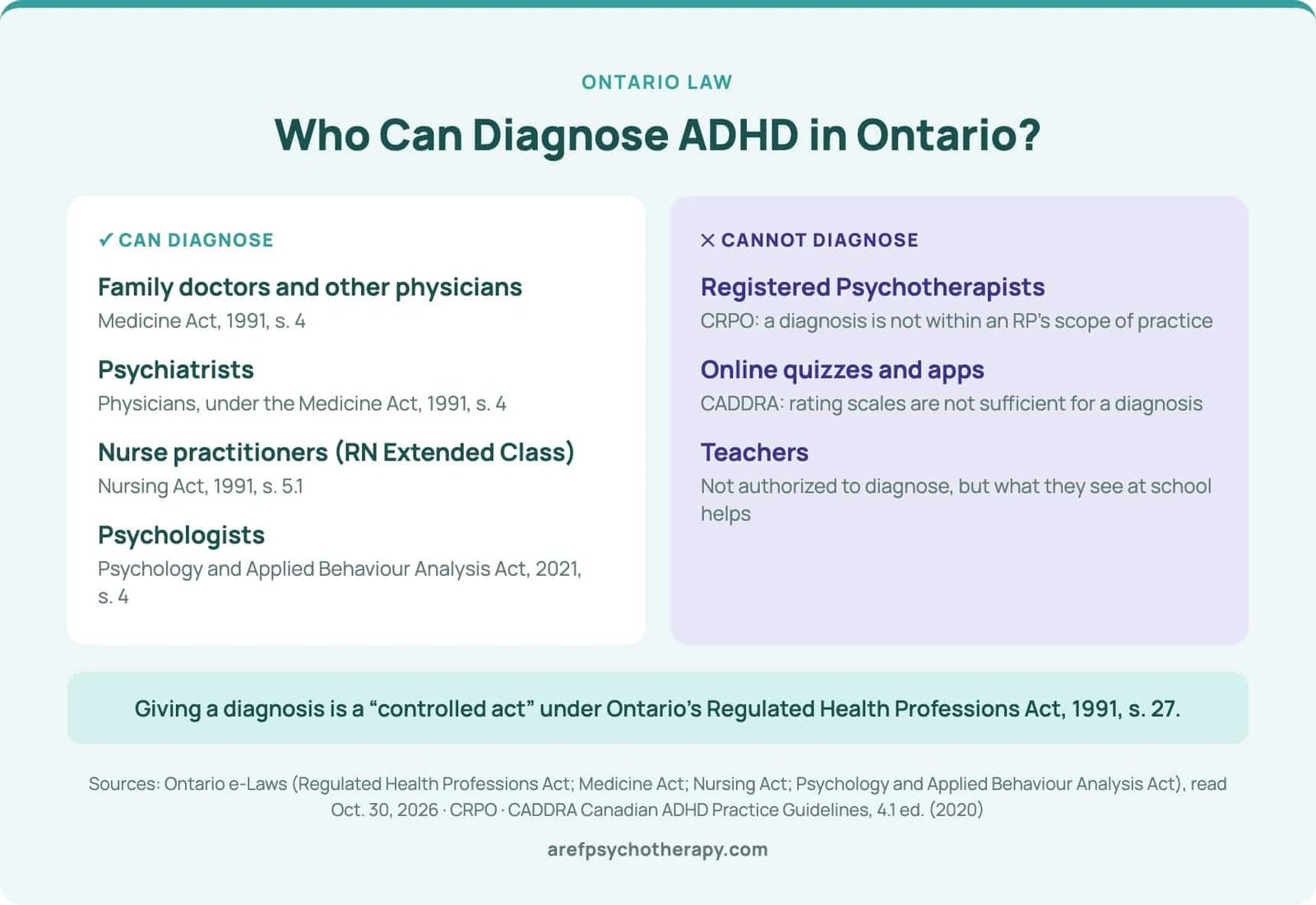
In Ontario, telling someone that a disorder is causing their symptoms is a legal “controlled act.” Under the Regulated Health Professions Act, 1991 (section 27), only people the law authorizes may do it. For ADHD, the professionals who can diagnose include:
- Physicians, including family doctors and psychiatrists. The Medicine Act, 1991 lets them give a diagnosis.
- Nurse practitioners (registered nurses in the Extended Class). Section 5.1 of the Nursing Act, 1991 lets them give a diagnosis they have made.
- Psychologists registered with the College of Psychologists and Behaviour Analysts of Ontario. Their authority comes from the Psychology and Applied Behaviour Analysis Act, 2021.
Registered Psychotherapists (RPs) are not on that list. Our regulator, the College of Registered Psychotherapists of Ontario, says RPs may assess emotional and behavioural difficulties, but “it is not within an RP’s scope of practice to provide a diagnosis.” That is true at every clinic, including ours.
What an RP can do is help with what feels hard right now, help you prepare for an assessment, and provide therapy before or after a diagnosis.
How to get an ADHD diagnosis: 4 routes, side by side
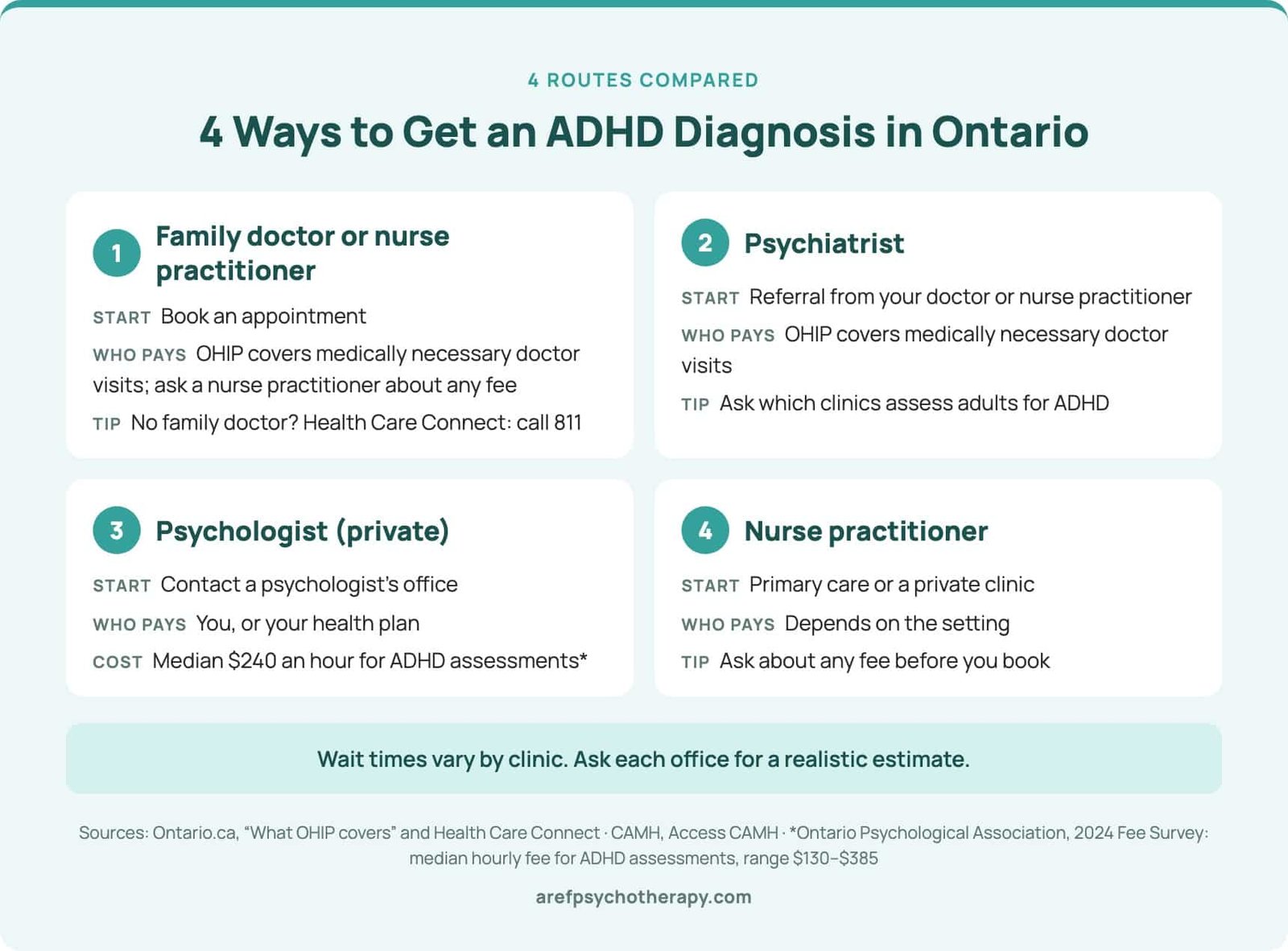
There are four common ways in. You can start with whichever one fits your budget, your timeline and the kind of support you want. Wait times vary from clinic to clinic, so for every route, ask the office for a realistic estimate before you commit.
Route 1: Your family doctor or nurse practitioner
- How to start: Book an appointment and say you want to talk about ADHD.
- Who pays: OHIP covers the full cost of medically necessary doctor visits, in person or by video or phone (Ontario: What OHIP covers). If you see a nurse practitioner, ask whether there is any fee.
- What to expect: Canada’s ADHD guideline says patients with ADHD “can be managed in a primary care setting” (CADDRA, Canadian ADHD Practice Guidelines, 4.1 edition). Your clinician may assess you or refer you on. CADDRA suggests more help when other health conditions make the picture unclear.
- No family doctor? Register with Health Care Connect online or by calling 811. A Care Connector looks for a family doctor, nurse practitioner or primary care team in your community. The province notes that a match may not happen right away.
Route 2: A psychiatrist, by referral
- Who they are: Psychiatrists are “medical doctors who specialize in the diagnosis and treatment of mental health problems” (HealthLinkBC). Because they are physicians, OHIP covers medically necessary visits.
- How to start: Ask your family doctor or nurse practitioner about a referral. Psychiatry clinics may require one. For example, the Access CAMH page says most of CAMH’s mental health services need a referral form completed by a physician or nurse practitioner.
- Good to know: CAMH also lists ADHD assessment and treatment among the services it is unable to offer. Before a referral goes out, ask which local clinics actually assess adults for ADHD.
Route 3: A psychologist in private practice
- Who pays: You, or a workplace or school health plan if you have one. OHIP does not cover health services delivered outside hospital by providers who are not physicians or other practitioners prescribed under Ontario law (Ontario: What OHIP covers).
- What it costs: The Ontario Psychological Association asked psychologists and psychological associates about their fees in a 2024 fee survey. For ADHD assessments, the median fee was $240 an hour. Fees ranged from $130 to $385 an hour. The total depends on how many hours your assessment takes, so ask for a written quote. It should list what is included, such as the interview, any testing, the report and the feedback meeting.
- Finding one: The College of Psychologists and Behaviour Analysts of Ontario does not make referrals. Its referrals page explains how to check a psychologist on its public register. It also points to referral services run by the Ontario Psychological Association and the Ontario Association of Mental Health Professionals.
- Before you book: If you have a health plan, ask what it pays for psychologist services each year and whether it needs a referral note.
Route 4: A nurse practitioner
- Who they are: Nurse practitioners (RN Extended Class) can make and communicate a diagnosis under the Nursing Act. Some work in primary care, which is why Health Care Connect can match you with one. Others work in private clinics.
- Who pays: It depends on the setting. Ask before you book whether there is a fee and what it covers.
- At AREF: Our Nurse Practitioner (RN-EC) offers ADHD assessments, and our Registered Psychotherapists provide therapy. You can read how it works on our ADHD assessment and therapy page.
If you are asking for your child: the same professionals can diagnose children and teens. Teachers cannot diagnose ADHD, but what they see at school matters: CADDRA calls communicating with the school “crucial” to collecting information for the assessment.
Not sure which route fits you? A free 15-minute consultation with our team is a low-pressure way to talk it through. Book a free consultation.
What happens in an adult ADHD assessment
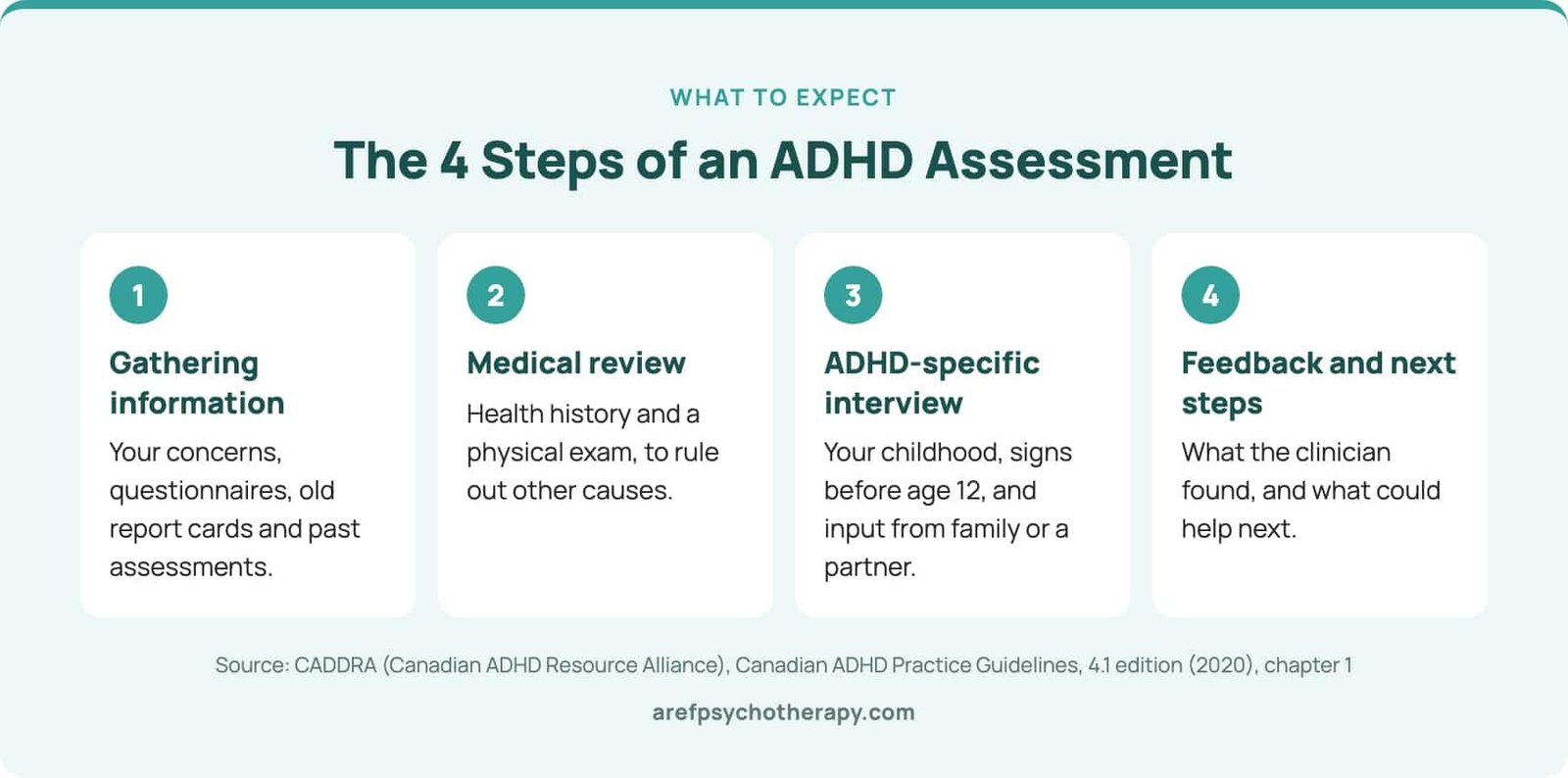
ADHD is not diagnosed with a single test. CADDRA says brain imaging has “no direct clinical application at this time.” Instead, “the clinical interview and evaluation continues to be the mainstay of ADHD diagnosis.” The guideline describes four steps:
- Gathering information. You talk about what brought you in and fill out questionnaires. You may be asked for old report cards or past assessments.
- Medical review. The clinician reviews your health history and makes sure a physical exam is done, to rule out medical causes that can look like ADHD.
- ADHD-specific interview. This covers your childhood and development, including whether symptoms were there before age 12. Adults often find childhood hard to remember, so the clinician may ask to hear from a parent or someone who knew you then. For adults, CADDRA also calls reports from family members or partners important.
- Feedback and recommendations. The clinician explains what they found, whether or not it is ADHD, and what could help next.
What the clinician checks
Clinicians use the criteria in the DSM, the manual of mental health conditions. Its current edition is the DSM-5-TR. As CADDRA and the American Psychiatric Association summarize them, a diagnosis needs:
- enough current symptoms of inattention, hyperactivity-impulsivity, or both. People 17 and older need at least 5 of the 9 symptoms in a group, instead of 6 for children;
- symptoms that started before age 12;
- problems in two or more areas of life, such as work, home, school or relationships, for at least six months; and
- no better explanation, such as another health or mental health condition.
CADDRA adds that an ADHD assessment “should always include a general mental health screening.” Depression and anxiety can overlap with ADHD symptoms. If you are wondering about that overlap, our guide ADHD or Anxiety? How to Tell the Difference goes deeper.
Two more points from CADDRA are worth knowing. Good school performance “does not necessarily rule out ADHD.” And asking for an assessment because you suspect ADHD yourself is a normal way to start; it does not decide the result either way. If you have always looked organized on the outside, our article on ADHD in women: signs, diagnosis and what helps may be useful.
Online ADHD quizzes vs a real assessment
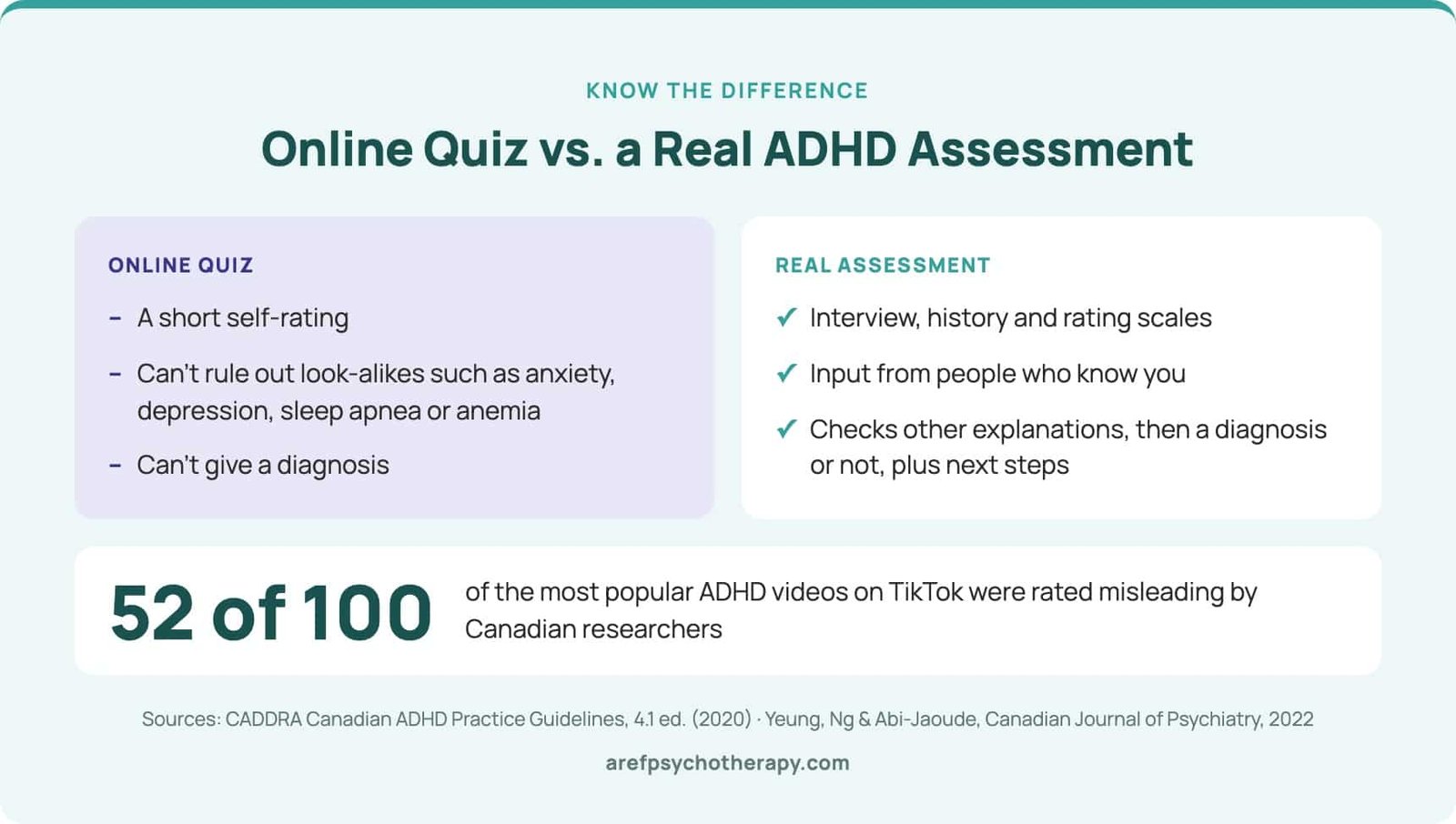
An online quiz can be a useful nudge, but it cannot diagnose you. CADDRA says rating scales and questionnaires “are not sufficient for a diagnosis,” because other conditions can also score high on ADHD scales. Its examples include depression and anxiety, and medical conditions such as sleep apnea or anemia. A careful assessment lowers the risk of a wrong diagnosis.
Social media adds its own noise. Canadian researchers reviewed the 100 most popular TikTok videos about ADHD. They found 52 were misleading, 27 were personal experience and 21 were useful (Yeung, Ng and Abi-Jaoude, Canadian Journal of Psychiatry, 2022). Videos from healthcare providers were higher quality and more useful.
If a quiz or a video got you thinking about ADHD, that is a fine reason to book an assessment. Just treat the result as a question, not an answer.
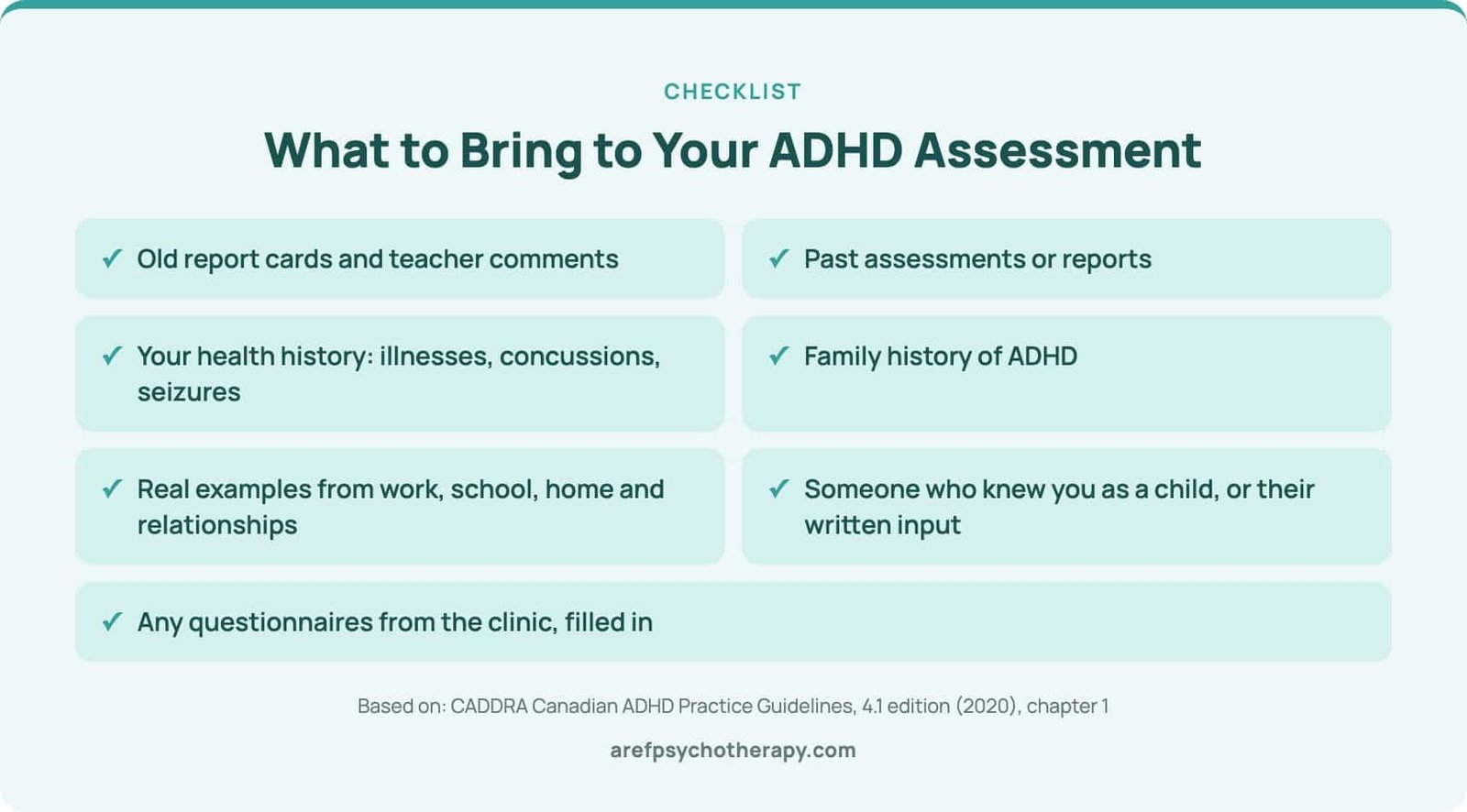
What to bring to your ADHD assessment
Preparing helps the clinician see the full picture. Based on what CADDRA asks clinicians to review, gather:
- Old report cards and teacher comments, if you can find them.
- Past assessments or reports.
- Your health history, including past illnesses, concussions or seizures.
- Family history, such as a parent, brother, sister or child with ADHD.
- Real examples of how focus, organization or impulsivity affect your work, school, home and relationships.
- Someone who knew you as a child, like a parent or older sibling, who can share what you were like. CADDRA notes that questionnaires are one way to collect what they know.
- Any questionnaires the clinic sent you, filled in ahead of time.
Bring a short list of your own questions, too. It is easy to forget them in the room.
What to do while you wait
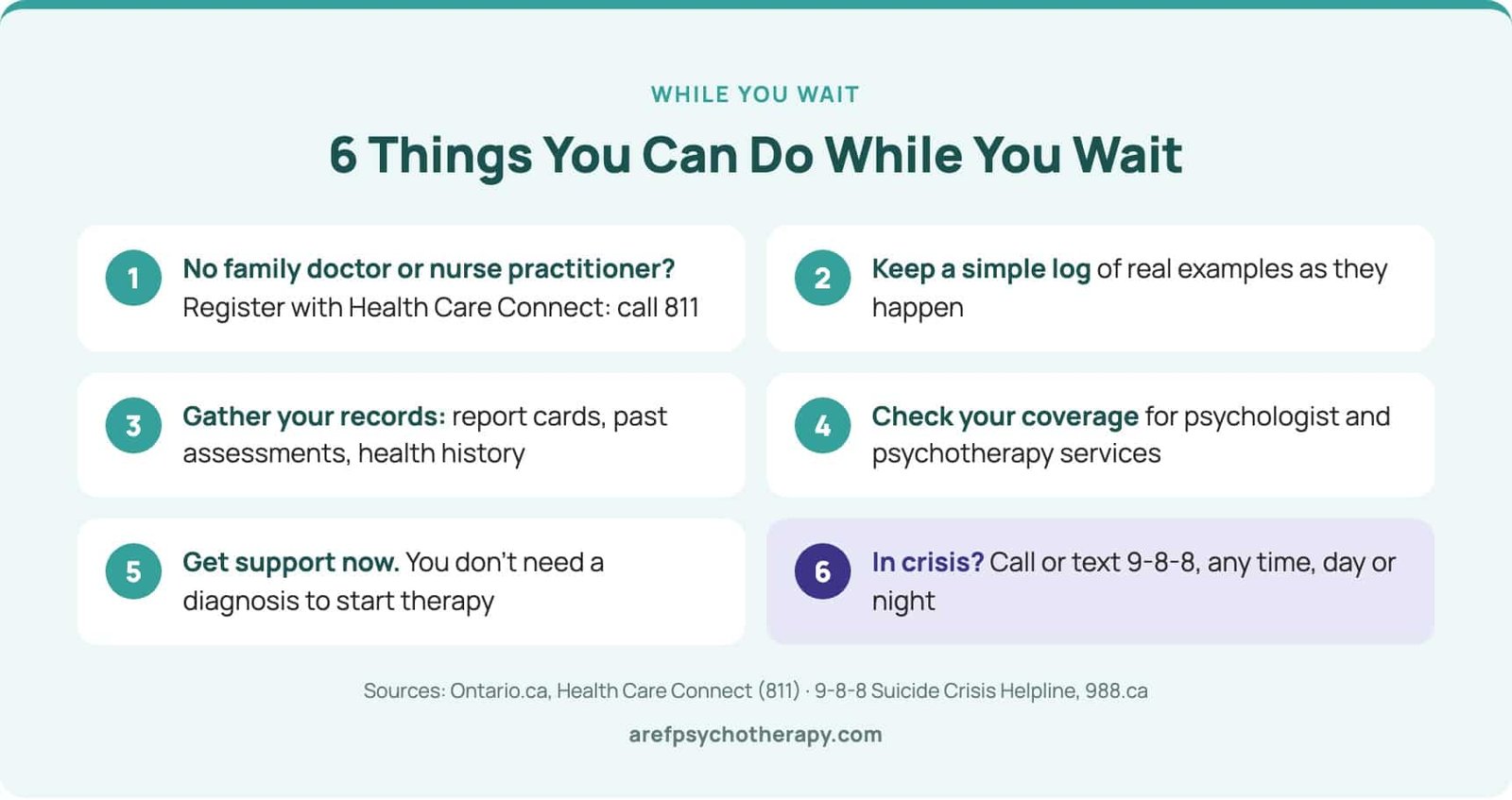
Waiting is hard, especially when everyday life already feels like a lot. These steps can make the wait more useful:
- Get on the list for primary care. No family doctor or nurse practitioner? Register with Health Care Connect online or by calling 811.
- Keep a simple log. Write down real examples as they happen, like missed deadlines or lost items, and how they affected your day. CADDRA notes that people with ADHD may not recall symptoms accurately, so notes made in the moment help.
- Gather your records. Report cards, past assessments and your health history (see the list above).
- Check your coverage. If you have a workplace or school health plan, ask what it pays for psychologist and psychotherapy services.
- Get support now. You do not need a diagnosis to start therapy. Ontario’s Psychotherapy Act, 2007 describes psychotherapy as the “assessment and treatment of cognitive, emotional or behavioural disturbances.” So a Registered Psychotherapist can work with you on stress, routines and relationships while you wait.
- Choose sources with care. CADDRA points people to CADDAC, the Centre for ADHD Awareness Canada, for more information.
If you are in crisis or thinking about suicide, call or text 9-8-8 at any time, day or night (9-8-8 Suicide Crisis Helpline).
After the diagnosis: what treatment can look like
A diagnosis is a starting point. CADDRA describes ADHD treatment as “multimodal,” meaning a mix that is tailored to the person. It can include:
- Learning about ADHD (psychoeducation). CADDRA says its purpose is “to educate and empower patients and their families.”
- Therapy and skills work. CADDRA calls cognitive behavioural therapy (CBT) “an effective psychological treatment for adults with ADHD.” CBT adapted for ADHD mainly works on things like time management and organization.
- Medication, for some people. That is a decision to make with a prescriber, such as a physician or nurse practitioner, who can explain the options for your health.
The research on therapy keeps growing. A 2026 review that pooled 70 studies with 5,152 participants found CBT for adult ADHD was linked to moderate improvements in day-to-day functioning, with the strongest effects on work (López-Pinar and colleagues, Behaviour Research and Therapy). The authors note limits, such as reliance on self-report and short follow-ups.
Ready to talk about your next step?
You do not have to work this out alone. At AREF Psychotherapy:
- Your first conversation is a free 15-minute consultation, with no commitment.
- Our Registered Psychotherapists provide therapy before or after a diagnosis.
- Our Nurse Practitioner (RN-EC) offers ADHD assessments.
Key takeaways
- In Ontario, communicating a diagnosis is a controlled act. Physicians (including family doctors and psychiatrists), nurse practitioners and psychologists can diagnose ADHD. Registered Psychotherapists cannot.
- OHIP covers medically necessary doctor visits. A private psychologist is paid by you or a health plan; in the Ontario Psychological Association’s 2024 fee survey, the median fee reported for ADHD assessments was $240 an hour.
- A thorough assessment follows four steps: gathering information, a medical review, an ADHD-specific interview, and feedback.
- Online quizzes cannot diagnose ADHD. Other conditions can score high on ADHD scales.
- While you wait, you can register for primary care, keep a log, gather records, check your coverage and get support.
Frequently asked questions
Can a Registered Psychotherapist diagnose ADHD in Ontario?
No. Communicating a diagnosis is a controlled act in Ontario, and the College of Registered Psychotherapists of Ontario says providing a diagnosis is not within an RP's scope of practice. Physicians, nurse practitioners and psychologists can diagnose ADHD. A Registered Psychotherapist can still help: they can work with you on stress, routines and relationships, help you prepare for an assessment, and provide therapy before or after a diagnosis.
Is an ADHD assessment covered by OHIP?
It depends on who does it. OHIP covers medically necessary visits with doctors, so an assessment by your family doctor or a psychiatrist is covered. OHIP does not cover services delivered outside hospital by providers who are not physicians or other prescribed practitioners, so a private psychologist is paid by you or a health plan. For a nurse practitioner, ask about fees before you book.
How much does a private ADHD assessment cost in Ontario?
Fees vary. In the Ontario Psychological Association's 2024 fee survey, the median fee reported for ADHD assessments was $240 an hour, with a range of $130 to $385 an hour. The total depends on how many hours your assessment takes. Ask for a written quote that lists what is included, such as the interview, any testing, the written report and the feedback meeting.
Can an online ADHD test diagnose me?
No. Online quizzes and rating scales can be a helpful first step, but Canada's ADHD practice guidelines say they are not sufficient for a diagnosis. Depression, anxiety and medical conditions such as sleep apnea or anemia can also score high on ADHD scales. A diagnosis needs a full assessment by a physician, nurse practitioner or psychologist, including your history and, where possible, input from people who know you.
Can you be diagnosed with ADHD as an adult?
Yes. Canada's ADHD guidelines cover assessment across the lifespan, and the criteria set a lower symptom threshold for people 17 and older. The assessment still looks for signs that began before age 12, which is why old report cards and input from family can help. CADDRA estimates that 3 to 5 per cent of adults have ADHD.
This article is for informational purposes only and does not replace professional mental health advice. If you’re in crisis, please contact Canada’s 9-8-8 Suicide Crisis Helpline by calling or texting 9-8-8.
Sources and further reading
Ontario law and regulators
- Regulated Health Professions Act, 1991, s. 27 (controlled acts)
- Medicine Act, 1991, s. 4
- Nursing Act, 1991, s. 5.1
- Psychology and Applied Behaviour Analysis Act, 2021, s. 4
- Psychotherapy Act, 2007, s. 3
- College of Registered Psychotherapists of Ontario: Can I write a letter for my client?
- College of Psychologists and Behaviour Analysts of Ontario: Referrals
Ontario government and health services
- Government of Ontario: What OHIP covers
- Government of Ontario: Find a family doctor or nurse practitioner (Health Care Connect)
- CAMH: Access CAMH
Clinical guidelines and professional bodies
- CADDRA: Canadian ADHD Practice Guidelines, 4.1 edition (2020)
- Ontario Psychological Association: 2024 Ontario Psychological Services Report: Fee Survey
- American Psychiatric Association: What is ADHD? and DSM-5-TR
- HealthLinkBC: Psychiatrist
Research
- Yeung A, Ng E, Abi-Jaoude E. TikTok and Attention-Deficit/Hyperactivity Disorder: A Cross-Sectional Study of Social Media Content Quality. Canadian Journal of Psychiatry, 2022.
- López-Pinar C, et al. Cognitive behavioral therapy effects on global functioning, domain-specific functioning, and quality of life in adult ADHD: a comprehensive meta-analysis. Behaviour Research and Therapy, 2026.
Support