
Reviewed by the clinical team at Aref Psychotherapy — a team of Registered Psychotherapists serving clients across Canada.
The dents in the car get fixed. The mental part is quieter — and it often lasts longer. Maybe you replay the moment of impact, tense up at every intersection, or feel jumpy and exhausted for no obvious reason. If that’s you, you’re not overreacting, and you’re not alone.
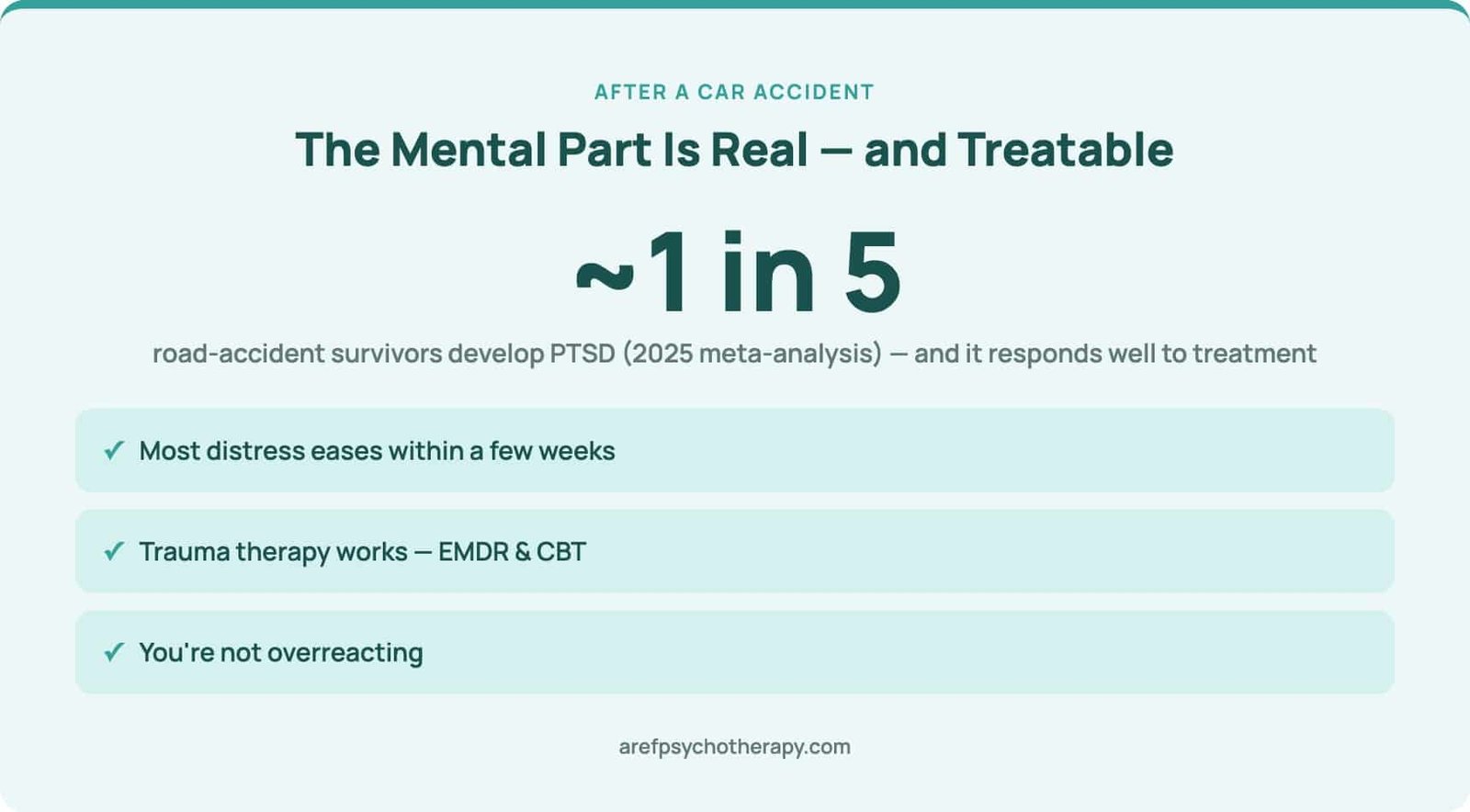
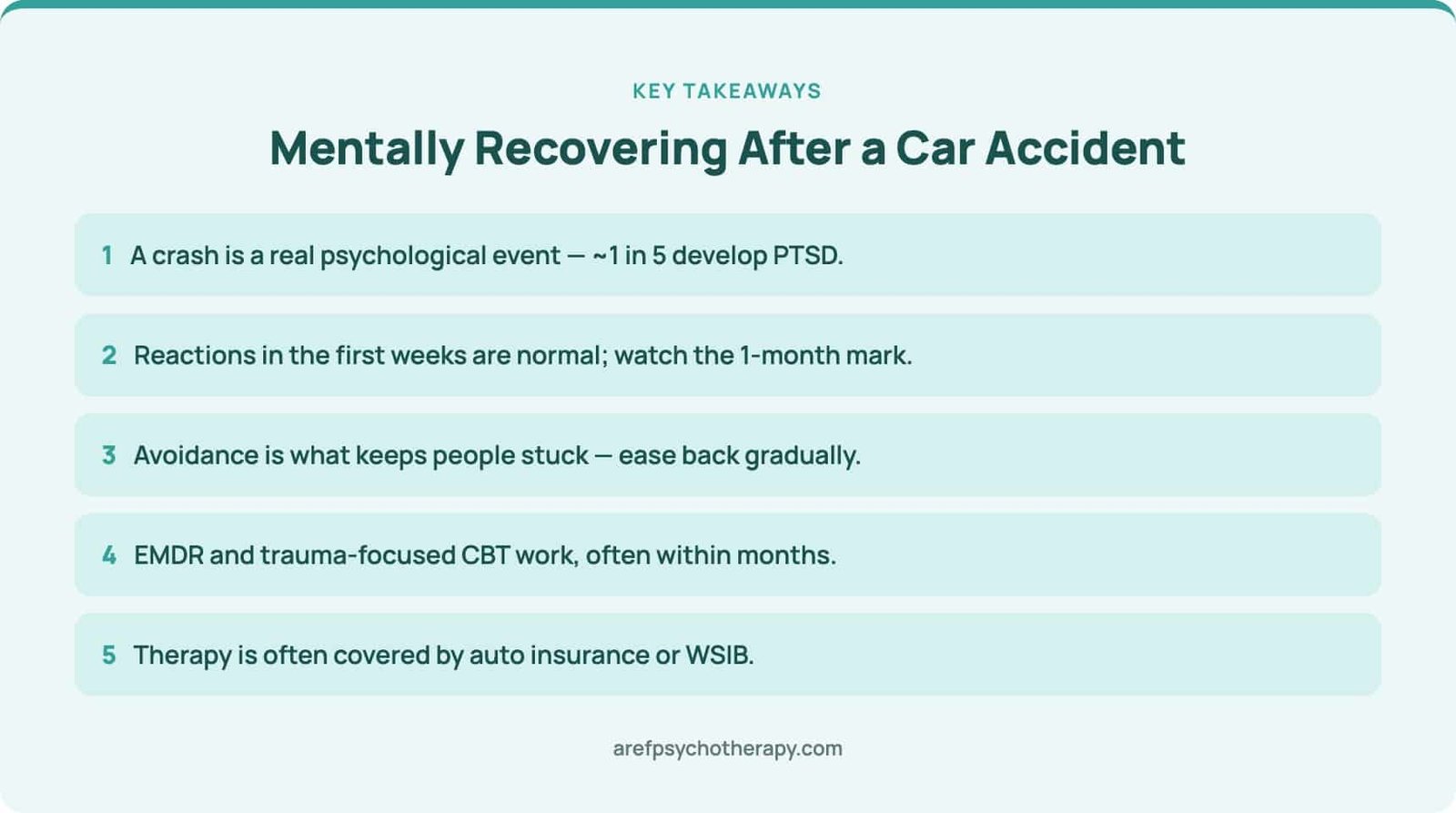
A car accident is a genuine psychological event, not just a physical one. Research shows roughly 1 in 5 road-accident survivors develop post-traumatic stress disorder (PTSD) — a 2025 meta-analysis put the pooled rate at about 20%, with estimates ranging from 6% to 45% depending on the study. Many more have anxiety, low mood, or trouble driving that never gets a formal label.
This guide walks through what mental recovery actually looks like — what’s normal, what isn’t, what helps, and when it’s worth reaching out for support.
How Long Does It Take to Mentally Recover From a Car Accident?
For most people, the sharpest distress eases within a few weeks. In the first days after a crash it’s normal to feel shaken, anxious, tearful, or on edge — this is your nervous system doing its job. When those reactions last 3 days to about a month, clinicians call it acute stress. If strong symptoms are still with you beyond a month, it may have shifted into PTSD, and that’s the point where therapy makes the biggest difference. Recovery isn’t a straight line, but with the right support most people improve steadily.
Why a Car Accident Hits You Mentally, Not Just Physically
In a crash, your brain registers a threat to your life in a fraction of a second. It floods your body with stress hormones and files the event away as danger. Afterward, your mind keeps scanning for that danger — which is why a screech of brakes, a busy highway, or even the smell of the car can bring the whole thing rushing back.
This is a protective response, not a weakness or a character flaw (the Centre for Addiction and Mental Health explains these trauma responses well). Understanding that can take some of the shame out of it. Your brain is trying to keep you safe; it just hasn’t learned yet that the danger has passed.
What’s Normal vs. What’s Not
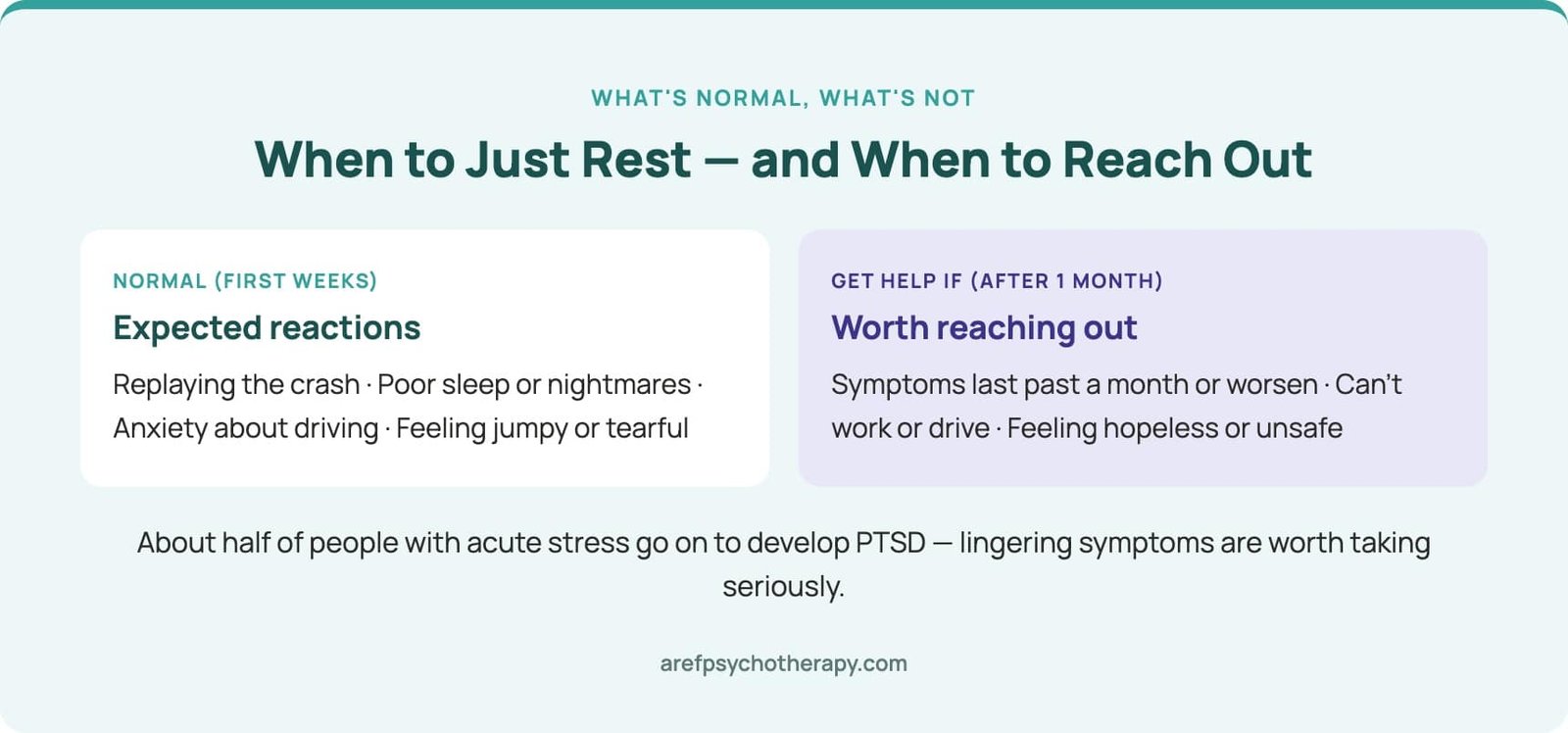
In the first few weeks, common and expected reactions include:
- Replaying the accident or having intrusive images of it
- Trouble sleeping, nightmares, or feeling “wired”
- Anxiety about driving or being a passenger
- Irritability, tearfulness, or feeling emotionally numb
- Being easily startled
These often ease on their own. The signs that it’s worth getting help are about time and impact: symptoms that last more than a month, get worse instead of better, or stop you from working, driving, or living your normal life. About half of people with acute stress go on to develop PTSD, so lingering symptoms are worth taking seriously rather than waiting out. (For a fuller picture, see our guide to PTSD after a car accident.)
The Emotional Timeline: What Recovery Often Looks Like
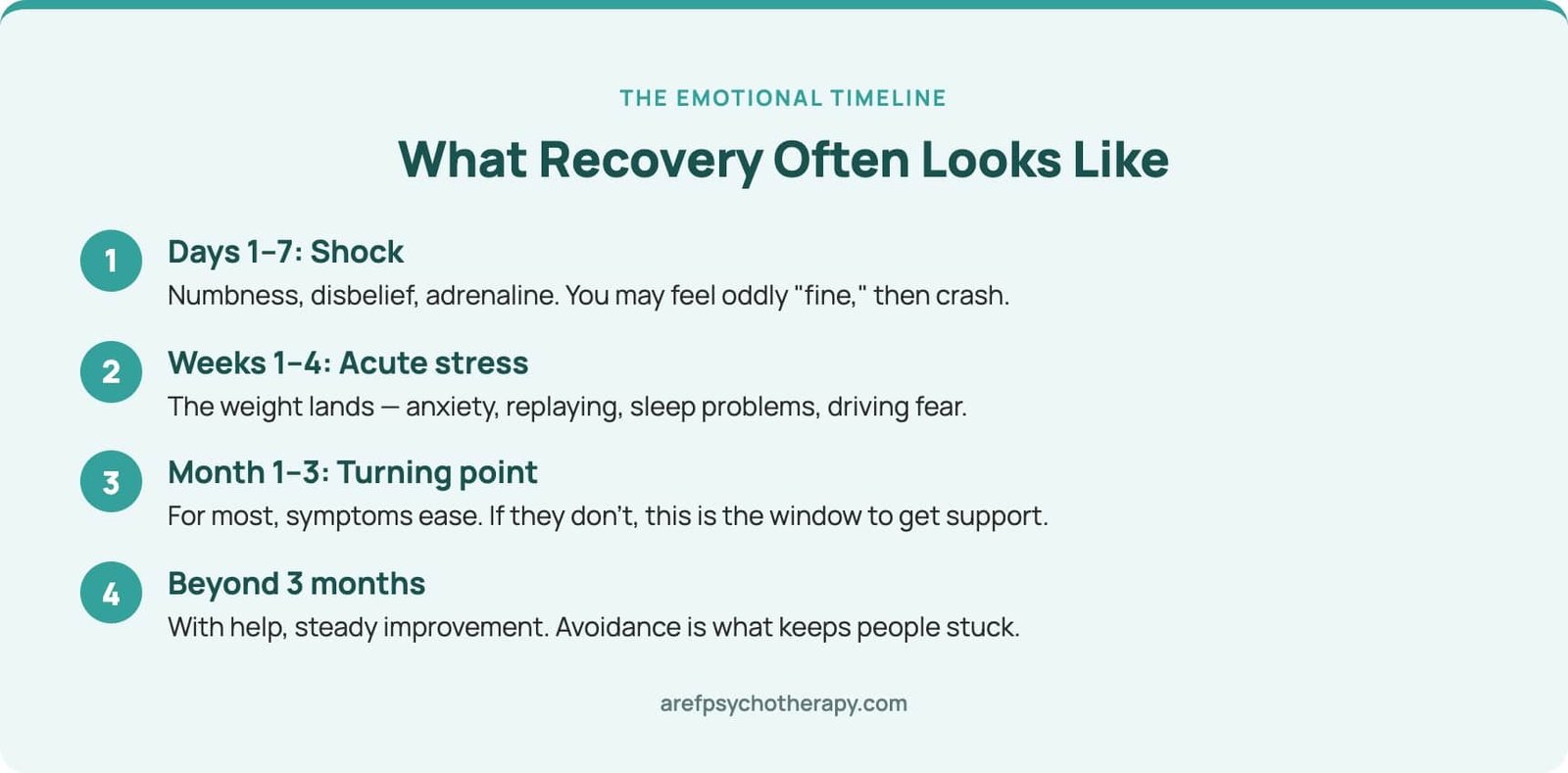
Everyone is different, but recovery often moves through rough phases:
- Days 1–7 (shock): numbness, disbelief, adrenaline. You may feel oddly “fine,” then crash.
- Weeks 1–4 (acute stress): the emotional weight lands — anxiety, replaying, sleep problems, driving fear.
- Month 1–3 (turning point): for most, symptoms start easing. If they don’t, this is the window to get support.
- Beyond 3 months: with help, steady improvement; without it, avoidance can lock symptoms in place.
The single biggest predictor of getting stuck is avoidance — not driving, not talking about it, organizing life around the fear. Gentle, gradual re-exposure is what unwinds it.
7 Ways to Support Your Mental Recovery
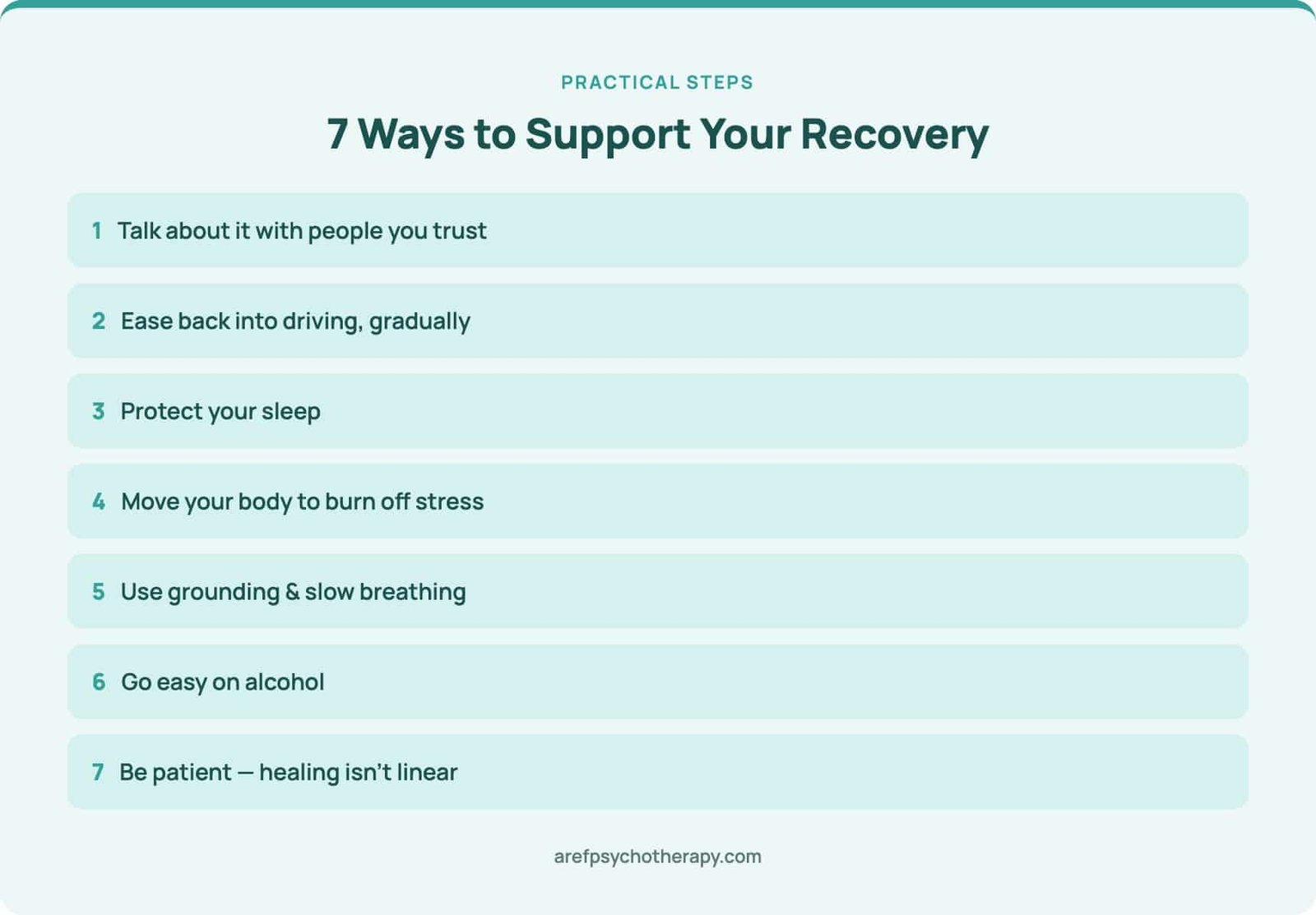
You can do a lot to help yourself heal alongside (or before) therapy:
- Talk about it — with people you trust. Putting the experience into words helps your brain process it.
- Don’t avoid driving forever — ease back gradually: a quiet street, then a longer route, then the highway. Small wins retrain your nervous system.
- Protect your sleep — consistent bedtimes, less screen time, and wind-down routines. Sleep is when your brain files trauma away.
- Move your body — walking, stretching, or light exercise burns off stress chemicals.
- Use grounding techniques — slow breathing (out longer than in) and the 5-4-3-2-1 senses exercise calm a spiking nervous system.
- Go easy on alcohol — it numbs short-term but worsens sleep and anxiety.
- Be patient with yourself — healing isn’t linear. A bad day isn’t a setback to zero.
When to Get Professional Help
Reach out if, more than a month after the accident, you’re still having flashbacks or nightmares, avoiding driving, feeling constantly on edge, or struggling to work or connect with people — or any time you feel hopeless or unsafe. Getting help early tends to mean a faster recovery. You don’t have to wait until it’s “bad enough.”
If you’re afraid to get back behind the wheel specifically, our guide to the fear of driving after a car accident covers that in depth.
Therapies That Work
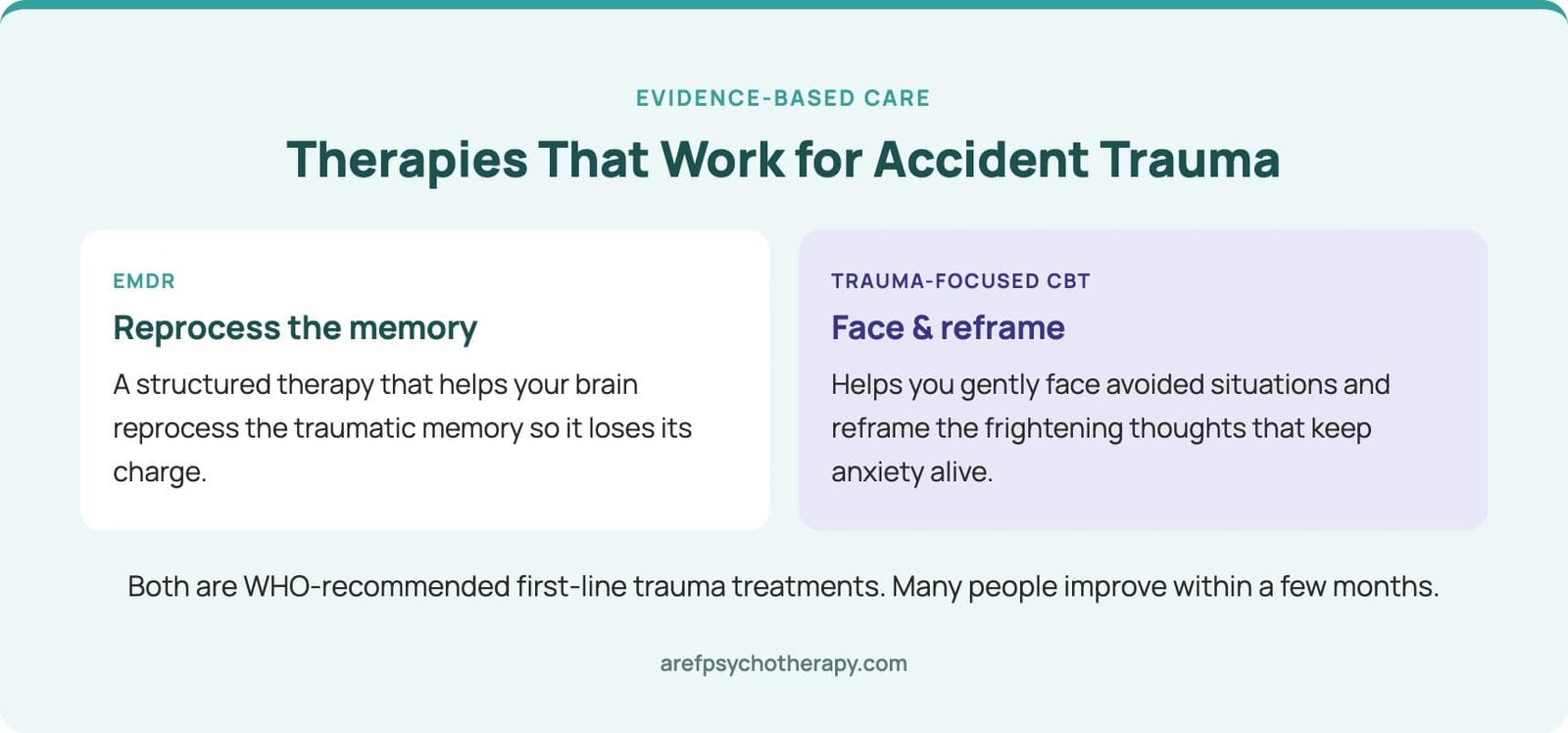
The good news: trauma after a car accident is very treatable. Two approaches have the strongest evidence:
- EMDR (Eye Movement Desensitization and Reprocessing) — a structured therapy that helps your brain reprocess the traumatic memory so it loses its charge. Learn about our EMDR therapy.
- Trauma-focused CBT (Cognitive Behavioural Therapy) — helps you gently face avoided situations and reframe the frightening thoughts that keep anxiety alive.
Both are recommended as first-line trauma treatments by the World Health Organization, the UK’s NICE guideline, and the American Psychological Association. Many people see meaningful improvement within a few months. If you’re not sure where to start, our team offers free consultations to help you find the right fit.
Paying for Therapy After an Accident
You may not have to pay out of pocket. In Ontario, if you were in a motor vehicle accident, therapy is often covered through your auto insurance (accident benefits) — see our motor vehicle accident support. If the accident happened at work (for example, if you drive for your job), it may be covered by WSIB. Coverage shouldn’t be the reason you go without care.
Ready to Take the Next Step?
Our team at Aref Psychotherapy offers virtual therapy across Canada. If a car accident is still weighing on you mentally, book a free consultation and we’ll help you find the right therapist for you.
- Virtual sessions across every province
- Registered Psychotherapists experienced in accident trauma and EMDR
- Support in 14+ languages
Key Takeaways
Frequently Asked Questions
How long does it take to mentally recover from a car accident?
For most people the sharpest distress eases within a few weeks. Reactions lasting 3 days to a month are called acute stress; if strong symptoms continue beyond a month, it may be PTSD, and therapy helps most at that point. Recovery isn't linear, but with support most people improve steadily.
Is it normal to feel anxious weeks after a car accident?
Yes. Anxiety, replaying the crash, trouble sleeping, and fear of driving are common in the first weeks — it's your nervous system reacting to a real threat. The time to seek help is when symptoms last more than a month, get worse, or interfere with your daily life.
Can you get PTSD from a minor car accident?
Yes. PTSD is about how your brain experienced the threat, not how much the car was damaged. Even a "minor" fender-bender can trigger lasting anxiety, flashbacks, or driving fear, and those reactions deserve support regardless of the physical damage.
What helps the most with recovery?
Not avoiding — gently facing what scares you (like driving), talking about the experience, protecting your sleep, and getting trauma-focused therapy such as EMDR or CBT if symptoms linger. Avoidance is the main thing that keeps people stuck.
Do I need therapy, or will it pass on its own?
Many mild reactions ease on their own within a few weeks. But because about half of people with acute stress go on to develop PTSD, symptoms that persist beyond a month are worth addressing with a professional rather than waiting them out.
Disclaimer
This article is for informational purposes only and does not replace professional mental health advice. If you’re in crisis, please contact Canada’s 9-8-8 Suicide Crisis Helpline by calling or texting 9-8-8.
Reviewed by the clinical team at Aref Psychotherapy — a team of Registered Psychotherapists serving clients across Canada. Meet our team.