
A car accident can be over in seconds. But for many people, the emotional impact stays much longer than the bruises or the body aches. You might notice that weeks after the crash, you’re still replaying it in your head. Maybe you flinch at sudden sounds. Maybe you’ve been avoiding the highway — or avoiding driving altogether.
If that sounds familiar, you may be experiencing post-traumatic stress disorder (PTSD) after a car accident. It’s more common than most people realize. And it’s treatable.
This guide will help you understand what PTSD after a car accident looks like, what’s happening in your brain, and how therapy can help you recover — including how to access treatment in Canada.
Can you get PTSD from a car accident? Yes — a serious crash is one of the most common causes of PTSD. Common signs of PTSD after a car accident include flashbacks or nightmares, avoiding driving or the crash site, feeling constantly on edge (hypervigilance), and trouble sleeping. If these last longer than a month, it is worth talking to a therapist.
It’s Not Just “Being Shaken Up” — PTSD After a Car Accident Is Real
Here’s something that surprises most people: car accidents are one of the most common causes of PTSD in the general population. This isn’t a condition reserved for combat veterans. It can happen to anyone — drivers, passengers, pedestrians, even witnesses.
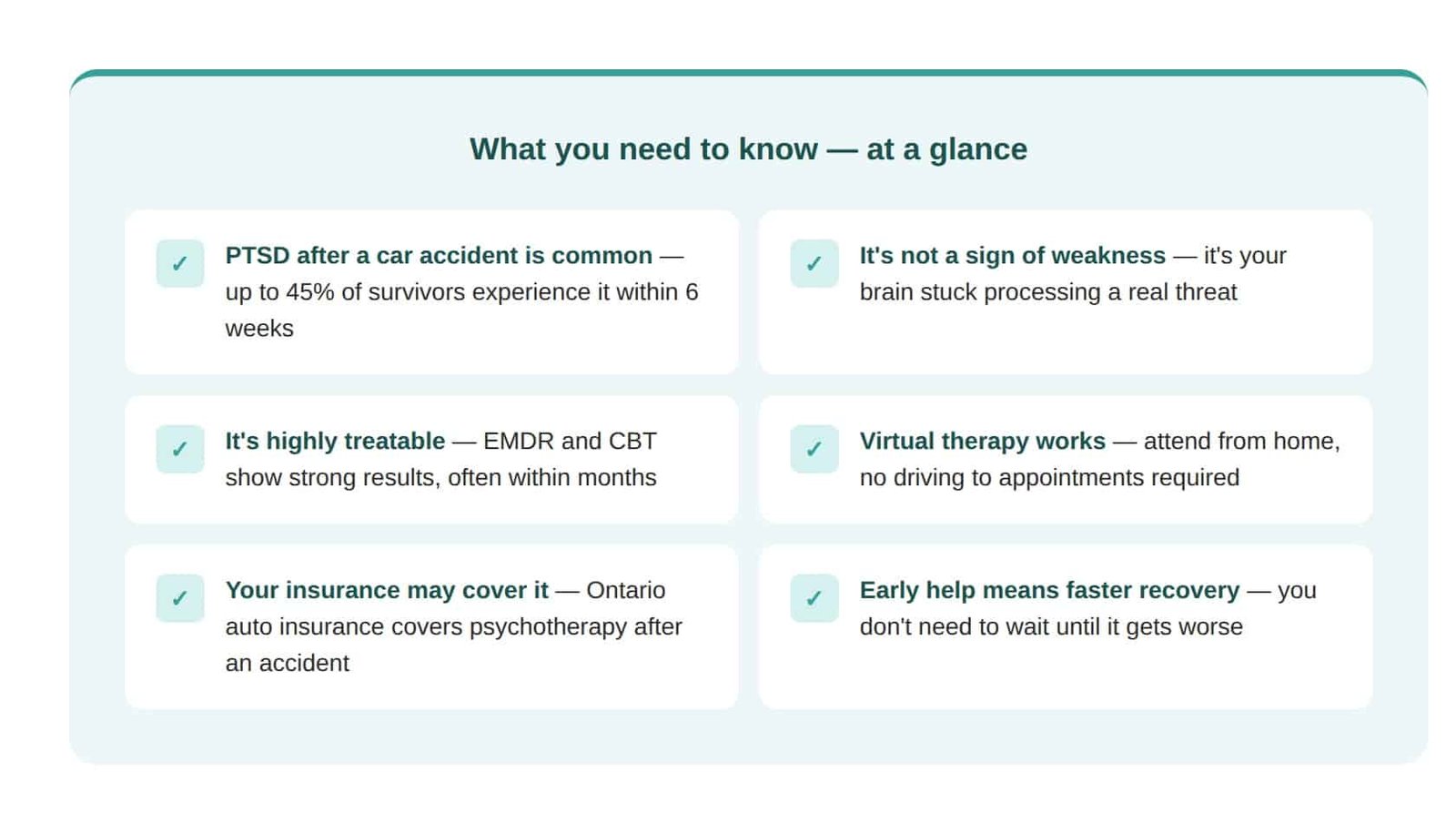
A 2025 systematic review of 96 studies involving over 50,000 road traffic accident survivors found that PTSD prevalence ranged from 20% to over 45% within six weeks of the accident. One-year prevalence rates ranged from roughly 18% to 30%, and in more than half of those initially diagnosed, symptoms persisted for up to three years.
You don’t have to have been seriously injured. Even a “minor” fender-bender can trigger PTSD if your brain perceived a genuine threat to your safety. The severity of the crash doesn’t always predict the severity of the emotional response.
If you’ve been struggling since your accident — even if everyone else thinks you should be “over it” by now — what you’re feeling is real, it has a name, and it responds to treatment.
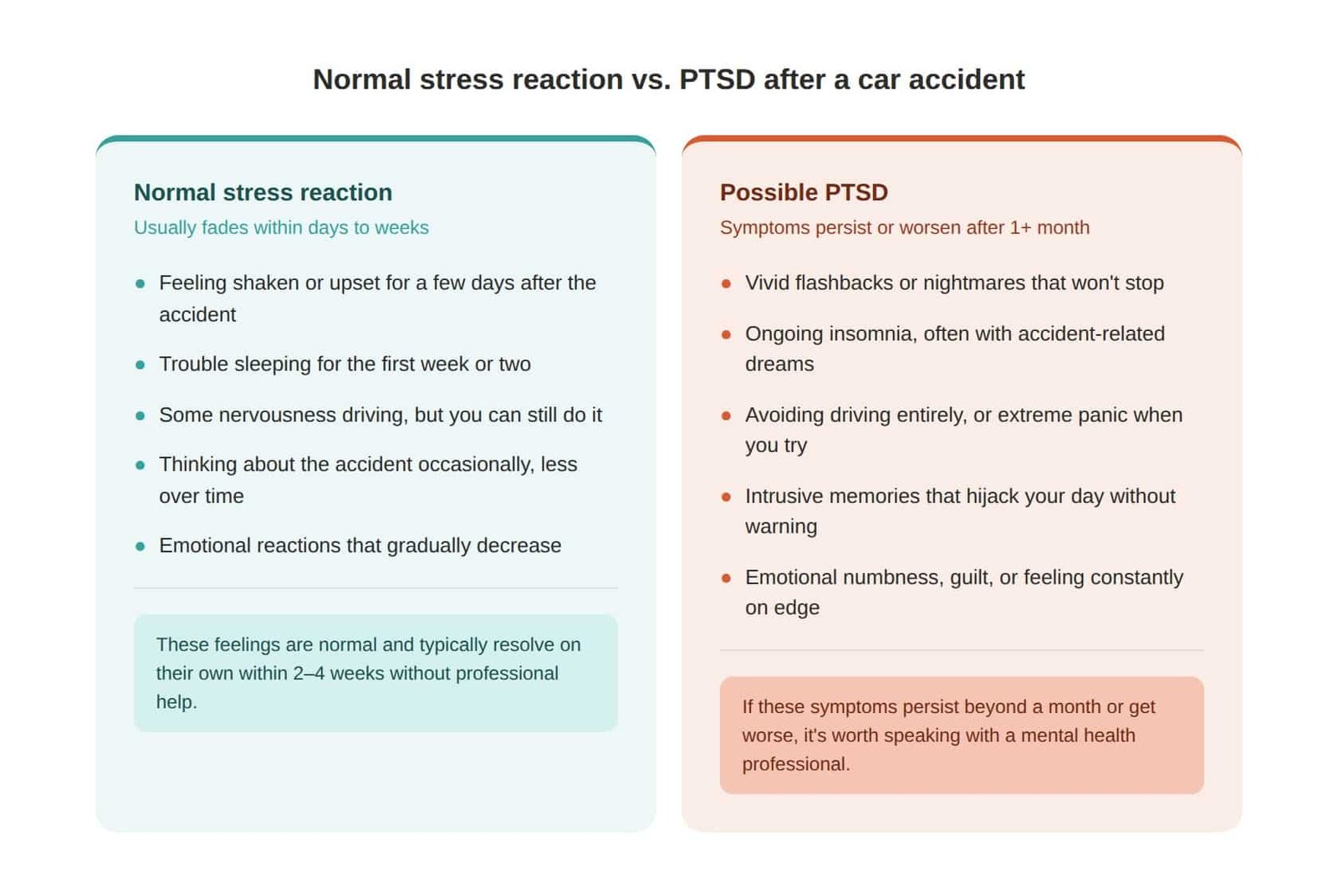
A car accident can be over in seconds. But for many people, the emotional impact stays much longer than the bruises or the body aches. You might notice that weeks after the crash, you’re still replaying it in your head. Maybe you flinch at sudden sounds. Maybe you’ve been avoiding the highway — or avoiding driving altogether.
If that sounds familiar, you may be experiencing post-traumatic stress disorder (PTSD) after a car accident. It’s more common than most people realize. And it’s treatable.
This guide will help you understand what PTSD after a car accident looks like, what’s happening in your brain, and how therapy can help you recover — including how to access treatment in Canada.
What Does PTSD After a Car Accident Look Like?
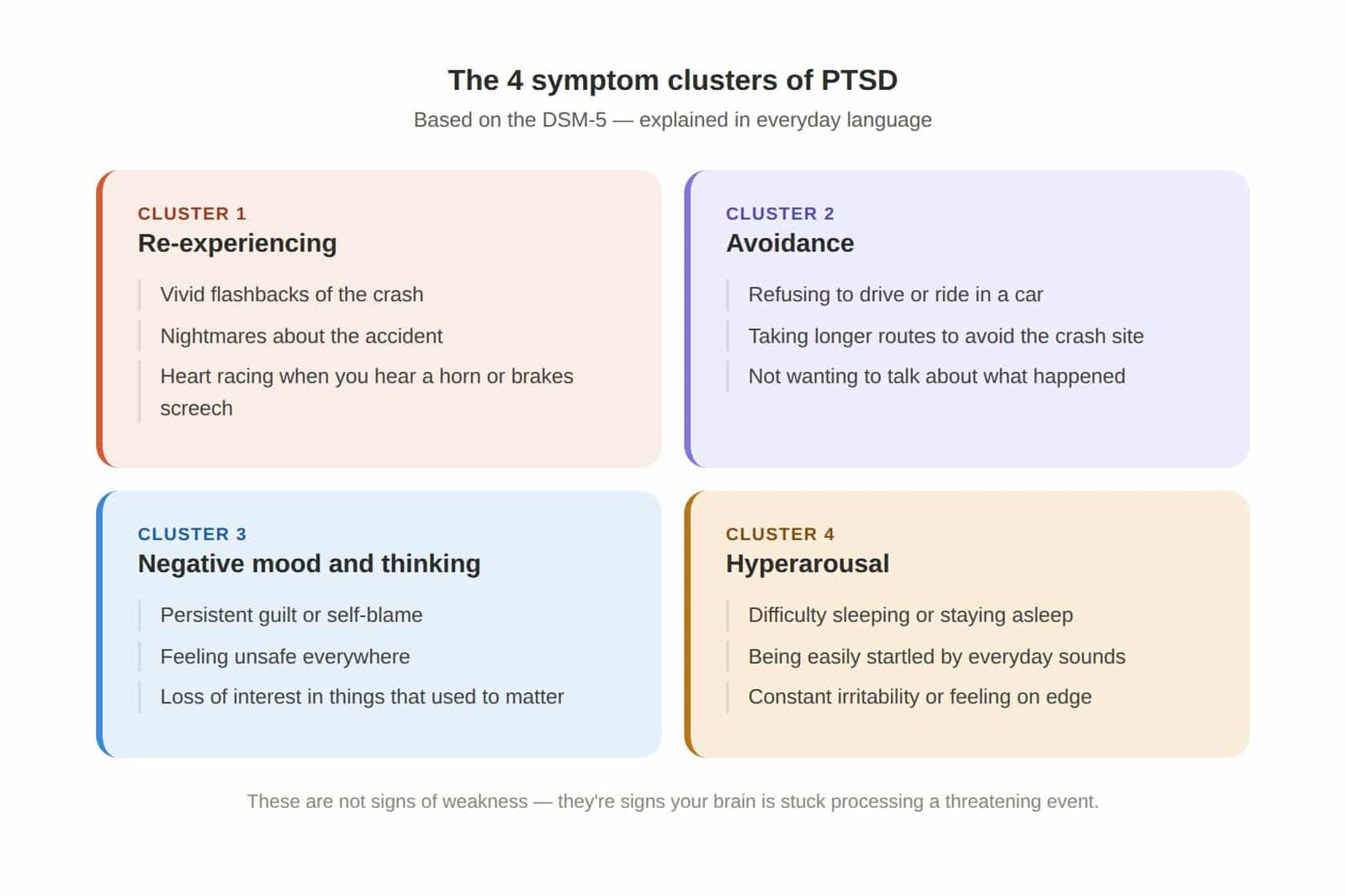
PTSD is defined in the DSM-5 by four core symptom clusters. Here’s what each one looks like in plain language after a car accident.
Re-experiencing the accident
Your brain keeps pulling you back to the crash — even when you don’t want it to. This might show up as vivid flashbacks where you feel like you’re back in the car, nightmares about the accident, or intrusive thoughts that pop into your head at random moments. A car horn or the screech of brakes might suddenly make your heart race.
Avoidance
You start organizing your life around not being reminded of the crash. Maybe you’ve stopped driving, or you take a longer route to avoid the intersection where it happened. If getting back behind the wheel feels impossible, our guide to the fear of driving after a car accident explains why it happens and what helps. You might not want to talk about the accident, or you change the subject when someone brings it up. You might feel emotionally numb — disconnected from things you used to enjoy.
Negative changes in mood and thinking
You might feel a heavy sense of guilt — even if the accident wasn’t your fault. Some people feel like the world is no longer safe, or they lose interest in activities that used to matter to them. You might feel detached from people you’re close to, or struggle to experience positive emotions at all.
Hyperarousal
Your nervous system is stuck on high alert. You might have trouble falling or staying asleep. You startle easily — a door closing, a car backfiring, someone tapping you on the shoulder. You may feel constantly on edge, irritable without knowing why, or find it hard to concentrate at work or school.
These are not signs of weakness. As CAMH (Centre for Addiction and Mental Health) explains, PTSD is a natural emotional response to a frightening or dangerous experience. Your brain got stuck trying to process a genuinely threatening event.
Could This Be PTSD? A Simple Self-Check
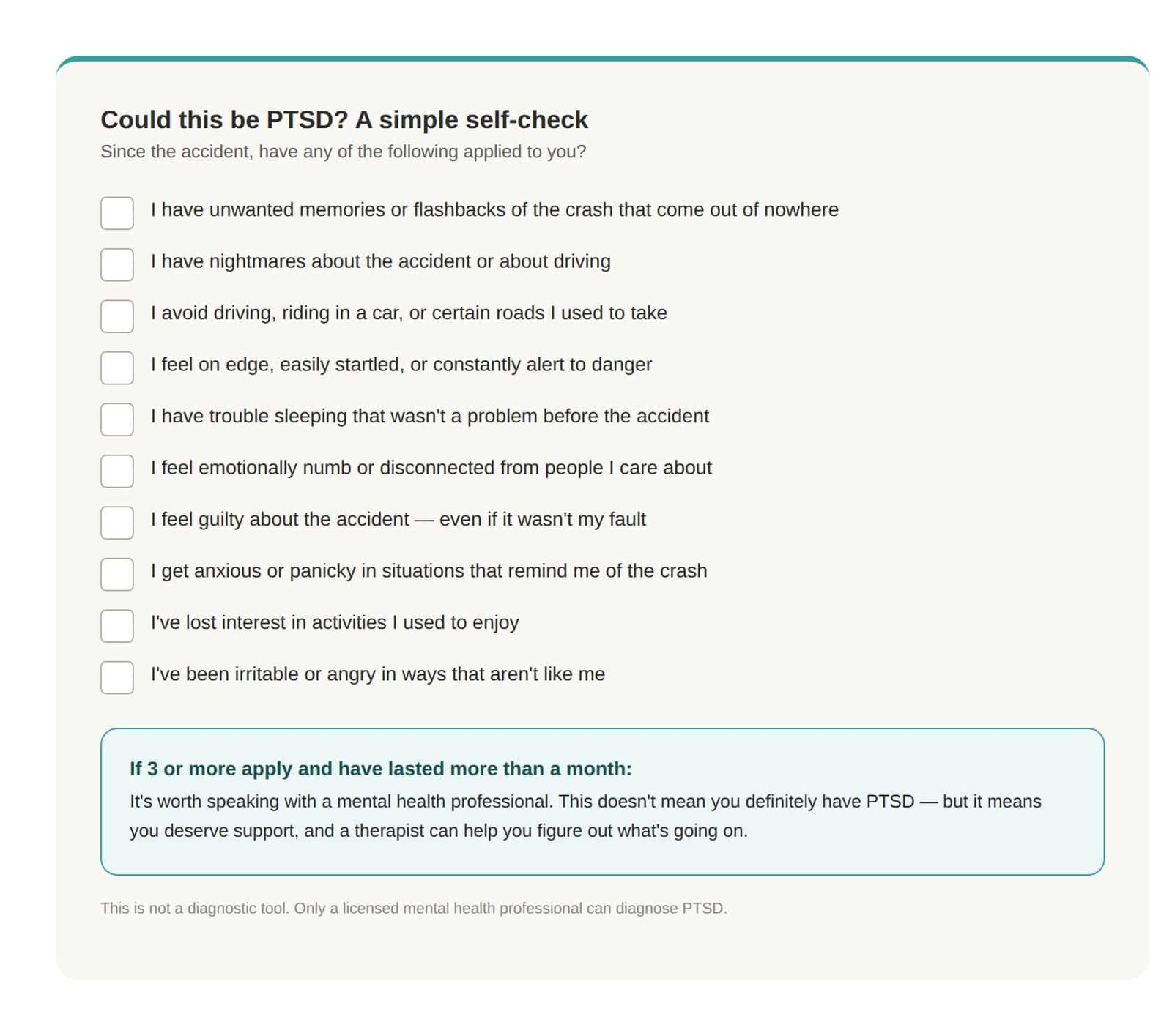
This is not a diagnostic tool — only a licensed mental health professional can diagnose PTSD. But if you’re wondering whether what you’re experiencing is more than “normal” stress after an accident, these questions can help you decide if it’s worth talking to someone.
Think about whether any of the following apply to you since the accident:
- I have unwanted memories or flashbacks of the crash that come out of nowhere
- I have nightmares about the accident or about driving
- I avoid driving, riding in a car, or certain roads I used to take
- I feel on edge, easily startled, or constantly alert to danger
- I have trouble sleeping that wasn’t a problem before the accident
- I feel emotionally numb or disconnected from people I care about
- I feel guilty about the accident — even if it wasn’t my fault
- I get anxious or panicky in situations that remind me of the crash
- I’ve lost interest in activities I used to enjoy
- I’ve been irritable or angry in ways that aren’t like me
If three or more of these apply and have lasted more than a month, it’s worth speaking with a mental health professional. This doesn’t mean you definitely have PTSD — but it does mean you deserve support, and a therapist can help you figure out what’s going on.
What’s Happening in Your Brain After a Car Accident
You don’t need a neuroscience degree to understand why PTSD happens. Here’s the simple version.
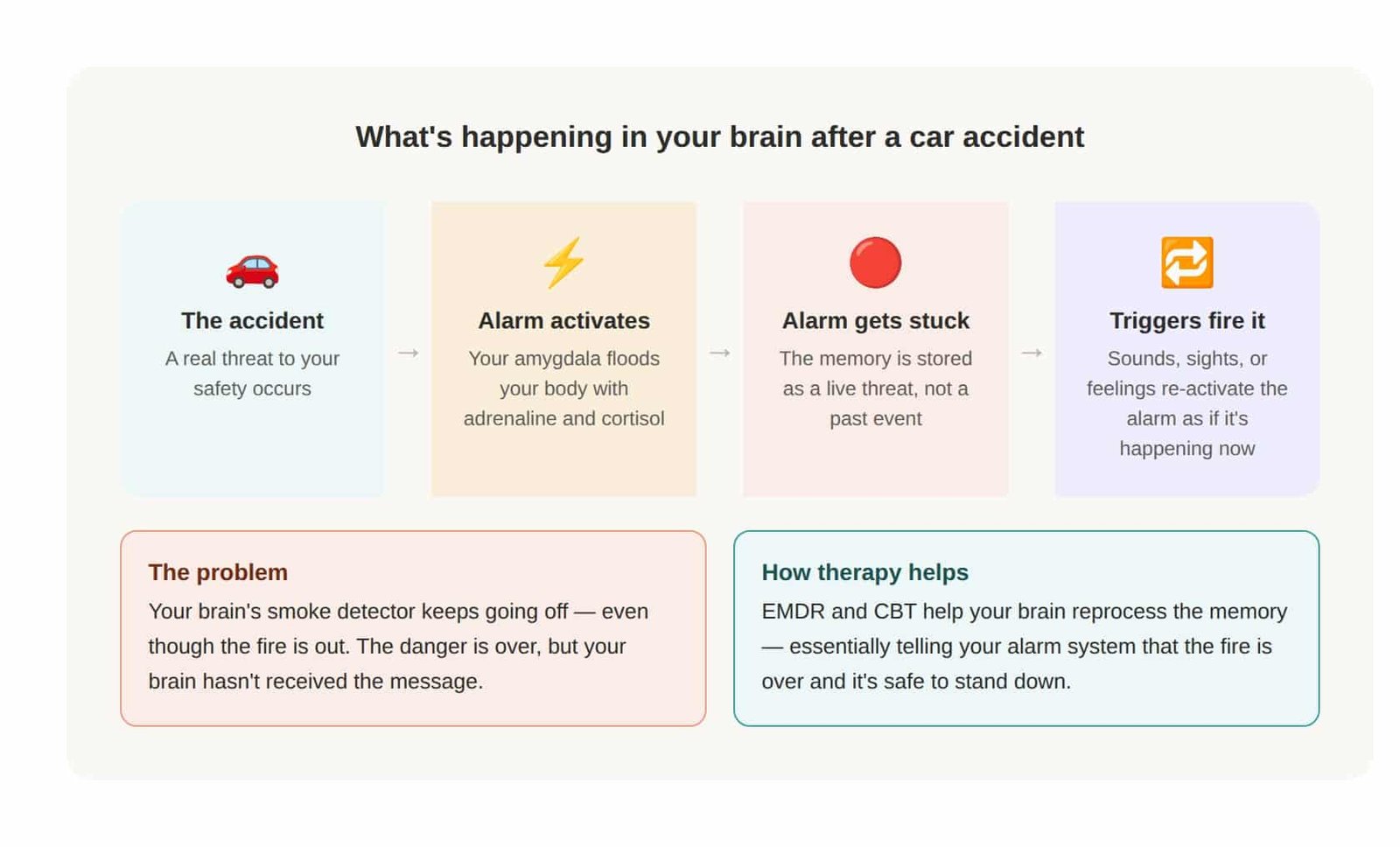
Your brain has a built-in alarm system called the amygdala. During the accident, your amygdala kicked into overdrive — flooding your body with adrenaline and cortisol to help you survive. That’s a normal, healthy response.
The problem is that after a traumatic event, this alarm system can get stuck in the “on” position. Your brain stored the memory of the accident as a live, ongoing threat rather than something that happened in the past and is now over. So every time something reminds you of the crash — a loud noise, a flash of headlights, the feeling of sudden braking — your alarm goes off as if the accident is happening again right now.
Think of it like a smoke detector that keeps going off even though the fire is out. The danger is gone, but your brain hasn’t received the message.
This is exactly why therapy works. Treatments like EMDR therapy and Cognitive Behavioural Therapy (CBT) help your brain reprocess the traumatic memory — essentially telling your alarm system that the fire is over and it’s safe to stand down.
How Is PTSD After a Car Accident Treated?
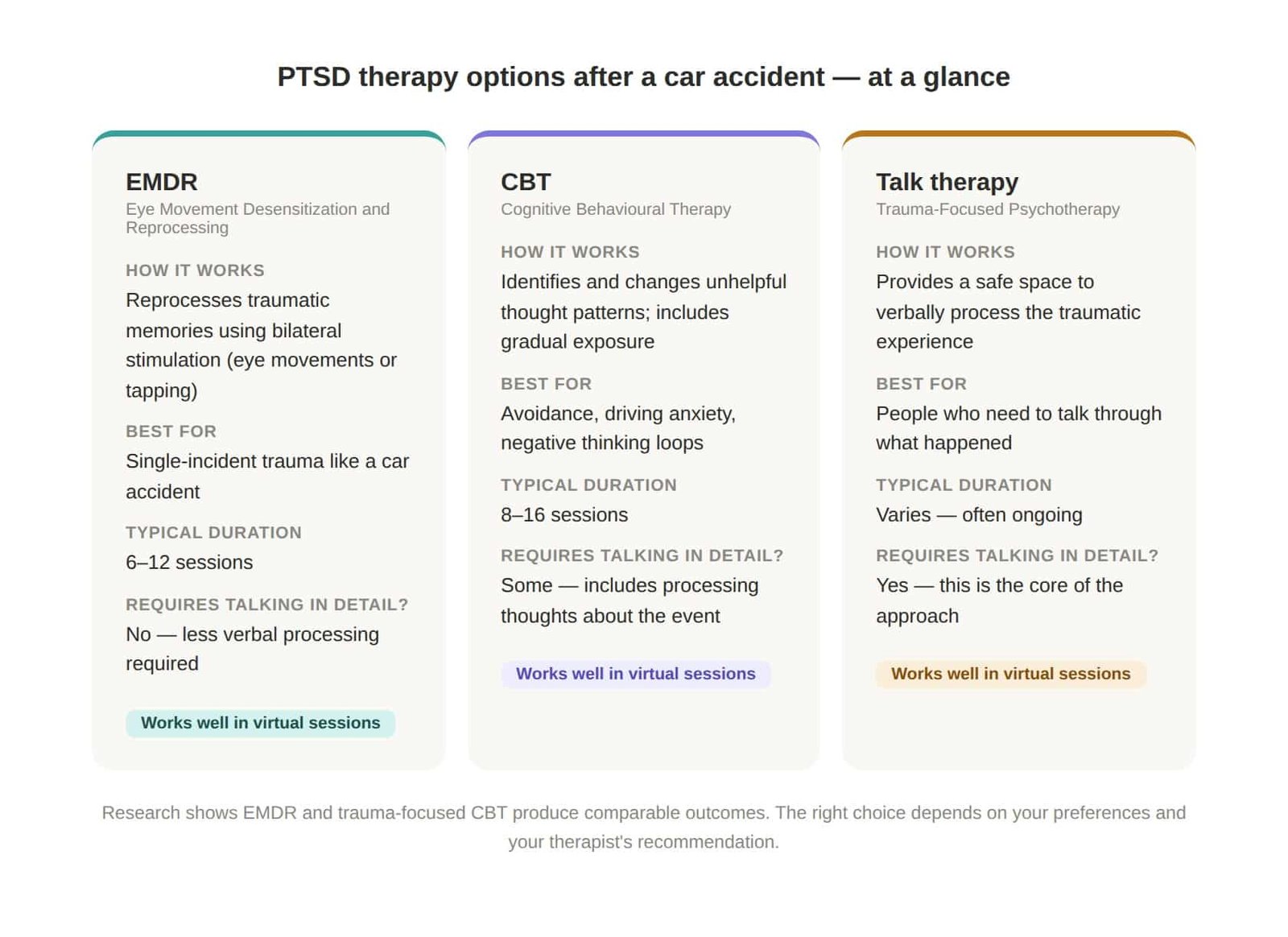
PTSD after a car accident responds well to therapy. Here are the three most evidence-based approaches, explained simply.
EMDR (Eye Movement Desensitization and Reprocessing)
EMDR therapy was originally developed specifically for trauma. During a session, your therapist guides you through the traumatic memory while using bilateral stimulation — typically side-to-side eye movements, tapping, or auditory tones. This helps your brain reprocess the memory so it loses its emotional charge.
EMDR is especially effective for single-incident trauma like car accidents because it targets specific memories. Many people notice a meaningful shift within 6 to 12 sessions. And it doesn’t require you to talk through the accident in detail — which some people find easier than traditional talk therapy.
EMDR works just as well in virtual sessions, where therapists use tapping instead of eye movements.
CBT (Cognitive Behavioural Therapy)
CBT helps you identify and change the thought patterns that keep you stuck. After a car accident, you might have developed beliefs like “I’m not safe anywhere” or “I should have done something differently.” CBT works by helping you examine these thoughts, test them against reality, and build healthier patterns.
CBT also includes gradual exposure — slowly and safely reintroducing the situations you’ve been avoiding (like driving or riding in a car) at a pace that feels manageable.
Trauma-focused talk therapy
Some people need to verbally process what happened to them. Trauma-focused talk therapy provides a safe space to do that — with a trained therapist who understands how to guide you through the experience without re-traumatizing you.
Research shows that EMDR and trauma-focused CBT produce comparable outcomes for PTSD. There’s no single “best” approach — the right one depends on your preferences, your symptoms, and your therapist’s recommendation.
If you’re not sure which approach is right for you, our team at Aref Psychotherapy offers virtual MVA therapy across Canada. We offer a free consultation to help match you with the right therapist and approach.
How Long Does PTSD After a Car Accident Last?
There’s no single answer — recovery timelines vary from person to person. Here’s what the research shows.
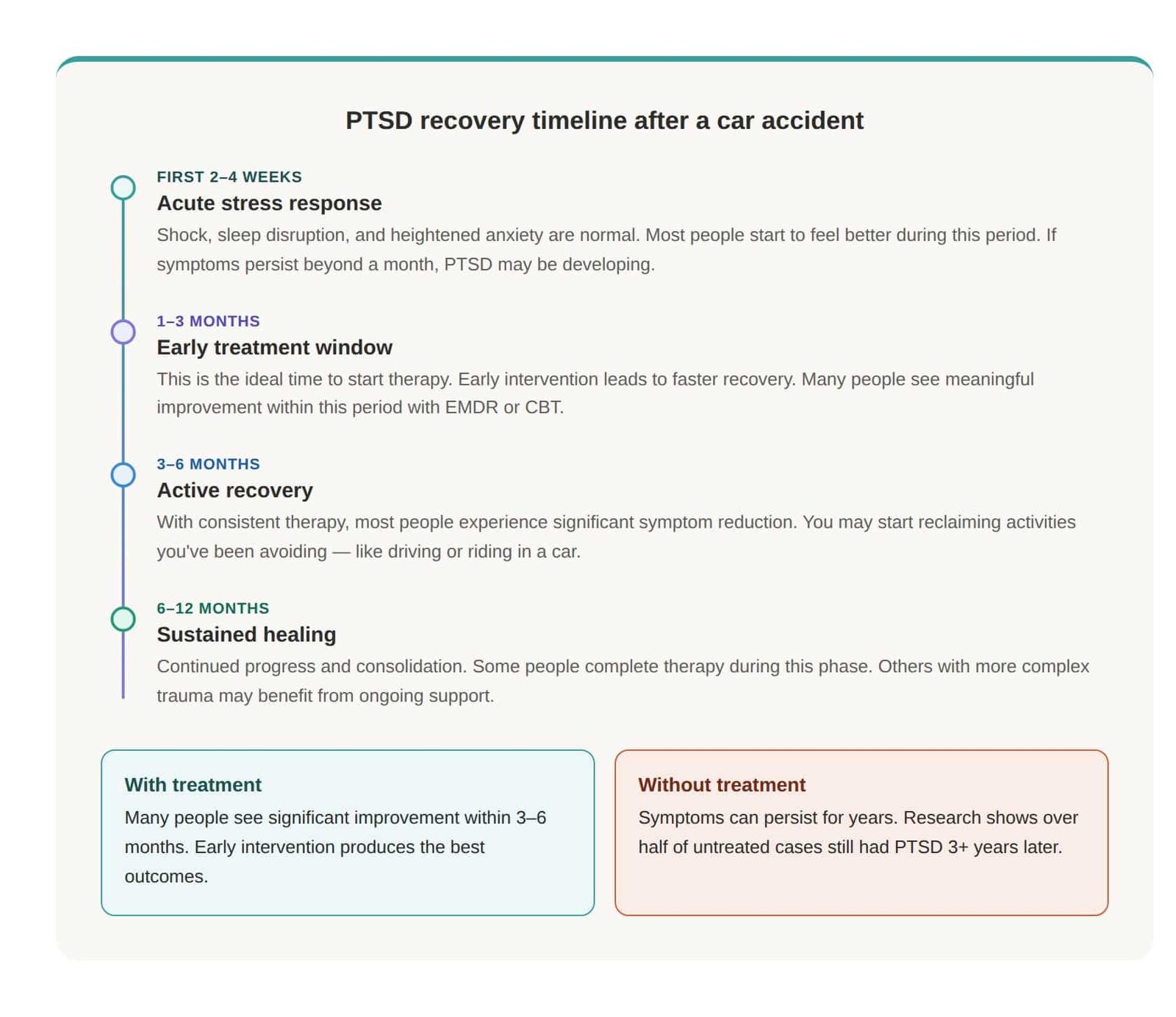
With treatment, many people see significant improvement within 3 to 6 months. Some people recover faster, especially with early intervention. Others — particularly those with more severe symptoms, prior trauma history, or limited support — may need 6 to 12 months or longer.
Without treatment, PTSD symptoms can persist for years. Research shows that in more than half of people initially diagnosed with PTSD after a car accident, symptoms were still present up to three years later when left untreated.
The most important takeaway: PTSD is not something you just have to “live with.” It’s a treatable condition, and the sooner you get support, the faster recovery tends to be. Seeking therapy is not a sign of weakness — it’s a sign that you’re taking your recovery seriously.
Your Insurance May Cover PTSD Therapy
If you’re in Ontario, there’s a good chance your auto insurance already covers the cost of psychotherapy after a car accident — regardless of who was at fault.
We covered this in detail in our guide: Does car insurance cover therapy after a car accident in Ontario?
The short version: Ontario’s Statutory Accident Benefits Schedule (SABS) covers psychotherapy, counselling, and psychological services. Many clinics offer direct billing, so you pay nothing out of pocket. You don’t need a referral to start.
If cost has been the thing holding you back from getting help, it may not be the barrier you think it is.
You Don’t Have to Wait Until It Gets Worse
If you’ve been struggling since your car accident — whether it was last week or last year — you deserve support. You don’t need to be in crisis to start therapy. You don’t need to wait until symptoms get unbearable. And you don’t need to have all the answers before reaching out.
The hardest part is usually the first step. Everything after that gets easier.
Can you get PTSD from a minor car accident?
Yes. PTSD is triggered by your brain's perception of threat, not by the physical severity of the crash. Even low-speed collisions can cause PTSD if you experienced fear, helplessness, or loss of control during the event. Research shows that injury severity does not reliably predict who develops PTSD — the emotional experience matters more than the damage to the vehicle.
How soon after a car accident can PTSD develop?
PTSD symptoms most commonly appear within the first three months after the accident. However, some people experience delayed onset, where symptoms don't emerge until six months or even a year later. If you notice symptoms appearing weeks or months after your accident, it's not too late to seek help.
What is the difference between anxiety and PTSD after a car accident?
General anxiety involves worry and fear that aren't necessarily tied to a specific event. PTSD is specifically connected to a traumatic experience and includes symptoms like flashbacks, nightmares, avoidance of reminders, and hyperarousal. If your anxiety is directly linked to the accident and includes re-experiencing the event, a therapist can help determine whether PTSD is the right framework.
Can PTSD from a car accident go away on its own?
For some people, symptoms gradually fade within a few months. But for many others, PTSD becomes chronic without treatment. Research shows that more than half of people initially diagnosed with PTSD after a car accident still had symptoms years later when they didn't receive therapy. Early intervention significantly improves outcomes.
Is virtual therapy effective for PTSD after a car accident?
Yes. Research supports that both EMDR and CBT are effective when delivered virtually. Virtual therapy is particularly well-suited for car accident survivors who may be afraid to drive to appointments, are in physical pain, or live in areas without local trauma specialists. At Aref Psychotherapy, all of our MVA therapy is delivered online.
This article is for informational purposes only and does not replace professional mental health advice. If you’re in crisis, please contact Crisis Services Canada at 1-833-456-4566 or text 45645.
Ready to Take the Next Step?
Our team at Aref Psychotherapy offers virtual therapy across Canada. If you’ve been in a car accident and you’re dealing with flashbacks, anxiety, trouble sleeping, or fear of driving, we’re here to help.