
When a child is in a car accident, most parents focus on the physical injuries — the scrapes, the bruises, the trip to the emergency room. But what often goes unnoticed is the emotional impact. Children can carry the weight of a car accident long after the visible injuries heal, and because they can’t always put their feelings into words, the signs are easy to miss. Adults recovering from the same crash may find our guide to mental recovery after a car accident helpful too.
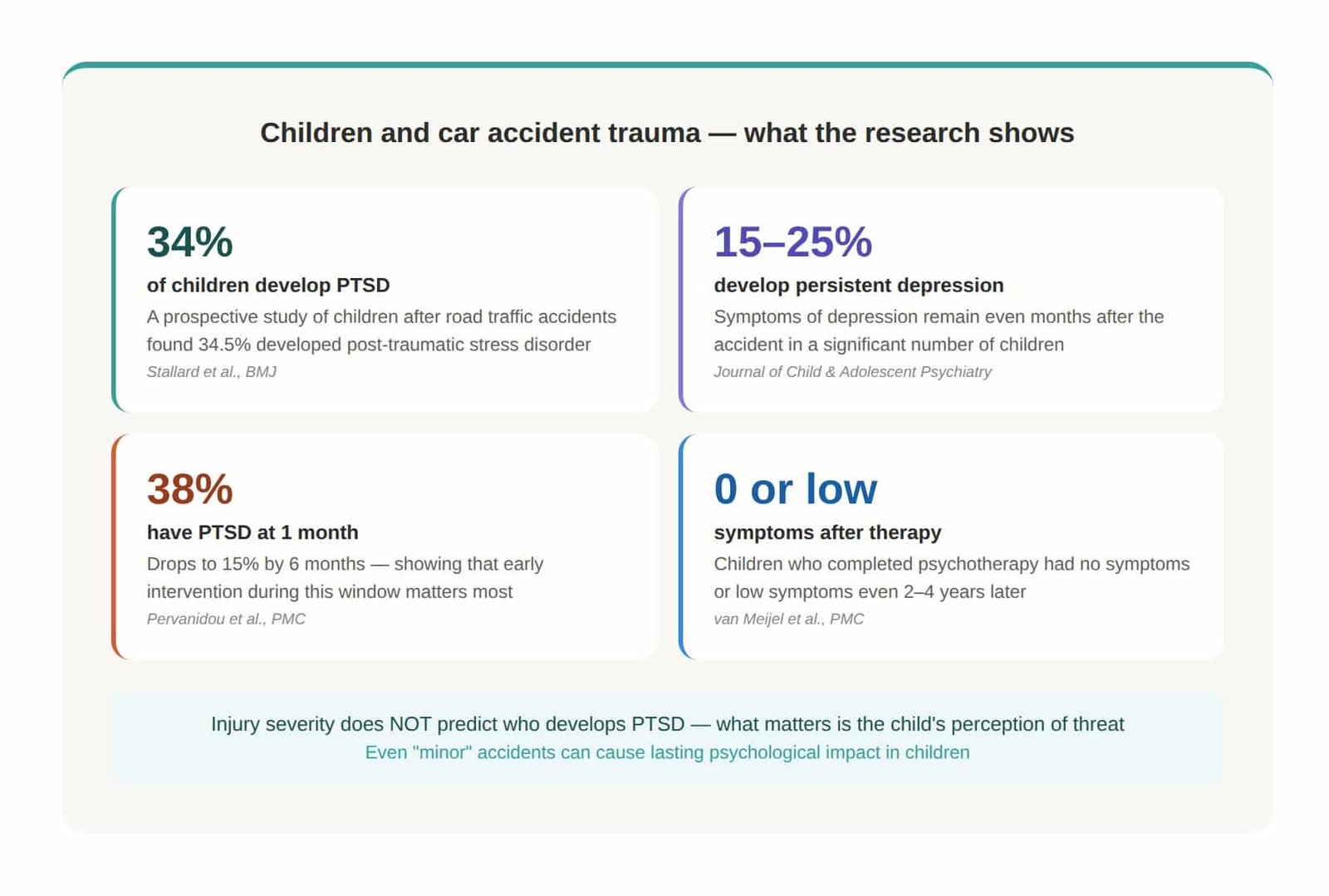
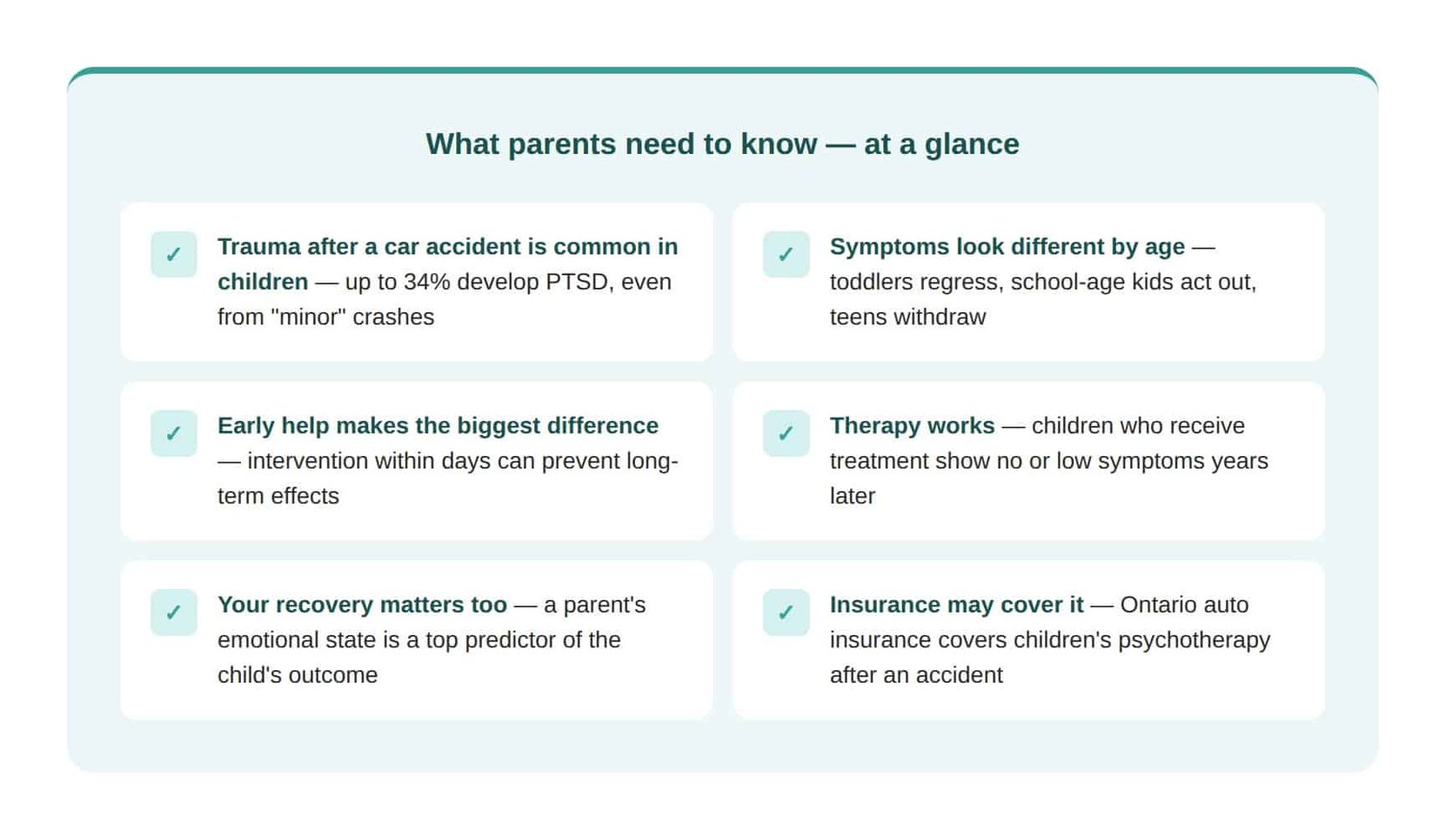
Research tells us that child trauma after a car accident is far more common than most parents expect. A prospective study of children involved in road traffic accidents found that 34.5% developed PTSD. Another study found that 38% of children had PTSD symptoms one month after the crash — and 15 to 25% of children involved in car accidents develop symptoms of depression that persist for months.
If your child has been in an accident and something feels “off” — changes in behaviour, new fears, trouble sleeping, pulling away from you — this guide is for you. We’ll walk through how trauma shows up at different ages, when to seek help, what to say (and what not to say), and how therapy can support your child’s recovery.
Children Experience Car Accident Trauma Differently Than Adults
Adults can usually name what they’re feeling after a traumatic event. Children often can’t. A five-year-old won’t say “I’m having intrusive memories of the collision.” Instead, they might start wetting the bed again, clinging to you at daycare drop-off, or refusing to get in the car.
Here’s what the research tells us about children and car accident trauma:
- Up to 34% of children develop PTSD after a road traffic accident — a rate comparable to adults
- 15 to 25% of children in car accidents develop depression symptoms that last months after the crash
- The severity of physical injury does not reliably predict who develops PTSD — what matters more is the child’s perception of threat during the accident
- Children who weren’t in the car but whose parent was injured can also develop trauma symptoms
- A mother’s own PTSD symptoms are one of the strongest predictors of whether her child develops PTSD
That last point is important. If you’re struggling after the accident too, getting support for yourself isn’t just about you — it directly helps your child.
How Trauma Shows Up by Age
One of the biggest challenges for parents is that trauma looks completely different depending on your child’s age. What’s concerning in a teenager might be totally normal in a toddler, and vice versa. Here’s a breakdown of what to watch for.
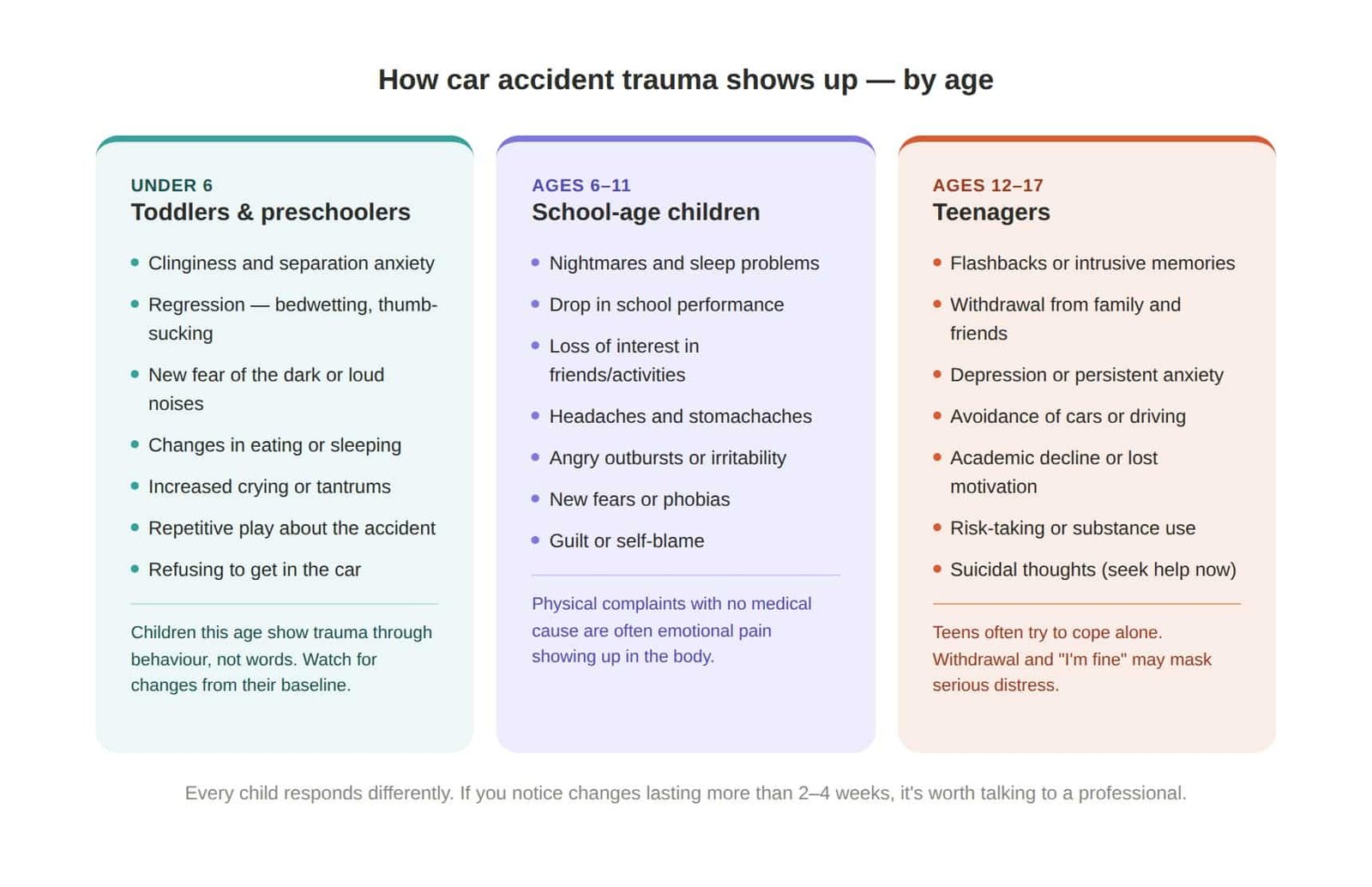
Toddlers and preschoolers (under 6)
Children this age don’t have the language to explain what’s happening inside them. Instead, trauma comes out through their behaviour and their body.
Watch for: increased clinginess or separation anxiety — not wanting you to leave the room or refusing to go to daycare. Regression to earlier behaviours like bedwetting, thumb-sucking, or wanting a bottle again after they’d stopped. New fears that weren’t there before — fear of the dark, fear of loud noises, fear of being in a car. Changes in eating or sleeping. Increased crying, screaming, or tantrums that seem out of proportion. Repetitive play where they “act out” the accident with toys — crashing cars together over and over.
This repetitive play is actually a normal way young children try to process what happened. It’s not something to shut down, but if it continues for weeks or becomes distressing to the child, it’s a sign they need more support.
School-age children (6 to 11)
Children in this age group can describe some of what they’re feeling, but they often express emotional pain through their body or their behaviour rather than their words.
Watch for: nightmares or difficulty sleeping — either trouble falling asleep, or waking up through the night. A drop in school performance — difficulty concentrating, forgetting things, avoiding homework. Loss of interest in activities and friends they used to enjoy. Physical complaints with no medical explanation — headaches, stomachaches, feeling tired all the time. Outbursts of anger or irritability that seem disproportionate. New fears or phobias — refusing to get in the car, anxiety about specific roads or situations. Guilt or self-blame — “If I hadn’t asked you to drive me, this wouldn’t have happened.”
That last one — the guilt — is more common than parents realize. Children this age are developing their understanding of cause and effect, and they may incorrectly assign responsibility to themselves.
Teenagers (12 to 17)
Teens often try to handle trauma on their own, which can make it harder to spot. Their symptoms may look less like “childhood fear” and more like withdrawal, defiance, or risk-taking.
Watch for: flashbacks or intrusive memories of the crash. Withdrawal from family and friends — spending more time alone, not wanting to talk. Depression or anxiety — persistent sadness, hopelessness, or worry. Avoiding cars, driving, or being a passenger. Academic decline or loss of motivation. Irritability, aggression, or angry outbursts. Risk-taking behaviour — reckless driving (if they’re of driving age), substance use, or acting out. Sleep problems — insomnia or sleeping too much. In some cases, suicidal thoughts.
If your teenager expresses thoughts of self-harm or suicide, seek help immediately. Contact Crisis Services Canada at 1-833-456-4566 or text 45645.
When Should I Get My Child Professional Help?
It’s normal for children to be shaken up after a car accident. A few rough nights, some clinginess, not wanting to get in the car for a day or two — these reactions often settle on their own within a couple of weeks.
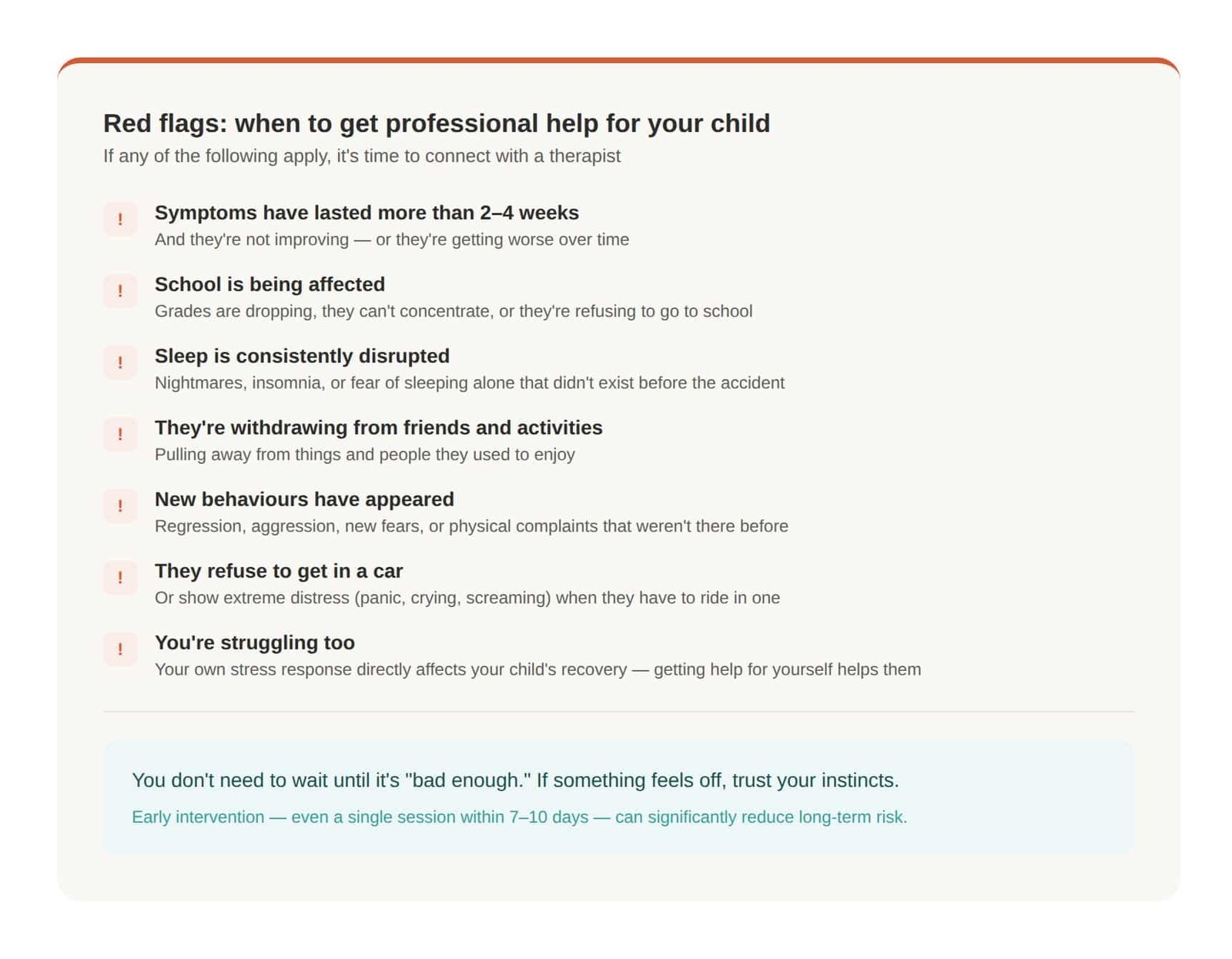
Here’s when to reach out to a professional:
Symptoms have lasted more than 2 to 4 weeks and aren’t improving — or they’re getting worse. Your child’s daily life is being affected — they’re struggling at school, withdrawing from friends, refusing to get in the car, or their sleep is consistently disrupted. New behaviours have appeared that weren’t there before the accident — regression, aggression, new fears, physical complaints. Your child seems “stuck” — they’re not bouncing back the way you’d expect, even if the accident was relatively minor. You’re struggling yourself — your own emotional state directly affects your child’s recovery. If you’re dealing with anxiety, flashbacks, or sleep problems since the accident, getting help for yourself is one of the best things you can do for your child.
Research supports that early intervention makes a real difference. One study found that a single psychological session within 7 to 10 days of the accident can significantly reduce the risk of long-term PTSD in children. And a long-term follow-up study found that children who received psychotherapy had no symptoms or low symptoms even 2 to 4 years later — while untreated children continued to struggle.
The bottom line: you don’t need to wait until things are “bad enough.” If something feels off, trust your instincts.
What to Say (and What Not to Say) to Your Child After an Accident
How you respond to your child in the days and weeks after the accident matters. You don’t need a script — but a few simple shifts in language can make a significant difference.
Things that help
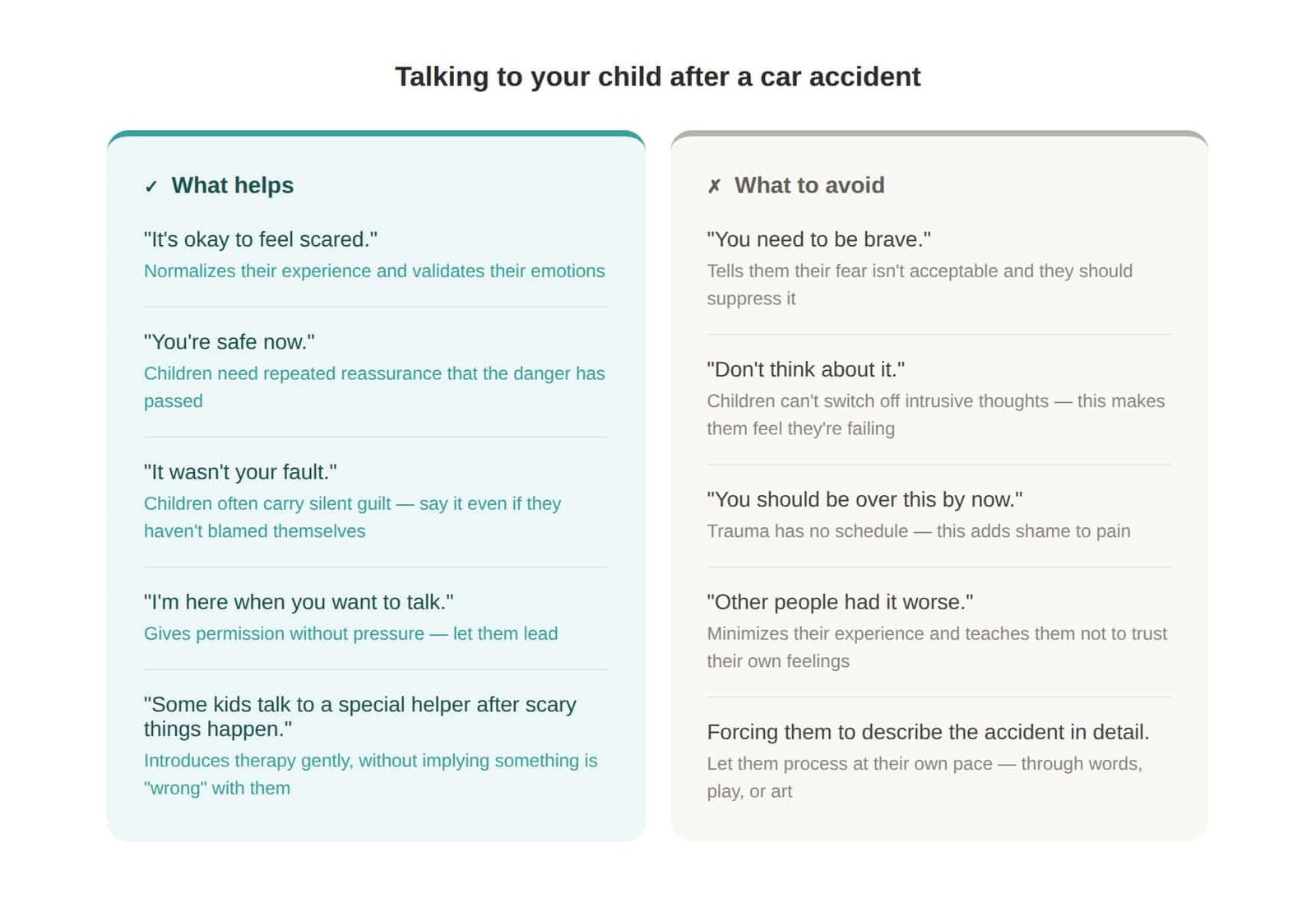
“It’s okay to feel scared. A lot of kids feel that way after something like this.” This normalizes their experience and tells them their feelings aren’t wrong or weird.
“You’re safe now. The accident is over and we’re okay.” Children need to hear — sometimes many times — that the danger has passed.
“It wasn’t your fault.” Even if they haven’t said they feel responsible, say it anyway. Children often carry guilt silently.
“I’m here whenever you want to talk about it. And it’s okay if you don’t want to talk right now.” This gives them permission without pressure.
“Some kids find it helpful to talk to someone outside the family — like a special kind of helper who understands how kids feel after scary things happen.” This introduces the idea of therapy gently, without making it feel like something is “wrong” with them.
Things to avoid
“You need to be brave.” This tells the child their fear isn’t acceptable and they should suppress it.
“Don’t think about it.” Children can’t just switch off intrusive thoughts. This makes them feel like they’re failing.
“You should be over this by now.” Trauma doesn’t follow a schedule. This adds shame to an already painful experience.
“Other people had it worse.” Comparing pain minimizes what the child is going through and teaches them not to trust their own feelings.
Forcing them to talk about the accident in detail before they’re ready. Let them lead. Some children process through talking, others through play or art. Follow their cues.
How Therapy Helps Children After a Car Accident
Children respond well to therapy — often faster than adults — especially when it’s age-appropriate and started early. Here are the main approaches.
Play therapy (for children under 6)
Very young children process the world through play, not conversation. Play therapy uses games, art, puppets, and storytelling to help children express and work through their feelings about the accident. A trained play therapist can observe themes in the child’s play — like repeatedly crashing toy cars — and gently guide them toward resolution and safety.
Trauma-focused CBT (for children 6 and older)
Trauma-focused Cognitive Behavioural Therapy (CBT) is the most widely recommended treatment for children with PTSD after a car accident. It’s specifically adapted for children’s developmental level — not a scaled-down version of adult therapy. Parents are actively involved, especially in the early stages. The therapy helps children identify and change unhelpful thought patterns, process the traumatic memory safely, and gradually re-engage with situations they’ve been avoiding.
EMDR (for older children and teenagers)
EMDR therapy uses bilateral stimulation to help the brain reprocess traumatic memories. It’s well-established for teens and increasingly used with younger children, though the evidence base is strongest for older age groups. EMDR can be particularly helpful when the child is experiencing vivid flashbacks or intrusive images of the crash.
Virtual therapy works for children too
One advantage of virtual therapy is that your child can attend from home — in their safe environment, with you nearby. This can reduce anxiety about the therapy process itself, especially for children who are already feeling unsafe. Our team at Aref Psychotherapy offers virtual child and adolescent therapy across Canada, with therapists trained in trauma-informed care for young people.
Your Auto Insurance May Cover Your Child’s Therapy
If the car accident happened in Ontario, your auto insurance covers psychotherapy for children — the same accident benefits that apply to adults apply to children involved in the crash.
We covered this in detail in our guide: Does car insurance cover therapy after a car accident in Ontario?
The key points: coverage is available regardless of fault, no referral is required, and many clinics offer direct billing so you pay nothing upfront. Your child deserves support, and cost shouldn’t be the barrier.
Your Child Can Recover — and So Can You
If your child has been in a car accident and you’re seeing changes in their behaviour, their mood, or their sense of safety — those are signals worth paying attention to. Not because something is “wrong” with your child, but because something difficult happened to them and they need support to process it.
The research is clear: children who receive appropriate therapy after a traumatic accident recover well. A long-term study found that children who completed psychotherapy had no symptoms or very low symptoms even years later. Early help leads to faster, more complete healing.
And if you’re struggling too — with your own anxiety, guilt, or stress since the accident — please know that taking care of yourself is part of taking care of your child. Your emotional state is one of the strongest predictors of how your child recovers. Getting help isn’t selfish. It’s parenting.
Can a child get PTSD from a minor car accident?
Yes. PTSD in children is triggered by their perception of threat, not by the physical severity of the crash. A child who felt terrified during a low-speed collision can develop PTSD just as a child in a serious accident can. Research consistently shows that the child's subjective experience during the event — not the extent of physical injury — is the strongest predictor of psychological impact.
How soon after the accident should I take my child to therapy?
If symptoms persist beyond 2 to 4 weeks or are interfering with school, sleep, or daily life, it's time to seek help. Research suggests that even a single psychological session within 7 to 10 days of the accident can reduce the risk of long-term PTSD. There's no downside to connecting with a therapist early — even if your child turns out to be fine, a brief assessment provides peace of mind.
What if my child seems fine — could they still be affected?
Yes. Some children cope by keeping busy or appearing "normal" on the surface while struggling internally. Symptoms can also have a delayed onset, appearing weeks or even months after the accident. Keep an eye on changes in sleep, mood, school performance, and social behaviour over the coming months — and trust your instincts if something feels off.
Is virtual therapy effective for children after a car accident?
Yes. Virtual therapy allows children to attend sessions from the comfort and safety of their own home, which can reduce anxiety about the therapy process itself. Trauma-focused CBT — the most recommended treatment for children with PTSD — works well in a virtual format. At Aref Psychotherapy, our child and adolescent therapists are experienced in delivering effective virtual sessions for young people.
Does auto insurance cover children's therapy after a car accident?
Yes, in Ontario. Children involved in a motor vehicle accident are entitled to the same Statutory Accident Benefits as adults, including coverage for psychotherapy and counselling. Coverage is available regardless of who was at fault, and many clinics offer direct billing. See our full guide: Does car insurance cover therapy after a car accident in Ontario?
This article is for informational purposes only and does not replace professional mental health advice. If your child is in crisis or expressing thoughts of self-harm, please contact Crisis Services Canada at 1-833-456-4566 or text 45645.
Ready to Start Your Recovery?
Our team at Aref Psychotherapy offers virtual therapy for children, teens, and parents across Canada. If your child has been in a car accident and you’re unsure whether they need support, a free consultation can help you figure out the right path.
Book a free consultation to find the right therapist for your child.