
You’ve probably heard that EMDR therapy can help with trauma after a car accident. Maybe your doctor mentioned it. Maybe you came across it while searching for answers to why you’re still having flashbacks, nightmares, or anxiety weeks after the crash.
But knowing EMDR exists and knowing what it actually involves are two different things. If you’re considering EMDR therapy for car accident trauma, the biggest question on your mind is probably: “What’s actually going to happen in a session?”
This guide walks you through exactly that — what EMDR is, why it works especially well for car accidents, what a session looks like step by step (including virtual sessions), and how long recovery typically takes.
What Is EMDR Therapy?
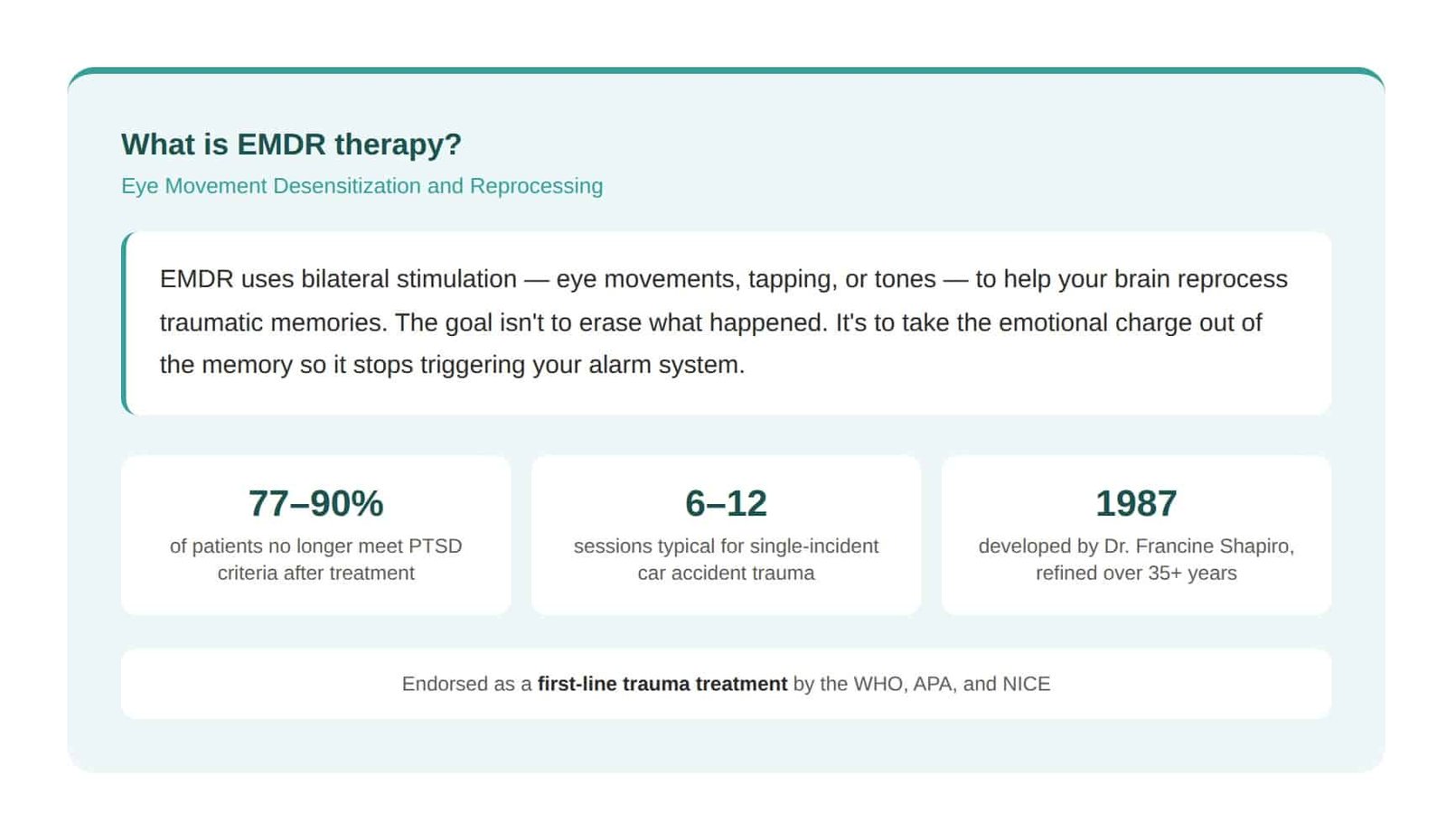
EMDR stands for Eye Movement Desensitization and Reprocessing. It’s a structured form of psychotherapy developed by Dr. Francine Shapiro in 1987, originally designed to treat post-traumatic stress disorder (PTSD).
Here’s how it works in plain language: during a traumatic event like a car accident, your brain sometimes stores the memory incorrectly. Instead of filing it away as something that happened in the past, the memory gets stuck in your brain’s alarm system — so every time something reminds you of the crash, your body reacts as if it’s happening right now.
EMDR uses bilateral stimulation — typically eye movements, tapping, or auditory tones — to help your brain reprocess that stuck memory. The goal isn’t to erase what happened. It’s to take the emotional charge out of the memory so it stops triggering your fight-or-flight response.
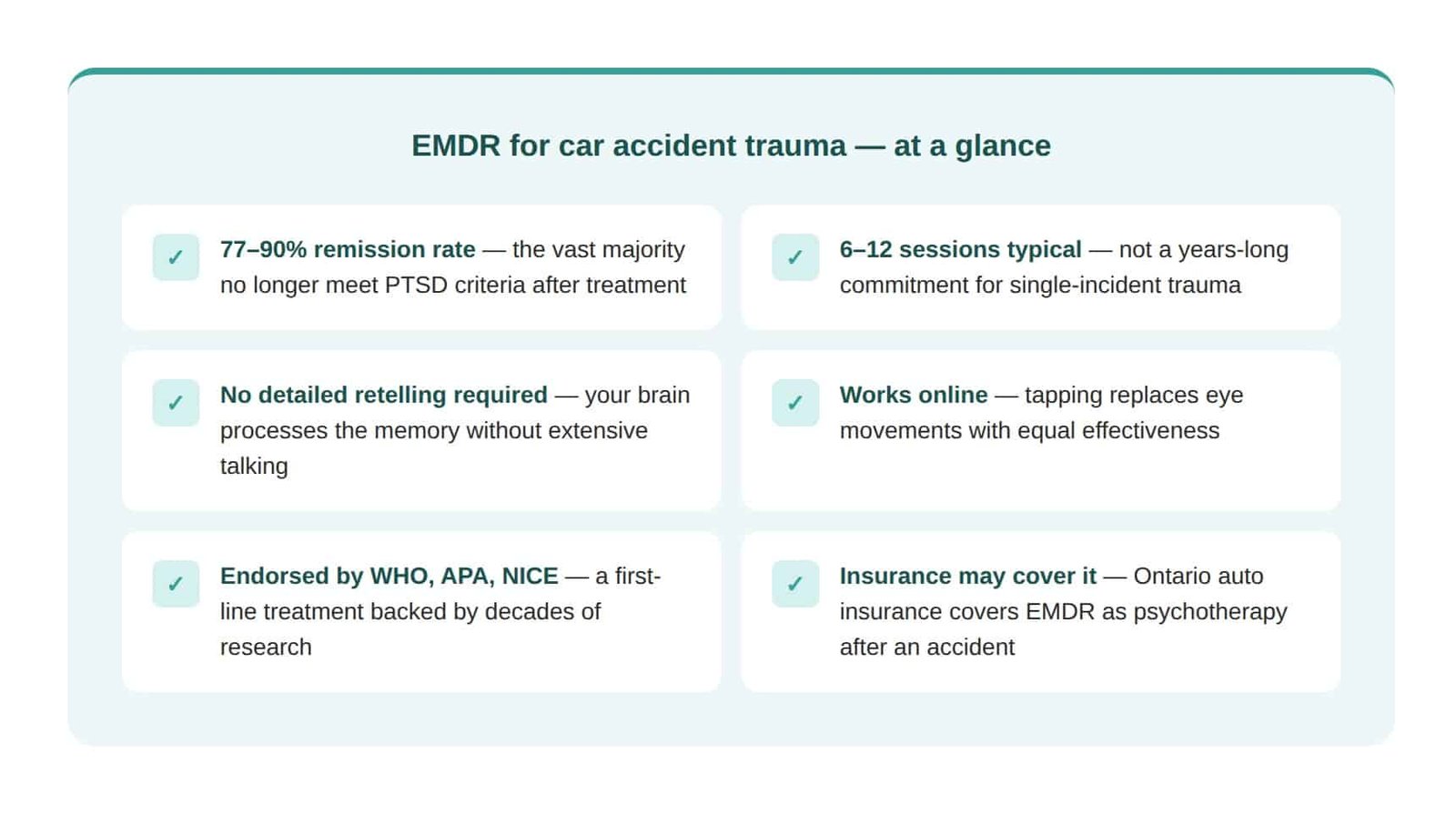
The results speak for themselves. According to a review of the research, 77 to 90% of EMDR patients no longer met the diagnostic criteria for PTSD by the end of treatment. EMDR is endorsed as a first-line trauma treatment by the American Psychological Association, the World Health Organization, and the National Institute for Health and Care Excellence (NICE).
Why EMDR Works Especially Well for Car Accident Trauma
Not all trauma is the same. A car accident is what clinicians call a single-incident trauma — one specific event that your brain is stuck on. This is exactly the type of trauma EMDR was designed for.
Here’s why car accident trauma responds so well to EMDR:
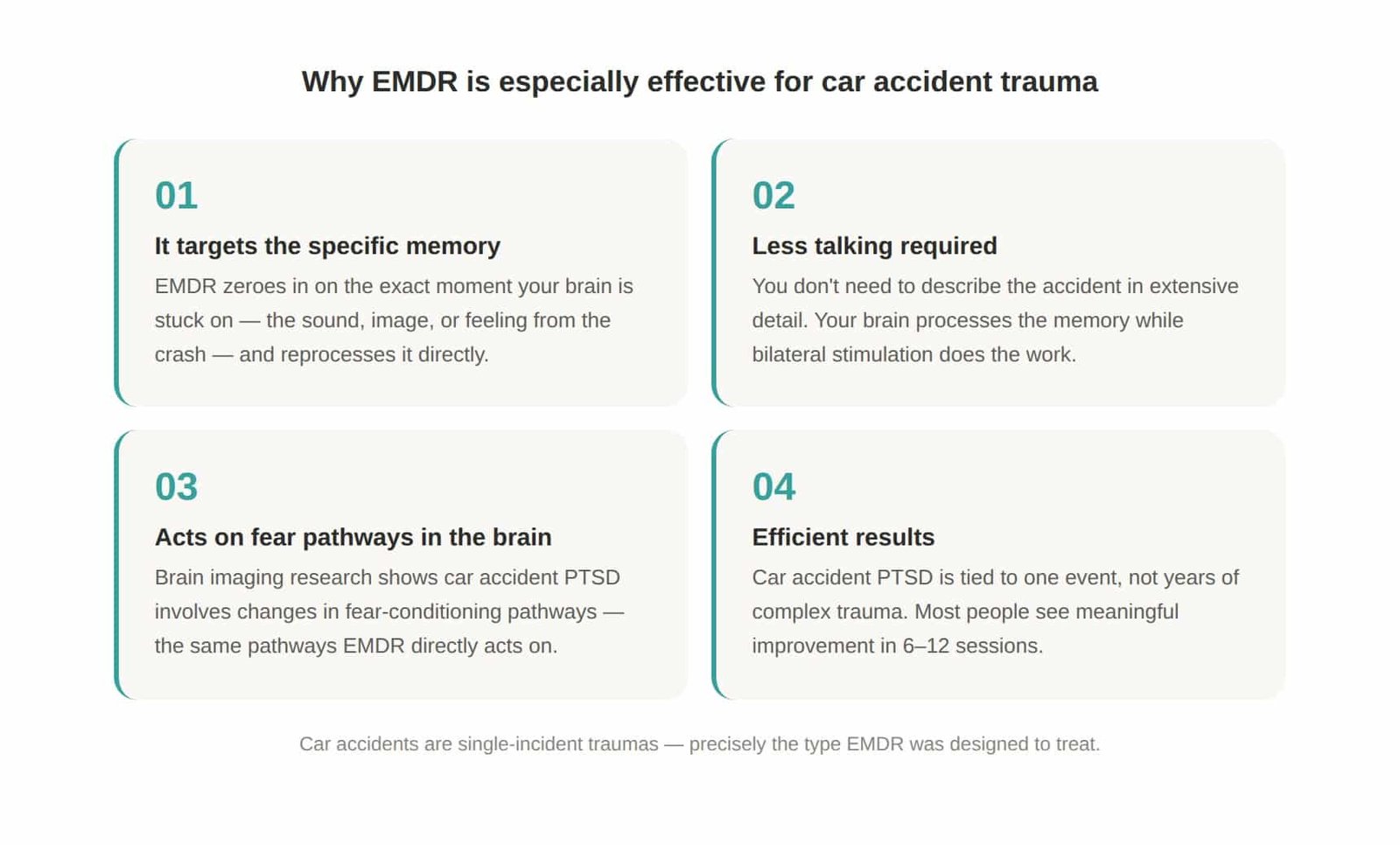
It targets the specific memory. Unlike general talk therapy, which explores your feelings broadly, EMDR zeroes in on the exact memory — the sound of the impact, the image of the headlights, the feeling of the seatbelt locking — and reprocesses it directly.
It doesn’t require you to talk through the accident in detail. Some people dread the idea of sitting in a room and describing the crash in words. With EMDR, you hold the memory in mind briefly while the bilateral stimulation does the processing. Many people describe it as watching the memory from a distance rather than being inside it.
It works on the brain’s fear pathways. A meta-analysis of brain imaging studies found that PTSD following car accidents involves changes in the anterior cingulate cortex — a brain structure involved in fear conditioning. EMDR and similar desensitization techniques act directly on these pathways, helping your brain learn that the danger is over.
It produces results efficiently. Because car accident PTSD is typically tied to one event (rather than years of complex trauma), many people see meaningful improvement within 6 to 12 sessions — sometimes fewer.
What Happens in an EMDR Session — Step by Step
EMDR follows a structured eight-phase protocol. Here’s what each phase actually looks like from your perspective — no jargon, just what you’ll experience.
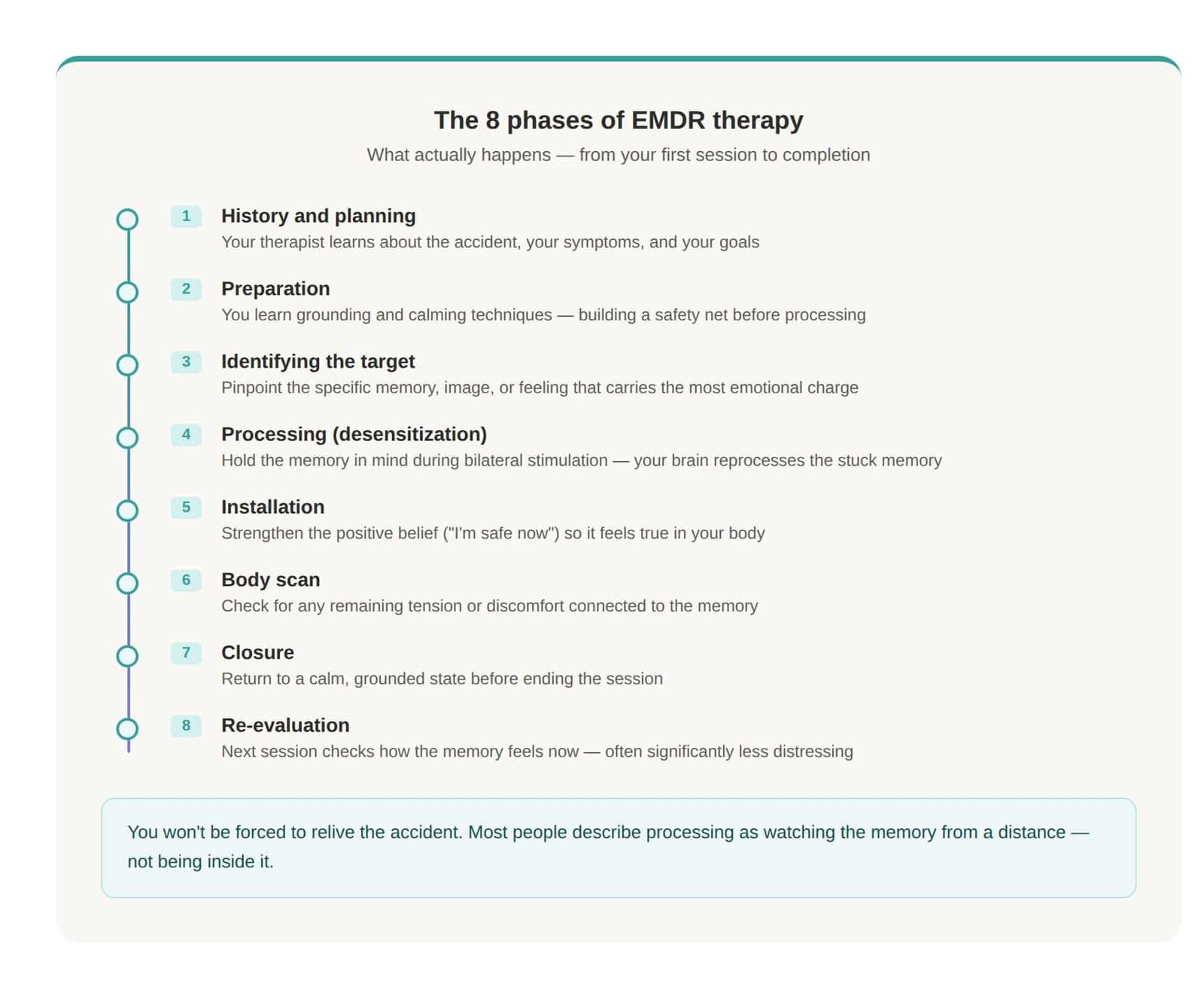
Phase 1 — History and planning
Your therapist asks about the accident, your symptoms, and how they’re affecting your daily life. Together, you identify what you want to work on and set goals. This is a conversation — nothing happens to you in this phase.
Phase 2 — Preparation
Before any processing begins, your therapist teaches you grounding and calming techniques — things like a “safe place” visualization, breathing exercises, or body-based calming strategies. These are tools you can use during and between sessions if things feel intense. You’re building a safety net before doing any heavy lifting.
Phase 3 — Identifying the target
Together, you pinpoint the specific memory from the accident that carries the most emotional charge. This might be a visual image (the car spinning), a sound (the crash), or a body sensation (the jolt). You also identify the negative belief attached to it — something like “I’m not safe” or “It was my fault” — and what you’d rather believe instead — “I survived and I’m safe now.”
Phase 4 — Processing (desensitization)
This is the core of EMDR. You hold the target memory in mind while engaging in bilateral stimulation — in person, this means following your therapist’s hand with your eyes. In virtual sessions, this is typically gentle self-tapping (alternating taps on your knees or crossing your arms and tapping your shoulders).
Your therapist guides you through sets of stimulation with brief check-ins between each set. During processing, you simply notice what comes up — thoughts, images, feelings, body sensations — without trying to control anything. Your brain does the work.
Most people describe this phase as surprisingly gentle. You’re aware of the memory, but it feels like watching it from a distance rather than being back in the car.
Phase 5 — Installation
Once the emotional charge has decreased, your therapist helps strengthen the positive belief you identified earlier. The goal is for “I’m safe now” to feel true in your body — not just something you tell yourself intellectually.
Phase 6 — Body scan
You scan your body for any remaining tension, tightness, or discomfort connected to the memory. If anything comes up, your therapist may do additional processing to clear it.
Phase 7 — Closure
Your therapist helps you return to a calm, grounded state before the session ends. You’ll discuss what to expect between sessions — some people notice continued processing through dreams or new insights — and you’ll have your grounding tools to use if needed.
Phase 8 — Re-evaluation
At the start of your next session, your therapist checks in on the target memory. How does it feel now? For many people, the memory is noticeably less distressing — often dramatically so. From here, you may continue processing the same memory or move to a new target.
How Does EMDR Work Online?
This is one of the most common questions we get — and the answer is encouraging
In virtual EMDR therapy sessions, the bilateral stimulation method changes but the therapeutic process stays the same. Instead of following your therapist’s hand with your eyes, you’ll use self-administered tapping — either the “butterfly hug” (crossing your arms and alternating taps on your shoulders) or alternating taps on your knees. Some therapists also use audio tones played through headphones.
Research supports that tapping-based bilateral stimulation is equally effective as eye movements. The processing, the therapeutic relationship, and the outcomes are the same.
For car accident survivors specifically, virtual EMDR has a practical advantage that’s hard to overstate: you don’t have to drive to your appointment. If driving anxiety or phobia is part of your trauma — which it is for many people after an accident — doing EMDR from your own couch removes the biggest barrier to getting started.
You’re also in your safe space. You have your comfort items around you. And if a session is emotionally intense, you’re already home — you don’t have to compose yourself for a drive back.
How Long Does EMDR Take for Car Accident Trauma?
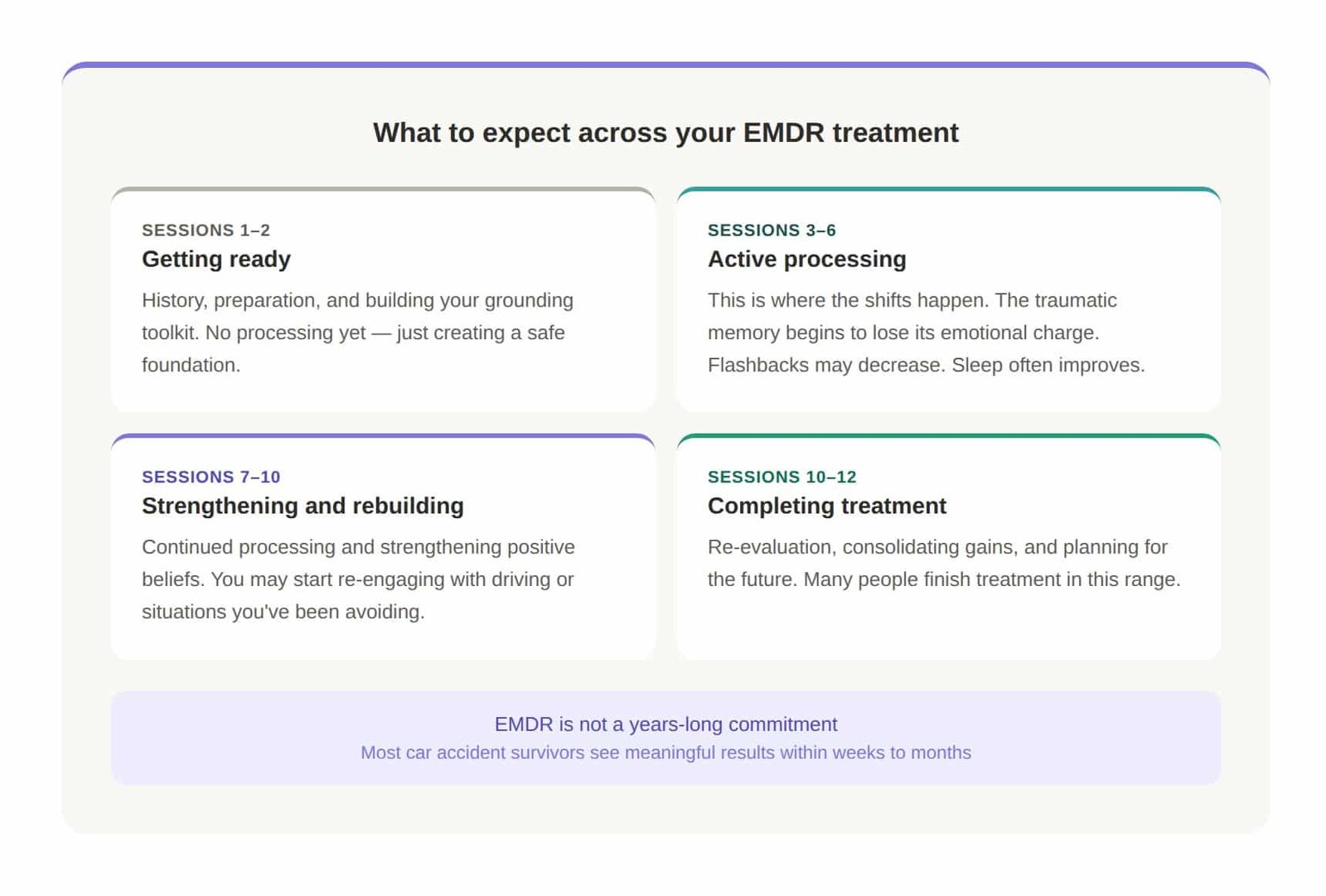
For single-incident car accident trauma, a typical course of EMDR runs 6 to 12 sessions. Some people notice meaningful shifts as early as session 3 or 4. Sessions are usually 60 to 90 minutes — longer than standard talk therapy to allow full processing within each session.
Here’s a general timeline of what to expect:
Sessions 1-2: History, preparation, and building your toolkit. No processing yet — just getting ready.
Sessions 3-6: Active processing of the traumatic memory. This is where the shifts happen. The memory begins to lose its emotional charge. Flashbacks may decrease. Sleep often improves.
Sessions 7-10: Continued processing and strengthening positive beliefs. You may begin re-engaging with situations you’ve been avoiding — like driving or riding in a car.
Sessions 10-12: Re-evaluation, consolidating gains, and planning for the future. Many people complete treatment in this range.
If you have a history of prior trauma or multiple accidents, treatment may take longer. Your therapist will give you a clearer estimate after the initial assessment.
The important contrast with traditional talk therapy: EMDR is not a years-long commitment. It’s designed to produce meaningful results within weeks to months, not years.
EMDR vs. CBT for Car Accident Trauma — Which Is Right for You?
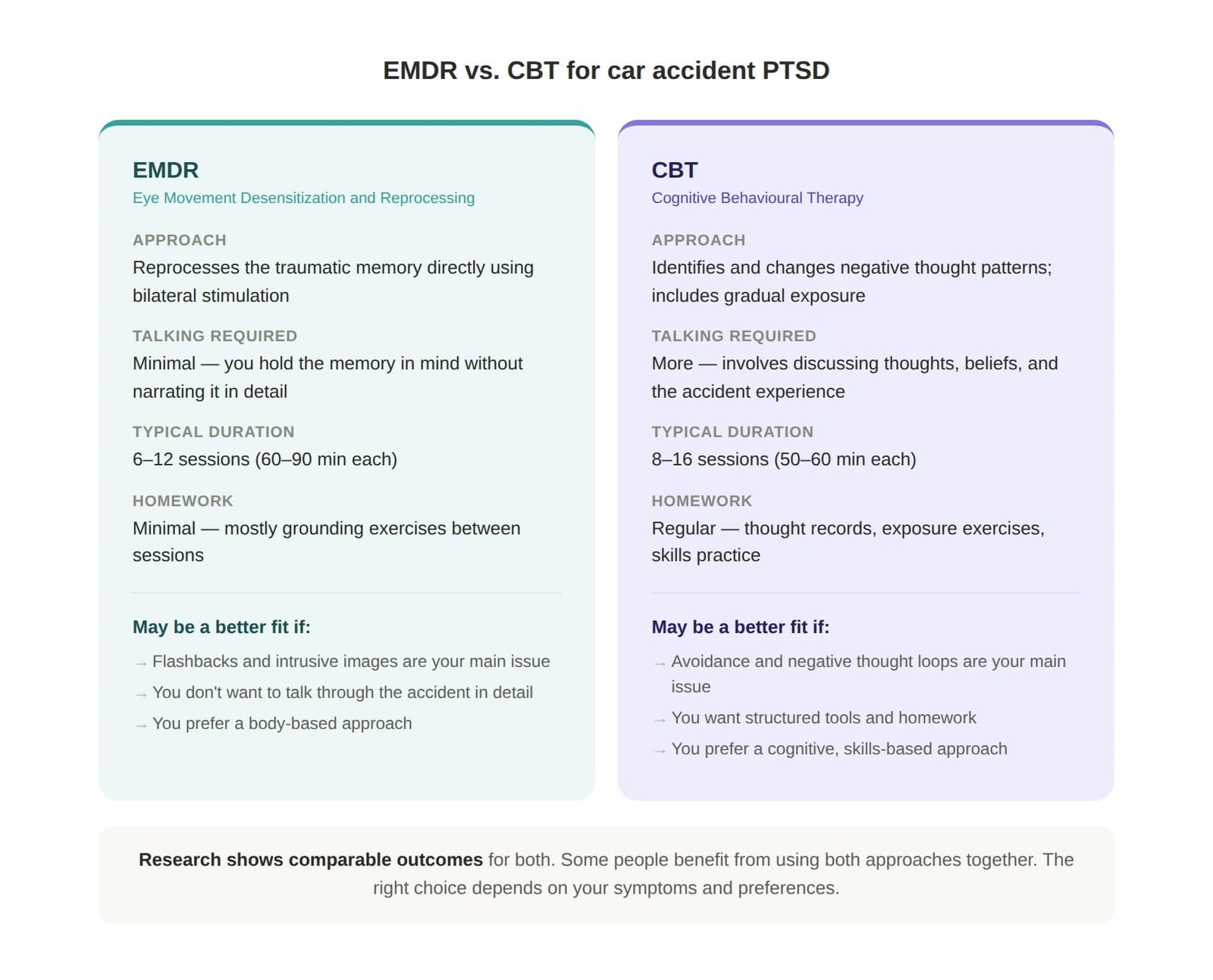
This is a question our team gets asked a lot. The honest answer: research shows that EMDR and trauma-focused CBT produce comparable outcomes for PTSD after car accidents. Neither is objectively “better.” The right choice depends on you.
EMDR may be a better fit if your main symptoms are flashbacks, intrusive images, or nightmares — the memory itself is the problem. You don’t want to talk through the accident in extensive detail. You want a more body-based, less verbal approach.
CBT may be a better fit if your main symptoms are avoidance behaviours and negative thought patterns — like catastrophizing about driving or believing the world is permanently unsafe. You prefer structured homework and practical tools. You want a more cognitive, skills-based approach.
Some people benefit from both — starting with EMDR to process the traumatic memory, then using CBT techniques to rebuild driving confidence and challenge lingering thought patterns. They’re complementary, not competing approaches.
If you’re not sure which is right for you, our team at Aref Psychotherapy can help. We offer a free consultation to match you with the right therapist and approach based on your specific symptoms and preferences.
Your Insurance May Cover EMDR After a Car Accident
If you’re in Ontario, EMDR therapy after a car accident is covered under your auto insurance as psychotherapy — through the Statutory Accident Benefits Schedule (SABS). This coverage is available regardless of who was at fault, and many clinics offer direct billing.
We wrote a full guide on how this works: Does car insurance cover therapy after a car accident in Ontario?
The short version: you don’t need a referral, you likely pay nothing upfront, and your therapist handles the paperwork.
You Don’t Have to Keep Reliving the Accident
If your brain is stuck replaying the crash — the sound, the jolt, the fear — EMDR can help it let go. Not by forgetting what happened, but by helping your brain file the memory where it belongs: in the past. So when you think about the accident, you remember it without your body reacting as though it’s happening again.
Car accident trauma is one of the most responsive types of PTSD to EMDR treatment. The vast majority of people who complete treatment no longer meet the criteria for PTSD. That’s not a vague promise — it’s what the research consistently shows.
Does EMDR work for car accident PTSD?
Yes. EMDR is one of the most effective treatments for PTSD after a car accident. Research shows that 77 to 90% of patients no longer meet PTSD criteria after completing EMDR treatment. Car accidents are single-incident traumas, which is precisely the type of trauma EMDR was designed to treat. It is endorsed by the WHO, APA, and NICE as a first-line trauma therapy.
Will I have to relive the accident during EMDR?
No — not in the way you might fear. You'll briefly hold the memory in mind while engaging in bilateral stimulation, but most people describe it as watching the memory from a distance rather than being back inside it. Your therapist will prepare you with grounding techniques first, and you'll process at a pace that feels safe. You won't be asked to describe the accident in extensive verbal detail.
How is EMDR different from talk therapy?
Traditional talk therapy involves discussing your thoughts and feelings about the accident in depth. EMDR focuses less on talking and more on reprocessing the traumatic memory directly through bilateral stimulation. This means your brain does much of the processing work, and you don't need to narrate the experience in detail. Many people find EMDR faster and less verbally demanding than talk therapy.
Can EMDR be done online?
Yes. In virtual sessions, therapists use self-administered tapping instead of eye movements for bilateral stimulation. Research supports that this is equally effective. Virtual EMDR is particularly well-suited for car accident survivors who experience driving anxiety, since you don't need to drive to your appointment. All EMDR sessions at Aref Psychotherapy are delivered virtually.
How many EMDR sessions will I need after a car accident?
For single-incident car accident trauma, most people complete treatment in 6 to 12 sessions. Some notice meaningful improvement within 3 to 4 sessions. Sessions are typically 60 to 90 minutes. If you have prior trauma history or multiple traumatic events, treatment may take longer. Your therapist will provide a clearer timeline after your initial assessment.
This article is for informational purposes only and does not replace professional mental health advice. If you’re in crisis, please contact Crisis Services Canada at 1-833-456-4566 or text 45645.
Ready to Take the Next Step?
Our team at Aref Psychotherapy offers virtual EMDR therapy and MVA therapy across Canada. If you’ve been in a car accident and you’re dealing with flashbacks, nightmares, driving anxiety, or emotional distress, we’re here to help.
Book a free consultation to find out if EMDR is right for you.