
Reviewed by the clinical team at AREF Psychotherapy — a team of Registered Psychotherapists and a Nurse Practitioner (CNO Extended Class) serving clients across Canada.
You can’t sit still. Your mind won’t stop. You started three projects this morning and finished none of them, and now your chest is tight thinking about the email you forgot to send. Is this ADHD? Is this anxiety? Is it both? You searched the symptoms and the lists looked identical — and the more you read, the more confused you became.
This is one of the most common questions people bring into an adult assessment. The short answer is that ADHD and anxiety look strikingly similar on the surface, run from very different mechanisms underneath, and very often co-occur. Treating one without seeing the other rarely produces lasting relief.
This guide walks through what makes ADHD and anxiety so easy to confuse, how clinicians actually tell them apart, what happens when both are present, and what evidence-based treatment looks like in Canada — including the integrated ADHD assessment and therapy our team offers across the country. We are not going to diagnose you. We are going to help you see the picture clearly.
Why ADHD and anxiety look so similar
ADHD and anxiety look similar because both produce racing thoughts, restlessness, difficulty concentrating, and emotional intensity. But they come from different mechanisms — ADHD is a regulation deficit, anxiety is an over-active threat detection system.
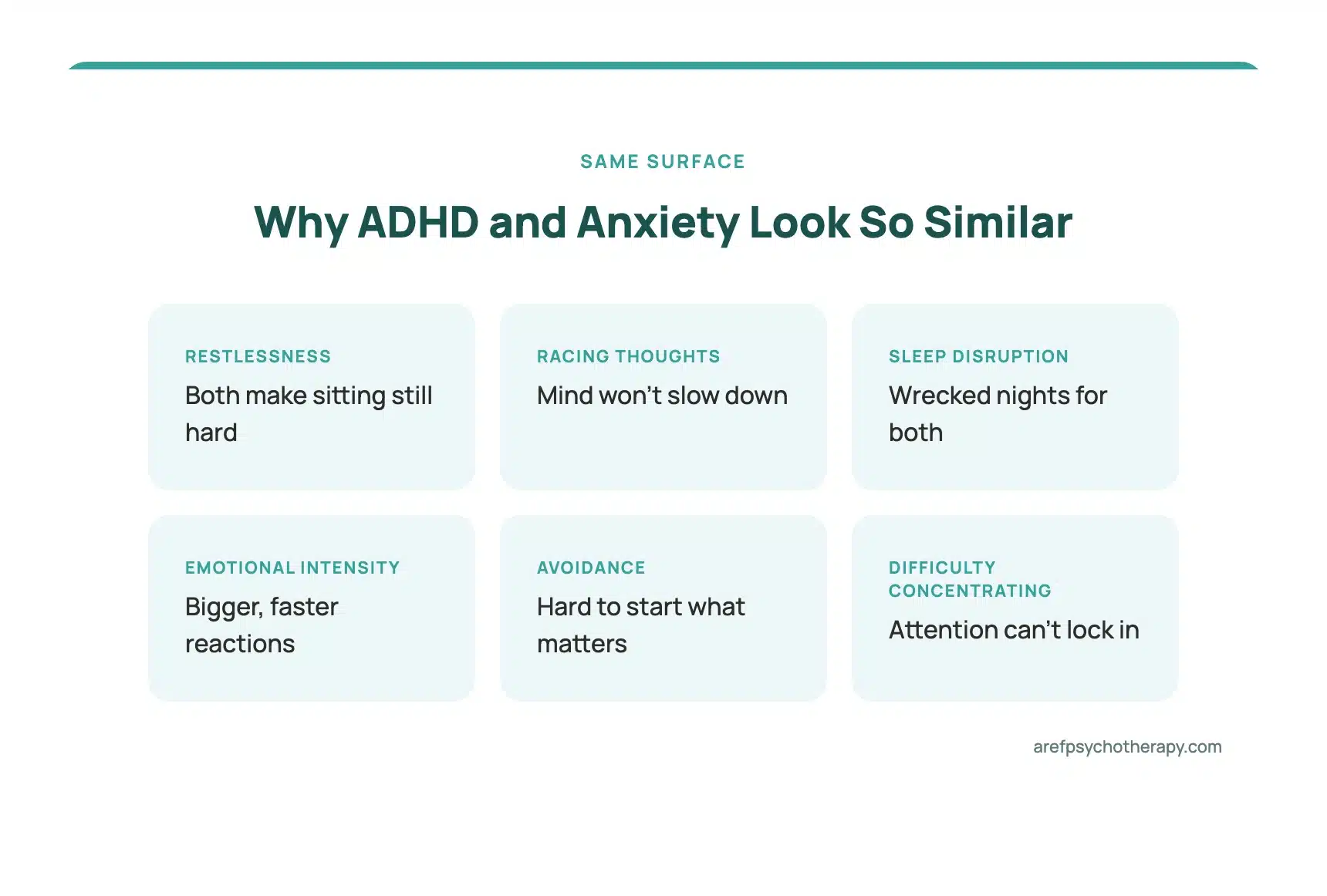
The overlapping symptoms catch almost everyone:
- Restlessness. Both make sitting still hard. ADHD restlessness is “my brain is hungry for stimulation.” Anxiety restlessness is “my nervous system thinks something bad is about to happen.”
- Racing thoughts. ADHD thoughts are often interesting but disorganized — jumping topics, chasing tangents. Anxiety thoughts loop, replay, and catastrophize the same scenario.
- Difficulty concentrating. ADHD can’t focus because the regulation system can’t lock on. Anxiety can’t focus because the threat system keeps pulling attention to perceived danger.
- Sleep disruption. Both wreck sleep — ADHD via the wandering mind that won’t settle, anxiety via the worry loops that hijack 2 a.m.
- Emotional intensity. ADHD makes emotions bigger and faster. Anxiety makes emotions amplified by anticipatory dread.
- Avoidance. Both produce avoidance — ADHD because executive function makes starting hard, anxiety because the threat system says don’t go near it.
Even experienced clinicians can find these patterns hard to disentangle without a careful history. A 2025 review in Frontiers in Psychiatry (Fu and colleagues) confirms the high comorbidity between adult ADHD and anxiety, with overlapping and interacting symptoms making accurate diagnosis a real challenge.
How they actually differ — the mechanism

Here is the part most articles skip, and where AREF can offer real clinical depth.
ADHD is a regulation deficit. The brain’s executive function networks — attention, working memory, response inhibition, emotional regulation — work differently from the start. The system can’t reliably lock on, prioritize, or shift away from what it’s currently doing. Symptoms have been there since childhood, even if no one named them. The exhausting part isn’t a specific worry — it’s the constant cost of keeping a deregulated system on track.
Anxiety is an over-active threat detection system. The brain’s danger circuits fire too readily, too often, and at things that aren’t actually threats. Worry produces physical activation (chest tight, stomach in knots, scalp tingling). The exhausting part is the dread, the rumination, and the avoidance.
A 2023 systematic review of 22 studies (Soler-Gutiérrez and colleagues, PLOS One) established that emotion dysregulation is a core symptom of adult ADHD — not a side effect, not anxiety, but a measurable difference in how the ADHD nervous system processes emotional signals. That’s a different mechanism from what generates an anxiety disorder.
The practical implication: treatments that work for one don’t automatically work for the other. CBT for anxiety alone often misses an underlying ADHD picture. ADHD medication or coaching alone doesn’t dissolve an anxiety disorder that has built up around years of compensating.
ADHD or anxiety — does this sound like you?

You may notice some of these patterns. None alone confirm either diagnosis. Several together — especially across many years — are worth a clinical conversation.
- You’ve been called “lazy” or “scattered” since school, despite working harder than people around you.
- You can hyper-focus on something interesting for six hours, then can’t start a three-minute email for three weeks.
- Your worries loop the same scenario for hours, not minutes.
- Restlessness is internal, not external — you look calm, but your brain is sprinting.
- You over-prepare for things that don’t need it and under-prepare for things that do.
- You have a chronic background dread that something is wrong, even when things are fine.
- Emotional reactions feel oversized — especially around perceived criticism or rejection (see rejection sensitive dysphoria).
- You avoid social situations not because you fear judgment but because they feel overwhelming.
- You’ve been treated for anxiety and it helped — but it never fully fit.
- You’ve been told “you can’t have ADHD, you’re successful” — yet you barely function on the inside.
If a number of these read like your life, the next sections will help you understand which mechanism (or both) is likely driving the picture.
ADHD and anxiety side-by-side

A side-by-side helps when symptoms blur. Clinical patterns differ in onset, duration, content, and what they respond to.
This binary picture is useful — and it’s also incomplete. Most adults who come to assessment with both ADHD-like and anxiety-like symptoms have BOTH conditions. That changes the plan.
When ADHD causes anxiety — the most common picture
The single most common adult presentation in our practice: undiagnosed ADHD that produced years of compensation, masking, near-misses, and chronic vigilance — which the nervous system eventually shaped into a generalized anxiety disorder. The anxiety is real. It’s not “just” the ADHD. But the ADHD is the upstream pattern.

What this looks like:
- Tracking what you might be forgetting. Constant background scanning (“did I send that email? did I lock the door? what’s the kid’s hockey schedule?”) drains the same nervous system that drives anxiety.
- The consequences of dropped things. When ADHD produces real-life consequences — missed deadlines, forgotten birthdays, lost wallets — the brain learns “stay alert at all times or something will go wrong.”
- Compensatory perfectionism. Adults with undiagnosed ADHD often armor up with rigid systems and intense preparation to prevent ADHD-driven mistakes. This works until the preparation itself becomes the source of dread.
- Emotional dysregulation feeding the loop. ADHD-related emotional intensity (including RSD) creates more interpersonal ruptures, which feed more anticipatory anxiety.
In this picture, treating anxiety alone produces partial relief. Treating the underlying ADHD — assessment, therapy, sometimes medication via a Nurse Practitioner — releases the upstream pressure. Both can shrink together.
When anxiety causes ADHD-like symptoms
The reverse happens too: an anxiety disorder produces concentration problems, restlessness, and emotional reactivity that look like ADHD on a checklist. The give-away signs that you’re looking at primary anxiety, not ADHD:
- No childhood history. ADHD has roots in early development. Anxiety-driven inattention often starts in adulthood after a stressful period.
- Symptoms cluster around specific triggers or themes — not present across every domain of life.
- The “ADHD-like” symptoms resolve when the anxiety is treated. A round of CBT or appropriate medication for anxiety dissolves the focus problems.
- Rumination is the dominant cognitive feature, not distractibility. You can hold attention on the worry just fine — it’s everything else that you can’t get to.
A skilled clinician can tell the difference. The wrong direction here is to assume that any restless, scattered, can’t-focus adult has ADHD. Some do. Some have an anxiety pattern that needs different treatment.
Both diagnoses can be present — what then?
Most adults who ask “ADHD or anxiety?” have both. The 2025 Fu et al. review highlights the high rate of comorbidity and notes that integrated pharmacological and psychotherapeutic approaches produce better outcomes than treating either alone.
When both are present, a thoughtful treatment plan does three things:
- Names the pattern accurately. A clinical assessment that screens for both — and for related patterns like ADHD overlap with women’s presentation, trauma, or burnout — gives you the actual map.
- Sequences treatment. Sometimes the anxiety stabilizes first so the person can engage the ADHD work. Sometimes the ADHD assessment + medication clears enough cognitive space to allow CBT for anxiety to land. The order depends on what’s most disabling right now.
- Coordinates across modalities. Our team’s integrated approach — Registered Psychotherapist for the therapy + Nurse Practitioner (CNO Extended Class) for the medical assessment — keeps everything in one care plan.
How a Canadian clinical assessment sorts this out
A good adult assessment for “ADHD or anxiety” includes several pieces:
- Developmental history. Were the symptoms present in childhood? Did anyone notice — teachers, parents, the report cards that said “smart but disorganized”?
- Functional impact across domains. ADHD shows up in school, work, friendships, finances, and home life — not just in one corner. Anxiety often clusters around specific themes.
- Validated screening tools. ASRS-type instruments for ADHD. GAD-7, PCL-5, or similar for anxiety and trauma. Plus structured interviews where the clinician asks the right follow-up questions.
- Ruling out alternatives. Sleep apnea, thyroid issues, perimenopausal hormonal shifts, depression, medication side effects, substance use — all can cause focus and mood symptoms that mimic both ADHD and anxiety.
- Coordination between disciplines. A Nurse Practitioner can complete the clinical interview, diagnose, and discuss medication options where appropriate. A Registered Psychotherapist can complete the therapy plan and identify the patterns that don’t fit cleanly into either box.
You do not need to figure out which one you have before booking. The assessment is what answers that question.
What treatment looks like for ADHD, anxiety, or both

Several evidence-based approaches work for each — and many overlap.
For ADHD:
- Cognitive Behavioural Therapy (CBT) for ADHD — targets catastrophic interpretations, executive function challenges, and avoidance
- Executive function support inside the therapy frame — building systems for time, planning, and energy
- Emotion regulation skills — distress tolerance, somatic work
- Medication options — discussed with our Nurse Practitioner
For anxiety:
- CBT for anxiety with exposure — gradually testing what the threat system says is dangerous
- ACT (Acceptance and Commitment Therapy) — defusing from worry thoughts, acting on values
- Somatic and nervous-system regulation — bottom-up tools for the body’s alarm
- EMDR therapy — when anxiety is rooted in or layered with trauma
For both together:
- An integrated treatment plan that addresses the upstream pattern (often ADHD) while also providing the anxiety-specific tools that the brain needs right now
- Coordinated care between NP and RP so adjustments in one piece are communicated to the other
- Skill work that targets the shared overlap — emotion regulation, sleep, distress tolerance
The Canadian context matters. Most employer Extended Health Benefit plans cover Registered Psychotherapy sessions; Health Spending Accounts often reimburse Nurse Practitioner ADHD assessment. OHIP does not cover private psychotherapy or private NP services. We provide receipts; you confirm coverage with your insurer before booking.
What to do this week
Five concrete steps if “ADHD or anxiety” feels like the question that has been following you around:
- Map your history. Phone note. Five moments — childhood, adolescence, early career, recent years — where focus, restlessness, or worry got in the way. Was the pattern there from the start, or did it arrive after a specific period?
- Track one week. Note what triggers the inattention or restlessness. Does it have a theme (work, relationships, money) or does it show up everywhere?
- Try the 90-second pause. When the restlessness or worry surges, set a timer and do not respond. Notice whether the wave moves on its own (often anxiety) or whether the brain just moves to the next thing (often ADHD).
- Tell one trusted person. Not the diagnosis — just the pattern. “I think I’ve been treating myself for the wrong thing.” Saying it out loud helps clarify.
- Book a free consultation if you want a plan. A 15-minute conversation can map the right starting point — therapy alone, NP assessment, or both pathways in parallel.
Key takeaways

Ready to take the next step?
Our team at AREF Psychotherapy offers integrated assessment and therapy for ADHD, anxiety, and the common picture where both are present. A free 15-minute consultation is the most useful thing you can do today — we’ll listen, ask the right questions, and recommend the right starting point.
Book a Free Consultation · Call 437-830-2088
Frequently asked questions
Can ADHD cause anxiety?
Yes. Adult ADHD frequently produces secondary anxiety because years of compensating, tracking missed details, and managing real-life consequences shape the nervous system into a state of chronic vigilance. Treating only the anxiety often produces partial relief; treating the underlying ADHD upstream releases the pressure and shrinks both.
Can anxiety cause ADHD-like symptoms?
Yes. An anxiety disorder can produce inattention, restlessness, and concentration problems that look like ADHD on a symptom checklist. The give-away signs that anxiety is primary include no childhood history of ADHD-like patterns, symptoms clustering around specific triggers, and resolution of the inattention when the anxiety is treated.
Can I have both ADHD and anxiety?
Yes — and it is the most common adult presentation. A 2025 review in Frontiers in Psychiatry confirmed high comorbidity rates between adult ADHD and anxiety, with integrated treatment producing better outcomes than addressing either condition alone.
What kind of clinician should I see for ADHD and anxiety?
A Registered Psychotherapist (RP) can complete the therapy work for both. A Nurse Practitioner in the CNO Extended Class can complete the clinical ADHD assessment and discuss medication options. Many adults benefit from working with both in an integrated care plan rather than choosing between them.
Will my insurance cover assessment and treatment?
Most employer Extended Health Benefit plans cover sessions with Registered Psychotherapists. Coverage for Nurse Practitioner ADHD assessment varies; Health Spending Accounts often reimburse NP fees. OHIP and other provincial plans do not cover private psychotherapy or private NP services. Call your benefits provider before booking to confirm.
This article is for informational purposes only and does not replace professional mental health advice. If you are in crisis, please contact Canada’s 9-8-8 Suicide Crisis Helpline by calling or texting 9-8-8. If you are in immediate danger, call 911.
Reviewed by the clinical team at AREF Psychotherapy — Registered Psychotherapists and a Nurse Practitioner (CNO Extended Class) serving clients across Canada.
Sources and further reading
Every claim in this article is grounded in peer-reviewed research, regulatory guidance, or named Canadian authorities. For deeper reading:
Peer-reviewed research
- Fu, X., Wu, W., Wu, Y., Liu, X., Liang, W., Wu, R., & Li, Y. (2025). Adult ADHD and comorbid anxiety and depressive disorders: a review of etiology and treatment. Frontiers in Psychiatry.
- Soler-Gutiérrez, A.-M., Pérez-González, J.-C., & Mayas, J. (2023). Evidence of emotion dysregulation as a core symptom of adult ADHD: A systematic review. PLOS One. Systematic review of 22 studies.
- Rowney-Smith, A., Sutton, B., Quadt, L., & Eccles, J. A. (2026). The lived experience of rejection sensitivity in ADHD. PLoS One.
Clinical guidelines
- National Institute for Health and Care Excellence (NICE). NG87: Attention deficit hyperactivity disorder — diagnosis and management.
Canadian health authorities and ADHD organisations
- CAMH (Centre for Addiction and Mental Health) — ADHD information
- Centre for ADHD Awareness, Canada (CADDAC)
Regulators
Crisis support
- 9-8-8 Suicide Crisis Helpline — 24/7 phone or text support, Public Health Agency of Canada.
Related reading on AREF Psychotherapy