
Reviewed by the clinical team at AREF Psychotherapy — a team of Registered Psychotherapists and a Nurse Practitioner (CNO Extended Class) serving clients across Canada.
Your boss replies “OK.” to a message you spent twenty minutes writing. Your chest tightens. You read it again. You decide you are about to be fired. You spend the next four hours building a case for why you are bad at your job and the next four nights checking your email at 2 a.m.
If that scene feels familiar — if small criticisms feel devastating, if perceived rejection sends you into a spiral that lasts hours or days, and if you have always wondered why others seem to bounce back from things that flatten you — you may be experiencing rejection sensitive dysphoria. Most adults living with this pattern have ADHD, often undiagnosed, often masked, and almost always exhausted.
This guide explains what rejection sensitive dysphoria is, why ADHD brains feel rejection differently, what daily life with it actually looks like, and what evidence-based help is available across Canada — including the kind of integrated ADHD therapy our clinical team provides. We are not going to diagnose you. We are going to help you see your own pattern clearly.
What is rejection sensitive dysphoria?
Rejection sensitive dysphoria, or RSD, is a clinical pattern of severe emotional pain triggered by perceived or real rejection, criticism, or failure. It is most commonly observed in people with ADHD and is not a standalone diagnosis in the DSM-5-TR, though clinicians widely recognize it as a meaningful and treatable pattern.
The term was popularized by Dr. William Dodson, an American ADHD specialist, in the early 2010s. Since then, the clinical literature has slowly caught up. A 2026 qualitative study published in PLoS One (Rowney-Smith and colleagues) used focus groups to document how rejection sensitivity shows up in the lived experience of ADHD adults — surfacing three recurring themes: masking, withdrawal, and bodily sensations. The research base is still small, but it confirms what clinicians have been seeing for years: the pattern is real, common, and frequently missed when only textbook ADHD symptoms are screened.
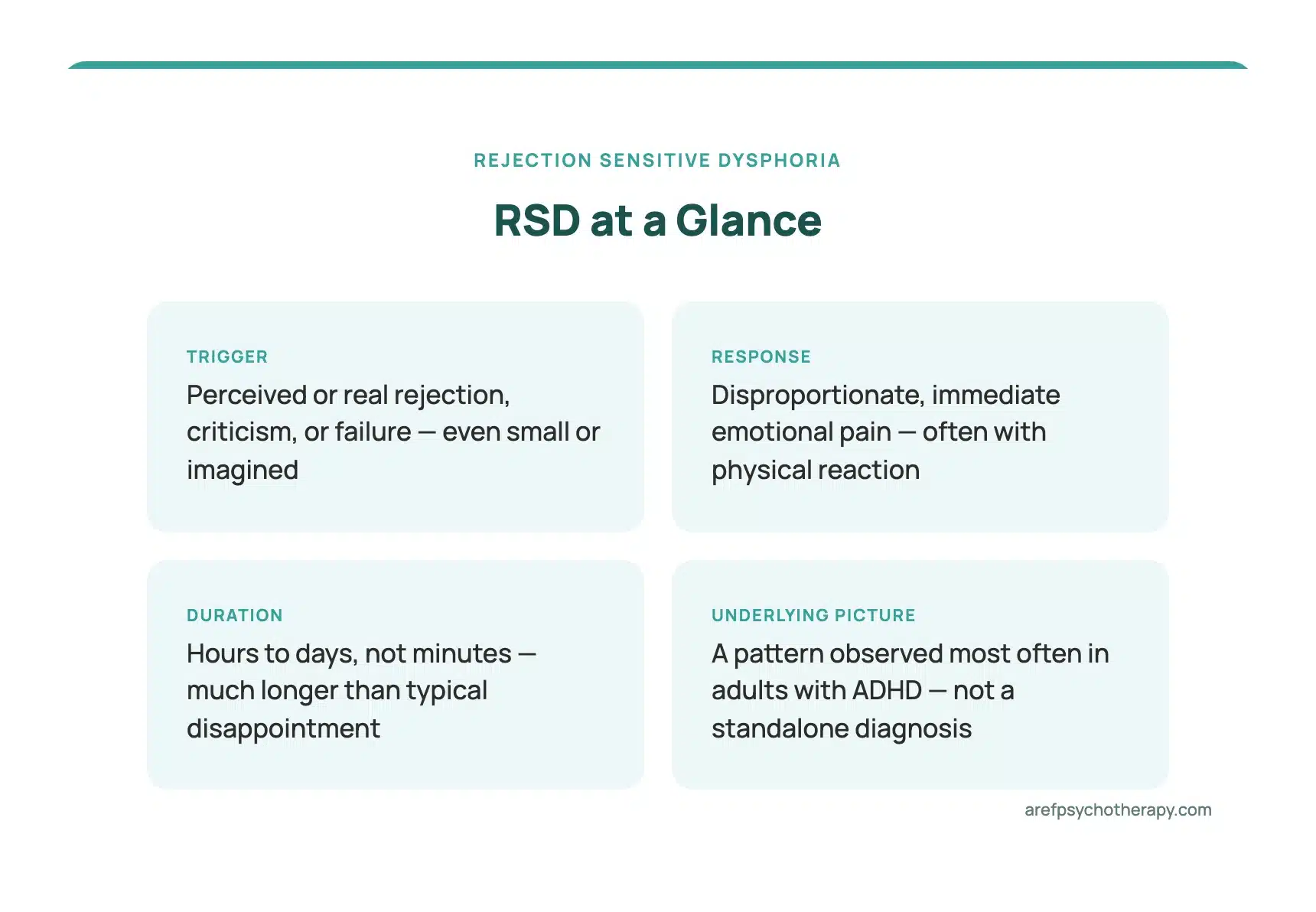
What makes RSD distinct from ordinary disappointment is the intensity, the speed, and the duration. A neurotypical person registers a critical email and feels mildly bad for fifteen minutes. An adult with RSD reads the same email and feels physically struck — chest tight, stomach dropping, scalp tingling — and then loops on it for hours, sometimes days. The trigger does not have to be real rejection. A pause in a friend’s text reply is enough.
Why ADHD brains feel rejection differently
Two pieces of neuroscience matter here, and both are explainable in plain language.
First, dopamine regulation. ADHD brains run on a dopamine reward system that does not produce a steady baseline the way neurotypical brains do. When something good happens, the bump is bigger. When something bad happens — including the perception of being rejected — the drop is also bigger and lasts longer. The same neurochemistry that makes a fascinating hobby feel ecstatic makes a curt reply feel like the floor falling away.
Second, emotion regulation. The prefrontal cortex networks that help most adults pause, evaluate, and reframe an upsetting moment work differently in ADHD. The pause is shorter. The evaluation tilts catastrophic. The reframe takes more conscious effort and burns more cognitive fuel. This is not a character flaw — it is a regulation deficit. A 2023 systematic review of 22 studies in PLOS One (Soler-Gutiérrez and colleagues) found that adults with ADHD consistently score lower on emotion regulation measures, rely more on maladaptive strategies, and show distinct brain activation patterns in the regions responsible for emotional processing. The good news in the same body of research: emotion regulation is teachable, and therapy that targets it specifically can change the pattern.
This is the part most generic articles skip: RSD is not “being too sensitive.” It is a measurable difference in how the ADHD nervous system processes social signals. Naming the mechanism out loud — to yourself, to a partner, to a clinician — is the first practical relief. You are not broken. You are running different hardware.
Signs of RSD — does this sound like you?

You may notice some of these patterns. None of them alone confirm RSD, but several together — especially if they have been with you since childhood — are worth bringing to a clinician.
- Catastrophizing after minor feedback. A small note from your manager spirals into “I am about to be fired.”
- Avoiding anything where rejection feels possible. You stop applying for jobs, stop pitching ideas, stop putting your work out.
- People-pleasing as protection. You say yes when you mean no because no feels like rejection in advance.
- Spiraling for hours or days. A perceived slight at 9 a.m. is still ringing at midnight.
- Physical response. Chest pain, nausea, scalp tingling, a sudden body heaviness.
- Pre-emptive shame. “I knew you would hate me” arrives before any actual rejection.
- Self-sabotage to control the rejection. Ending a relationship before it can end. Quitting a job before being let go.
- Disproportionate response to small ruptures. A friend takes a day to reply and you assume the friendship is over.
If three or more of these feel like home — and especially if you also live with classic ADHD patterns like time blindness, executive function struggles, or chronic overwhelm — a clinical conversation is worth having. Our integrated ADHD assessment and therapy is designed precisely for adults sorting through this picture.
RSD versus other emotional patterns

Several other clinical patterns can look like RSD from the outside. Knowing the difference matters — because the treatment plans differ.
RSD vs. borderline personality disorder (BPD). BPD is a personality disorder with distinct DSM-5-TR criteria including identity disturbance, chronic emptiness, and pervasive instability across relationships. RSD episodes are typically triggered, often brief, and not accompanied by identity disturbance. The two can co-occur, and a careful clinical assessment helps clarify which pattern is driving the distress.
RSD vs. social anxiety. Social anxiety is anticipatory and persistent — the dread builds for days before a social event. RSD is reactive — it fires when a rejection cue lands. People can have both, and they often respond to overlapping interventions, but the timeline is different.
RSD vs. depression. Depression is pervasive and continuous — the low mood is the weather, not the storm. RSD episodes are sharp spikes that resolve, even if they take a day. When the storms are frequent enough, they can produce depressive episodes downstream, which is why untreated RSD often appears alongside depression in adults with ADHD.
RSD vs. perfectionism. These often run together. Perfectionism is sometimes the armor an RSD-prone adult builds to prevent the trigger — produce flawless work, give no one anything to criticize. It works, until it does not, and the collapse looks like burnout.
A trauma-informed therapist will not just slot you into a label. They will help you see which patterns are present, which are interacting, and where to start.
The hidden cost of RSD in daily life

Most articles describe RSD as an emotional problem. The bigger picture is what it does to a whole life over time.
Career. Adults with RSD often plateau professionally — not because they lack capability, but because every step up requires risking rejection. They stop pitching ideas, stop asking for raises, stop applying for promotions. Sometimes they leave a job after one bad performance review they would have been fine to recover from. The talent is there. The exposure tolerance is not.
Relationships. Partners describe walking on eggshells. Small comments turn into multi-hour repairs. Some adults end relationships pre-emptively when they sense distance, because the controlled rupture feels safer than the feared one. Long-term, this carries an enormous cost.
Parenting. A child’s “no” or “I want Mommy not Daddy” can land like a knife if RSD is active. The parent over-apologizes, withdraws, or compensates by over-pleasing the child — none of which serves the kid’s regulation either.
Self-image. There is a low, constant hum of “everyone secretly hates me” running in the background. Even good news gets reframed (“they’re being nice because they pity me”). Years of this corrode self-trust.
Body. Chronic muscle tension, sleep disrupted by 2 a.m. rumination, stomach issues during anticipated social events. The nervous system does not get to rest.
This is the cost worth naming. It is also the cost that effective treatment reduces — not to zero, but enough that you stop organizing your life around avoiding the trigger.
Masking, people-pleasing, and the perfectionism trap
Here is where many adults — especially high-functioning women, immigrants, and professionals who learned early that survival meant performing — finally recognize themselves.
ADHD masking is the work of hiding ADHD traits to appear neurotypical. For an adult with RSD, masking is not just camouflage — it is rejection prevention. If you can produce work that no one can criticize, you have inoculated yourself against the trigger. The cost is that the masking takes enormous cognitive fuel. By 5 p.m. you have nothing left.
People-pleasing is the social-relational version of the same pattern. You agree to things you do not want. You laugh at jokes that are not funny. You absorb other people’s emotions so the room stays calm. You become the friend everyone confides in and tell no one what is happening inside you.
Perfectionism is the work-product version. You re-read the email seven times. You miss the deadline because the version is not perfect yet. You apologize for things you did not do wrong, just in case. You hold yourself to a standard no one else is holding you to, then resent everyone for not noticing.

The cycle looks like this: mask hard → exhaust yourself → small rupture happens anyway → spiral → recover with even harder masking. Over years it produces the picture most clinicians call adult burnout, and it explains why so many high-achieving adults with undiagnosed ADHD only discover the underlying pattern after a complete collapse.
Naming the cycle does not break it. But it does change the question from “what is wrong with me” to “what is the pattern I have been running, and what would help.”
What helps — evidence-based approaches

Several treatment approaches have meaningful evidence for the kind of emotion regulation work that helps with RSD.
Cognitive Behavioural Therapy (CBT) for ADHD focuses on identifying and restructuring the catastrophic interpretations that drive an RSD spike. Modern CBT protocols for ADHD adults — distinct from generic CBT — also address the behavioural avoidance that grows around the trigger. The UK’s NICE NG87 guideline on ADHD diagnosis and management covers psychological and behavioural treatment alongside medication as part of comprehensive ADHD care across children, young people, and adults. AREF offers virtual CBT therapy across Canada.
Acceptance and Commitment Therapy (ACT) teaches you to defuse from rejection thoughts rather than fight them — to notice “my brain is telling me I am about to be fired” as a thought passing through, while you take action consistent with your values rather than your fear. ACT is especially useful when RSD has built years of avoidance that need to be gently reversed.
Dialectical Behaviour Therapy (DBT) skills — particularly distress tolerance and emotion regulation modules — give you concrete tools for the moment a spike arrives. These are skills, not insights, and they get better with practice.
Somatic and nervous-system work addresses the body-up surge that arrives before the thoughts. For some adults, this is more useful than top-down cognitive work because the physical reaction comes first.
EMDR therapy can be part of the plan when RSD is layered on top of relational trauma — a common picture, since people who grew up in environments where they were criticized often develop both. AREF’s EMDR therapy is offered virtually across Canada by clinicians trained in trauma-focused protocols.
Medication options are a separate conversation handled by our Nurse Practitioner during a clinical assessment. We do not name specific medications on our marketing pages — that conversation belongs in the consultation, with someone licensed to prescribe and to follow up safely.
Three skills you can try this week, today:
- Name it before acting. Out loud or in writing: “This is RSD. The story my brain is telling me is not necessarily true. I do not need to make a decision in this state.”
- The 90-second pause. When the surge arrives, do not respond, do not send the message, do not quit the thing. Set a 90-second timer and just feel the body sensation move through.
- Reality-check protocol. Pick one trusted person. When the spiral starts, ask them one question: “Am I reading this right?” Outsource the reality check while the storm passes.
Working with a Canadian psychotherapist on RSD
Most RSD content online is American, written for a healthcare system you do not have. Here is what working on RSD looks like inside Canadian psychotherapy, specifically with a virtual clinic like ours.
A typical first six to eight sessions focus on three things: naming the pattern (often with relief and grief in roughly equal parts), mapping the triggers so you know when you are most vulnerable, and starting one regulation skill that gives you a foothold during a spike. From there, the plan branches — into deeper trauma work if relevant, into ACT or CBT depth, into couples sessions if a partner is involved, or into coordination with our Nurse Practitioner if a medication conversation makes sense.
Virtual therapy is particularly well-suited to RSD work. You do not have to drive somewhere. You do not have to sit in a waiting room next to other clients. Your home is the regulated environment. We see Canadians across every province who would never have made it to a clinic in person.
On coverage: most employer Extended Health Benefit plans cover sessions with a Registered Psychotherapist. Coverage for Nurse Practitioner ADHD assessment varies — Health Spending Accounts often reimburse it. Provincial health plans like OHIP do not cover private psychotherapy. We provide receipts; you confirm with your insurer before booking.
Book a free 15-minute consultation and we will figure out together what the right starting point looks like for you.
What to do this week if RSD sounds like you
Five concrete steps, in order of effort:
- Track three RSD episodes this week. Phone notes are fine. For each one, write: what triggered it, what your body did, the story your brain told you, what you did next. This is not therapy — it is data collection. Patterns become visible in writing that are invisible in memory.
- Tell one trusted person what you noticed. Not the whole story. Just: “I think I have been responding to small criticisms way bigger than they are.” Saying it out loud breaks the secrecy that keeps RSD alive.
- Try the 90-second pause once. When the surge arrives, set a timer and do not act for ninety seconds. Just feel it. Notice how the wave actually moves on its own if you stop feeding it.
- Read one substantive resource. The 2026 qualitative study on the lived experience of rejection sensitivity in ADHD is small but useful as an honest snapshot of what RSD looks like from the inside. Skim the abstract if the full text feels dense.
- Book a free consultation if you want help building a plan. Self-management is real, but RSD shaped by years of masking does not usually resolve from skills alone. A therapist who knows ADHD can shorten the timeline meaningfully.
Key takeaways

Ready to take the next step?
Our team at AREF Psychotherapy offers integrated ADHD care across Canada — therapy designed for the rejection sensitivity that so often comes with ADHD, an integrated Nurse Practitioner pathway when medication conversation makes sense, and a calm, virtual-first model that meets you where you are. Book a free 15-minute consultation and we will map the right starting point together.
Book a Free Consultation · Call 437-830-2088
Frequently asked questions
Is rejection sensitive dysphoria a real diagnosis?
RSD is not a standalone DSM-5-TR diagnosis. It is a clinical pattern observed most often in people with ADHD, characterized by intense emotional pain triggered by perceived rejection or criticism. Clinicians recognize it as a meaningful pattern even though it does not have its own diagnostic code. Treatment focuses on the underlying ADHD and the emotion-regulation pattern itself.
Is RSD the same as borderline personality disorder?
No. BPD is a personality disorder with distinct DSM-5-TR criteria including identity disturbance, pervasive interpersonal instability, and chronic emptiness. RSD episodes are typically triggered, often short-duration emotional spikes most commonly seen alongside ADHD. The two can co-occur, and a clinical assessment can help clarify which pattern is driving distress.
Can therapy actually help with rejection sensitive dysphoria?
Yes. Psychotherapy that targets emotion regulation — including CBT for ADHD, ACT, somatic work, and DBT-informed distress tolerance — can reduce the frequency, duration, and behavioural cost of RSD episodes. When RSD is layered with trauma, EMDR can be part of the care plan.
Do I need an ADHD diagnosis before I can treat RSD?
Not necessarily. You can start psychotherapy with a Registered Psychotherapist while you decide whether to pursue a formal ADHD assessment. If a diagnosis becomes relevant — for medication discussion, workplace accommodation, or insurance coverage — a Nurse Practitioner can provide a clinical ADHD assessment. The two pathways work in parallel.
Will my insurance cover therapy for RSD?
Most employer Extended Health Benefit plans cover sessions with Registered Psychotherapists. Coverage for Nurse Practitioner ADHD assessment varies — Health Spending Accounts often reimburse it. Provincial plans like OHIP do not cover private psychotherapy. Call your benefits provider before booking to confirm what your plan includes.
Sources and further reading
Every claim in this article is grounded in peer-reviewed research, regulatory guidance, or named Canadian authorities. For deeper reading:
Peer-reviewed research
- Soler-Gutiérrez, A.-M., Pérez-González, J.-C., & Mayas, J. (2023). Evidence of emotion dysregulation as a core symptom of adult ADHD: A systematic review. PLOS One. Systematic review of 22 studies.
- Rowney-Smith, A., Sutton, B., Quadt, L., & Eccles, J. A. (2026). The lived experience of rejection sensitivity in ADHD — A qualitative exploration. PLoS One.
Clinical guidelines
- National Institute for Health and Care Excellence (NICE). NG87: Attention deficit hyperactivity disorder — diagnosis and management. Last updated 2019.
Canadian health authorities and ADHD organisations
- CAMH (Centre for Addiction and Mental Health) — ADHD information
- Centre for ADHD Awareness, Canada (CADDAC) — National Canadian ADHD charity providing education and advocacy.
Regulators (verify your clinician)
- College of Registered Psychotherapists of Ontario (CRPO) — The regulator for Registered Psychotherapists in Ontario.
- College of Nurses of Ontario (CNO) — Verify Nurse Practitioner registration on the public register.
Crisis support
- 9-8-8 Suicide Crisis Helpline — 24/7 phone or text support, operated by the Public Health Agency of Canada.
Related reading on AREF Psychotherapy