
Reviewed by the clinical team at AREF Psychotherapy — a team of Registered Psychotherapists and a Nurse Practitioner (CNO Extended Class) serving clients across Canada.
You spent twenty years working twice as hard as everyone around you and never told anyone. From the outside you looked organised, capable, even high-achieving. From the inside you were running a sustained cognitive marathon to keep ADHD invisible. And then, somewhere — after a child, a job change, a perimenopausal shift, or just gradual depletion — the marathon stopped being sustainable. You hit a wall. And the wall has not moved.
ADHD burnout is real, common, and different from regular burnout. It is what happens when an undiagnosed or under-supported ADHD brain runs out of cognitive fuel after years or decades of masking. The standard burnout advice — “take a vacation,” “set better boundaries,” “practise self-care” — does not work for it. The recovery path is different.
This guide explains what ADHD burnout actually is, why it gets tangled with regular burnout in clinical practice, the masking-exhaustion cycle that drives it, what evidence-based recovery looks like, and how integrated ADHD care fits in. Our team offers virtual ADHD therapy across Canada with a Nurse Practitioner pathway when assessment makes sense.
Why ADHD and burnout get tangled together
The clinical overlap is striking. People living with undiagnosed ADHD often present to therapy first with what looks like classic burnout: chronic exhaustion, cynicism, reduced effectiveness, withdrawal from things that used to matter. The therapist treats the burnout — rest, role changes, work-life boundaries — and improvement is partial at best. The exhaustion comes back.
Here is what is actually happening. ADHD is a regulation deficit (a 2023 systematic review in PLOS One of 22 studies established emotion dysregulation as a core symptom of adult ADHD). Living with an unregulated nervous system for years requires constant compensation — tracking, masking, perfectionism, over-preparation. The compensation works until it stops working. The crash that follows looks like burnout because the symptoms overlap, but the upstream cause is the ADHD that has been carrying the load.
Until the ADHD is named and supported, burnout recovery is incomplete. The masking starts up again as soon as the energy comes back, and the cycle repeats.
How ADHD burnout differs from regular burnout

The two share surface symptoms — chronic fatigue, emotional flattening, withdrawal, reduced functioning. The mechanisms and recovery paths are different.
- Regular burnout is the response to chronic, unmanageable workplace stress. The World Health Organization classifies it as an “occupational phenomenon.” Recovery involves rest, workload adjustment, and role changes.
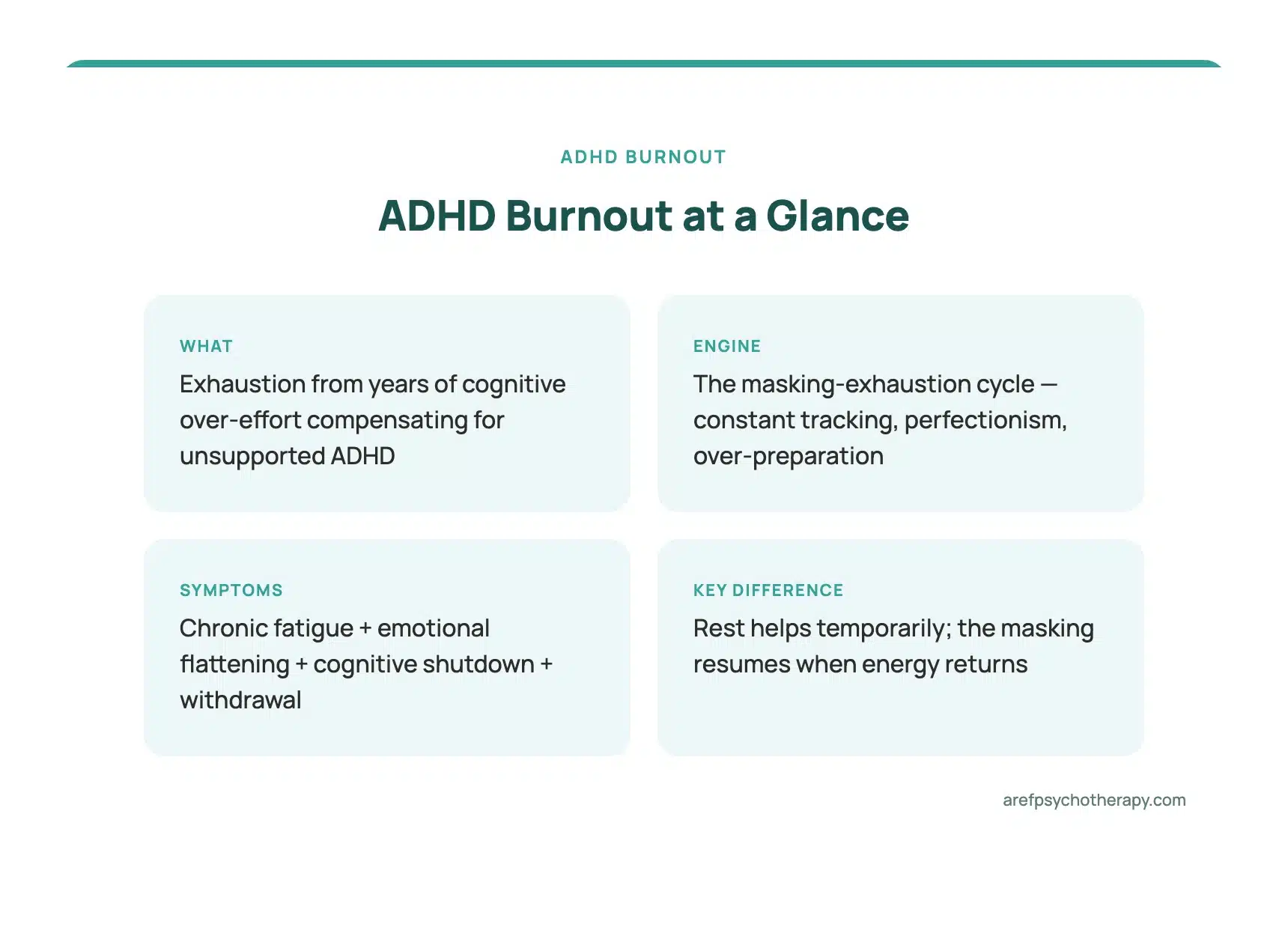
- ADHD burnout is the response to the cumulative cognitive cost of compensating for unsupported ADHD — masking, over-preparation, perfectionism, constant tracking. Rest helps temporarily but the masking resumes when energy returns.
A useful test: when you rest for a long weekend, does the exhaustion lift? Regular burnout usually responds to rest. ADHD burnout often does not — the rest is consumed by anxiety about everything that is undone, and the compensation begins again the moment you return.
The masking-exhaustion cycle — the engine of ADHD burnout

Most adults with undiagnosed ADHD develop an elaborate compensation system without realising it. The cycle goes:
Stage 1 — Mask. You hide ADHD traits. You produce rigid systems to prevent missed deadlines, missed appointments, missed details. You over-prepare for things that should not need that much preparation. You perform competence at home, at work, and in relationships.
Stage 2 — Exhaust. The masking takes enormous cognitive fuel. By 5 p.m. you have nothing left for your family. By the end of the work week you have nothing left for friends. By the end of the month you cannot remember the last time you felt rested.
Stage 3 — Rupture. Something breaks. A missed deadline. A forgotten birthday. A reactive parenting moment. An RSD spike that explodes a relationship. The rupture confirms the underlying fear: “I knew I was about to be exposed.”
Stage 4 — Re-mask. You recover with even harder masking. You build more rigid systems. You promise yourself you will not let it happen again. You restart the cycle.
Over years this produces the picture clinicians call ADHD burnout. It is also why high-functioning adults with undiagnosed ADHD often only discover the pattern after a complete collapse. Until that point, the masking has been working — at enormous internal cost.
If the masking part of this cycle sounds especially familiar, our rejection sensitive dysphoria guide explores how the emotional layer drives masking even harder.
Signs of ADHD burnout

You may notice some of these patterns. None alone confirms ADHD burnout. Several together, especially after years of high-functioning compensation, are worth a clinical conversation.
- Decision fatigue at trivial scales — choosing dinner feels impossibly hard
- Cognitive shutdown after work — you can function professionally but cannot reply to a text message at 7 p.m.
- Crying at small things that would not have moved you a year ago
- Increased reliance on caffeine, sugar, or substances to start the day
- Sleep dysregulation — sleeping more but not feeling rested, or sleeping less because your brain will not settle
- Withdrawal from the things you used to love — hobbies abandoned, friends not called back
- Physical exhaustion that rest does not fix — chronic muscle tension, low-grade illness, frequent infections
- A persistent sense of “I cannot keep going like this” combined with not knowing what to change
- Resentment at the level of effort you have been expending that no one else has noticed
- Rage or despair at the prospect of one more month of compensating
If five or more of these are present and have been persisting for months, the picture is worth taking seriously. Our integrated ADHD assessment and therapy is built for exactly this presentation.
ADHD burnout in women — the most common presentation
The clinical pattern is not gender-specific, but the demographic concentration is striking. Adult women — particularly high-achieving professionals, mothers, and women in caretaker roles — present with ADHD burnout disproportionately. Several factors drive this:
- Gendered expectations of competence and emotional labour — the cultural script is “she holds everything together”
- Late ADHD diagnosis — many women are first diagnosed after a child is assessed, often well into their 30s or 40s
- Perimenopausal hormonal shifts — estrogen modulates dopamine; as estrogen declines, ADHD symptoms intensify and previously-working coping strategies stop being enough
- Caretaker overload — the household executive function load is enormous and tends to fall disproportionately on women
- Compensatory perfectionism that hides the ADHD — successful masking delays the diagnosis until collapse
The 2025 BMC Women’s Health integrative review on ADHD across women’s lifespan (Krebs and Donnellan-Fernandez) maps the developmental progression of these patterns. If you are a woman recognising yourself in this picture, our companion guide on ADHD in Women goes deeper.
ADHD burnout vs depression vs anxiety — the differential

These three present similarly enough that clinicians can miss the ADHD underneath. The differential matters because treatments differ.
- ADHD burnout is exhaustion from cognitive over-effort. Energy returns with rest but the masking returns with it. The relief is conditional.
- Depression is pervasive low mood and anhedonia. Energy does not return easily with rest. The relief from sleep is minimal.
- Anxiety disorder is hyperarousal and catastrophic thinking. Restlessness is anticipatory (“something bad is coming”). Treatment with CBT or anxiety medication produces clear improvement.
- ADHD with comorbid anxiety or depression is the most common picture — the ADHD or anxiety question goes into the diagnostic distinction in depth.
A skilled clinical assessment screens for all of these together. Treating burnout alone, depression alone, or anxiety alone in an undiagnosed ADHD adult often produces partial relief that does not hold.
Why traditional burnout advice does not work for ADHD
The standard burnout playbook fails for ADHD burnout in specific ways:
- “Take a vacation” — the vacation gets consumed by anxiety about everything that will be undone when you return. You come back exhausted from the vacation itself.
- “Set better boundaries” — saying no to one thing creates room for the brain to take on three more. Boundaries are a strategy that works after the ADHD is supported, not before.
- “Practise self-care” — generic self-care assumes you have the executive function to plan, schedule, and follow through on self-care. ADHD burnout is the absence of that capacity.
- “Build better routines” — your masking already built routines. The routines are part of what is exhausting you.
- “Mindfulness will help” — for ADHD brains specifically, mindfulness is harder to sustain. It can help, but it is not a primary intervention.
What does work is different: name the ADHD, support the regulation, reduce the masking gradually, and rebuild from a system that works WITH your brain rather than against it.
What actually works — recovery for ADHD burnout

Evidence-based recovery has three threads, often running in parallel.
1. Clinical assessment first. A formal ADHD assessment from a Nurse Practitioner clarifies what you are dealing with. The diagnosis is not a label — it is the framework that makes the rest of recovery efficient. Without it, you keep treating downstream symptoms.
2. Trauma- and emotion-focused therapy — particularly:
- CBT for adult ADHD — restructures the catastrophic narratives (“I am lazy,” “I have to keep performing”) that drive the masking
- ACT (Acceptance and Commitment Therapy) — defuses from the perfectionism trap, builds values-based action instead of fear-based action
- Somatic and nervous-system work — for the chronic activation in the body
- EMDR when there is layered trauma underneath the burnout — common in women whose ADHD masking grew up alongside relational trauma
3. Practical recalibration — sleep, exercise, structured rest, reducing the masking load in low-stakes contexts first. Plus, where appropriate, medication options discussed with our Nurse Practitioner.
A typical recovery arc is 4–6 months for noticeable improvement and 12–18 months for sustained change. The pace is set by how deep the masking has gone and what other patterns (anxiety, depression, trauma) are layered.
We also coordinate with WSIB and Extended Health Benefit coverage where applicable. For workplace-related cases that include trauma exposure, our Workplace PTSD coverage guide explains the relevant Ontario WSIB framework.
What to do this week
Five concrete steps if ADHD burnout sounds like your experience:
- Write down what you are masking. Phone note. List the things you compensate for every day — checking, re-checking, over-preparing, performing. Naming the compensation makes it visible.
- Track one week of energy. Note when you feel rested, when you feel depleted, what activities cost the most. Patterns emerge in writing that are invisible in memory.
- Talk to one trusted person about what you noticed. Saying it out loud breaks the secrecy that keeps the masking alive.
- Stop one low-stakes act of masking. Tell one friend you are running late instead of staying up to over-prepare. Notice what happens.
- Book a free 15-minute consultation if you want to map a recovery plan. Self-management has limits; clinician-supported recovery is meaningfully faster.
Key takeaways

Ready to take the next step?
Our team at AREF Psychotherapy offers integrated ADHD care across Canada — assessment, therapy designed for the masking-exhaustion cycle, and a calm, virtual-first model. Book a free 15-minute consultation and we will map the right starting point together.
Book a Free Consultation · Call 437-830-2088
Frequently asked questions
This article is for informational purposes only and does not replace professional mental health advice. If you are in crisis, please contact Canada’s 9-8-8 Suicide Crisis Helpline by calling or texting 9-8-8. If you are in immediate danger, call 911.
Reviewed by the clinical team at AREF Psychotherapy — Registered Psychotherapists and a Nurse Practitioner (CNO Extended Class) serving clients across Canada.
What is ADHD burnout, exactly?
ADHD burnout is the exhaustion that follows years of cognitive over-effort compensating for unsupported ADHD — masking traits, over-preparing, maintaining rigid systems to prevent ADHD-related mistakes. It looks like regular burnout but has a different mechanism: the engine is the masking, not the workplace itself. Recovery requires naming and supporting the underlying ADHD, not just rest.
Is ADHD burnout the same as regular burnout?
No. Regular burnout responds to rest, workload adjustment, and role changes. ADHD burnout often does not — the masking resumes as soon as energy returns. The mechanisms differ: regular burnout is downstream of chronic workplace stress; ADHD burnout is downstream of years of cognitive compensation for an unsupported regulation deficit.
How long does ADHD burnout recovery take?
A typical arc is 4–6 months for noticeable improvement and 12–18 months for sustained change. The pace depends on how deeply the masking has gone and what other patterns (anxiety, depression, trauma) are layered. Working with a clinician who knows ADHD specifically tends to shorten the timeline meaningfully.
Will my insurance cover ADHD burnout treatment?
Most employer Extended Health Benefit plans cover sessions with Registered Psychotherapists. Coverage for Nurse Practitioner ADHD assessment varies — Health Spending Accounts often reimburse it. Provincial plans like OHIP do not cover private psychotherapy or private NP services. Please call your insurer before booking to confirm what your plan includes.
Can I recover from ADHD burnout without medication?
Yes. Many adults recover from ADHD burnout through psychotherapy, lifestyle recalibration, and reducing the masking load — without medication. Some choose to add medication discussed with a Nurse Practitioner; both pathways are valid. The question of medication is a clinical conversation, not a prerequisite for starting treatment.
Sources and further reading
Every claim in this article is grounded in peer-reviewed research, regulatory guidance, or named Canadian authorities. For deeper reading:
Peer-reviewed research
- Soler-Gutiérrez, A.-M., Pérez-González, J.-C., & Mayas, J. (2023). Evidence of emotion dysregulation as a core symptom of adult ADHD: A systematic review. PLOS One. Systematic review of 22 studies.
- Krebs, K., & Donnellan-Fernandez, R. (2025). Integrative literature review — the impact of ADHD across women’s lifespan. BMC Women’s Health.
- Fu, X., et al. (2025). Adult ADHD and comorbid anxiety and depressive disorders. Frontiers in Psychiatry.
Clinical guidelines
- National Institute for Health and Care Excellence (NICE). NG87: ADHD diagnosis and management
Canadian health authorities
Regulators
Crisis support
Related reading on AREF Psychotherapy