
If you’ve been in a car accident in Ontario and you’re struggling with anxiety, flashbacks, trouble sleeping, or just not feeling like yourself — you’re not alone. And if the cost of therapy is what’s holding you back, there’s something important you should know: your car insurance almost certainly covers therapy after an accident, regardless of who was at fault.
Most people have no idea this coverage exists. They assume therapy is an out-of-pocket expense, or that their auto insurance only covers physical treatments like physiotherapy. That’s not the case. Ontario’s auto insurance system is designed to cover psychotherapy, counselling, and psychological services — and you may not have to pay a single dollar upfront.
Here’s everything you need to know about accessing therapy through your accident benefits, explained in plain language.
The Short Answer — Yes, Your Auto Insurance Covers Therapy
In Ontario, every auto insurance policy includes something called Statutory Accident Benefits (SABs). These benefits cover medical and rehabilitation expenses after a car accident — and that includes psychotherapy, counselling, and psychological assessments.
Here’s what makes this different from your regular health coverage:
- It’s separate from OHIP. OHIP doesn’t cover psychotherapy with registered psychotherapists. Your auto insurance does.
- It’s separate from your workplace benefits. You don’t need to use your extended health plan. Your auto insurer covers MVA-related therapy directly.
- It applies regardless of fault. Even if you caused the accident, you’re still entitled to accident benefits through your own insurance.
- You don’t need to sue anyone. This isn’t about a lawsuit. It’s about benefits that are already built into your auto insurance policy.
Ontario operates under what’s called a “no-fault” system for accident benefits. That doesn’t mean nobody was at fault for the crash. It simply means you deal with your own insurance company — not the other driver’s — to access treatment.
What Is the Statutory Accident Benefits Schedule (SABS)?
The Statutory Accident Benefits Schedule — or SABS — is part of Ontario Regulation 34/10 under the Insurance Act. In simple terms, it’s a set of rules that every auto insurer in Ontario must follow. It spells out the minimum benefits your insurance company has to provide if you’re injured in a car accident.
These benefits cover a range of needs, including income replacement if you can’t work, attendant care if you need personal support, and — most relevant here — medical and rehabilitation benefits. Psychotherapy, counselling, and psychological assessments all fall under this category.
Think of SABS as a safety net that’s already woven into your car insurance. You’ve been paying for it this whole time. If you’ve been in an accident and you’re struggling emotionally, now is the time to use it.
How Much Therapy Coverage Do You Get?
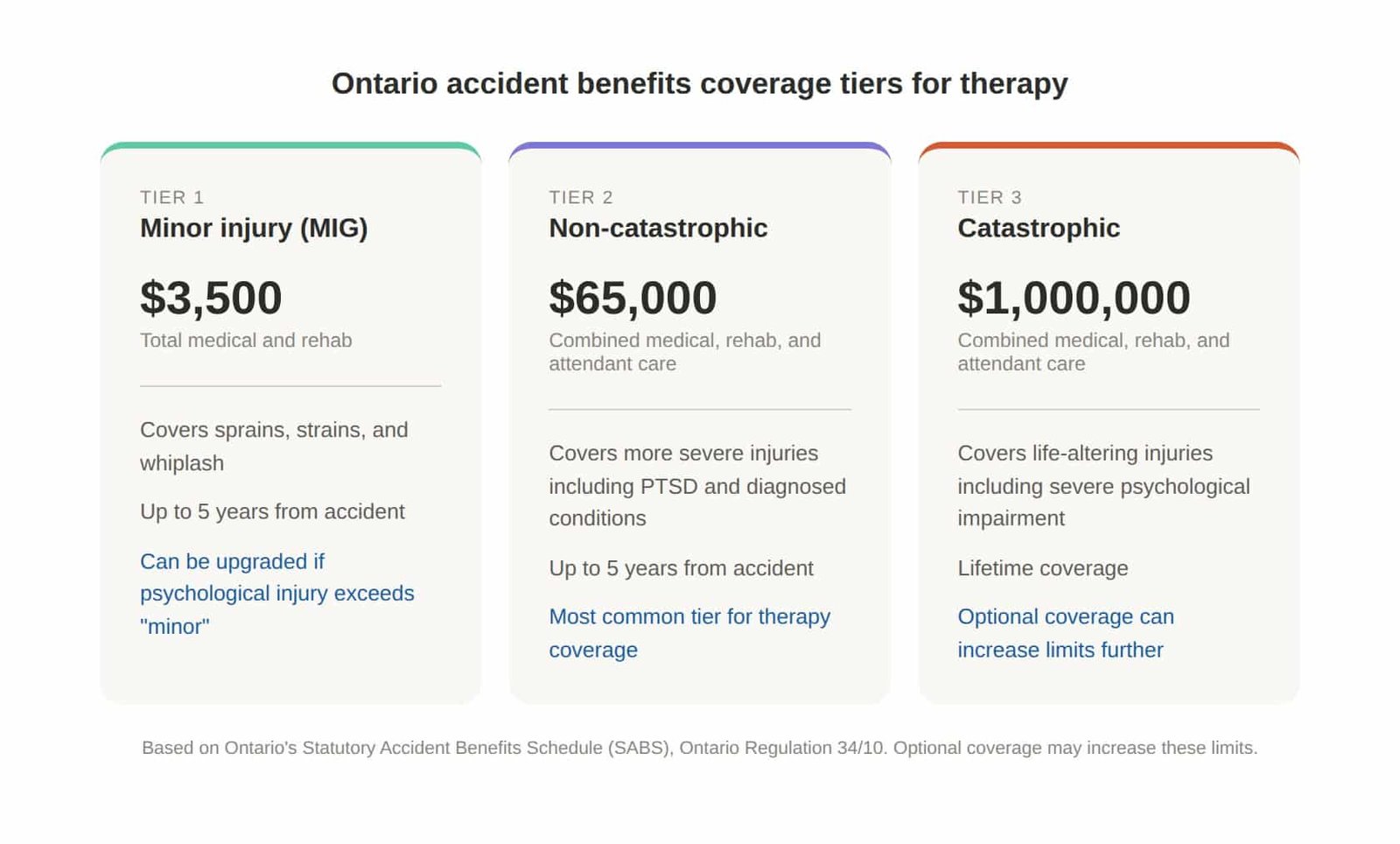
The amount of coverage you’re entitled to depends on how your injuries are classified. Ontario’s system groups injuries into three tiers, and each tier comes with different limits.
Minor Injury Guideline (MIG) — $3,500
If your injuries are classified as “minor” — typically soft tissue injuries like sprains, strains, and whiplash — your total medical and rehabilitation coverage is capped at $3,500. This includes all treatments, not just therapy.
Here’s the important thing to know: psychological injuries can be removed from the Minor Injury Guideline. If your therapist or psychologist determines that your emotional or psychological symptoms go beyond what’s considered “minor” — for example, if you’re diagnosed with PTSD, a specific phobia, or a major depressive episode caused by the accident — they can submit clinical evidence to have your file moved to the non-catastrophic tier. This opens the door to significantly more coverage.
Non-catastrophic injuries — $65,000
For injuries that go beyond “minor” but aren’t life-altering, the combined limit for medical, rehabilitation, and attendant care benefits is $65,000 over five years from the date of the accident. This is the tier where most people receiving ongoing trauma and PTSD treatment after a car accident will land.
This amount can cover a significant course of therapy — often more than enough for a full treatment plan.
Catastrophic impairment — $1,000,000
For the most severe injuries, including severe psychological impairment, the standard combined limit increases to $1,000,000 over your lifetime. This tier is less common but important to know about.
A note on optional coverage: Many Ontario drivers purchase optional accident benefit coverage that increases these limits — for example, raising the non-catastrophic limit to $130,000 or the catastrophic limit to $2,000,000. Check your policy or call your insurance broker to find out exactly what you have.
The July 1, 2026 reform: what’s different now
If you were in an accident on or after July 1, 2026, Ontario’s reformed accident benefits rules apply — and one change directly affects how your therapy gets paid.
Auto insurance now pays first. The first-payer rule was reversed: your auto insurer is now the first payer for eligible medical and rehabilitation expenses, psychological treatment included, rather than you having to run the cost through a workplace or private health plan first. Medication still coordinates through other plans.
The core coverage is unchanged. Medical, rehabilitation and attendant care benefits remain mandatory on every policy, with the combined limits described above. Most other accident benefits are now optional and must be chosen at purchase or renewal — and those optional benefits now extend only to the named insured, spouse, dependants and listed drivers.
Approval rules haven’t loosened: insurers can still request evidence and decline treatment they don’t consider reasonable and necessary, so a well-documented treatment plan still matters. See the Insurance Bureau of Canada summary of the changes.
What Types of Therapy Are Covered?
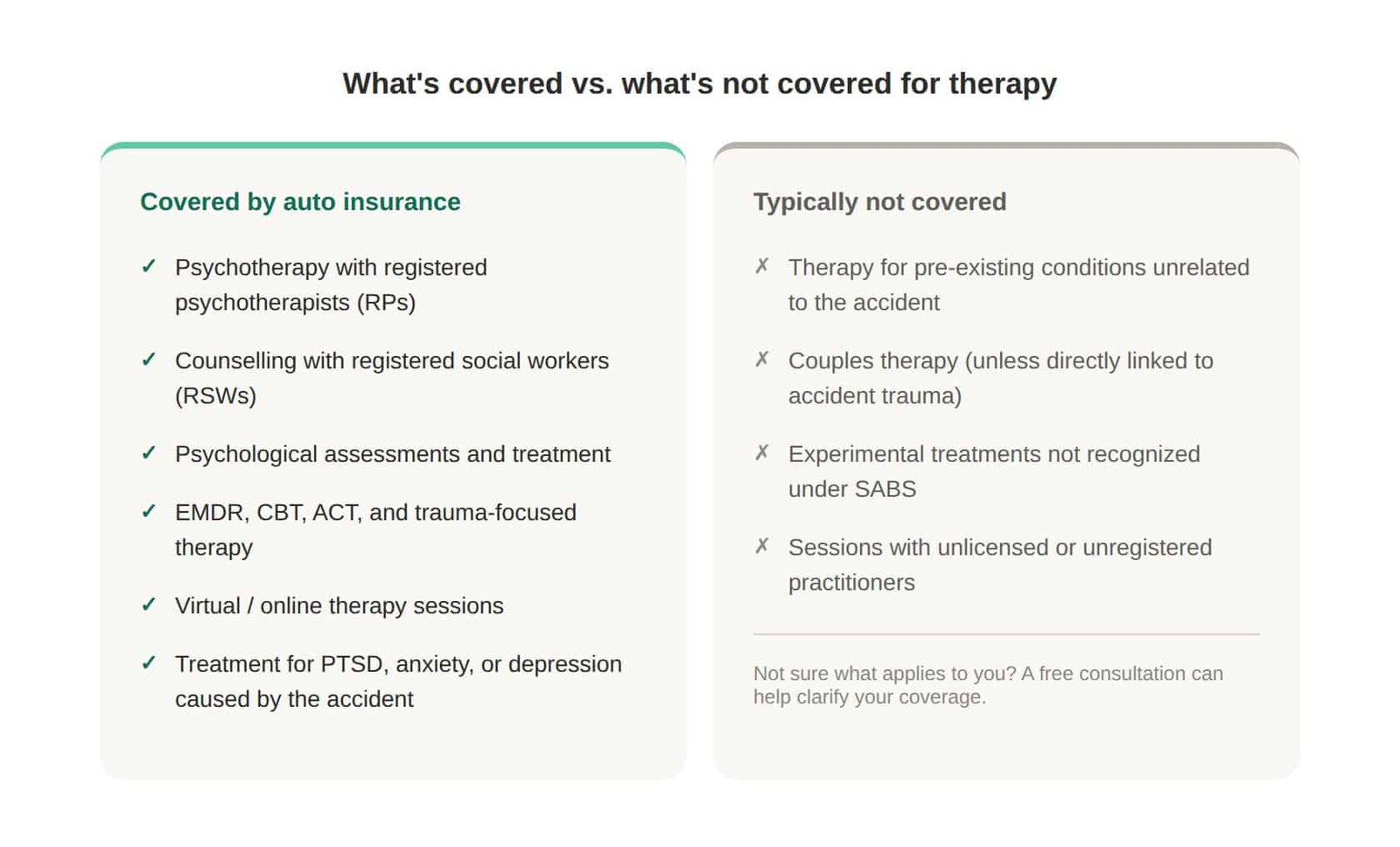
Ontario’s accident benefits cover a range of mental health services, including:
- Psychotherapy with registered psychotherapists (RPs)
- Counselling with registered social workers (RSWs)
- Psychological assessments and treatment with registered psychologists
- Psychiatric assessment and treatment with psychiatrists
The specific therapy modalities covered include evidence-based approaches like Cognitive Behavioural Therapy (CBT), EMDR therapy (Eye Movement Desensitization and Reprocessing), Acceptance and Commitment Therapy (ACT), and other trauma-focused treatments. These are the same modalities that research has shown to be most effective for car accident-related PTSD, anxiety, and depression.
Virtual therapy is an eligible format. You don’t need to attend sessions in person. This is especially helpful if you’re experiencing a fear of driving after your accident — a common and treatable condition — or if you live in a part of Ontario without easy access to a trauma-specialised therapist.
At Aref Psychotherapy, our team offers virtual MVA therapy across Canada. If you’re in Ontario, your auto insurance may cover the cost of your sessions. If you’re curious whether this applies to your situation, our team offers free consultations to help you figure out the right fit.
How to Access Therapy Through Your Accident Benefits — Step by Step
The process can feel overwhelming when you’re already dealing with the stress of an accident. Here’s the good news: it’s simpler than it looks, and most therapy clinics handle the paperwork for you.
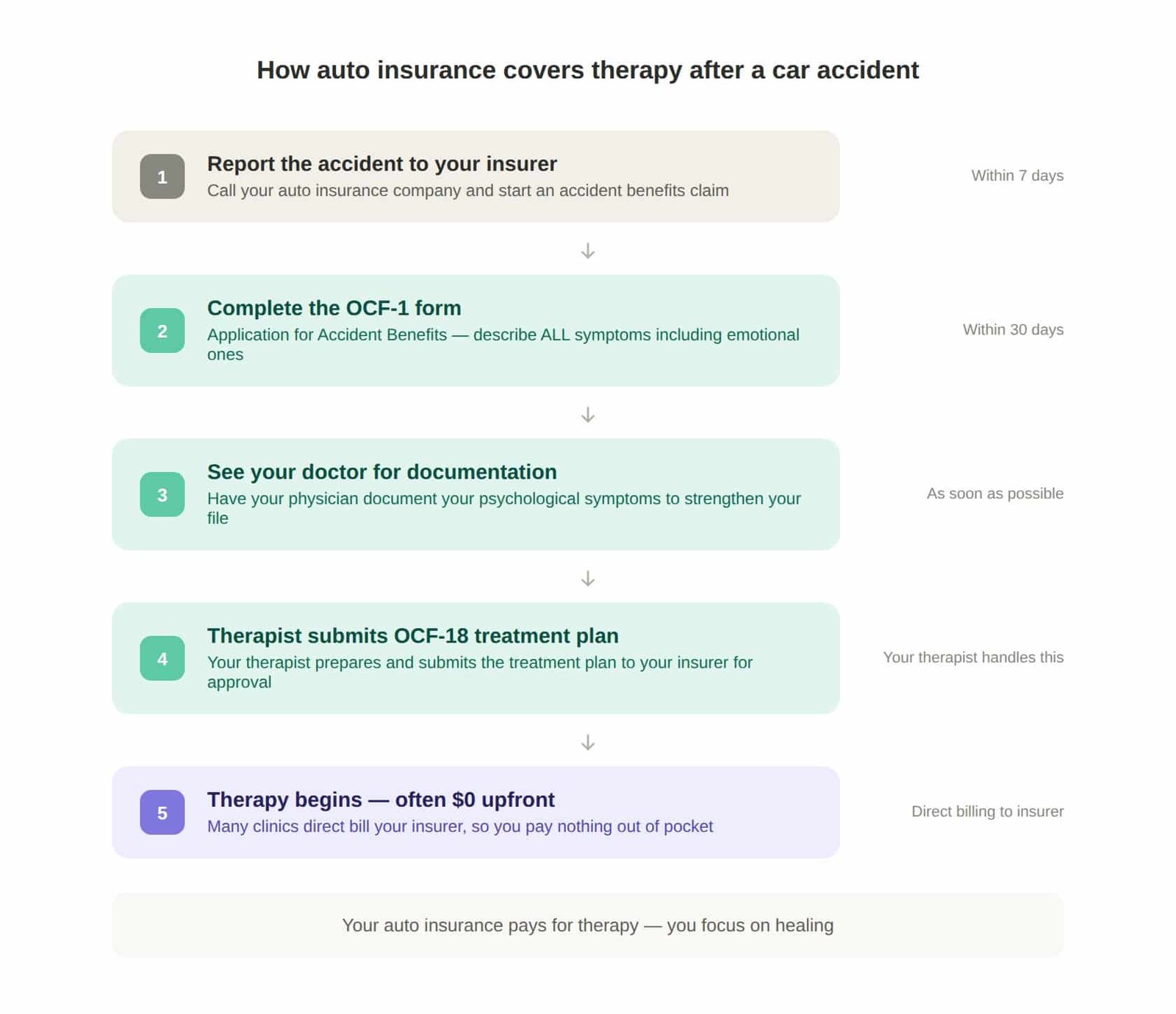
Step 1 — Report the accident to your insurer. Call your auto insurance company as soon as possible after the accident — ideally within seven days. Let them know you were injured and want to file an accident benefits claim. They’ll give you a claim number and send you paperwork.
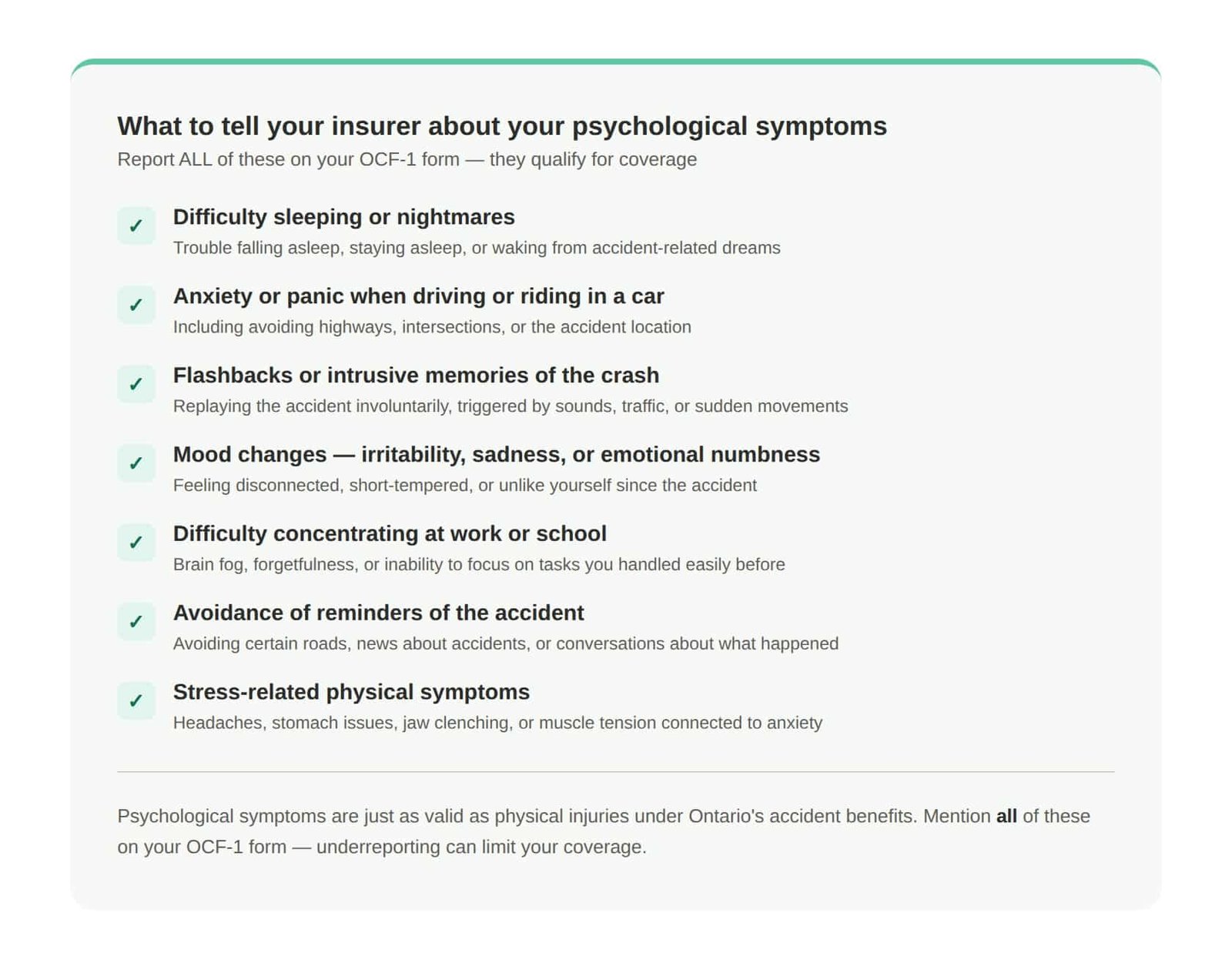
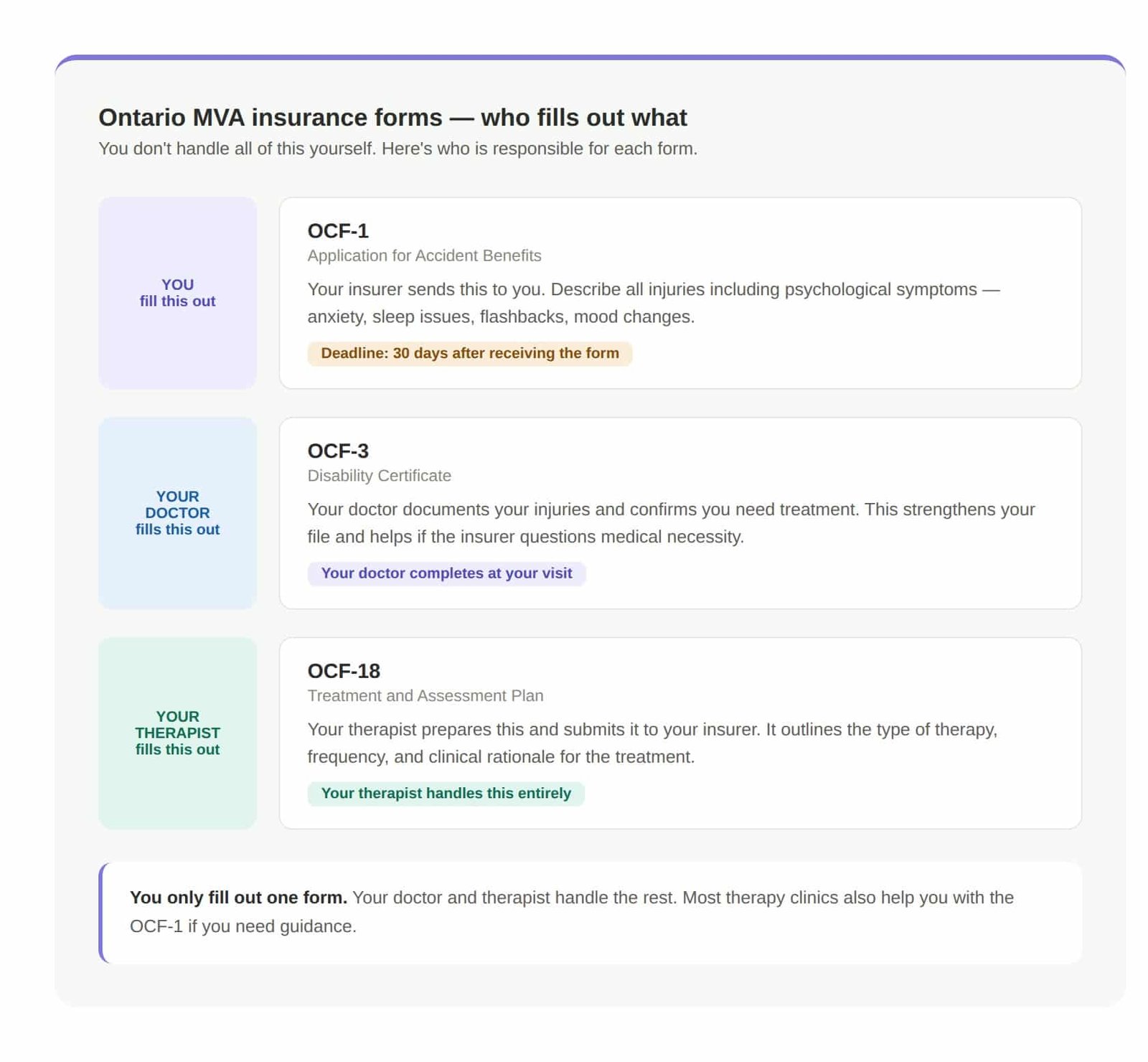
Step 2 — Complete the OCF-1 form. The OCF-1 is the standard Ontario application for accident benefits. Your insurer will send it to you. Fill it out completely, and make sure to describe all your symptoms — including emotional ones like anxiety, trouble sleeping, flashbacks, or mood changes. These are just as important as physical symptoms. You have 30 days to submit this form.
Step 3 — See your doctor and document your symptoms. Visit your family doctor or a walk-in clinic and let them know you’re experiencing psychological symptoms after the accident. You don’t technically need a doctor’s referral to see a psychotherapist in Ontario, but having your symptoms documented by a physician strengthens your file and helps avoid delays with your insurer.
Step 4 — Your therapist submits a treatment plan. Once you connect with a therapist, they’ll complete an OCF-18 — a treatment and assessment plan — and submit it to your auto insurer. This outlines the therapy you need, how often, and why. The insurer reviews and approves it.
Step 5 — Therapy begins. Once approved, your therapy sessions can start. Many clinics offer direct billing to your auto insurer, which means you pay nothing out of pocket. Your job is to focus on getting better. Your therapist handles the rest.
Do I Need a Referral to Start Therapy After a Car Accident?
No — you do not need a referral from a doctor to see a registered psychotherapist in Ontario. You can contact a therapy clinic directly and begin the process.
That said, it’s a good idea to visit your doctor anyway. Having a medical professional document your symptoms creates a paper trail that supports your insurance file. If your insurer ever questions whether your therapy is “medically necessary,” your doctor’s notes become valuable evidence.
Your therapist will also create clinical documentation as part of the OCF-18 treatment plan, which goes to your insurer. Between your doctor’s records and your therapist’s plan, you’ll have a strong foundation for your claim.
What If My Insurer Denies or Delays My Therapy?
Insurance companies sometimes push back on therapy claims. Here are the most common reasons and what you can do about them.
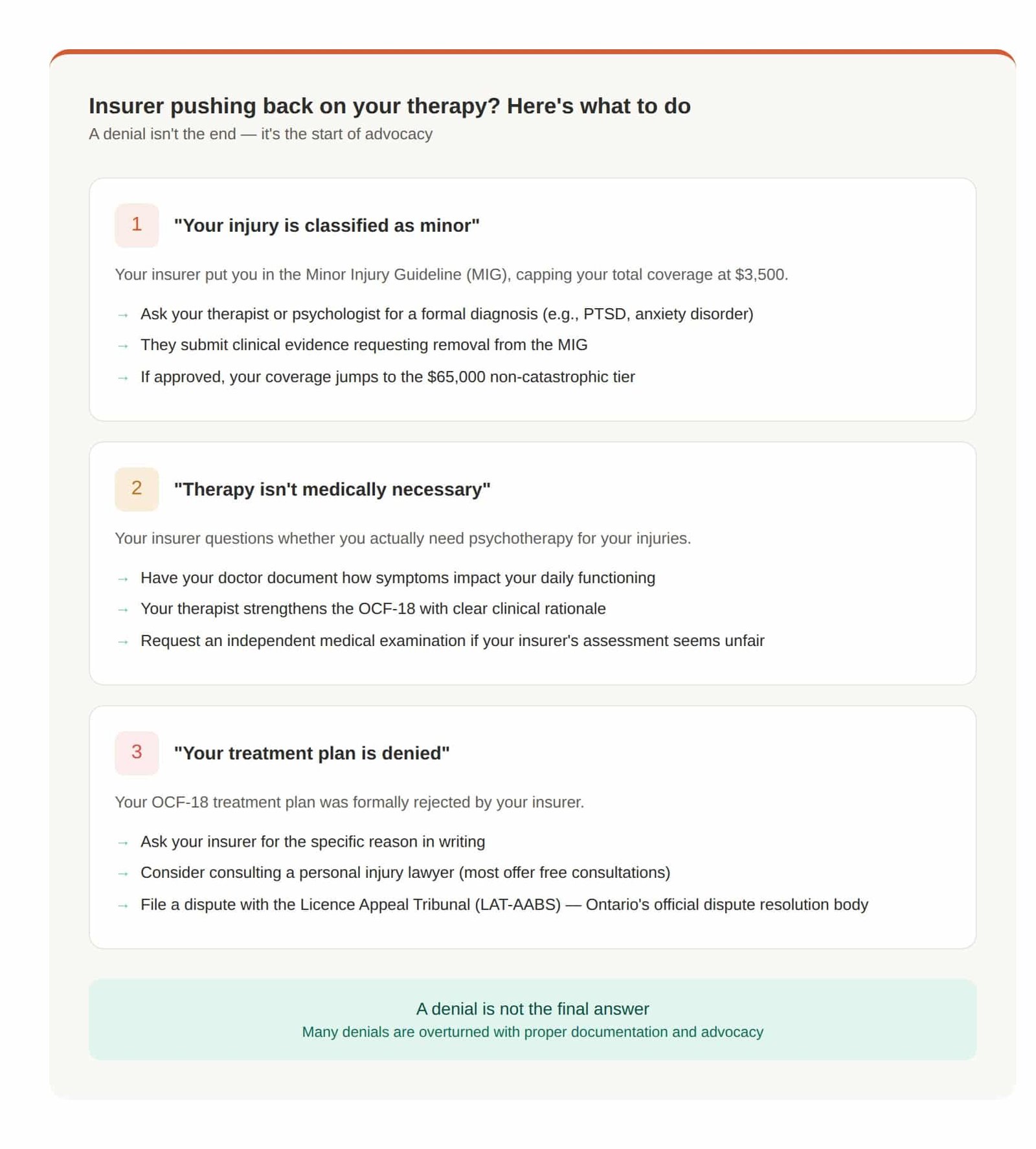
Your injury was classified as “minor.” If your psychological symptoms are grouped under the Minor Injury Guideline ($3,500 cap), your therapist or psychologist can submit clinical evidence — such as a formal diagnosis of PTSD or anxiety disorder — to have your file removed from the MIG. This moves you into the non-catastrophic tier with up to $65,000 in coverage.
Your insurer says therapy isn’t “medically necessary.” This is where strong documentation matters. Your therapist should clearly outline how your symptoms are connected to the accident, how they impact your daily functioning, and why the proposed treatment is appropriate. A referral from your doctor can also help.
Your treatment plan was denied. If your OCF-18 is denied, you have the right to dispute the decision. You can apply to the Licence Appeal Tribunal through Ontario’s Automobile Accident Benefits Service (AABS) to resolve the disagreement. Many people also work with a personal injury lawyer at this stage.
The most important thing to remember: a denial isn’t the end of the road. It’s a starting point for advocacy — and you don’t have to navigate it alone.
Important Changes Coming in July 2026
Ontario’s auto insurance system is undergoing reform. According to the Financial Services Regulatory Authority of Ontario (FSRA), as of July 2026, some accident benefits — such as income replacement and caregiver benefits — will become optional. Drivers will need to actively choose these coverages when purchasing or renewing their policies.
However, medical and rehabilitation benefits — including psychotherapy — will remain mandatory in every Ontario auto insurance policy. This means your therapy coverage after a car accident is not going away.
Still, it’s worth reviewing your policy with your broker to understand how these changes may affect your overall coverage. Being informed now means fewer surprises later.
You Don’t Have to Wait — Therapy Can Start Now
If you’ve been in a car accident and you’re dealing with anxiety, flashbacks, difficulty sleeping, fear of driving, or emotional numbness, you deserve support. And the cost shouldn’t be what stops you.
To recap what we’ve covered:
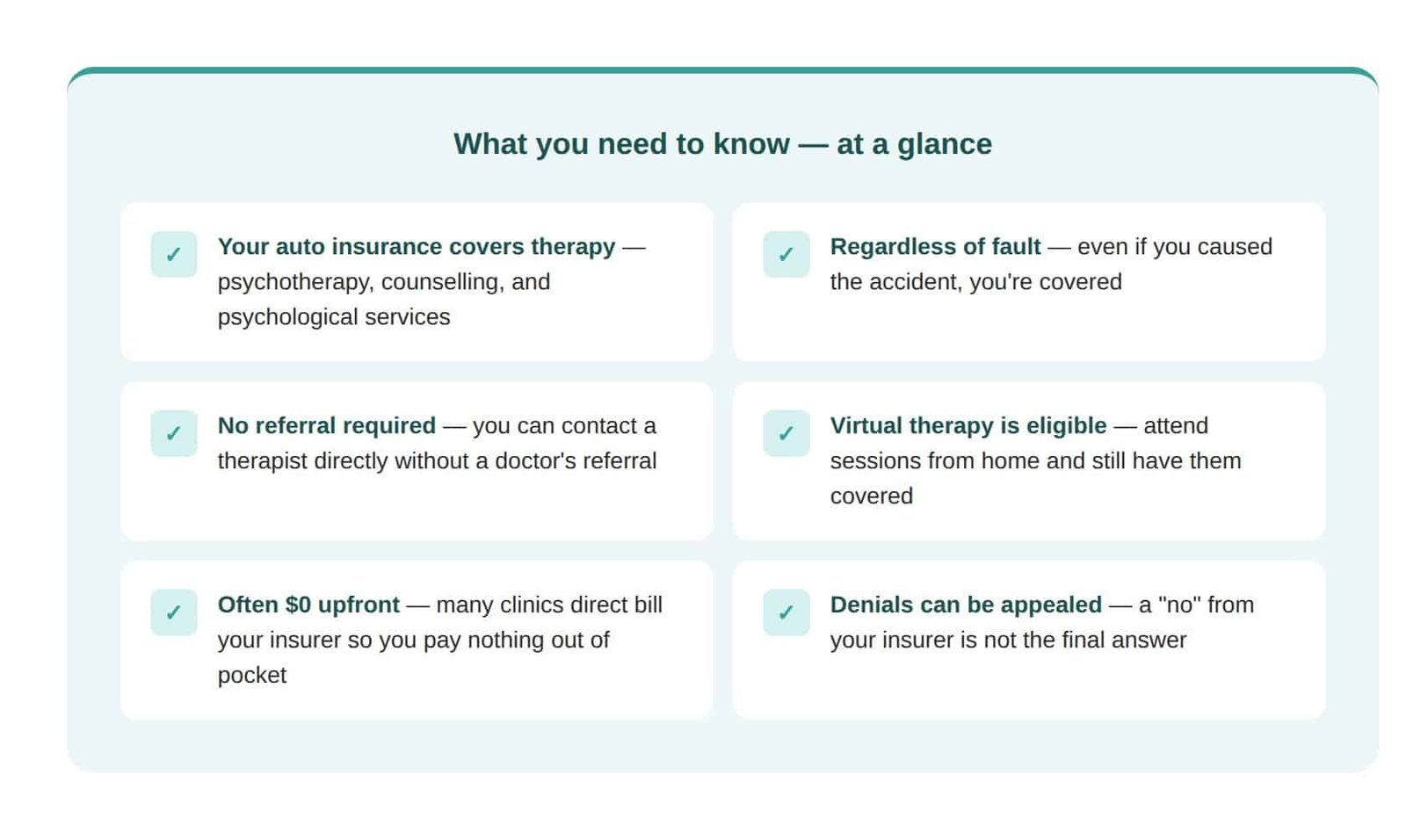
- Your Ontario auto insurance covers psychotherapy, counselling, and psychological services after a car accident.
- This coverage is available regardless of who was at fault.
- You don’t need a referral to see a psychotherapist.
- Many clinics offer direct billing, so you pay nothing out of pocket.
- If your claim is denied, you have options to appeal.
The biggest barrier for most people isn’t the insurance system. It’s simply not knowing this coverage exists. Now you know.
Does Ontario auto insurance cover virtual therapy after a car accident?
Yes. Virtual psychotherapy is an eligible format under Ontario's Statutory Accident Benefits Schedule. You can attend therapy sessions online from home and have them covered by your auto insurance, just as you would with in-person sessions. This is especially helpful if driving anxiety makes it difficult to attend appointments in person.
Can I get therapy even if the car accident was my fault?
Yes. Ontario uses a no-fault system for accident benefits, which means you access treatment through your own insurance company regardless of who caused the accident. Fault determination is a separate process that affects your premiums — it does not affect your right to receive therapy.
How long after the accident can I start therapy?
You can start therapy at any time after your accident, though starting sooner is generally better for your recovery. You should report the accident to your insurer within seven days and submit your OCF-1 application within 30 days. However, even if some time has passed since the accident, it's not too late to seek help and access your benefits.
Is psychotherapy covered under the Minor Injury Guideline?
Psychotherapy is covered under the MIG, but the total cap is $3,500 for all medical and rehabilitation services combined. If your psychological injury is more than "minor" — for example, a formal diagnosis of PTSD — your therapist can request that your file be moved out of the MIG to access up to $65,000 in coverage.
Do I pay anything out of pocket for MVA therapy in Ontario?
In many cases, no. Many therapy clinics offer direct billing to your auto insurer, meaning the insurer pays the clinic directly and you pay nothing upfront. However, this can depend on your specific insurance policy and the clinic's billing practices. Ask your therapist about direct billing options during your first consultation.
This article is for informational purposes only and does not replace professional mental health advice, legal counsel, or insurance guidance. If you’re in crisis, please contact Crisis Services Canada at 1-833-456-4566 or text 45645.
Ready to Take the Next Step?
Our team at Aref Psychotherapy offers virtual therapy across Canada. If you’ve been in a car accident and you’re struggling with the emotional aftermath, we’re here to help — and your auto insurance may cover the cost.
Book a free consultation to find out if your sessions are covered and to find the right therapist for you.