
Clinically informed. Sources cited from peer-reviewed neuroscience and trauma research.
If you keep reliving the accident in your mind—seeing it happen, feeling the impact, hearing the sounds—you are not going crazy. You are not weak. Your brain is doing exactly what it was built to do.
The bad news: flashbacks after a car crash are one of the most distressing psychological experiences a person can have. They are intrusive, exhausting, and feel impossible to control.
The good news: they are a well-understood response to trauma, they serve a specific neurological purpose, and there are highly effective, evidence-based techniques for reducing and eventually eliminating them. In this guide, you’ll learn exactly why your brain creates flashbacks after a crash—and precisely what to do about them.
What Is a Flashback After a Car Accident?
Definition
A flashback is an involuntary, vivid re-experiencing of a traumatic event that feels as though it is happening in the present moment, not as a memory of the past. Flashbacks are a core symptom of Post-Traumatic Stress Disorder (PTSD) and can include visual images, sounds, smells, physical sensations, or overwhelming emotions from the original event.
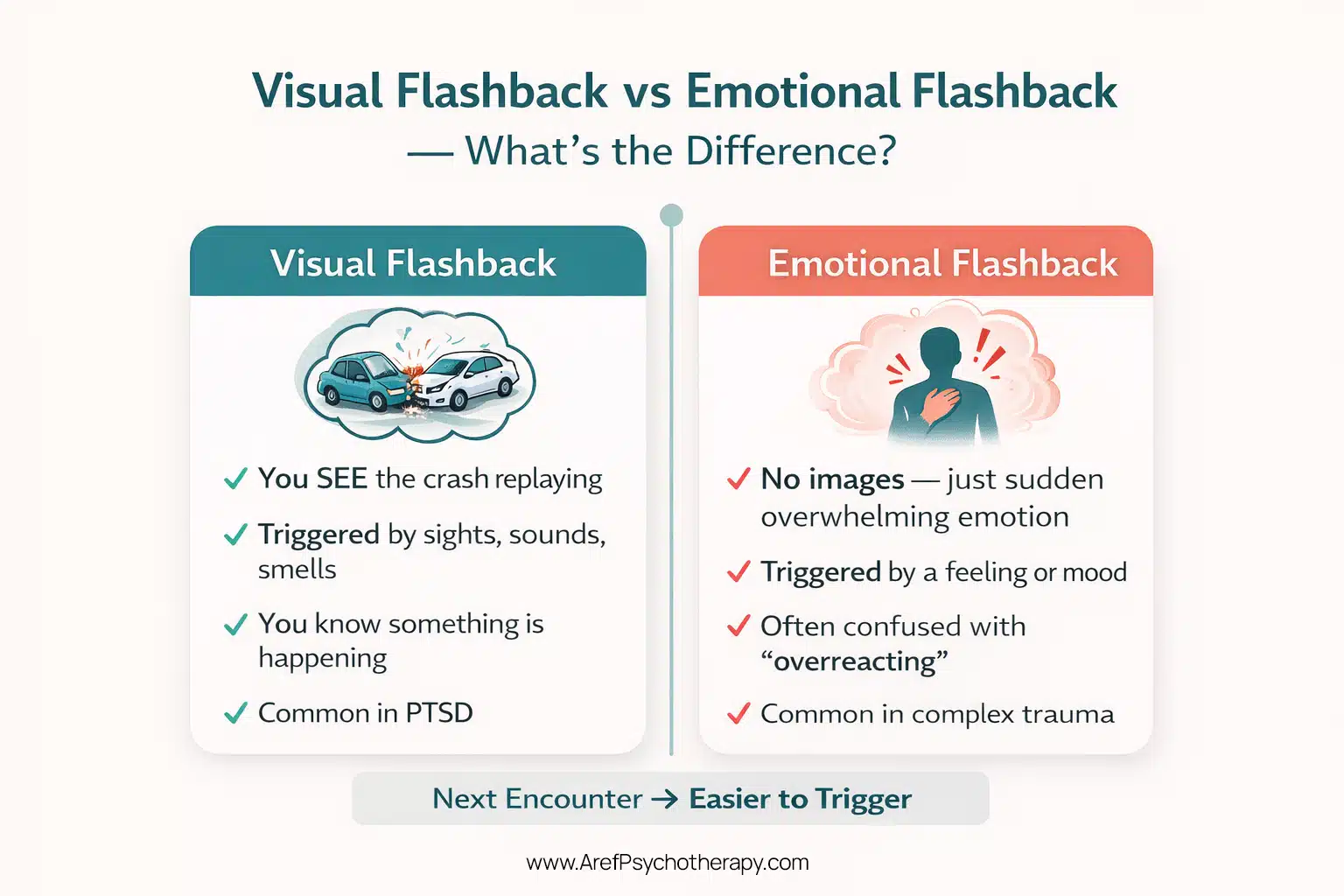
It’s important to distinguish between two types of flashbacks that car accident survivors often experience:
Visual / Sensory Flashbacks
The most recognized form—vivid mental replays where you see, hear, or physically feel the crash occurring again. Many survivors describe these as more “real” than ordinary memories, with the brain treating them as happening now rather than then.
Emotional Flashbacks
These are less recognized but equally distressing. In an emotional flashback, the specific images of the crash may not be present, but you are suddenly flooded with the exact emotional state of the accident—terror, helplessness, panic—triggered by something in your environment, often without understanding why. These are especially common when the crash involved extreme helplessness or loss of control.
The Neuroscience: Why Your Brain Creates Flashbacks
Understanding the biology of flashbacks is genuinely reassuring. Here’s what actually happens:
The Role of the Amygdala and Hippocampus
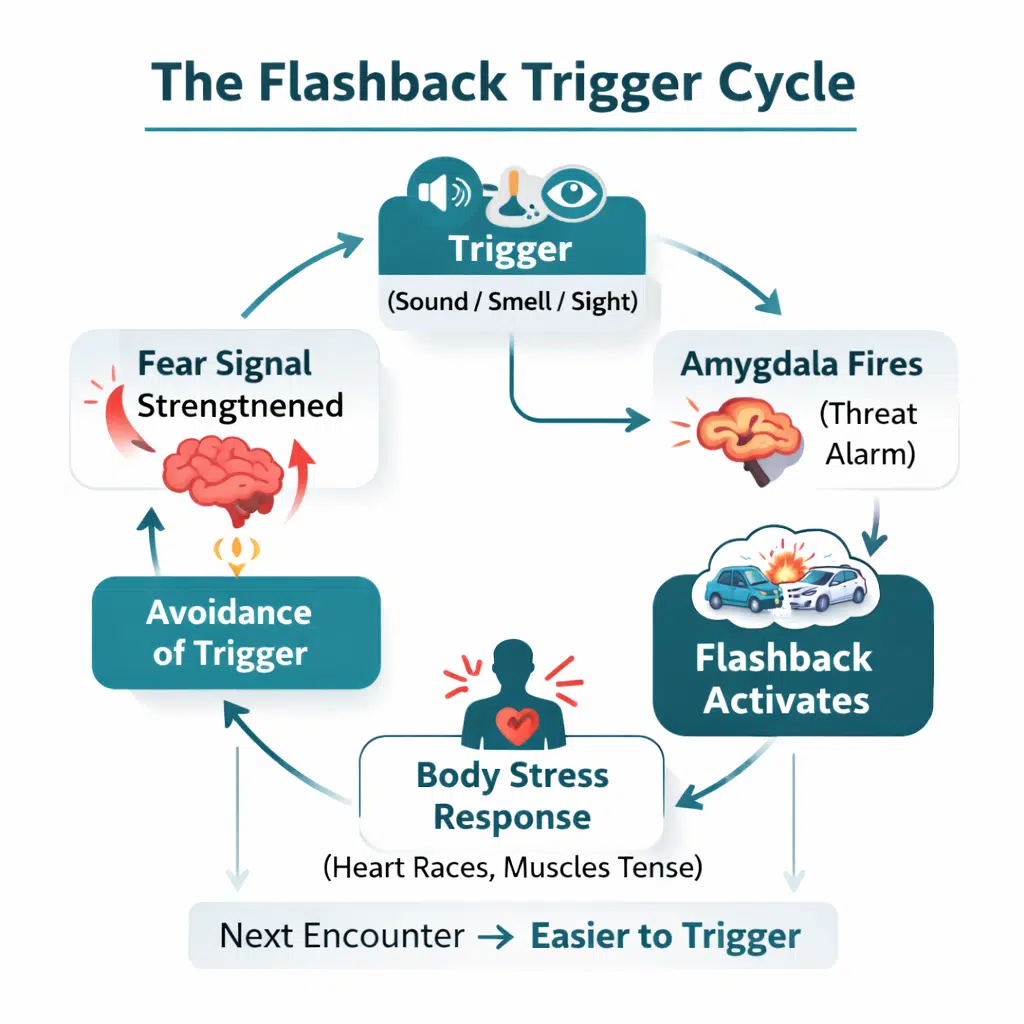
During a traumatic event like a car crash, two brain regions come into conflict. The amygdala—your brain’s alarm system—fires at full intensity, branding the emotional intensity of the moment into your threat-detection system. Meanwhile, the hippocampus—responsible for time-stamping memories and placing them in the past—is flooded with stress hormones and doesn’t function effectively.
The result: your brain stores a deeply emotional record of the crash, but fails to properly “file” it as a completed past event. This is why flashbacks feel present-tense. Without the hippocampus successfully tagging the memory as over, the amygdala treats every reminder as a signal that the threat is happening again right now.

The Trigger Mechanism
Because the crash memory was never fully encoded as past, virtually any sensory input associated with the accident can “unlock” it: the sound of brakes, a similar intersection, the smell of gasoline, rain on a windshield, the color of a specific car. When the amygdala detects these associations, it re-triggers the full emotional and physiological crash response—flooding your body with stress hormones even though you’re safe.
Key Insights
Flashbacks are not a character flaw or a sign of mental weakness. They are a predictable consequence of how traumatic events are neurologically encoded during extreme stress. Your brain was protecting you during the crash—and it’s still trying to protect you now, even when that protection is no longer needed.
Common Flashback Triggers After a Car Accident
Triggers vary by person and by the specific circumstances of the crash. Common categories include:
Visual Triggers
- The crash site or similar intersections
- The type or color of vehicle involved in the crash
- Deployed airbags, broken glass, or emergency vehicles
- Weather conditions matching the day of the accident (rain, darkness, fog)
- News footage or social media videos of car accidents
Auditory Triggers
- Screeching tires or braking sounds
- Impact or collision sounds
- Emergency sirens
- Horns or sudden loud traffic noise
Olfactory Triggers
- Gasoline or motor oil
- Burnt rubber
- Hospital or antiseptic smells
Situational Triggers
- Being a passenger when someone else is driving
- Driving at high speed or on highways
- Being in traffic or at the specific location of the crash
- Physical sensations resembling the impact (turbulence on a plane, amusement rides)
Evidence-Based Techniques to Cope With Flashbacks
1. Grounding — The 5-4-3-2-1 Method
Grounding pulls your nervous system out of the flashback and back into the present. The most evidence-supported technique uses your five senses in the moment:
- Name 5 things you can see right now
- Name 4 things you can physically touch
- Name 3 things you can hear
- Name 2 things you can smell
- Name 1 thing you can taste
By forcing your brain to engage with present-moment sensory input, you interrupt the flashback cycle and give the hippocampus real-time information that contradicts the threat signal.
2. The STOP Technique
- S — Stop what you’re doing immediately
- T — Take a slow breath. Inhale for 4 counts, hold for 4, exhale for 6.
- O — Observe your surroundings. Where are you? What is actually around you?
- P — Proceed with intention. Choose a grounding statement: “I am [name]. I am safe. The accident is over. I am in [location].”
3. Safe Place Visualization
Developed within trauma therapy, this technique involves building a detailed mental image of a place—real or imagined—where you feel completely safe. When flashbacks begin, you mentally travel to that place, engaging all your senses to inhabit it. With practice, this becomes a reliable interrupt for intrusive memories.
4. Name the Flashback
When a flashback begins, saying aloud or internally: “This is a flashback. I am not in danger. My brain is replaying a past event. I am safe now.” This sounds simple but is neurologically significant—it activates the prefrontal cortex (rational brain) and begins to counterbalance the amygdala’s alarm response.
5. Professional EMDR Therapy
Eye Movement Desensitization and Reprocessing (EMDR) is the gold-standard clinical treatment specifically designed to eliminate PTSD flashbacks. A trained therapist guides you through brief exposures to traumatic memories while simultaneously engaging bilateral stimulation (eye movements, taps, or tones). Research shows EMDR significantly reduces flashback frequency and intensity, often in fewer sessions than traditional talk therapy.
6. Cognitive Processing Therapy (CPT)
CPT helps you identify and challenge the stuck points—the unhelpful beliefs that keep trauma active, such as “I should have done something differently” or “The world is never safe.” By processing these beliefs systematically, the emotional charge attached to traumatic memories diminishes, reducing flashback frequency.

When to Seek Professional Help for Flashbacks
Quick Answer
Seek professional evaluation if flashbacks occur more than once a week, persist longer than one month, are worsening in frequency or intensity, or significantly disrupt sleep, work, or daily functioning. Flashbacks that include thoughts of self-harm require immediate professional support.
Many people feel embarrassed or resistant to seeking help for flashbacks—they minimize them as “just thoughts” or worry about appearing weak. This is exactly the stigma that keeps people suffering unnecessarily. Flashbacks are a neurological injury, and they respond to treatment. Most people who receive appropriate care see dramatic reduction in flashback frequency within weeks to months.
How AREF Psychotherapy Can Help
If you’re struggling with the mental or emotional aftermath of a car accident, you don’t have to navigate it alone. Aref Psychotherapy is a Canadian-registered psychotherapy practice, offering specialized trauma-informed care for motor vehicle accident (MVA) survivors — entirely online, available across Canada, and covered under MVA insurance programs.
Services Available for Car Accident Survivors:
- Motor Vehicle Accident (MVA) Psychological Support — covered by your auto insurance
- PTSD Treatment — using CBT, EMDR, and Cognitive Processing Therapy (CPT)
- Driving Anxiety & Phobia Recovery — structured exposure-based programs
- Flashback and Intrusive Memory Reduction — EMDR-focused therapy
- Depression & Emotional Numbing After Crashes — individual and group options
- Survivor Guilt Processing — Acceptance and Commitment Therapy (ACT)
- Sleep Disruption Therapy — integrated into trauma treatment plans
- Child & Adolescent MVA Recovery — age-appropriate trauma therapy for young survivors
Ready to Start Your Recovery?
Book a free 15-minute consultation with an AREF therapist. We’ll match you with the right specialist, handle your MVA paperwork, and guide you through every step of recovery — at your pace.