
Reviewed by the AREF Psychotherapy team
The crash is behind you. The car has been fixed or replaced, the bruises have faded, and people have stopped asking how you are. But you still feel flat, tired and not like yourself. Things you used to enjoy feel like too much work, and you can’t quite explain why.
You are not imagining it. Depression after a car accident is a recognized response to what you went through, and it can be treated. Ontario’s Centre for Addiction and Mental Health (CAMH) names being in a car accident as one kind of traumatic experience, and it calls trauma a major risk factor for depression.
This guide explains why depression can follow a crash, the signs to watch for, how it differs from everyday stress and from PTSD (post-traumatic stress disorder), what helps, and how to get support in Ontario.
Can a car accident cause depression?
Yes, it can. CAMH describes a traumatic experience as any negative experience that deeply affects a person, and it lists trauma, major life changes and stress among the risk factors for depression. A crash can bring all three at once.
Emotional after-effects are common. A Canadian study followed people treated in three British Columbia emergency departments after a crash. More than 1 in 5 (22.4 per cent) reported PTSD symptoms two months later, and 16.2 per cent reported them at 12 months (Momenyan and colleagues, 2025). PTSD and depression are different conditions, but they often show up together. In an Australian study of 284 adults with crash injuries who had made an insurance claim, about 1 in 5 (20.8 per cent) met the criteria for more than one condition at six months, such as PTSD together with depression or anxiety (Kenardy and colleagues, 2018).
Depression after a crash is not a sign of weakness. It is a health condition, and it deserves care just like your physical injuries.
Why depression can follow a crash
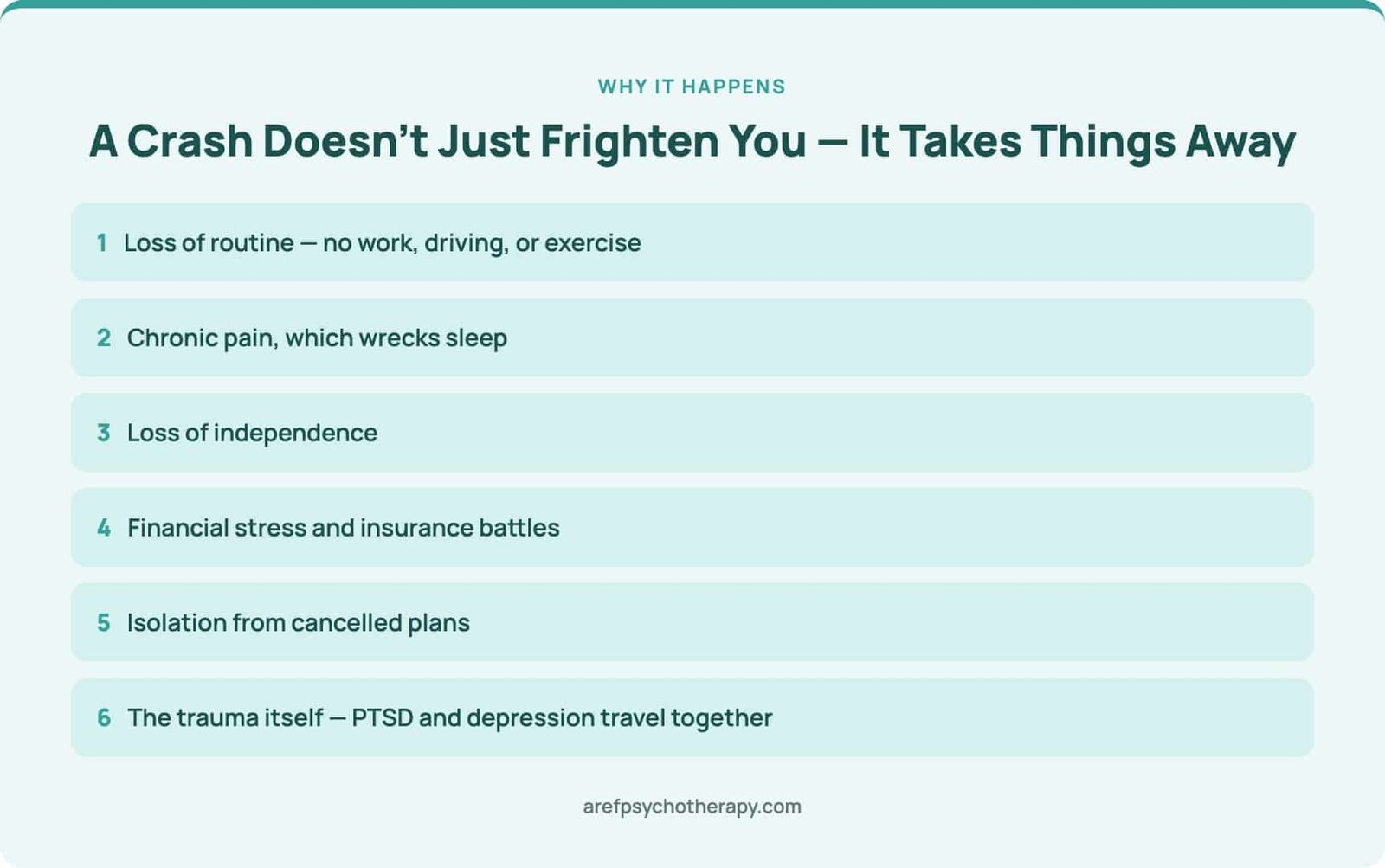
A crash can take things away from you, and loss is hard on mood. Several pressures can pile up at once:
- Loss of routine. You may not be able to work, drive, exercise or see people the way you used to.
- Pain that disrupts sleep. Health Canada’s Canadian Pain Task Force says living with unmanaged pain can lead to sleeplessness, hopelessness, depression and anxiety.
- Loss of independence. Needing rides or help at home can wear down how you see yourself.
- Money worries and insurance claims. Lost income and paperwork can add stress every day.
- Isolation. Cancelled plans and more time at home can cut you off from the people who usually lift you up.
- The trauma itself. CAMH notes that depression is common in people with PTSD.
Pain, sleep and mood can feed each other. Pain keeps you awake, poor sleep drains your energy, and with less energy you do less and feel more alone. The Living Concussion Guidelines, written for people recovering from a concussion, describe the same link: sleep problems can make a person feel depressed, and treating the sleep problem is likely to help with mood. None of this is a character flaw. It is a cycle, and a cycle can be interrupted.
Signs of depression after a car accident
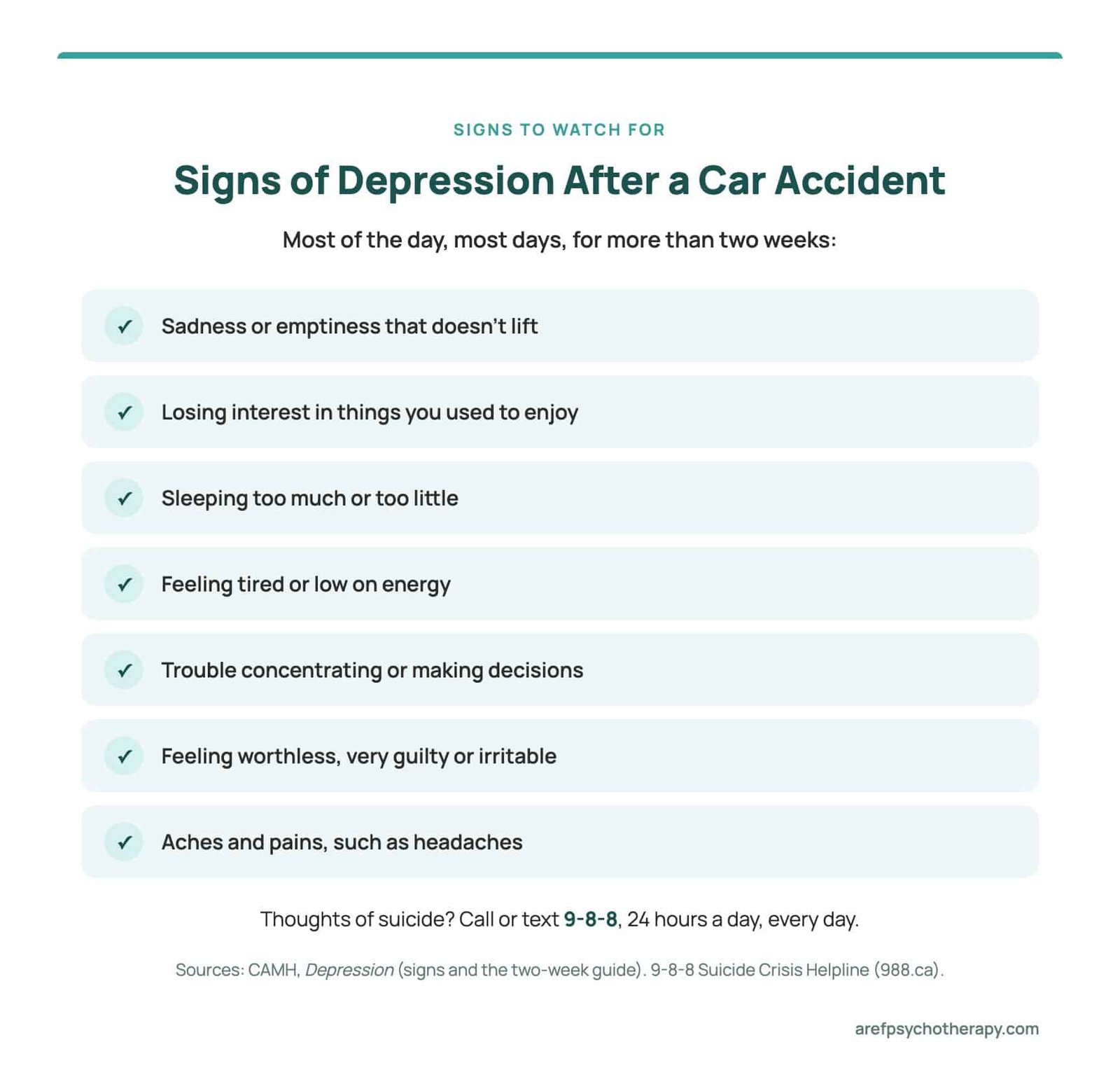
Feeling low for a few days after a crash is common. CAMH says someone may have depression when symptoms are there most days, last for most of the day, persist for more than two weeks and get in the way of work, school or relationships. Signs can include:
- Sadness or emptiness most of the day, nearly every day
- Losing interest in things you used to enjoy
- Sleeping too much or too little
- Feeling tired or low on energy
- Trouble concentrating or making decisions
- Changes in appetite or weight
- Feeling worthless, very guilty or irritable
- Aches and pains, such as headaches or stomach pain
- Thoughts of death or suicide
You don’t need to have every sign. If several sound familiar and they have lasted more than two weeks, talk to your family doctor, a nurse practitioner or a therapist.
If you are having thoughts of suicide or of harming yourself, please reach out now. Call or text 9-8-8, the 9-8-8 Suicide Crisis Helpline. Someone is there to talk 24 hours a day, every day of the year. If your safety is at risk right now, call 9-1-1.
Normal low mood, depression or PTSD?
After a crash, a normal stress reaction, depression and PTSD can look alike, and they can overlap. Here is how they tend to differ.
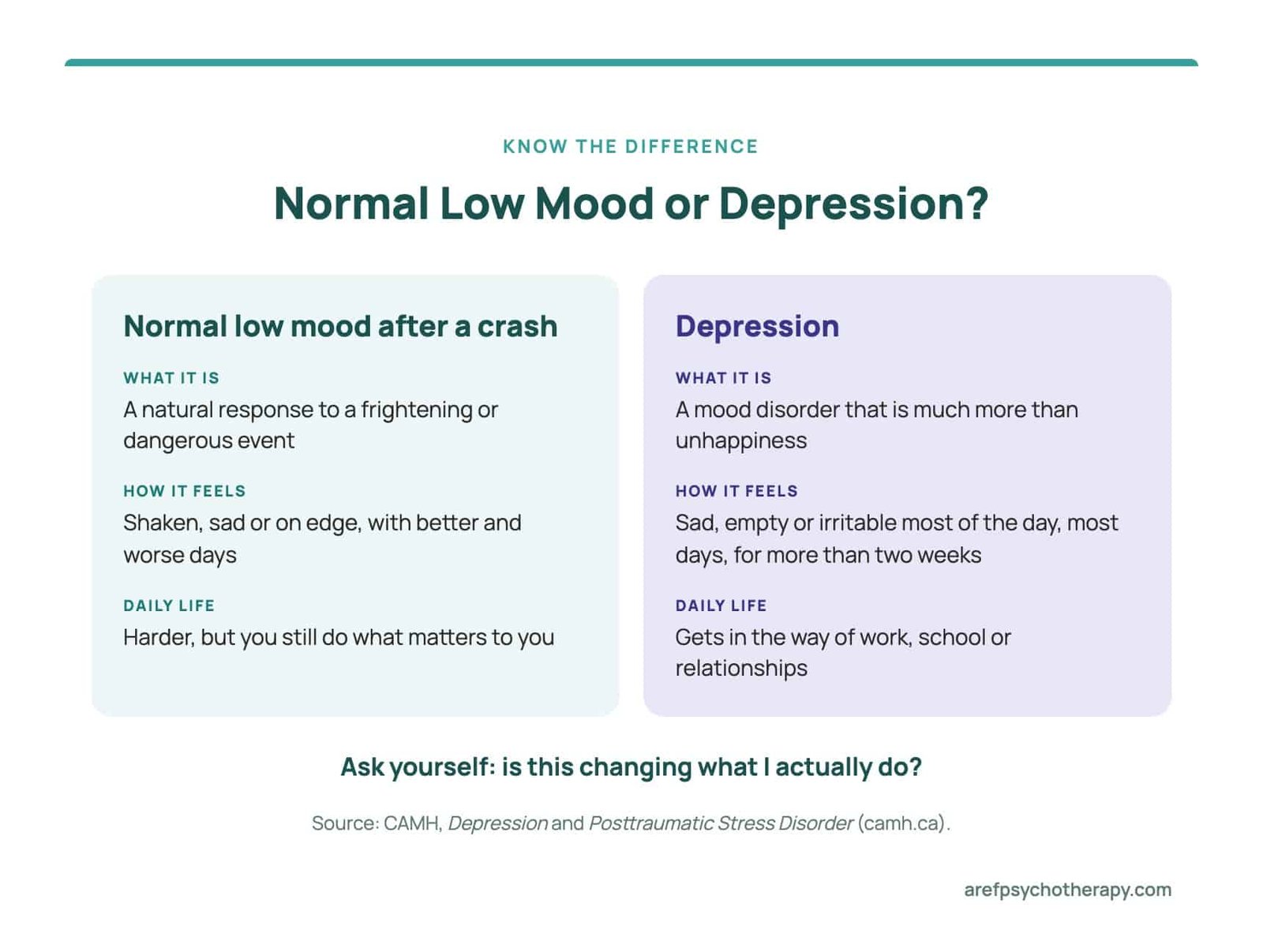
A normal stress reaction. CAMH describes strong emotions after a frightening or dangerous event as a natural response. You may feel shaken, tearful or on edge. The concern is when these feelings seriously affect your life long after the danger has passed.
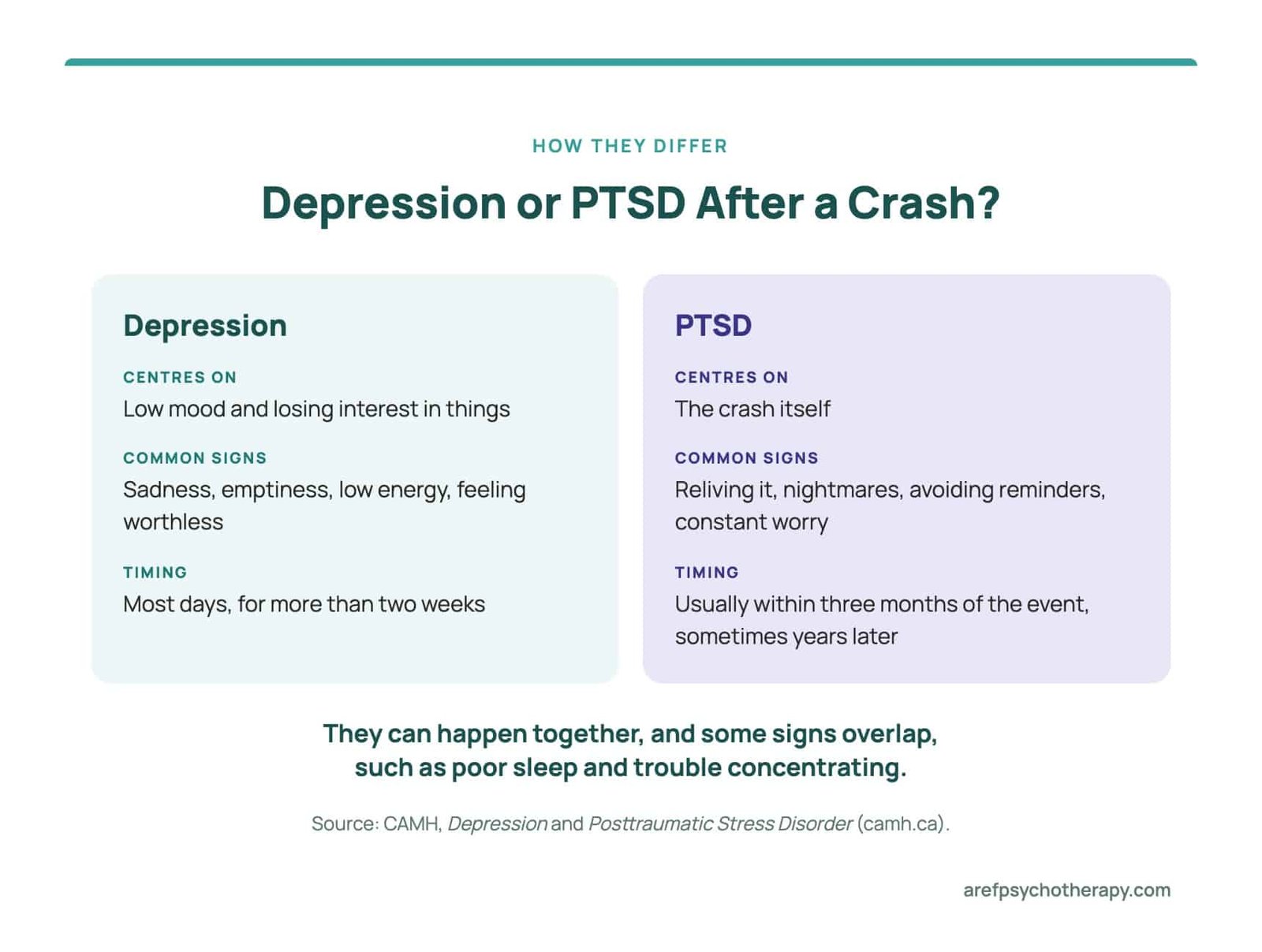
Depression. The heaviness stays most of the day, most days, for more than two weeks, and it starts to shrink your life. You may cancel plans or stop doing things, not because you are too sore, but because you can’t find a reason to. A simple question can help: is this changing what I actually do?
PTSD. PTSD centres on the crash itself. CAMH’s guide to PTSD lists signs such as reliving the event, nightmares, staying away from reminders, constant worry and getting angry easily. It says PTSD usually appears within three months of the event, but sometimes symptoms appear years later. Our guide to PTSD after a car accident covers it in more depth.
The lines can blur. CAMH lists losing interest in activities, trouble concentrating and trouble sleeping among the signs of PTSD too. The picture can also change: in the Australian study, the diagnosis changed between check-ups for about 4 in 10 people (42.3 per cent). That is one reason it helps to talk to a professional rather than label it yourself.
If someone was hurt, or you lost something important such as your job or your confidence on the road, some of what you feel may be grief. Grief and depression can overlap, and both deserve support. For a wider look at anxiety, PTSD and other reactions, see our broader guide to mental health after a car accident.
Why depression after a crash can be missed
Depression after a crash is easy to miss, for a few reasons:
- The focus is on your body. Appointments can centre on your neck, back or concussion, and no one may ask how you are sleeping.
- PTSD can be easier to spot. Flashbacks and fear of driving stand out, so the low mood underneath gets less attention.
- Many people blame themselves. They think they should be over it by now, so they don’t mention it.
The researchers behind the B.C. study make the same point: recovery after a crash often focuses on physical healing and can overlook PTSD, anxiety and depression. CAMH reports that in a 2016 survey, 40 per cent of respondents had felt anxious or depressed but never sought medical help for it. A concussion can also blur the picture. The Living Concussion Guidelines say mental health symptoms such as depression and anxiety are common after a concussion, and that they might only show up over time. Tell your family doctor or nurse practitioner about all of your symptoms, including your mood and sleep.
If this sounds like you, you don’t have to sort it out alone. Book a free consultation with our intake team to talk about what you’re going through and find a therapist who fits.
What helps with depression after a crash
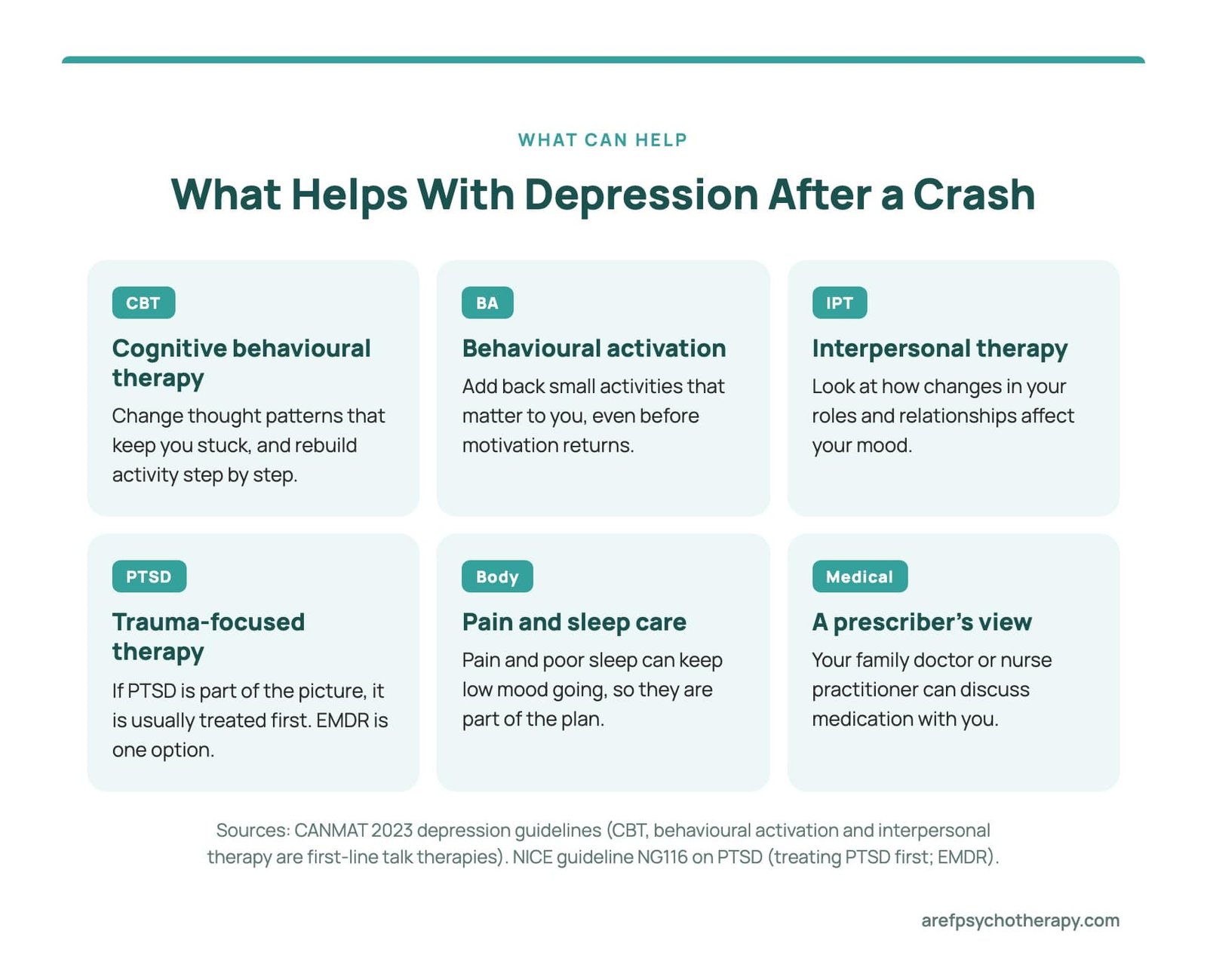
CAMH notes that depression can be treated, and that treatment can include counselling and individual or group therapy. Canada’s depression guidelines, from the Canadian Network for Mood and Anxiety Treatments (CANMAT, 2023), name three talk therapies as first-line psychological treatments, which means the guideline recommends them as a first choice:
- Cognitive behavioural therapy (CBT) helps you notice and change thought patterns that keep you stuck, such as “I’ll never get back to normal,” and slowly rebuild your activities. Learn more about cognitive behavioural therapy (CBT).
- Behavioural activation is a short therapy that changes how you spend your days by adding back small activities that matter to you, even before your motivation returns.
- Interpersonal therapy (IPT) looks at how changes in your relationships and roles, such as being off work, affect your mood.
CANMAT also notes that CBT appears to work in different formats, including individual, group and telephone or digital sessions. That can help if pain or fear of driving makes travel hard.
If PTSD is part of the picture. The UK’s National Institute for Health and Care Excellence (NICE) PTSD guideline says that when someone has both PTSD and depression, the PTSD is usually treated first, because the depression often improves when PTSD treatment works. If the depression is severe, or there is a risk of harm, the depression is treated first. NICE recommends EMDR (eye movement desensitization and reprocessing) as one option for adults with PTSD after a non-combat trauma, such as a crash. EMDR is a structured therapy that works step by step with distressing memories of the event. Learn more about EMDR therapy.
Pain and sleep care. Pain and poor sleep can keep low mood going, so managing them is part of the plan. In the B.C. study, injury pain was linked to PTSD symptoms at every check-up, and the researchers suggest that early pain management and psychological support may help ease those symptoms.
A medical check-in. Medication is something a prescriber, such as your family doctor or a nurse practitioner, can discuss with you. CANMAT says treatment choices should be made together with you, based on how severe the depression is, your preferences and what is available.
What therapy looks like. Therapy for depression after a crash is practical. You and your therapist might map out what you have stopped doing since the crash, rebuild it in small steps and problem-solve real obstacles, such as pain, transport, money or your claim.
Small steps you can take this week
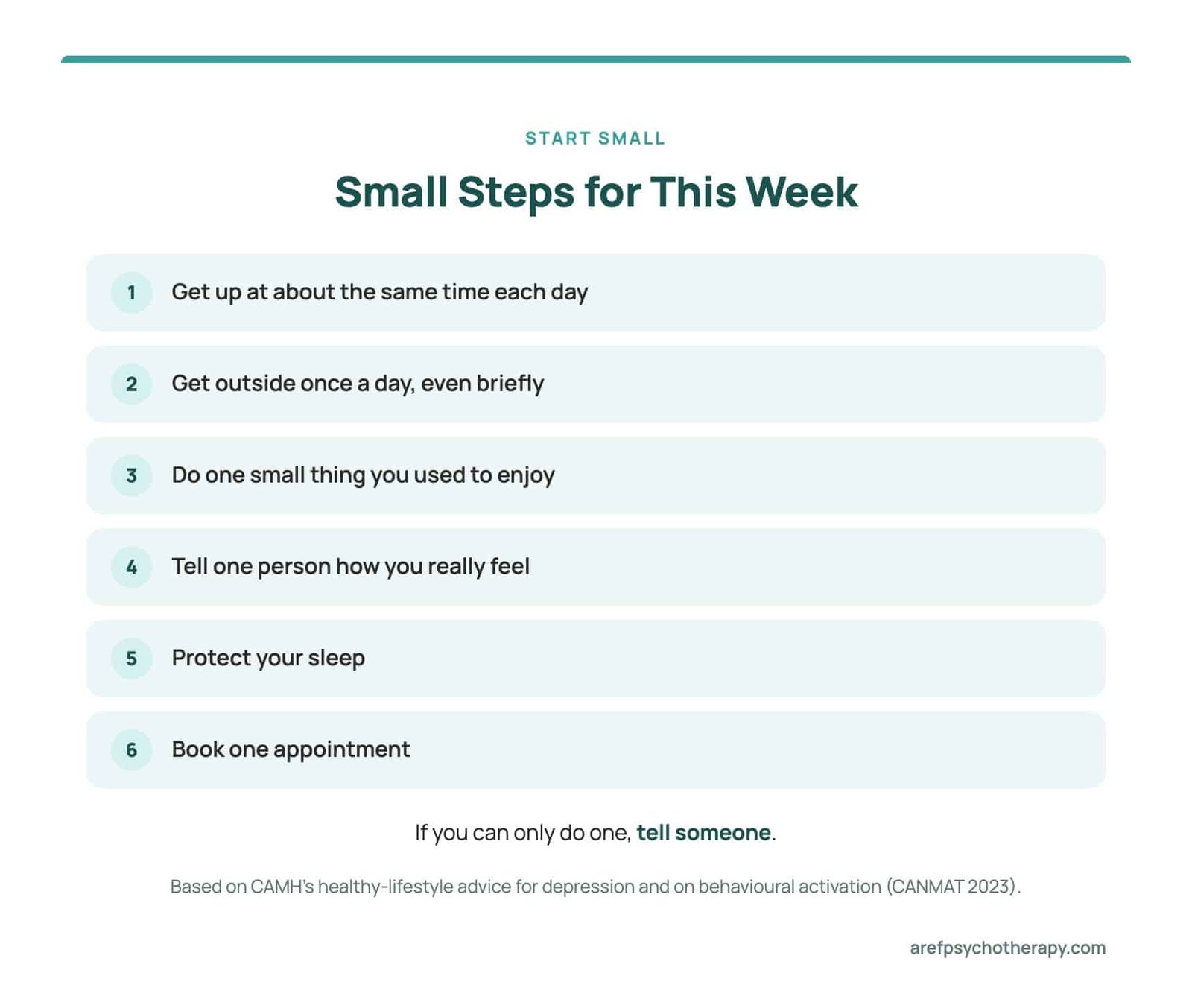
Depression can make big plans feel impossible, so start small:
- Get up at about the same time each day, even after a bad night.
- Get outside once a day, even for a few minutes.
- Do one small thing you used to enjoy, without waiting to feel like it. This is the idea behind behavioural activation.
- Tell one person how you really feel. You could say: “I’ve been really low since the accident.”
- Protect your sleep, and tell your doctor or nurse practitioner if pain is waking you up.
- Book one appointment with your family doctor, a nurse practitioner or a therapist.
CAMH lists being active, sleeping, spending time outdoors and limiting alcohol as parts of a healthy lifestyle that can help recovery from depression. It also lists support from friends and family as something that may lower the risk of PTSD after a traumatic event. If you can only manage one step, make it the fourth: tell someone.
How to get support in Ontario after a crash
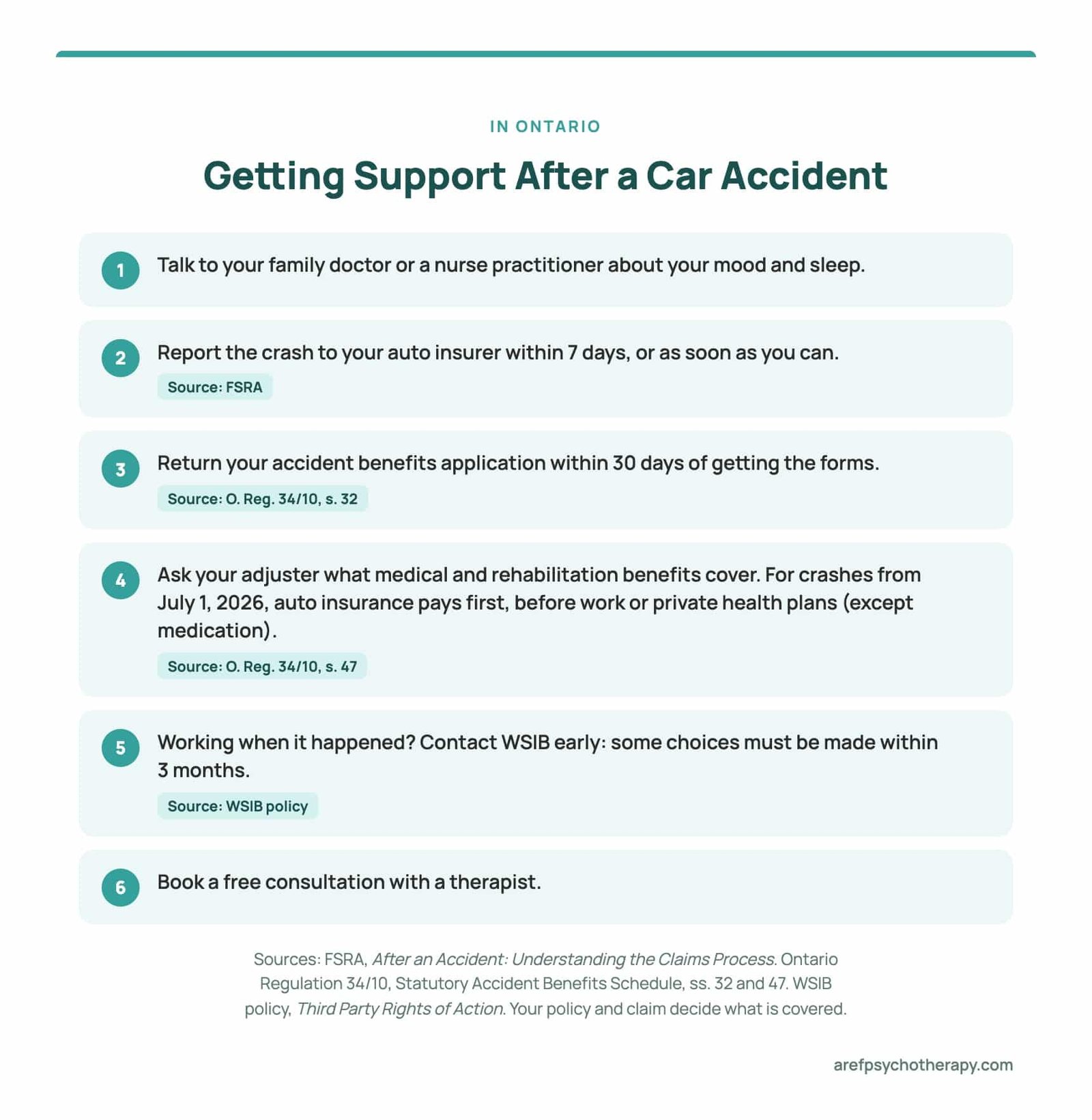
Here is a step-by-step path to support. Every claim is different, so ask your insurer or adjuster about the details of yours.
- Talk to your family doctor or a nurse practitioner. Tell them how you’re feeling and sleeping, not only how your body is healing.
- Tell your auto insurer about the crash. The Financial Services Regulatory Authority of Ontario (FSRA) says you must report an accident to your insurance company, agent or broker within seven days, or as quickly as possible after that.
- Send in your application for accident benefits. Under Ontario’s Statutory Accident Benefits Schedule, you tell your insurer within seven days that you plan to apply, or as soon as you can after that, and return the completed application within 30 days of receiving the forms. FSRA says these benefits are available no matter who caused the accident.
- Ask what your benefits cover. Medical and rehabilitation benefits may cover therapy. For crashes in Ontario on or after July 1, 2026, the rules say your auto insurer pays these benefits, other than medication, even if a workplace or private health plan would also cover them. Your adjuster can tell you what your policy covers and what your therapist needs to send.
- If you were working when the crash happened, contact WSIB too. WSIB’s policy on third-party rights says some choices about how you claim must be made within three months of the accident.
- Book a free consultation with a therapist to talk about what kind of support fits you.
If you and your insurer can’t agree about your benefits, FSRA says you can apply to the Automobile Accident Benefits Service (AABS). Our motor vehicle accident (MVA) support page explains how we work with accident benefits.
Talk to someone who understands
At AREF Psychotherapy, our team includes Registered Psychotherapists (RPs), who are regulated by the College of Registered Psychotherapists of Ontario (CRPO). We help people across Ontario after motor vehicle accidents. Sessions can be funded through auto insurance accident benefits or WSIB where they apply, or paid privately.
- Sessions by secure video, from wherever you feel safe in Ontario
- Therapy in 14+ languages
- A free 15-minute phone consultation to find the right fit
If you have been feeling low since your accident, you don’t have to wait to reach out. Call us at (437) 830-2088, or book a free consultation below. You can ask about session options during that call.
Key takeaways
- Depression after a car accident is a recognized response to trauma, pain and loss, and it can be treated.
- Watch for low mood or loss of interest that lasts most of the day, most days, for more than two weeks.
- Normal stress, depression and PTSD can look alike and overlap, so a professional can help you sort them out.
- Canadian guidelines name CBT, behavioural activation and interpersonal therapy as first-line talk therapies for depression.
- In Ontario, accident benefits may cover therapy. Report the crash to your insurer within seven days, and call or text 9-8-8 if you are thinking about suicide.
Frequently asked questions
Is it normal to feel depressed after a car accident?
Feeling low, shaken or tearful after a crash is common, and CAMH names car accidents as one kind of traumatic experience. It may be depression if low mood or loss of interest lasts most of the day, most days, for more than two weeks, and gets in the way of work, relationships or daily life. If that sounds familiar, talk to your family doctor, a nurse practitioner or a therapist.
How long does depression after a car accident last?
There is no set timeline, and it is different for everyone. Pain, other injuries, money stress and the support around you can all play a part. Depression can be treated, and Canadian guidelines recommend talk therapies such as cognitive behavioural therapy. If low mood has lasted more than two weeks or is getting in the way of daily life, it is worth reaching out now rather than waiting.
Can a minor car accident cause depression?
Yes, it can. The damage to the car does not decide how you feel. CAMH describes a traumatic experience as any negative experience that deeply affects a person. Even a small crash can disrupt your sleep, routine, work or confidence on the road, and those losses can weigh on your mood. What matters is how the crash has affected you.
What is the difference between depression and PTSD after a crash?
PTSD centres on the crash itself, with signs such as reliving it, nightmares, avoiding reminders like driving, and constant worry. Depression centres on low mood and losing interest in things, most of the day, for more than two weeks. The two often show up together, and some signs overlap, such as poor sleep and trouble concentrating. A therapist can help you sort out what is going on.
Does car insurance cover therapy after an accident in Ontario?
It may. Ontario auto insurance includes medical and rehabilitation benefits, and FSRA says accident benefits are available no matter who caused the accident. For crashes in Ontario on or after July 1, 2026, your auto insurer pays these benefits, other than medication, even if a workplace or private health plan would also cover them. Ask your insurer or adjuster what your policy covers. If the crash happened at work, WSIB may also be involved.
This article is for informational purposes only and does not replace professional mental health advice. If you’re in crisis, please contact Canada’s 9-8-8 Suicide Crisis Helpline by calling or texting 9-8-8.
Sources and further reading
Mental health information
- Depression, Centre for Addiction and Mental Health (CAMH)
- Posttraumatic Stress Disorder, Centre for Addiction and Mental Health (CAMH)
- Mental Health Symptoms, Living Concussion Guidelines (patient version)
- Canadian Pain Task Force Report: June 2019, Health Canada
Research and guidelines
- Lam RW, Kennedy SH, et al. CANMAT 2023 Update on Clinical Guidelines for Management of Major Depressive Disorder in Adults. Canadian Journal of Psychiatry, 2024.
- Momenyan S, et al. Predictors of Acute and Chronic PTSD in Road Trauma Survivors: Insights from a 12-Month Cohort Study. Psychology Research and Behavior Management, 2025.
- Kenardy J, et al. Changing patterns in the prevalence of PTSD, major depressive episode and generalized anxiety disorder over 24 months following a road traffic crash. Journal of Affective Disorders, 2018.
- Post-traumatic stress disorder, NICE guideline NG116. National Institute for Health and Care Excellence, 2018.
Ontario insurance and WSIB
- After an Accident: Understanding the Claims Process, Financial Services Regulatory Authority of Ontario (FSRA)
- O. Reg. 34/10: Statutory Accident Benefits Schedule, Government of Ontario
- Third Party Rights of Action, WSIB Operational Policy Manual
Support
- 9-8-8 Suicide Crisis Helpline: call or text 9-8-8